

 登录
登录
Ⅰ. 狂卷风暴 龙卷风以每小时数百公里的风速摧毁路径上的一切。随着科技发展,科学家正在逐步解开它的奥秘,为人们争取更多逃生和应对时间。
A tornado is a kind of strong storm with air which moves in a circle quickly. It can move over 200 miles per hour and cause a lot of damage. As they move 1.
A basement(地下室) or the lowest floor could be a safe place 3.
5.
One special tool 7.
To be able to get these measurements, the scientists have to get a tornado probe near or into a tornado. Scientists will try to guess where a tornado 9.
A tornado is a kind of strong storm with air which moves in a circle quickly. It can move over 200 miles per hour and cause a lot of damage. As they move 1.
across/over
the land, they can easily pick up cars, trucks and even houses, and then throw them very far. It is important to find a safe place if a tornado 2. comes
(come) towards you.A basement(地下室) or the lowest floor could be a safe place 3.
to hide
(hide) yourself. If you are in a home without a basement, try to find a first-floor bathroom or a small room without windows in the middle of your house. You should curl up(蜷缩) into 4. a
ball and cover your head and neck with your hands.5.
But
there are some people who actually want to get close to tornadoes. They are scientists who want to learn more about tornadoes. One of the 6. best
(good) ways to do this is to get as close as possible to the tornado. They then use special tools to measure(测量) what is happening in and around a tornado.One special tool 7.
is called
(call) a tornado probe(探测仪). Inside the tornado probe, there are sensors(传感器) to measure wind speed, temperature, pressure and direction. Some probes even have 8. cameras
(camera), so the scientists can see and understand what it's like to be in a tornado.To be able to get these measurements, the scientists have to get a tornado probe near or into a tornado. Scientists will try to guess where a tornado 9.
will go/is going
(go) next. Then they drive to that location and put down the probe. If they do not guess 10. correctly
(correct), they pick up their probe and try another place. If they are right, the tornado will go near or even right over the probe. Then they take all of the measurements from the probe and use them to predict where future tornadoes may form and travel. And they can give people some warnings to keep away from a dangerous tornado.答案
Ⅰ.【语篇解读】本文是一篇说明文。文章主要介绍了龙卷风的相关知识以及科学家如何研究龙卷风。
1. across/over 解析:根据句意“当它们在陆地上移动时”,表示从陆地的一端移到另一端或在上方移动。across或over均可表示“越过、穿过(表面)”。故填across/over。
2. comes 解析:考查if引导的条件状语从句。此处描述的是一般事实,主句使用一般现在时(It is ...),从句也应用一般现在时。主语“a tornado”是单数。故填comes。
3. to hide 解析:考查动词不定式作定语。a safe place to do sth意为“一个做某事的安全地方”。故填to hide。
4. a 解析:考查固定搭配。curl up into a ball意为“蜷缩成球状”。此处表示形状,用不定冠词a。故填a。
5. But 解析:前一段讲的是如何躲避龙卷风,这一段讲有些科学家却想要靠近它。前后语意发生转折。故填But(注意首字母大写)。
6. best 解析:考查最高级。固定结构“one of the+形容词最高级+名词复数”,意为“最……之一”。good的最高级为best。故填best。
7. is called 解析:考查被动语态。工具(tool)是被叫作“探测仪”的,且描述的是一般事实,用一般现在时的被动语态(am/is/are+过去分词)。主语为单数。故填is called。
8. cameras 解析:根据前面的“Some probes(一些探测仪)”可知,此处是指安装了“照相机/摄像头”。camera为可数名词,在此处泛指多台机器上的摄像头,应用复数形式。故填cameras。
9. will go/is going 解析:根据时间状语“next”可知,此处指龙卷风“接下来将要”去哪里,应用一般将来时或现在进行时表将来。故填will go/is going。
10. correctly 解析:此处修饰动词“guess(猜测)”,应使用副词形式。correct的副词形式为correctly,意为“正确地”。故填correctly。
1. across/over 解析:根据句意“当它们在陆地上移动时”,表示从陆地的一端移到另一端或在上方移动。across或over均可表示“越过、穿过(表面)”。故填across/over。
2. comes 解析:考查if引导的条件状语从句。此处描述的是一般事实,主句使用一般现在时(It is ...),从句也应用一般现在时。主语“a tornado”是单数。故填comes。
3. to hide 解析:考查动词不定式作定语。a safe place to do sth意为“一个做某事的安全地方”。故填to hide。
4. a 解析:考查固定搭配。curl up into a ball意为“蜷缩成球状”。此处表示形状,用不定冠词a。故填a。
5. But 解析:前一段讲的是如何躲避龙卷风,这一段讲有些科学家却想要靠近它。前后语意发生转折。故填But(注意首字母大写)。
6. best 解析:考查最高级。固定结构“one of the+形容词最高级+名词复数”,意为“最……之一”。good的最高级为best。故填best。
7. is called 解析:考查被动语态。工具(tool)是被叫作“探测仪”的,且描述的是一般事实,用一般现在时的被动语态(am/is/are+过去分词)。主语为单数。故填is called。
8. cameras 解析:根据前面的“Some probes(一些探测仪)”可知,此处是指安装了“照相机/摄像头”。camera为可数名词,在此处泛指多台机器上的摄像头,应用复数形式。故填cameras。
9. will go/is going 解析:根据时间状语“next”可知,此处指龙卷风“接下来将要”去哪里,应用一般将来时或现在进行时表将来。故填will go/is going。
10. correctly 解析:此处修饰动词“guess(猜测)”,应使用副词形式。correct的副词形式为correctly,意为“正确地”。故填correctly。
解析
【分析】
先通读全文,明确本文是介绍龙卷风及科学家研究龙卷风的说明文。解题时需结合语境、语法规则(涵盖介词、时态、非谓语动词、冠词、连词、形容词最高级、被动语态、名词单复数、副词等)逐个分析每个空格,确保填入的内容符合句子结构和上下文逻辑。
【解析】
1. 考查介词。根据句意“当它们在陆地上移动时”,表示在陆地表面移动,可用介词across或over,故填across/over。
2. 考查if引导的条件状语从句。主句为一般现在时,从句描述一般事实,需用一般现在时;主语a tornado是单数,故谓语动词用comes。
3. 考查动词不定式作定语。“a safe place to do sth”是固定结构,意为“做某事的安全地方”,故填to hide。
4. 考查固定搭配。“curl up into a ball”是固定短语,意为“蜷缩成球状”;ball为可数名词单数,前用不定冠词a,故填a。
5. 考查连词。前文讲躲避龙卷风,后文讲有人靠近龙卷风,前后为转折关系,句首单词首字母需大写,故填But。
6. 考查形容词最高级。“one of the + 形容词最高级 + 名词复数”是固定结构,意为“最……之一”;good的最高级为best,故填best。
7. 考查被动语态。主语tool与动词call是被动关系,描述一般事实需用一般现在时的被动语态;主语为单数,故填is called。
8. 考查名词复数。camera是可数名词,此处指多个探测仪上的摄像头,需用复数形式,故填cameras。
9. 考查将来时态。根据时间状语next可知,此处表将来,可用一般将来时will go或现在进行时表将来is going,故填will go/is going。
10. 考查副词。此处修饰动词guess,需用副词形式;correct的副词为correctly,故填correctly。
【答案】
1. across/over;2. comes;3. to hide;4. a;5. But;6. best;7. is called;8. cameras;9. will go/is going;10. correctly
【知识点】
介词用法、动词时态、非谓语动词
【点评】
本题为说明文语境下的语法填空题,主要考查基础语法知识与固定搭配,需结合上下文逻辑和语法规则解题,难度适中,适合初中或高中学生练习。
【难度系数】
0.6
先通读全文,明确本文是介绍龙卷风及科学家研究龙卷风的说明文。解题时需结合语境、语法规则(涵盖介词、时态、非谓语动词、冠词、连词、形容词最高级、被动语态、名词单复数、副词等)逐个分析每个空格,确保填入的内容符合句子结构和上下文逻辑。
【解析】
1. 考查介词。根据句意“当它们在陆地上移动时”,表示在陆地表面移动,可用介词across或over,故填across/over。
2. 考查if引导的条件状语从句。主句为一般现在时,从句描述一般事实,需用一般现在时;主语a tornado是单数,故谓语动词用comes。
3. 考查动词不定式作定语。“a safe place to do sth”是固定结构,意为“做某事的安全地方”,故填to hide。
4. 考查固定搭配。“curl up into a ball”是固定短语,意为“蜷缩成球状”;ball为可数名词单数,前用不定冠词a,故填a。
5. 考查连词。前文讲躲避龙卷风,后文讲有人靠近龙卷风,前后为转折关系,句首单词首字母需大写,故填But。
6. 考查形容词最高级。“one of the + 形容词最高级 + 名词复数”是固定结构,意为“最……之一”;good的最高级为best,故填best。
7. 考查被动语态。主语tool与动词call是被动关系,描述一般事实需用一般现在时的被动语态;主语为单数,故填is called。
8. 考查名词复数。camera是可数名词,此处指多个探测仪上的摄像头,需用复数形式,故填cameras。
9. 考查将来时态。根据时间状语next可知,此处表将来,可用一般将来时will go或现在进行时表将来is going,故填will go/is going。
10. 考查副词。此处修饰动词guess,需用副词形式;correct的副词为correctly,故填correctly。
【答案】
1. across/over;2. comes;3. to hide;4. a;5. But;6. best;7. is called;8. cameras;9. will go/is going;10. correctly
【知识点】
介词用法、动词时态、非谓语动词
【点评】
本题为说明文语境下的语法填空题,主要考查基础语法知识与固定搭配,需结合上下文逻辑和语法规则解题,难度适中,适合初中或高中学生练习。
【难度系数】
0.6
Ⅱ.交通安全 轨道交通过往的平安,藏着不轻易示人的“应急卫士”,但一次误触便可能让出行蒙上危险。这些紧急装置的存在常被我们忽略,那么,就让我们一起来认识下,轨道交通里的这些安全装置吧!
新语篇 使用说明 Chongqing Rail Transit(CRT)has many safety devices to protect passengers. Let's learn about two important emergency(紧急) devices below. Remember where to find them and how to use them properly.
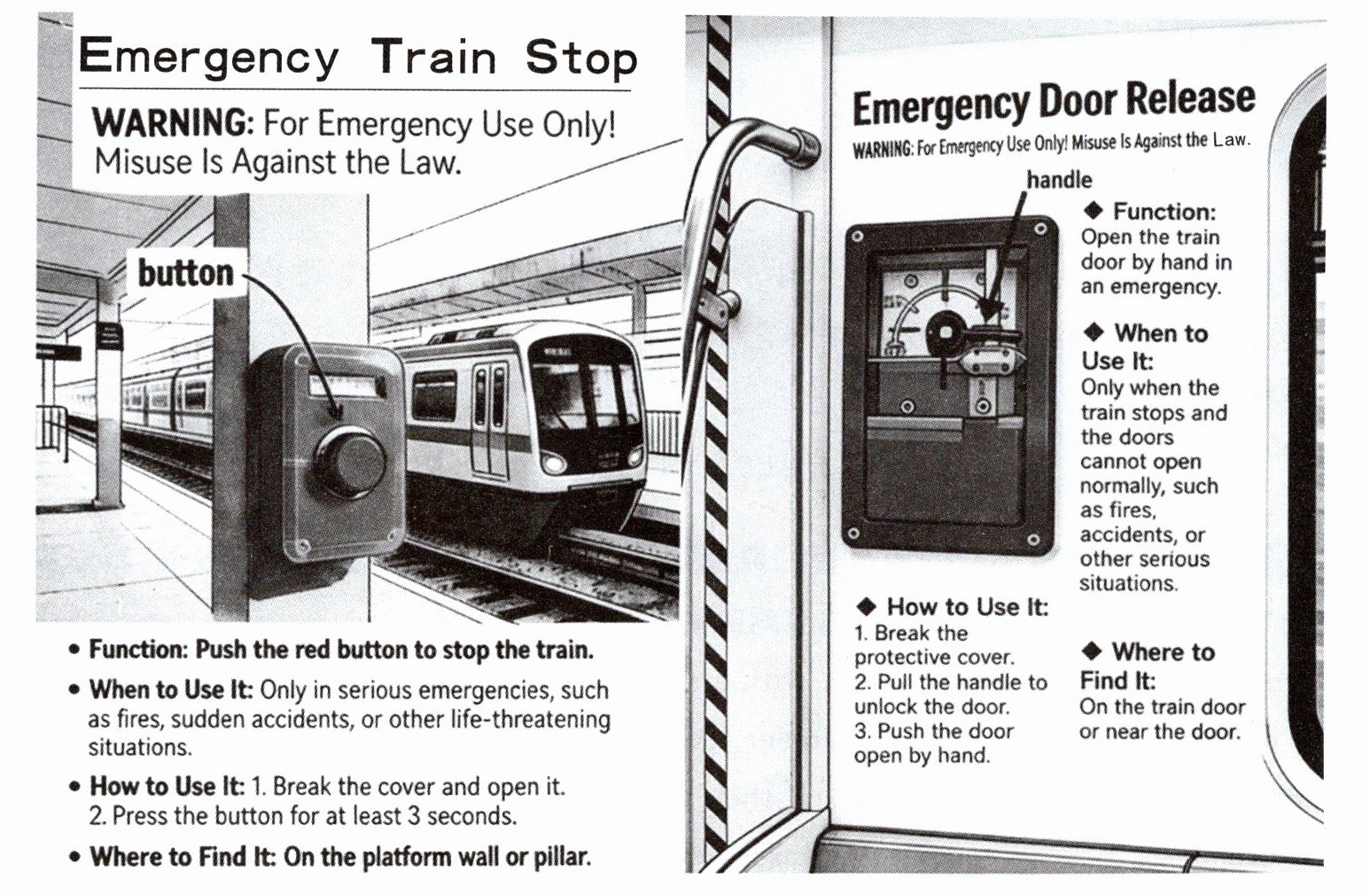
Do Remember: If you use them wrongly, you may bring danger to yourself and other passengers.
1. When can the two devices be used?
A. Only in dangerous or serious emergencies.
B. When the train is moving fast.
C. Whenever there is something wrong with the train.
D. Only when the train stops at a station.
2. 新考法 图示理解 What's the second step to use the Emergency Train Stop?

3. Where can we find the Emergency Door Release device?
A. On the platform wall or pillar.
B. On the train door or near the door.
C. Under the seat.
D. On the train window.
4. 语言能力 推断能力 What can we infer from the passage about the CRT emergency devices?
A. Emergency Door Release can be used if the train suddenly stops on the track for no reason in the tunnel.
B. It's possible that wrong use of the Emergency Door Release may cause passengers to fall off the train.
C. Passengers need to master the professional operation skills before using the two emergency devices.
D. The Emergency Door Release is more commonly used than the Emergency Train Stop in daily travel.
新语篇 使用说明 Chongqing Rail Transit(CRT)has many safety devices to protect passengers. Let's learn about two important emergency(紧急) devices below. Remember where to find them and how to use them properly.
Do Remember: If you use them wrongly, you may bring danger to yourself and other passengers.
1. When can the two devices be used?
A. Only in dangerous or serious emergencies.
B. When the train is moving fast.
C. Whenever there is something wrong with the train.
D. Only when the train stops at a station.
2. 新考法 图示理解 What's the second step to use the Emergency Train Stop?
3. Where can we find the Emergency Door Release device?
A. On the platform wall or pillar.
B. On the train door or near the door.
C. Under the seat.
D. On the train window.
4. 语言能力 推断能力 What can we infer from the passage about the CRT emergency devices?
A. Emergency Door Release can be used if the train suddenly stops on the track for no reason in the tunnel.
B. It's possible that wrong use of the Emergency Door Release may cause passengers to fall off the train.
C. Passengers need to master the professional operation skills before using the two emergency devices.
D. The Emergency Door Release is more commonly used than the Emergency Train Stop in daily travel.
答案
Ⅱ. 1.A 2.A 3.B 4.B
【语篇解读】本文是一篇说明文。文章主要介绍了重庆轨道交通两种重要紧急安全装置(紧急列车停车装置、紧急车门解锁装置)的功能、使用场景、操作步骤和安装位置,提醒乘客仅在紧急情况下正确使用。
1. A 解析:细节理解题。Emergency Train Stop部分:“Only in serious emergencies ...”;Emergency Door Release部分“Only when the train stops ... other dangerous situations”,两处均标注“For Emergency Use Only”,两种装置均明确标注仅在危险/严重紧急情况下使用。故选A。
2. A 解析:图示理解题。Emergency Train Stop部分:“How to Use It: 1. Break the cover and open it. 2. Press the button for at least 3 seconds.”,第二步是Press the button“按下按钮”。故选A。
3. B 解析:细节理解题。Emergency Door Release部分:“Where to Find It: On the train door or near the door.”,明确指出紧急车门解锁装置在列车车门上或车门附近。故选B。
4. B 解析:推理判断题。根据原文提到紧急车门解锁装置仅列车完全停稳时可用,且错误使用紧急装置会给自身和其他乘客带来危险,结合实际乘车场景可推理,若在列车未停稳时错误使用该装置打开车门,乘客有跌落列车的可能性;可知A项无故停车非严重紧急情况、C项无需专业操作技能、D项无使用频率相关信息均与原文不符,B项推断合理;故选B。
【语篇解读】本文是一篇说明文。文章主要介绍了重庆轨道交通两种重要紧急安全装置(紧急列车停车装置、紧急车门解锁装置)的功能、使用场景、操作步骤和安装位置,提醒乘客仅在紧急情况下正确使用。
1. A 解析:细节理解题。Emergency Train Stop部分:“Only in serious emergencies ...”;Emergency Door Release部分“Only when the train stops ... other dangerous situations”,两处均标注“For Emergency Use Only”,两种装置均明确标注仅在危险/严重紧急情况下使用。故选A。
2. A 解析:图示理解题。Emergency Train Stop部分:“How to Use It: 1. Break the cover and open it. 2. Press the button for at least 3 seconds.”,第二步是Press the button“按下按钮”。故选A。
3. B 解析:细节理解题。Emergency Door Release部分:“Where to Find It: On the train door or near the door.”,明确指出紧急车门解锁装置在列车车门上或车门附近。故选B。
4. B 解析:推理判断题。根据原文提到紧急车门解锁装置仅列车完全停稳时可用,且错误使用紧急装置会给自身和其他乘客带来危险,结合实际乘车场景可推理,若在列车未停稳时错误使用该装置打开车门,乘客有跌落列车的可能性;可知A项无故停车非严重紧急情况、C项无需专业操作技能、D项无使用频率相关信息均与原文不符,B项推断合理;故选B。
解析
【分析】本题为英语阅读理解题,围绕重庆轨道交通的两种紧急安全装置展开,包含细节理解、图示理解、推理判断三类题型。解题思路为:先通读语篇,把握两种应急装置的使用场景、操作步骤、安装位置等核心信息;再针对每个问题,定位原文对应内容,结合题干要求逐一分析选项;图示理解题需准确提取操作步骤的先后顺序,推理判断题需结合原文信息合理推断,排除与原文不符的选项。
【解析】1. 第1题:细节理解题。定位原文中两种装置的使用说明,两处均标注“For Emergency Use Only”,明确仅在危险或严重紧急情况下使用,故选A。2. 第2题:图示理解题。定位Emergency Train Stop的操作步骤,第二步为“Press the button for at least 3 seconds”,即按下按钮,故选A。3. 第3题:细节理解题。定位Emergency Door Release的安装位置,原文明确“On the train door or near the door”,故选B。4. 第4题:推理判断题。原文指出错误使用应急装置会带来危险,结合紧急车门解锁装置仅列车停稳时可用,可推断错误使用可能导致乘客跌落;A项无故停车非严重紧急情况、C项无需专业操作技能、D项无使用频率相关信息均与原文不符,故选B。
【答案】Ⅱ. 1.A 2.A 3.B 4.B
【知识点】英语阅读理解、细节理解题、推理判断题
【点评】本文结合轨道交通安全常识,考查学生的语篇信息定位、图示理解与逻辑推理能力,兼具知识性与实用性,提醒学生重视应急装置的正确使用。
【难度系数】0.6
【解析】1. 第1题:细节理解题。定位原文中两种装置的使用说明,两处均标注“For Emergency Use Only”,明确仅在危险或严重紧急情况下使用,故选A。2. 第2题:图示理解题。定位Emergency Train Stop的操作步骤,第二步为“Press the button for at least 3 seconds”,即按下按钮,故选A。3. 第3题:细节理解题。定位Emergency Door Release的安装位置,原文明确“On the train door or near the door”,故选B。4. 第4题:推理判断题。原文指出错误使用应急装置会带来危险,结合紧急车门解锁装置仅列车停稳时可用,可推断错误使用可能导致乘客跌落;A项无故停车非严重紧急情况、C项无需专业操作技能、D项无使用频率相关信息均与原文不符,故选B。
【答案】Ⅱ. 1.A 2.A 3.B 4.B
【知识点】英语阅读理解、细节理解题、推理判断题
【点评】本文结合轨道交通安全常识,考查学生的语篇信息定位、图示理解与逻辑推理能力,兼具知识性与实用性,提醒学生重视应急装置的正确使用。
【难度系数】0.6
