

 登录
登录
15.(本小题满分10分)如图,为测量河两岸A,B两点间的距离,在点B所在河岸平地上取点C和点D,使点A,B,C在同一条直线上,且$CD=CB$,测得$∠DCB=100°,∠ADC=65°$,在CD的延长线上取一点E,使$∠E=15°$,这时由测得的DE的长能否得到A,B两点间的距离?请说明理由.

答案
解:能得到.理由如下:$\because ∠ DCB=100°,∠ ADC=65°, \therefore ∠ CAD=180°-∠ DCB-∠ ADC=15°. \because ∠ E=15°, \therefore ∠ CAD=∠ E.$ 在$△ DCA$ 和$△ BCE$ 中,$\begin{cases} ∠ CAD=∠ E, \\ ∠ ACD=∠ ECB, \\ CD=CB, \end{cases}$$\therefore △ DCA ≌ △ BCE(\mathrm{AAS}). \therefore AC=EC. \because CB=CD, \therefore AC-CB=EC-CD, \mathrm{即 } AB=DE. \therefore \mathrm{测得的 } DE \mathrm{ 的长就是 } A,B \mathrm{ 两点间的距离}.$
解析
【分析】
要判断测得DE的长能否得到A、B间的距离,本质是证明AB=DE。首先可利用三角形内角和定理计算∠CAD的度数,对比已知的∠E可得到一组等角;再结合已知的CD=CB,以及公共角∠ACD=∠ECB,即可证明△DCA和△BCE全等,利用全等三角形对应边相等得到AC=EC,最后通过线段和差关系推导得到AB=DE,即可得出结论。
【解析】
解:能得到,理由如下:
$\because ∠ DCB=100°,∠ ADC=65°, \therefore ∠ CAD=180°-∠ DCB-∠ ADC=180°-100°-65°=15°.$
$\because ∠ E=15°, \therefore ∠ CAD=∠ E.$
在$△ DCA$ 和$△ BCE$ 中,
$\begin{cases} ∠ CAD=∠ E, \\ ∠ ACD=∠ ECB, \\ CD=CB, \end{cases}$
$\therefore △ DCA ≌ △ BCE(\mathrm{AAS}).$
$\therefore AC=EC.$
$\because CB=CD, \therefore AC-CB=EC-CD, \mathrm{即 } AB=DE.$
$\therefore \mathrm{测得的 } DE \mathrm{ 的长就是 } A,B \mathrm{ 两点间的距离}.$
【答案】
能得到,测得DE的长即为A、B两点间的距离。
【知识点】
三角形内角和定理、全等三角形的判定、全等三角形的性质
【点评】
本题以实际测量河两岸距离为背景,考查了全等三角形判定与性质的应用,解题关键是通过角度计算找到全等所需的等角条件,将不可直接测量的距离转化为可测量的线段长度,体现了数学知识的实际应用价值。
【难度系数】
0.7
要判断测得DE的长能否得到A、B间的距离,本质是证明AB=DE。首先可利用三角形内角和定理计算∠CAD的度数,对比已知的∠E可得到一组等角;再结合已知的CD=CB,以及公共角∠ACD=∠ECB,即可证明△DCA和△BCE全等,利用全等三角形对应边相等得到AC=EC,最后通过线段和差关系推导得到AB=DE,即可得出结论。
【解析】
解:能得到,理由如下:
$\because ∠ DCB=100°,∠ ADC=65°, \therefore ∠ CAD=180°-∠ DCB-∠ ADC=180°-100°-65°=15°.$
$\because ∠ E=15°, \therefore ∠ CAD=∠ E.$
在$△ DCA$ 和$△ BCE$ 中,
$\begin{cases} ∠ CAD=∠ E, \\ ∠ ACD=∠ ECB, \\ CD=CB, \end{cases}$
$\therefore △ DCA ≌ △ BCE(\mathrm{AAS}).$
$\therefore AC=EC.$
$\because CB=CD, \therefore AC-CB=EC-CD, \mathrm{即 } AB=DE.$
$\therefore \mathrm{测得的 } DE \mathrm{ 的长就是 } A,B \mathrm{ 两点间的距离}.$
【答案】
能得到,测得DE的长即为A、B两点间的距离。
【知识点】
三角形内角和定理、全等三角形的判定、全等三角形的性质
【点评】
本题以实际测量河两岸距离为背景,考查了全等三角形判定与性质的应用,解题关键是通过角度计算找到全等所需的等角条件,将不可直接测量的距离转化为可测量的线段长度,体现了数学知识的实际应用价值。
【难度系数】
0.7
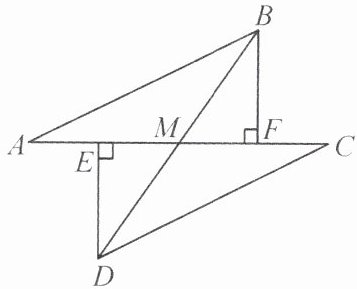
16.(本小题满分12分)如图,E,F分别为线段AC上的两个点,且$DE⊥AC$于点E,$BF⊥AC$于点F,$AB=CD$,$AE=CF$,BD交AC于点M。
(1)求证:$BF=DE$;
(2)求证:$MB=MD$。
(1)求证:$BF=DE$;
(2)求证:$MB=MD$。
答案
证明:(1) $\because DE ⊥ AC, BF ⊥ AC, \therefore ∠ DEC=∠ BFA=90°. \because AE=CF, \therefore AE+EF=CF+EF, \mathrm{即 } AF = CE.$ 在 $\mathrm{Rt}△ ABF$ 和 $\mathrm{Rt}△ CDE$ 中,$\begin{cases} AB=CD, \\ AF=CE, \end{cases}$$\therefore \mathrm{Rt}△ ABF ≌ \mathrm{Rt}△ CDE(\mathrm{HL}). \therefore BF=DE.$ (2)由(1)知,$BF=DE.$ 在$△ BFM$ 和$△ DEM$ 中,$\begin{cases} ∠ BFM=∠ DEM, \\ ∠ BMF=∠ DME, \\ BF=DE, \end{cases}$$\therefore △ BFM ≌ △ DEM(\mathrm{AAS}). \therefore MB=MD.$
解析
【分析】
(1)要证明$BF=DE$,可通过证明两条线段所在的直角三角形全等实现。已知$DE⊥ AC$、$BF⊥ AC$,说明$△ ABF$和$△ CDE$都是直角三角形,题目已给出斜边$AB=CD$,只需再推导一组直角边相等即可:由$AE=CF$,两边同时加公共线段$EF$可得$AF=CE$,满足HL定理的判定条件,证得两三角形全等后即可得到对应边$BF=DE$。
(2)要证明$MB=MD$,同理证明两条线段所在的$△ BFM$和$△ DEM$全等即可。由(1)已得$BF=DE$,结合垂直关系可得$∠ BFM=∠ DEM=90°$,再加上一组对顶角$∠ BMF=∠ DME$,满足AAS的判定条件,证得两三角形全等后即可得到对应边$MB=MD$。
【解析】
(1) $\because DE ⊥ AC, BF ⊥ AC, \therefore ∠ DEC=∠ BFA=90°. \because AE=CF, \therefore AE+EF=CF+EF$,即$AF = CE.$
在$\mathrm{Rt}△ ABF$和$\mathrm{Rt}△ CDE$中,$\begin{cases} AB=CD, \\ AF=CE, \end{cases}$
$\therefore \mathrm{Rt}△ ABF ≌ \mathrm{Rt}△ CDE(\mathrm{HL}). \therefore BF=DE.$
(2)由(1)知,$BF=DE.$
在$△ BFM$和$△ DEM$ 中,$\begin{cases} ∠ BFM=∠ DEM, \\ ∠ BMF=∠ DME, \\ BF=DE, \end{cases}$
$\therefore △ BFM ≌ △ DEM(\mathrm{AAS}). \therefore MB=MD.$
【答案】
(1) $BF=DE$得证;(2) $MB=MD$得证。
【知识点】
1. 全等三角形的判定
2. 全等三角形的性质
3. 直角三角形全等判定(HL)
【点评】
本题是基础类几何证明题,核心考查全等三角形判定与性质的应用,解题的关键是定位待证边所在的三角形,结合已知条件推导全等的判定条件,熟练掌握全等三角形的各类判定定理即可快速解决这类问题。
【难度系数】
0.7
(1)要证明$BF=DE$,可通过证明两条线段所在的直角三角形全等实现。已知$DE⊥ AC$、$BF⊥ AC$,说明$△ ABF$和$△ CDE$都是直角三角形,题目已给出斜边$AB=CD$,只需再推导一组直角边相等即可:由$AE=CF$,两边同时加公共线段$EF$可得$AF=CE$,满足HL定理的判定条件,证得两三角形全等后即可得到对应边$BF=DE$。
(2)要证明$MB=MD$,同理证明两条线段所在的$△ BFM$和$△ DEM$全等即可。由(1)已得$BF=DE$,结合垂直关系可得$∠ BFM=∠ DEM=90°$,再加上一组对顶角$∠ BMF=∠ DME$,满足AAS的判定条件,证得两三角形全等后即可得到对应边$MB=MD$。
【解析】
(1) $\because DE ⊥ AC, BF ⊥ AC, \therefore ∠ DEC=∠ BFA=90°. \because AE=CF, \therefore AE+EF=CF+EF$,即$AF = CE.$
在$\mathrm{Rt}△ ABF$和$\mathrm{Rt}△ CDE$中,$\begin{cases} AB=CD, \\ AF=CE, \end{cases}$
$\therefore \mathrm{Rt}△ ABF ≌ \mathrm{Rt}△ CDE(\mathrm{HL}). \therefore BF=DE.$
(2)由(1)知,$BF=DE.$
在$△ BFM$和$△ DEM$ 中,$\begin{cases} ∠ BFM=∠ DEM, \\ ∠ BMF=∠ DME, \\ BF=DE, \end{cases}$
$\therefore △ BFM ≌ △ DEM(\mathrm{AAS}). \therefore MB=MD.$
【答案】
(1) $BF=DE$得证;(2) $MB=MD$得证。
【知识点】
1. 全等三角形的判定
2. 全等三角形的性质
3. 直角三角形全等判定(HL)
【点评】
本题是基础类几何证明题,核心考查全等三角形判定与性质的应用,解题的关键是定位待证边所在的三角形,结合已知条件推导全等的判定条件,熟练掌握全等三角形的各类判定定理即可快速解决这类问题。
【难度系数】
0.7
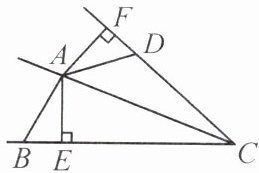
17.(本小题满分12分)如图,CA平分∠∠BCD,AB=AD,AE⊥BC,AF⊥CD,垂足分别为E,F.
(1)若∠ABE=60°,求∠ADC的度数;
(2)若AE=2,EB=1,CD=3,则四边形AECD的面积为
(1)若∠ABE=60°,求∠ADC的度数;
(2)若AE=2,EB=1,CD=3,则四边形AECD的面积为
7
.答案
17. 解:(1) $\because CA$ 平分$∠ BCD, AE ⊥ BC, AF ⊥ CD, \therefore AF=AE, ∠ AEB=∠ AFD=90°.$ 在 $\mathrm{Rt}△ AFD$ 和 $\mathrm{Rt}△ AEB$ 中,$\begin{cases} AD=AB, \\ AF=AE, \end{cases}$$\therefore \mathrm{Rt}△ AFD ≌ \mathrm{Rt}△ AEB(\mathrm{HL}). \therefore ∠ ADF=∠ ABE=60°. \therefore ∠ ADC=180°-∠ ADF=120°.$ (2)7
解析
【分析】
(1) 先利用角平分线的性质,得到角平分线上的点到角两边的距离相等,即AE=AF,结合已知AB=AD,且△AFD和△AEB均为直角三角形,可通过HL定理证明两三角形全等,得到∠ADF=∠ABE=60°,再根据邻补角的和为180°即可求出∠ADC的度数。
(2) 由第一问的全等可得DF=EB=1、AF=AE=2,再证明Rt△AEC和Rt△AFC全等,得到EC=FC=CD+DF=4,将四边形AECD的面积拆分为△AEC和△ADC的面积之和,分别计算后相加即可得到结果。
【解析】
(1) $\because$ CA平分$∠ BCD$,$AE ⊥ BC$,$AF ⊥ CD$,
$\therefore AF=AE$,$∠ AFD=∠ AEB=90°$,
在$\mathrm{Rt}△ AFD$和$\mathrm{Rt}△ AEB$中,
$\begin{cases} AD=AB \\ AF=AE \end{cases}$
$\therefore \mathrm{Rt}△ AFD ≌ \mathrm{Rt}△ AEB(\mathrm{HL})$,
$\therefore ∠ ADF=∠ ABE=60°$,
$\therefore ∠ ADC=180°-∠ ADF=180°-60°=120°$。
(2) 由(1)中$\mathrm{Rt}△ AFD ≌ \mathrm{Rt}△ AEB$,得$DF=EB=1$,$AF=AE=2$,
在$\mathrm{Rt}△ AEC$和$\mathrm{Rt}△ AFC$中,
$\begin{cases} AC=AC \\ AE=AF \end{cases}$
$\therefore \mathrm{Rt}△ AEC ≌ \mathrm{Rt}△ AFC(\mathrm{HL})$,
$\therefore EC=FC=CD+DF=3+1=4$,
$\therefore S_{△ AEC}=\frac{1}{2} × EC × AE=\frac{1}{2} × 4 × 2=4$,
$S_{△ ADC}=\frac{1}{2} × CD × AF=\frac{1}{2} × 3 × 2=3$,
$\therefore S_{四边形AECD}=S_{△ AEC}+S_{△ ADC}=4+3=7$。
【答案】
(1) $\boxed{120°}$;(2) $\boxed{7}$
【知识点】
角平分线的性质,直角三角形全等的判定,图形面积计算
【点评】
本题属于几何基础综合题,解题的核心是利用角平分线性质找到相等的垂线段,再通过全等三角形转化相等的线段,最后拆分不规则四边形面积为两个规则三角形面积求解,需要熟练掌握全等三角形的判定定理和面积计算公式。
【难度系数】
0.7
(1) 先利用角平分线的性质,得到角平分线上的点到角两边的距离相等,即AE=AF,结合已知AB=AD,且△AFD和△AEB均为直角三角形,可通过HL定理证明两三角形全等,得到∠ADF=∠ABE=60°,再根据邻补角的和为180°即可求出∠ADC的度数。
(2) 由第一问的全等可得DF=EB=1、AF=AE=2,再证明Rt△AEC和Rt△AFC全等,得到EC=FC=CD+DF=4,将四边形AECD的面积拆分为△AEC和△ADC的面积之和,分别计算后相加即可得到结果。
【解析】
(1) $\because$ CA平分$∠ BCD$,$AE ⊥ BC$,$AF ⊥ CD$,
$\therefore AF=AE$,$∠ AFD=∠ AEB=90°$,
在$\mathrm{Rt}△ AFD$和$\mathrm{Rt}△ AEB$中,
$\begin{cases} AD=AB \\ AF=AE \end{cases}$
$\therefore \mathrm{Rt}△ AFD ≌ \mathrm{Rt}△ AEB(\mathrm{HL})$,
$\therefore ∠ ADF=∠ ABE=60°$,
$\therefore ∠ ADC=180°-∠ ADF=180°-60°=120°$。
(2) 由(1)中$\mathrm{Rt}△ AFD ≌ \mathrm{Rt}△ AEB$,得$DF=EB=1$,$AF=AE=2$,
在$\mathrm{Rt}△ AEC$和$\mathrm{Rt}△ AFC$中,
$\begin{cases} AC=AC \\ AE=AF \end{cases}$
$\therefore \mathrm{Rt}△ AEC ≌ \mathrm{Rt}△ AFC(\mathrm{HL})$,
$\therefore EC=FC=CD+DF=3+1=4$,
$\therefore S_{△ AEC}=\frac{1}{2} × EC × AE=\frac{1}{2} × 4 × 2=4$,
$S_{△ ADC}=\frac{1}{2} × CD × AF=\frac{1}{2} × 3 × 2=3$,
$\therefore S_{四边形AECD}=S_{△ AEC}+S_{△ ADC}=4+3=7$。
【答案】
(1) $\boxed{120°}$;(2) $\boxed{7}$
【知识点】
角平分线的性质,直角三角形全等的判定,图形面积计算
【点评】
本题属于几何基础综合题,解题的核心是利用角平分线性质找到相等的垂线段,再通过全等三角形转化相等的线段,最后拆分不规则四边形面积为两个规则三角形面积求解,需要熟练掌握全等三角形的判定定理和面积计算公式。
【难度系数】
0.7
