

 登录
登录
1. (2024·南京期末)定义:如图,点C、点D把线段AB分割成AC,CD和BD,若以AC,CD,BD为边的三角形是一个直角三角形,则称点C、点D是线段AB的勾股分割点.已知点M、点N是线段AB的勾股分割点,$AM = 2$,$MN = 3$,则

$BN = $____.
$BN = $____.
答案
$\sqrt{5}$或$\sqrt{13}$ 解析:①当$MN$为最长线段时,$\because$点$M$,$N$是线段$AB$的勾股分割点,$\therefore BN=\sqrt{MN^{2}-AM^{2}}=\sqrt{3^{2}-2^{2}}=\sqrt{5}$。②当$BN$为最长线段时,$\because$点$M$,$N$是线段$AB$的勾股分割点,$\therefore BN=\sqrt{MN^{2}+AM^{2}}=\sqrt{3^{2}+2^{2}}=\sqrt{13}$。综上所述,$BN=\sqrt{5}$或$\sqrt{13}$。
2. (2024·宿迁期末)我们知道,负数没有算术平方根,但对于三个互不相等的负整数,若两两乘积的算术平方根都是整数,则称这三个数为“完美组合数”.例如:$-1$,$-4$,$-9$这三个数,$\sqrt {(-9)×(-4)} = 6$,$\sqrt {(-9)×(-1)} = 3$,$\sqrt {(-4)×(-1)} = 2$,其结果6,3,2都是整数,所以$-1$,$-4$,$-9$这三个数称为“完美组合数”.
(1)$-3$,$-12$,$-27$这三个数____“完美组合数”(填“是”或“不是”).
(2)若三个数$-5$,$m$,$-20$是“完美组合数”,其中有两个数乘积的算术平方根为15,求$m$的值.
(1)$-3$,$-12$,$-27$这三个数____“完美组合数”(填“是”或“不是”).
(2)若三个数$-5$,$m$,$-20$是“完美组合数”,其中有两个数乘积的算术平方根为15,求$m$的值.
答案
(1)是 解析:$\because \sqrt{(-3)\times(-12)}=\sqrt{36}=6$,$\sqrt{(-3)\times(-27)}=\sqrt{81}=9$,$\sqrt{(-12)\times(-27)}=\sqrt{324}=18$,其中$6$,$9$,$18$都是整数,$\therefore -3$,$-12$,$-27$这三个数是“完美组合数”。
(2)当$\sqrt{-5m}=15$时,则$-5m=225$,解得$m=-45$。$\because \sqrt{(-45)\times(-20)}=\sqrt{900}=30$,$\sqrt{(-5)\times(-20)}=\sqrt{100}=10$,且$10$,$15$,$30$都是整数,$\therefore$此时满足$-5$,$m$,$-20$是“完美组合数”。当$\sqrt{-20m}=15$时,则$-20m=225$,解得$m=-\frac{45}{4}$,不满足$m$是整数,不符合题意。综上所述,$m=-45$。
(2)当$\sqrt{-5m}=15$时,则$-5m=225$,解得$m=-45$。$\because \sqrt{(-45)\times(-20)}=\sqrt{900}=30$,$\sqrt{(-5)\times(-20)}=\sqrt{100}=10$,且$10$,$15$,$30$都是整数,$\therefore$此时满足$-5$,$m$,$-20$是“完美组合数”。当$\sqrt{-20m}=15$时,则$-20m=225$,解得$m=-\frac{45}{4}$,不满足$m$是整数,不符合题意。综上所述,$m=-45$。
3. (2025·扬州期末)定义:在$\triangle ABC$中,若$BC = a$,$AC = b$,$AB = c$,$a$,$b$,$c满足ac + a^{2} = b^{2}$,则称这个三角形为“类勾股三角形”.请根据以上定义解决下列问题:
(1)如图①所示,若等腰三角形ABC是“类勾股三角形”,$AB = BC$,$AC>AB$,求$∠A$的度数.
(2)如图②所示,在$\triangle ABC$中,$∠B = 2∠A$,且$∠C>∠A$. 求证:$\triangle ABC$为“类勾股三角形”.小明同学想到可以在AB上找一点D使得$AD = CD$,再作$CE⊥BD$.
①探索$\triangle CDB$的形状并说明理由.
②请你帮助小明完成证明过程.
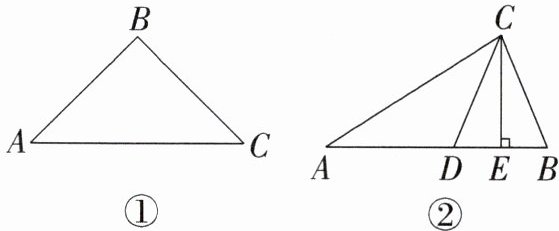
(1)如图①所示,若等腰三角形ABC是“类勾股三角形”,$AB = BC$,$AC>AB$,求$∠A$的度数.
(2)如图②所示,在$\triangle ABC$中,$∠B = 2∠A$,且$∠C>∠A$. 求证:$\triangle ABC$为“类勾股三角形”.小明同学想到可以在AB上找一点D使得$AD = CD$,再作$CE⊥BD$.
①探索$\triangle CDB$的形状并说明理由.
②请你帮助小明完成证明过程.
答案
(1)$\because AB=BC$,$AC>AB$,$\therefore a=c$,$b>c$。$\because \triangle ABC$是“类勾股三角形”,$\therefore ac+a^{2}=b^{2}$,$\therefore c^{2}+a^{2}=b^{2}$,$\therefore \triangle ABC$是等腰直角三角形,$\therefore \angle A=45^{\circ}$。
(2)①等腰三角形,理由如下:$\because AD=CD$,$\therefore \angle A=\angle ACD$,$\therefore \angle CDB=\angle ACD+\angle A=2\angle A$。$\because \angle B=2\angle A$,$\therefore \angle CDB=\angle B$,$\therefore \triangle CDB$是等腰三角形。
②由①得$CD=CB=a$,$\therefore AD=CD=a$,$\therefore DB=AB - AD=c - a$。$\because CE\perp AB$,$\therefore DE=BE=\frac{1}{2}(c - a)$,$\therefore AE=AD + DE=\frac{1}{2}(c + a)$。在$Rt\triangle ACE$中,$CE^{2}=AC^{2}-AE^{2}=b^{2}-\left[\frac{1}{2}(c + a)\right]^{2}$,在$Rt\triangle BCE$中,$CE^{2}=BC^{2}-BE^{2}=a^{2}-\left[\frac{1}{2}(c - a)\right]^{2}$,$\therefore b^{2}-\left[\frac{1}{2}(c + a)\right]^{2}=a^{2}-\left[\frac{1}{2}(c - a)\right]^{2}$,$\therefore b^{2}=ac + a^{2}$,$\therefore \triangle ABC$是“类勾股三角形”。
(2)①等腰三角形,理由如下:$\because AD=CD$,$\therefore \angle A=\angle ACD$,$\therefore \angle CDB=\angle ACD+\angle A=2\angle A$。$\because \angle B=2\angle A$,$\therefore \angle CDB=\angle B$,$\therefore \triangle CDB$是等腰三角形。
②由①得$CD=CB=a$,$\therefore AD=CD=a$,$\therefore DB=AB - AD=c - a$。$\because CE\perp AB$,$\therefore DE=BE=\frac{1}{2}(c - a)$,$\therefore AE=AD + DE=\frac{1}{2}(c + a)$。在$Rt\triangle ACE$中,$CE^{2}=AC^{2}-AE^{2}=b^{2}-\left[\frac{1}{2}(c + a)\right]^{2}$,在$Rt\triangle BCE$中,$CE^{2}=BC^{2}-BE^{2}=a^{2}-\left[\frac{1}{2}(c - a)\right]^{2}$,$\therefore b^{2}-\left[\frac{1}{2}(c + a)\right]^{2}=a^{2}-\left[\frac{1}{2}(c - a)\right]^{2}$,$\therefore b^{2}=ac + a^{2}$,$\therefore \triangle ABC$是“类勾股三角形”。
