

 登录
登录
Ⅰ.用括号中所给单词的适当形式填空
1. The farmers put the
2. The famous
3. When the teacher asked if they understood, the students
4. This boy always likes to use
5. In the class, the teacher asked us to write a
1. The farmers put the
freshly
(fresh) picked apples in the baskets.2. The famous
writer
(write) shared his writing experiences during the speech.3. When the teacher asked if they understood, the students
nodded
(nod) one after another.4. This boy always likes to use
jokes
(joke) to make his classmates happy.5. In the class, the teacher asked us to write a
description
(describe) of the scenery.答案
1. freshly 2. writer 3. nodded 4. jokes 5. description
解析
【分析】本题考查英语单词的适当形式填空,需结合句子结构、词性要求、时态及名词单复数等规则解题:1. 需用副词修饰动词picked,故将形容词fresh转换为副词;2. 形容词famous后需接表示人的名词,故将动词write转换为名词;3. 主句时态为一般过去时,谓语动词需用过去式;4. joke为可数名词,此处表泛指需用复数形式;5. 不定冠词a后需接名词,故将动词describe转换为名词。
【解析】1. 句中picked是动词,需用副词修饰,fresh的副词形式为freshly,故填freshly;2. famous是形容词,后接名词,write对应的表示人的名词是writer,故填writer;3. 由前文asked可知句子为一般过去时,nod的过去式是nodded,故填nodded;4. joke是可数名词,此处表泛指,用复数形式jokes,故填jokes;5. a后接名词,describe对应的名词是description,故填description。
【答案】1. freshly 2. writer 3. nodded 4. jokes 5. description
【知识点】副词的用法、词形转换、动词时态
【点评】本题为基础词形转换题,主要考查学生对词性变化、动词时态及名词单复数的掌握,属于英语基础题型,难度较低。
【难度系数】0.8
【解析】1. 句中picked是动词,需用副词修饰,fresh的副词形式为freshly,故填freshly;2. famous是形容词,后接名词,write对应的表示人的名词是writer,故填writer;3. 由前文asked可知句子为一般过去时,nod的过去式是nodded,故填nodded;4. joke是可数名词,此处表泛指,用复数形式jokes,故填jokes;5. a后接名词,describe对应的名词是description,故填description。
【答案】1. freshly 2. writer 3. nodded 4. jokes 5. description
【知识点】副词的用法、词形转换、动词时态
【点评】本题为基础词形转换题,主要考查学生对词性变化、动词时态及名词单复数的掌握,属于英语基础题型,难度较低。
【难度系数】0.8
Ⅱ. 根据汉语意思完成句子,每空一词
6. 我们应该和家人分享生活中的快乐。
We should
7. 不论结果怎样,尽力就好。
8. 他看见孩子们在花园里开心地玩耍。
He
9. 爸爸忙着修理家里的坏椅子。
Dad is
10. 在中国,不论你走到哪里都能感受到传统文化。
In China,
6. 我们应该和家人分享生活中的快乐。
We should
share
the happiness in life with
our family.7. 不论结果怎样,尽力就好。
No
matter
what the result is, just do your best.8. 他看见孩子们在花园里开心地玩耍。
He
sees
the children playing
happily in the garden.9. 爸爸忙着修理家里的坏椅子。
Dad is
busy
repairing
the broken chair at home.10. 在中国,不论你走到哪里都能感受到传统文化。
In China,
wherever
you
go
, you can feel traditional culture.答案
6. share; with 7. No matter 8. sees; playing 9. busy repairing 10. wherever you go
解析
【分析】
本题为根据汉语意思完成句子的基础题型,需结合英语固定短语、动词搭配及从句用法解题:第6题考查“和某人分享某物”的固定短语;第7题考查表“不论”的让步状语从句引导词;第8题考查“看见某人正在做某事”的动词搭配及时态;第9题考查“忙于做某事”的固定结构;第10题考查表“不论哪里”的让步状语从句引导词用法,需匹配汉语提示对应英语表达。
【解析】
6. 固定短语“share sth with sb”意为“和某人分享某物”,情态动词should后接动词原形,故填share;
7. “No matter + 疑问词”可引导让步状语从句,表“不论……”,符合句意,故填No matter;
8. “see sb doing sth”表示“看见某人正在做某事”,主语he为第三人称单数,句子用一般现在时,see用sees,play的动名词形式为playing,故填sees; playing;
9. 固定结构“be busy doing sth”意为“忙于做某事”,故填busy repairing;
10. “wherever”相当于“no matter where”,引导让步状语从句,表“不论哪里”,符合句意,故填wherever you go。
【答案】6. share; with 7. No matter 8. sees; playing 9. busy repairing 10. wherever you go
【知识点】固定短语搭配、动词固定结构、让步状语从句
【点评】本题为基础题型,主要考查英语常用的固定短语、动词搭配及让步状语从句引导词用法,需学生熟练掌握课本基础知识点,难度适中。
【难度系数】0.3
本题为根据汉语意思完成句子的基础题型,需结合英语固定短语、动词搭配及从句用法解题:第6题考查“和某人分享某物”的固定短语;第7题考查表“不论”的让步状语从句引导词;第8题考查“看见某人正在做某事”的动词搭配及时态;第9题考查“忙于做某事”的固定结构;第10题考查表“不论哪里”的让步状语从句引导词用法,需匹配汉语提示对应英语表达。
【解析】
6. 固定短语“share sth with sb”意为“和某人分享某物”,情态动词should后接动词原形,故填share;
7. “No matter + 疑问词”可引导让步状语从句,表“不论……”,符合句意,故填No matter;
8. “see sb doing sth”表示“看见某人正在做某事”,主语he为第三人称单数,句子用一般现在时,see用sees,play的动名词形式为playing,故填sees; playing;
9. 固定结构“be busy doing sth”意为“忙于做某事”,故填busy repairing;
10. “wherever”相当于“no matter where”,引导让步状语从句,表“不论哪里”,符合句意,故填wherever you go。
【答案】6. share; with 7. No matter 8. sees; playing 9. busy repairing 10. wherever you go
【知识点】固定短语搭配、动词固定结构、让步状语从句
【点评】本题为基础题型,主要考查英语常用的固定短语、动词搭配及让步状语从句引导词用法,需学生熟练掌握课本基础知识点,难度适中。
【难度系数】0.3
Ⅲ.阅读还原
As we all know, doing chores helps to improve children's living skills and teaches them how to look after themselves. So, now more and more children do chores.
11.
In autumn, the most common outdoor chore is cleaning leaves. 12.
After a heavy snowfall in winter, children also play an important role in doing outdoor chores. They help shovel(铲) snow in their front yard. 13.
Doing all of these chores might sound like a lot of work. 14.
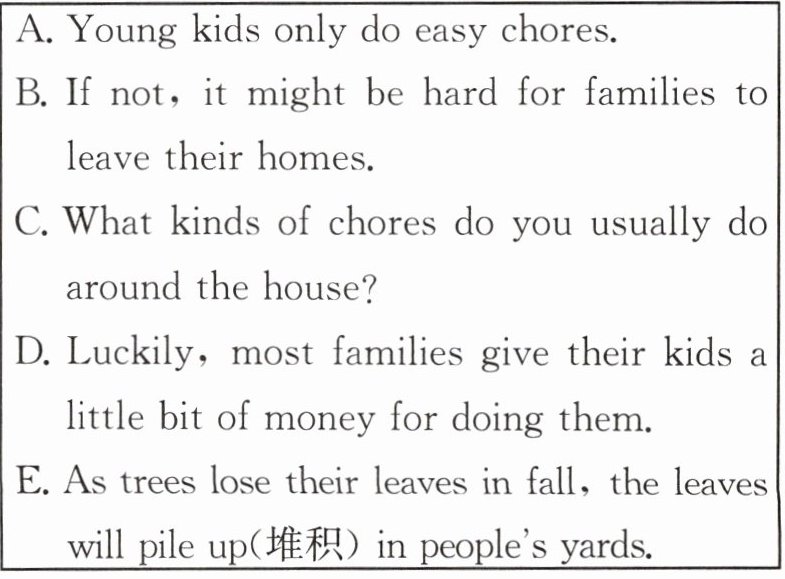
As we all know, doing chores helps to improve children's living skills and teaches them how to look after themselves. So, now more and more children do chores.
11.
C
Maybe you clean your room, wash the dishes, and sweep the floor. All of these are “indoor chores”. But in many places—especially in the countryside in the US, kids have different “outdoor chores” during different seasons.In autumn, the most common outdoor chore is cleaning leaves. 12.
E
It is time for each family to clean up the leaves.After a heavy snowfall in winter, children also play an important role in doing outdoor chores. They help shovel(铲) snow in their front yard. 13.
B
Spring and summer bring lots of rain and sun which make the grass in the yards grow tall. It is common for kids to mow(割草) their yards to keep them fresh and tidy.Doing all of these chores might sound like a lot of work. 14.
D
People who don't have children might even pay neighbourhood kids to do chores for them. It's also a good way for kids to make some money.答案
11. C 12. E 13. B 14. D
解析
【分析】本题为英语阅读还原题,需结合上下文的语境及句子间的逻辑关系选择合适的选项。需逐一分析每个空的前后内容,匹配对应选项:11空后举例室内家务,对应询问家务类型的内容;12空前后围绕秋天清理树叶展开,需衔接树叶堆积的描述;13空前后涉及季节家务的过渡,需补充不做相关家务的后果;14空后提到支付报酬,对应给孩子零花钱的内容。
【解析】11. 空后举例“clean your room, wash the dishes...”等室内家务,选项C“你通常在家里做什么种类的家务?”能引出下文举例,符合语境,故选C。12. 空前说明秋天常见户外家务是清理树叶,空后提到家庭清理树叶,选项E“秋天树掉叶子,叶子会堆积在院子里”衔接上下文,解释清理树叶的原因,故选E。13. 空前说冬天孩子铲雪,空后转说春秋的家务,选项B“如果不这样,家庭出门可能会很难”承接上文铲雪的必要性,实现季节内容的过渡,故选B。14. 空前说做家务工作量大,空后提到他人付钱给孩子做家务,选项D“幸运的是,大多数家庭给孩子一点钱做这些家务”衔接下文的报酬内容,故选D。
【答案】11.C 12.E 13.B 14.D
【知识点】英语阅读还原、语境理解、逻辑衔接
【点评】本题考查学生对英语语篇上下文逻辑和语境的把握能力,解题时需紧扣前后文内容匹配选项,难度适中。
【难度系数】0.6
【解析】11. 空后举例“clean your room, wash the dishes...”等室内家务,选项C“你通常在家里做什么种类的家务?”能引出下文举例,符合语境,故选C。12. 空前说明秋天常见户外家务是清理树叶,空后提到家庭清理树叶,选项E“秋天树掉叶子,叶子会堆积在院子里”衔接上下文,解释清理树叶的原因,故选E。13. 空前说冬天孩子铲雪,空后转说春秋的家务,选项B“如果不这样,家庭出门可能会很难”承接上文铲雪的必要性,实现季节内容的过渡,故选B。14. 空前说做家务工作量大,空后提到他人付钱给孩子做家务,选项D“幸运的是,大多数家庭给孩子一点钱做这些家务”衔接下文的报酬内容,故选D。
【答案】11.C 12.E 13.B 14.D
【知识点】英语阅读还原、语境理解、逻辑衔接
【点评】本题考查学生对英语语篇上下文逻辑和语境的把握能力,解题时需紧扣前后文内容匹配选项,难度适中。
【难度系数】0.6
