

 登录
Ⅷ. 任务型阅读
(2026·山西中考改编) Money is part of our life. So we are faced with the same question: what to do with our money?
Smart spending(理性消费)means using money in a way that fits real needs, real value and real plans.
In daily life, teenagers usually spend most of their money buying something necessary—food, clothes or school things. But sometimes, they buy things they don't really need. Following the crowd may lead teenagers to buy something unnecessary. For example, when some classmates have the same kind of pencil case, a teenager may feel unhappy about having a different one. So he will buy a new one like theirs.
Teenagers can start learning how to manage money wisely at an early age. On Tom's 6th birth- day, his grandmother gave him several jars(罐子)to help him make good use of money. One was for spending, one for saving and another for giving. It was at that time that Tom started his own mon- ey journal(记账本)to record where the money had gone. He has had this habit since then.
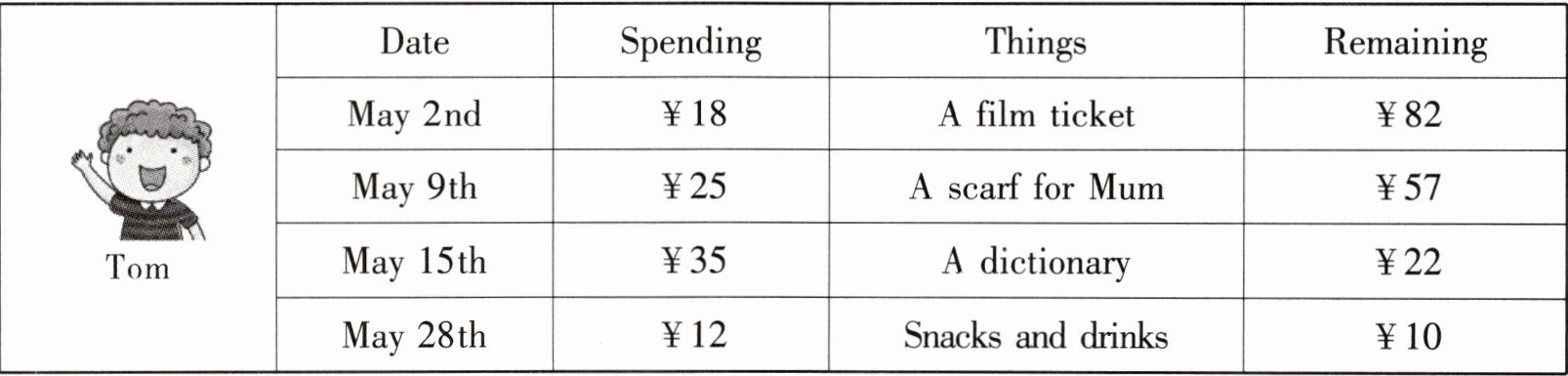
Tom's birthday present is more than several jars. His grandmother has given a kid the chance to learn lifelong values. The wider goal of the jars is to encourage teenagers to think more wisely about the money and the things they can do.
1. What does smart spending mean?
It means
2. What may lead teenagers to buy something unnecessary?
3. Why did Tom's grandmother give him several jars?
To help him
4. What were the top two things Tom spent money on in May?
They are
5. What's the wider goal of the jars?
It's to encourage teenagers to think more wisely about
(2026·山西中考改编) Money is part of our life. So we are faced with the same question: what to do with our money?
Smart spending(理性消费)means using money in a way that fits real needs, real value and real plans.
In daily life, teenagers usually spend most of their money buying something necessary—food, clothes or school things. But sometimes, they buy things they don't really need. Following the crowd may lead teenagers to buy something unnecessary. For example, when some classmates have the same kind of pencil case, a teenager may feel unhappy about having a different one. So he will buy a new one like theirs.
Teenagers can start learning how to manage money wisely at an early age. On Tom's 6th birth- day, his grandmother gave him several jars(罐子)to help him make good use of money. One was for spending, one for saving and another for giving. It was at that time that Tom started his own mon- ey journal(记账本)to record where the money had gone. He has had this habit since then.
Tom's birthday present is more than several jars. His grandmother has given a kid the chance to learn lifelong values. The wider goal of the jars is to encourage teenagers to think more wisely about the money and the things they can do.
1. What does smart spending mean?
It means
using money in a way that fits real needs, real value and real plans
.2. What may lead teenagers to buy something unnecessary?
Following the crowd
may lead teenagers to buy something unnecessary.3. Why did Tom's grandmother give him several jars?
To help him
make good use of money
.4. What were the top two things Tom spent money on in May?
They are
a dictionary and a scarf
.5. What's the wider goal of the jars?
It's to encourage teenagers to think more wisely about
the money and the things they can do
.答案
1. using money in a way that fits real needs, real value and real plans
2. Following the crowd
3. make good use of money
4. a dictionary and a scarf
5. the money and the things they can do
2. Following the crowd
3. make good use of money
4. a dictionary and a scarf
5. the money and the things they can do
解析
【分析】
本题为任务型阅读,考查细节信息提取能力。解题思路为:针对每个小题,先明确问题关键词,再定位原文对应段落/语句,提取匹配的答案内容;其中第4题需结合表格数据计算花费金额,排序后确定前两位物品。
【解析】
1. 定位原文第二段,直接提取“smart spending”的定义句,即为答案;
2. 定位原文第三段,找到导致青少年买不必要物品的原因,提取关键信息;
3. 定位原文第四段,找到奶奶给罐子的目的,提取对应内容;
4. 从表格中提取Tom的各项花费金额(¥18、¥25、¥35、¥12),按金额从高到低排序,确定前两位对应的物品;
5. 定位原文最后一段,找到罐子的更广泛目标,提取对应内容。
【答案】
1. using money in a way that fits real needs, real value and real plans
2. Following the crowd
3. make good use of money
4. a dictionary and a scarf
5. the money and the things they can do
【知识点】
任务型阅读,细节理解
【点评】
本题为基础任务型阅读题,主要考查学生对原文细节信息的定位与提取能力,题目难度适中,只要仔细阅读原文即可准确解答。
【难度系数】
0.7
