

 登录
如图15-3-44①,在等边三角形ABC中,D是边AB上的动点,以CD为一边,向上作等边三角形EDC,连接AE.
(1)△DBC和△EAC全等吗?请说明理由.
(2)求证AE//BC.
(3)如图15-3-44②,动点D运动到边BA的延长线上,△EDC仍为等边三角形,请问是否仍有AE//BC?证明你的猜想.
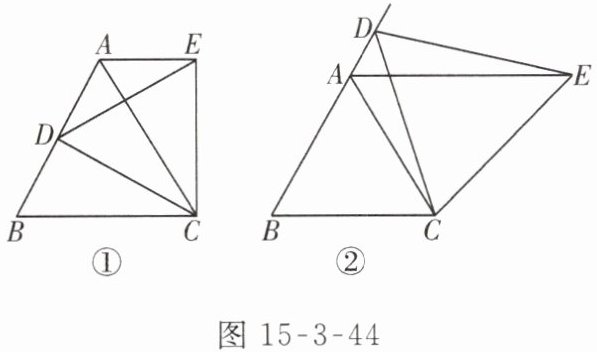
图15-3-44
(1)△DBC和△EAC全等吗?请说明理由.
(2)求证AE//BC.
(3)如图15-3-44②,动点D运动到边BA的延长线上,△EDC仍为等边三角形,请问是否仍有AE//BC?证明你的猜想.
图15-3-44
答案
(1)解:$△ DBC≌△ EAC.$
理由:$\because △ ABC,△ EDC$ 是等边三角形,
$\therefore ∠ ACB=∠ DCE=60°,BC=AC,DC=EC.$
$\therefore ∠ ACB-∠ ACD=∠ DCE-∠ ACD,$
即$∠ BCD=∠ ACE.$
在$△ DBC$ 和$△ EAC$ 中,$\begin{cases}BC=AC,\\∠ BCD=∠ ACE,\\DC=EC,\end{cases}$
$\therefore △ DBC≌△ EAC(\mathrm{SAS}).$
(2)证明:$\because △ DBC≌△ EAC,$
$\therefore ∠ EAC=∠ B=60°.$
又$\because ∠ ACB=60°,$
$\therefore ∠ EAC=∠ ACB. \therefore AE// BC.$
(3)解:仍有 $AE// BC.$
证明:$\because △ ABC,△ EDC$ 为等边三角形,
$\therefore BC=AC,DC=CE,∠ BCA=∠ DCE=60°.$
$\therefore ∠ BCA+∠ ACD=∠ DCE+∠ ACD,$
即$∠ BCD=∠ ACE.$
在$△ DBC$ 和$△ EAC$ 中,$\begin{cases}BC=AC,\\∠ BCD=∠ ACE,\\DC=EC,\end{cases}$
$\therefore △ DBC≌△ EAC(\mathrm{SAS}).$
$\therefore ∠ EAC=∠ B=60°.$
又$\because ∠ ACB=60°,\therefore ∠ EAC=∠ ACB.$
$\therefore AE// BC.$
