

 登录
登录
二、阅读理解(本题有10小题,每小题2分,共计20分)
阅读下面的材料,从各题所给的四个选项中选出一个最佳答案。
A
Instructions
Step 1: Ask 500 boys and girls from an American school, “Do you always, sometimes, or never send postcards when travelling?” Record their answers.
Step 2: Choose 50 students from them. Ask why they send postcards—or why they don’t. Write down their answers.
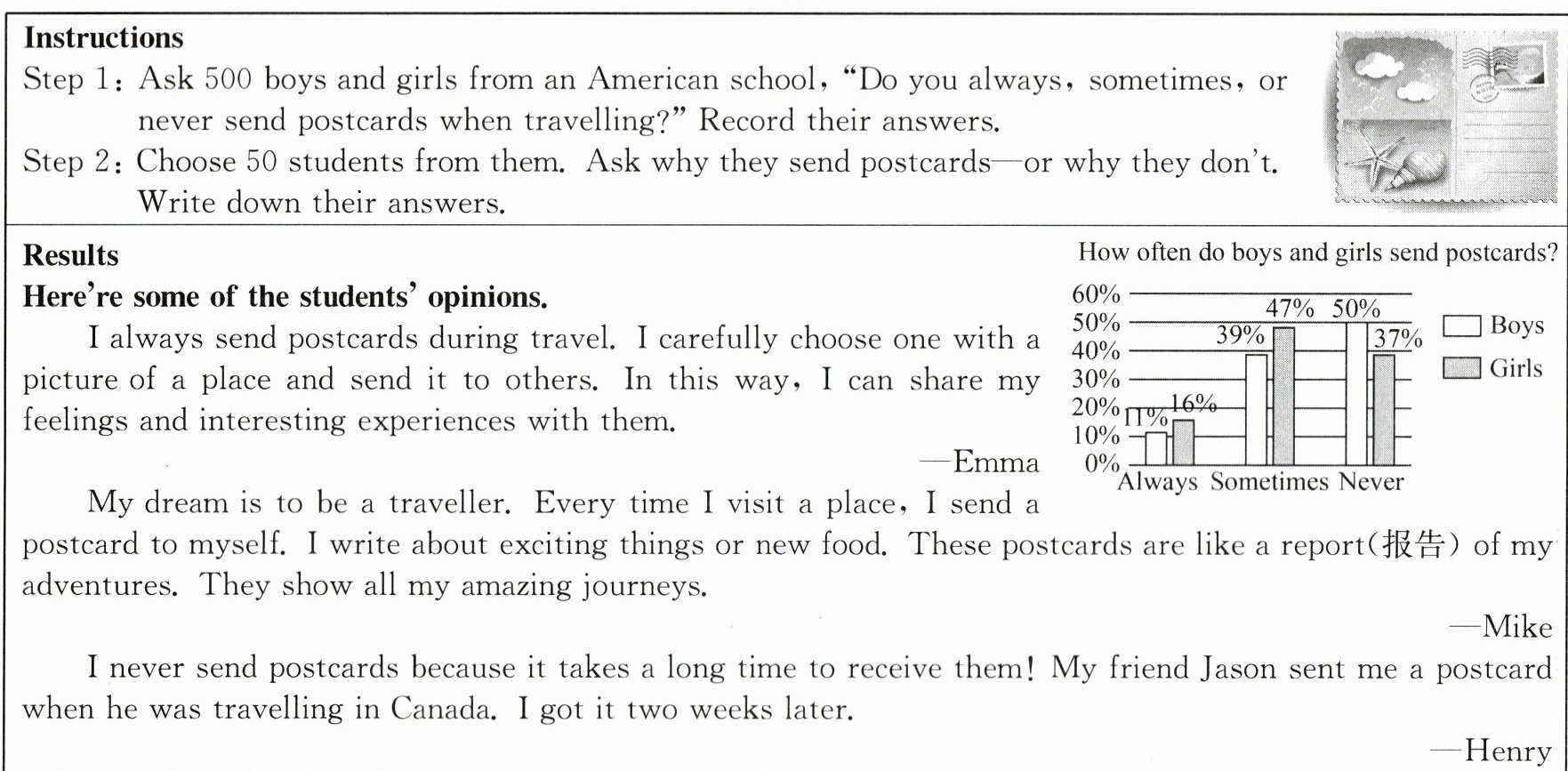
Results
Here’re some of the students’ opinions.
I always send postcards during travel. I carefully choose one with a picture of a place and send it to others. In this way I can share my feelings and interesting experiences with them.
—Emma
My dream is to be a traveller. Every time I visit a place, I send a postcard to myself. I write about exciting things or new food. These postcards are like a report(报告) of my adventures. They show all my amazing journeys.
—Mike
I never send postcards because it takes a long time to receive them! My friend Jason sent me a postcard when he was travelling in Canada. I got it two weeks later.
—Henry
(
A. 16%.
B. 39%.
C. 47%.
D. 55%.
(
A. To become a traveller.
B. To get others’ replies.
C. To remember journeys.
D. To share trip experiences.
(
A. A survey report.
B. A road map.
C. A travel guide.
D. A thank-you letter.
阅读下面的材料,从各题所给的四个选项中选出一个最佳答案。
A
Instructions
Step 1: Ask 500 boys and girls from an American school, “Do you always, sometimes, or never send postcards when travelling?” Record their answers.
Step 2: Choose 50 students from them. Ask why they send postcards—or why they don’t. Write down their answers.
Results
Here’re some of the students’ opinions.
I always send postcards during travel. I carefully choose one with a picture of a place and send it to others. In this way I can share my feelings and interesting experiences with them.
—Emma
My dream is to be a traveller. Every time I visit a place, I send a postcard to myself. I write about exciting things or new food. These postcards are like a report(报告) of my adventures. They show all my amazing journeys.
—Mike
I never send postcards because it takes a long time to receive them! My friend Jason sent me a postcard when he was travelling in Canada. I got it two weeks later.
—Henry
(
C
)16. What per cent(百分比) of girls sometimes send postcards?A. 16%.
B. 39%.
C. 47%.
D. 55%.
(
D
)17. Why does Emma send postcards when travelling?A. To become a traveller.
B. To get others’ replies.
C. To remember journeys.
D. To share trip experiences.
(
A
)18. What is the text?A. A survey report.
B. A road map.
C. A travel guide.
D. A thank-you letter.
答案
16.C 17.D 18.A
解析
【分析】
本题为英语阅读理解题,包含3道小题,分别考查图表信息提取、细节理解和主旨大意。解题思路:1. 第16题需定位右侧柱状图中女生“Sometimes”寄明信片的百分比;2. 第17题需找到Emma的表述,提取她寄明信片的原因;3. 第18题需分析文本结构,判断其类型。
【解析】
16. 题目询问“有时寄明信片的女生百分比”,定位右侧柱状图,“Sometimes”类别下灰色柱子(代表女生)对应的数值为47%,对应选项C。
17. 题目询问Emma寄明信片的原因,找到Emma的表述:“In this way, I can share my feelings and interesting experiences with them.”,即分享旅行感受和经历,对应选项D。
18. 题目询问文本类型,文本开头是调查步骤(Step1、Step2),后续呈现调查结果和学生观点,属于调查报告,对应选项A。
【答案】
16.C 17.D 18.A
【知识点】
英语阅读理解(细节理解、主旨大意),图表信息提取
【点评】
本题为基础英语阅读理解题,侧重考查学生定位关键信息、提取内容的能力,题目设置简单,只要仔细对应原文或图表信息即可解答。
【难度系数】
0.8
本题为英语阅读理解题,包含3道小题,分别考查图表信息提取、细节理解和主旨大意。解题思路:1. 第16题需定位右侧柱状图中女生“Sometimes”寄明信片的百分比;2. 第17题需找到Emma的表述,提取她寄明信片的原因;3. 第18题需分析文本结构,判断其类型。
【解析】
16. 题目询问“有时寄明信片的女生百分比”,定位右侧柱状图,“Sometimes”类别下灰色柱子(代表女生)对应的数值为47%,对应选项C。
17. 题目询问Emma寄明信片的原因,找到Emma的表述:“In this way, I can share my feelings and interesting experiences with them.”,即分享旅行感受和经历,对应选项D。
18. 题目询问文本类型,文本开头是调查步骤(Step1、Step2),后续呈现调查结果和学生观点,属于调查报告,对应选项A。
【答案】
16.C 17.D 18.A
【知识点】
英语阅读理解(细节理解、主旨大意),图表信息提取
【点评】
本题为基础英语阅读理解题,侧重考查学生定位关键信息、提取内容的能力,题目设置简单,只要仔细对应原文或图表信息即可解答。
【难度系数】
0.8
B
①Playing games and watching videos on the smartphone are fun. But too much screen time can cause problems like bad sleep and information anxiety(焦虑). Why do these problems happen and how can you solve them?
②Melatonin is a natural sleep hormone(激素). When the day gets dark, your body starts to
make lots of melatonin. It makes you less excited. That means you are ready for sleep. But if you use your smartphone before sleep, blue light from the screen will stop your body making melatonin. What can you do? First, don't use the screen before going to bed. Also, remember to stay outside during the day because sunlight helps you make more melatonin at night.
③Information anxiety happens when there's too much information. You may feel worried about missing something important. To solve this problem, first, you should think about your real needs. Ask yourself, "Do I need this information now?"Then, cut down your screen time step by step. For example, start with a 30 minutes' no-screen time. When it's easy for you, make the time longer. You can also try some fun activities without using the screen. This way, you will pay less attention to information and feel less worried.
④Use the screen correctly, and you can sleep better and feel happier.
(
A. Make the screen dark.
B. Get people ready to sleep.
C. Stop the body making hormone.
D. Help people feel more excited.
(
A. Watch interesting videos to relax.
B. Check information when studying.
C. Use screens for 30 minutes every day.
D. Think about real information needs.
(

C
①Playing games and watching videos on the smartphone are fun. But too much screen time can cause problems like bad sleep and information anxiety(焦虑). Why do these problems happen and how can you solve them?
②Melatonin is a natural sleep hormone(激素). When the day gets dark, your body starts to
make lots of melatonin. It makes you less excited. That means you are ready for sleep. But if you use your smartphone before sleep, blue light from the screen will stop your body making melatonin. What can you do? First, don't use the screen before going to bed. Also, remember to stay outside during the day because sunlight helps you make more melatonin at night.
③Information anxiety happens when there's too much information. You may feel worried about missing something important. To solve this problem, first, you should think about your real needs. Ask yourself, "Do I need this information now?"Then, cut down your screen time step by step. For example, start with a 30 minutes' no-screen time. When it's easy for you, make the time longer. You can also try some fun activities without using the screen. This way, you will pay less attention to information and feel less worried.
④Use the screen correctly, and you can sleep better and feel happier.
(
B
)19. What can melatonin do according to Paragraph 2?A. Make the screen dark.
B. Get people ready to sleep.
C. Stop the body making hormone.
D. Help people feel more excited.
(
D
)20. Which is the right way to solve information anxiety?A. Watch interesting videos to relax.
B. Check information when studying.
C. Use screens for 30 minutes every day.
D. Think about real information needs.
(
D
)21. What is the correct structure(结构) of the text?C
答案
19.B 20.D 21.D
【阅读理解】
B篇
本文告诉大家太多的屏幕时间会导致睡眠不好和信息焦虑,并具体说明了问题产生的原因和解决方法,让你睡得更好,感觉更快乐。
第19题:细节理解题。根据第二段中 It makes you less excited. That means you are ready for sleep. (它让你不那么兴奋。这意味着你准备好睡觉了。)可知,褪黑素可以让人们准备睡觉,故选 B。
第20题:细节理解题。根据第三段中 To solve this problem, first, you should think about your real needs. (要解决这个问题,首先,你应该想想你的实际需求。)可知,解决信息焦虑的正确方法是考虑实际信息需求,故选 D。
第21题:篇章结构题。通读文章内容可知,本文第一段总述太多的屏幕时间会导致睡眠不好和信息焦虑等问题;第二、三段分别从睡眠和信息焦虑两个方面具体说明问题出现的原因和如何解决问题;第四段总结,如果正确使用屏幕,你可以睡得更好,感觉更快乐;因此文章结构是总—分—总;再结合选项,D选项符合,故选 D。
【阅读理解】
B篇
本文告诉大家太多的屏幕时间会导致睡眠不好和信息焦虑,并具体说明了问题产生的原因和解决方法,让你睡得更好,感觉更快乐。
第19题:细节理解题。根据第二段中 It makes you less excited. That means you are ready for sleep. (它让你不那么兴奋。这意味着你准备好睡觉了。)可知,褪黑素可以让人们准备睡觉,故选 B。
第20题:细节理解题。根据第三段中 To solve this problem, first, you should think about your real needs. (要解决这个问题,首先,你应该想想你的实际需求。)可知,解决信息焦虑的正确方法是考虑实际信息需求,故选 D。
第21题:篇章结构题。通读文章内容可知,本文第一段总述太多的屏幕时间会导致睡眠不好和信息焦虑等问题;第二、三段分别从睡眠和信息焦虑两个方面具体说明问题出现的原因和如何解决问题;第四段总结,如果正确使用屏幕,你可以睡得更好,感觉更快乐;因此文章结构是总—分—总;再结合选项,D选项符合,故选 D。
解析
【分析】
本题为英语阅读理解题,包含细节理解、篇章结构两类题型。第19题需定位第二段中褪黑素的相关描述,判断其作用;第20题需定位第三段解决信息焦虑的方法,匹配正确选项;第21题需通读全文,梳理文章结构层次,确定正确结构。
【解析】
第19题:细节理解题。根据第二段内容,“It makes you less excited. That means you are ready for sleep.”可知,褪黑素能让人们做好睡觉的准备,对应选项B。
第20题:细节理解题。根据第三段中“To solve this problem, first, you should think about your real needs.”可知,解决信息焦虑的正确方法是考虑自身的实际信息需求,对应选项D。
第21题:篇章结构题。通读全文,第一段总述过多屏幕时间会导致睡眠差、信息焦虑等问题;第二、三段分别从睡眠问题和信息焦虑问题两方面具体说明原因及解决方法;第四段总结正确使用屏幕的好处,因此文章结构为“总-分-总”,对应选项D。
【答案】
19.B 20.D 21.D
【知识点】
英语阅读理解、细节理解题、篇章结构题
【点评】
本文围绕屏幕时间带来的问题展开,题型贴合初中英语阅读考点,侧重考查学生快速定位原文信息和梳理文章结构的能力,整体难度适中,是典型的实用类阅读理解文本。
【难度系数】
0.7
本题为英语阅读理解题,包含细节理解、篇章结构两类题型。第19题需定位第二段中褪黑素的相关描述,判断其作用;第20题需定位第三段解决信息焦虑的方法,匹配正确选项;第21题需通读全文,梳理文章结构层次,确定正确结构。
【解析】
第19题:细节理解题。根据第二段内容,“It makes you less excited. That means you are ready for sleep.”可知,褪黑素能让人们做好睡觉的准备,对应选项B。
第20题:细节理解题。根据第三段中“To solve this problem, first, you should think about your real needs.”可知,解决信息焦虑的正确方法是考虑自身的实际信息需求,对应选项D。
第21题:篇章结构题。通读全文,第一段总述过多屏幕时间会导致睡眠差、信息焦虑等问题;第二、三段分别从睡眠问题和信息焦虑问题两方面具体说明原因及解决方法;第四段总结正确使用屏幕的好处,因此文章结构为“总-分-总”,对应选项D。
【答案】
19.B 20.D 21.D
【知识点】
英语阅读理解、细节理解题、篇章结构题
【点评】
本文围绕屏幕时间带来的问题展开,题型贴合初中英语阅读考点,侧重考查学生快速定位原文信息和梳理文章结构的能力,整体难度适中,是典型的实用类阅读理解文本。
【难度系数】
0.7
