

 登录
登录
一、阅读短文,选择最佳选项。
新情境·科普知识 ◎建议用时:6分钟 ✔难度:★★★☆
It's helpful to know how much money we usually spend on different things. Then, if we also know how much money we will have, we can decide which things we should buy now and which things we can go without.
Here is a student's weekly budget during the school year.
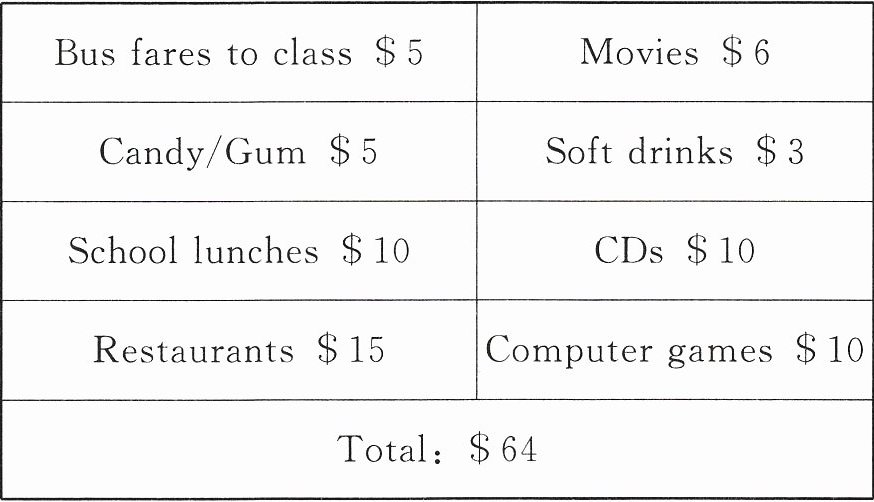
This student has only 50 a week to spend, so he must spend less on some things or not have them at all. If he wants to save on bus fares, he can walk to class. If he doesn't buy any candy, he can save 5 a week. Or, he can save 3 if he has no soft drinks. He can save on lunches if he brings his own.He may be able to save on CDs by borrowing(借) them from his friends or buying them second-hand. He doesn't have to go to the movies or restaurants.Different people need or want different things, so their budgets are different. Girls may not like computer games. They may want to spend more money on clothes or jewellery.For most of us, a weekly budget is only a little helpful. We really need to have a monthly budget, or even a yearly budget. This is because we have to pay for some things only once a month or once a year. For example, clothes, textbooks, vacations and so on are not weekly expenses(费用). They are monthly or yearly expenses.( )1. We can see ______ if we use a monthly budget.A. more moneyB. things we don't buy all the timeC. how prices go up quicklyD. the best place to buy sweets( )2. [学科融合] If the student doesn't go to the movies and doesn't buy soft drinks for three weeks, he can save ______.A. 192
B. 64C. 27
D. 21
( )3. [观点态度] The writer mainly tries to tell the readers that _________.
A. buying second-hand things can help to save lots of money
B. students can only buy textbooks once a month
C. a weekly budget is not helpful at all
D. making plans for money is very important
新情境·科普知识 ◎建议用时:6分钟 ✔难度:★★★☆
It's helpful to know how much money we usually spend on different things. Then, if we also know how much money we will have, we can decide which things we should buy now and which things we can go without.
Here is a student's weekly budget during the school year.
This student has only 50 a week to spend, so he must spend less on some things or not have them at all. If he wants to save on bus fares, he can walk to class. If he doesn't buy any candy, he can save 5 a week. Or, he can save 3 if he has no soft drinks. He can save on lunches if he brings his own.He may be able to save on CDs by borrowing(借) them from his friends or buying them second-hand. He doesn't have to go to the movies or restaurants.Different people need or want different things, so their budgets are different. Girls may not like computer games. They may want to spend more money on clothes or jewellery.For most of us, a weekly budget is only a little helpful. We really need to have a monthly budget, or even a yearly budget. This is because we have to pay for some things only once a month or once a year. For example, clothes, textbooks, vacations and so on are not weekly expenses(费用). They are monthly or yearly expenses.( )1. We can see ______ if we use a monthly budget.A. more moneyB. things we don't buy all the timeC. how prices go up quicklyD. the best place to buy sweets( )2. [学科融合] If the student doesn't go to the movies and doesn't buy soft drinks for three weeks, he can save ______.A. 192
B. 64C. 27
D. 21
( )3. [观点态度] The writer mainly tries to tell the readers that _________.
A. buying second-hand things can help to save lots of money
B. students can only buy textbooks once a month
C. a weekly budget is not helpful at all
D. making plans for money is very important
答案
1. B
2. C
3. D
2. C
3. D
解析
【分析】
本题为英语阅读理解题,包含细节理解、数字计算和主旨大意三类题型。解题思路如下:
1. 第1题:定位原文最后一段关于月度预算的描述,明确月度预算对应的是不每周发生的费用,匹配对应选项。
2. 第2题:先计算每周节省的金额(电影费用+软饮费用),再乘以周数得到总节省金额,计算时注意数值准确性。
3. 第3题:通读全文梳理作者核心观点,排除干扰选项,确定主旨内容。
【解析】
1. 第1题:根据原文最后一段“For example, clothes, textbooks, vacations and so on are not weekly expenses. They are monthly or yearly expenses.”可知,月度预算能体现那些并非每周都购买的事物,对应选项B。
2. 第2题:每周节省的金额为电影费用(6)+软饮费用(3)=9,三周共节省9×3=27,对应选项C。
3. 第3题:原文开篇指出了解日常花费可帮助决策购买,后续围绕预算的重要性展开,核心观点是做金钱计划十分重要,对应选项D。
【答案】
1. B
2. C
3. D
【知识点】
英语阅读理解、细节理解、数字计算
【点评】
本题结合了英语阅读的细节查找、简单计算和主旨归纳,需要学生精准定位原文信息、准确计算数值、理解作者核心意图,是中等难度的阅读题。
【难度系数】
0.5
本题为英语阅读理解题,包含细节理解、数字计算和主旨大意三类题型。解题思路如下:
1. 第1题:定位原文最后一段关于月度预算的描述,明确月度预算对应的是不每周发生的费用,匹配对应选项。
2. 第2题:先计算每周节省的金额(电影费用+软饮费用),再乘以周数得到总节省金额,计算时注意数值准确性。
3. 第3题:通读全文梳理作者核心观点,排除干扰选项,确定主旨内容。
【解析】
1. 第1题:根据原文最后一段“For example, clothes, textbooks, vacations and so on are not weekly expenses. They are monthly or yearly expenses.”可知,月度预算能体现那些并非每周都购买的事物,对应选项B。
2. 第2题:每周节省的金额为电影费用(6)+软饮费用(3)=9,三周共节省9×3=27,对应选项C。
3. 第3题:原文开篇指出了解日常花费可帮助决策购买,后续围绕预算的重要性展开,核心观点是做金钱计划十分重要,对应选项D。
【答案】
1. B
2. C
3. D
【知识点】
英语阅读理解、细节理解、数字计算
【点评】
本题结合了英语阅读的细节查找、简单计算和主旨归纳,需要学生精准定位原文信息、准确计算数值、理解作者核心意图,是中等难度的阅读题。
【难度系数】
0.5
