

 登录
登录
二、☑对标 KET 能力 阅读关于 Mary 和 Wu Hui 的采访.回答问题。
新语篇·访谈报道 ◎建议用时:6分钟 ☑难度:★★★★☆
The school English Club has had an interview about pocket money. Let's have a look.
Mary
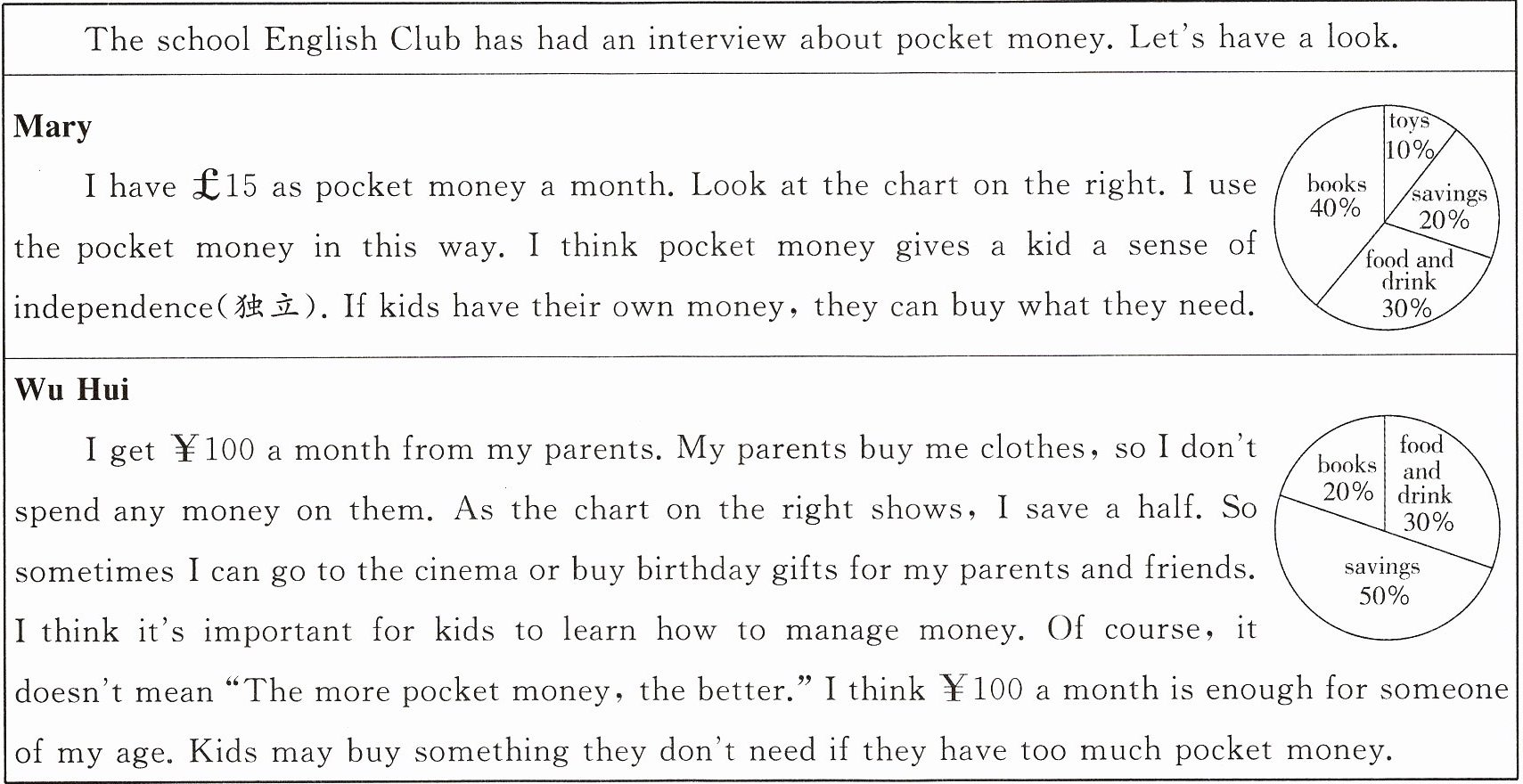
I have £15 as pocket money a month. Look at the chart on the right. I use the pocket money in this way. I think pocket money gives a kid a sense of independence(独立). If kids have their own money, they can buy what they need.
Wu Hui
I get ¥100 a month from my parents. My parents buy me clothes, so I don't spend any money on them. As the chart on the right shows, I save a half. So sometimes I can go to the cinema or buy birthday gifts for my parents and friends. I think it's important for kids to learn how to manage money. Of course, it doesn't mean "The more pocket money, the better." I think ¥100 a month is enough for someone of my age. Kids may buy something they don't need if they have too much pocket money.
1. What does Mary spend 30% of her pocket money on?
2. What can Wu Hui do with his savings?
3. How do you spend your pocket money? Why?
词汇积累: go without 在没有……的情况下凑合/不用/不要 fare n. 票价;车费
interview n. 采访 chart n. 图表 a sense of ... 一种……的感觉/观念
新语篇·访谈报道 ◎建议用时:6分钟 ☑难度:★★★★☆
The school English Club has had an interview about pocket money. Let's have a look.
Mary
I have £15 as pocket money a month. Look at the chart on the right. I use the pocket money in this way. I think pocket money gives a kid a sense of independence(独立). If kids have their own money, they can buy what they need.
Wu Hui
I get ¥100 a month from my parents. My parents buy me clothes, so I don't spend any money on them. As the chart on the right shows, I save a half. So sometimes I can go to the cinema or buy birthday gifts for my parents and friends. I think it's important for kids to learn how to manage money. Of course, it doesn't mean "The more pocket money, the better." I think ¥100 a month is enough for someone of my age. Kids may buy something they don't need if they have too much pocket money.
1. What does Mary spend 30% of her pocket money on?
Food and drink.
2. What can Wu Hui do with his savings?
He can go to the cinema or buy birthday gifts for his parents and friends with his savings.
3. How do you spend your pocket money? Why?
I spend most of my pocket money on books because I love reading.(答案不唯一)
词汇积累: go without 在没有……的情况下凑合/不用/不要 fare n. 票价;车费
interview n. 采访 chart n. 图表 a sense of ... 一种……的感觉/观念
答案
1. Food and drink.
2. He can go to the cinema or buy birthday gifts for his parents and friends with his savings.
3. I spend most of my pocket money on books because I love reading.(答案不唯一)
2. He can go to the cinema or buy birthday gifts for his parents and friends with his savings.
3. I spend most of my pocket money on books because I love reading.(答案不唯一)
解析
【分析】
本题是关于零花钱话题的阅读理解题,包含细节查找和开放性表达两类问题。解题思路:1. 针对细节题,先定位到对应人物的段落,再找到对应数据或描述,提取关键信息作答;2. 针对开放性问题,结合自身实际情况,围绕零花钱使用合理表述即可。
【解析】
1. 问题询问Mary将30%的零花钱花在什么上,定位到Mary的段落,查看其饼图可知,30%对应的项目是food and drink,据此得出答案;
2. 问题询问Wu Hui用积蓄能做什么,定位到Wu Hui的段落,找到相关句子“So sometimes I can go to the cinema or buy birthday gifts for my parents and friends.”,提取内容作答;
3. 问题为开放性问题,结合自身情况,围绕零花钱使用合理表述即可,示例为把大部分零花钱花在书上,原因是喜欢阅读。
【答案】
1. Food and drink.
2. He can go to the cinema or buy birthday gifts for his parents and friends with his savings.
3. I spend most of my pocket money on books because I love reading.(答案不唯一)
【知识点】
英语阅读、细节理解、开放性表达
【点评】
本题围绕学生熟悉的零花钱话题展开,贴近生活,既考查文本细节查找能力,又考查开放性表达能力,难度适中。
【难度系数】
0.6
本题是关于零花钱话题的阅读理解题,包含细节查找和开放性表达两类问题。解题思路:1. 针对细节题,先定位到对应人物的段落,再找到对应数据或描述,提取关键信息作答;2. 针对开放性问题,结合自身实际情况,围绕零花钱使用合理表述即可。
【解析】
1. 问题询问Mary将30%的零花钱花在什么上,定位到Mary的段落,查看其饼图可知,30%对应的项目是food and drink,据此得出答案;
2. 问题询问Wu Hui用积蓄能做什么,定位到Wu Hui的段落,找到相关句子“So sometimes I can go to the cinema or buy birthday gifts for my parents and friends.”,提取内容作答;
3. 问题为开放性问题,结合自身情况,围绕零花钱使用合理表述即可,示例为把大部分零花钱花在书上,原因是喜欢阅读。
【答案】
1. Food and drink.
2. He can go to the cinema or buy birthday gifts for his parents and friends with his savings.
3. I spend most of my pocket money on books because I love reading.(答案不唯一)
【知识点】
英语阅读、细节理解、开放性表达
【点评】
本题围绕学生熟悉的零花钱话题展开,贴近生活,既考查文本细节查找能力,又考查开放性表达能力,难度适中。
【难度系数】
0.6
