

 登录
登录
Ⅱ. 根据汉语意思完成句子,每空一词
6. 他过去不喜欢蔬菜,但现在很喜欢。
He didn't
7. 电影开始前我们还有大把时间。
We have
8. 在过去的20年里,我的家乡发生了巨大的变化。
9. 这家店出售蜂蜜、水果等当地产品。
The shop sells
10. 许多农民现在通过网络把农产品卖给全国各地的顾客。
Many farmers now
6. 他过去不喜欢蔬菜,但现在很喜欢。
He didn't
use
to
like vegetables, but now he loves them.7. 电影开始前我们还有大把时间。
We have
tons
of
time before the movie starts.8. 在过去的20年里,我的家乡发生了巨大的变化。
Over
the
last
20
years
, great changes have taken place in my hometown.9. 这家店出售蜂蜜、水果等当地产品。
The shop sells
local
products
such as honey and fruit.10. 许多农民现在通过网络把农产品卖给全国各地的顾客。
Many farmers now
sell
farm products
online
to
customers all over the country.答案
6. use to
7. tons of
8. Over the last 20 years
9. local products
10. sell;products online to
7. tons of
8. Over the last 20 years
9. local products
10. sell;products online to
解析
【分析】
本题为根据汉语意思完成英语句子的题型,主要考查英语常用固定搭配、短语及时间状语的表达。解题时需结合汉语提示,回忆对应的英语固定用法,注意每空一词的要求,确保短语搭配、动词形式等符合英语表达习惯。
【解析】
6. 表示“过去常常”的固定结构为used to,否定句中助动词didn't后需接动词原形,故填use to;
7. 修饰不可数名词time表示“大把、许多”,用固定短语tons of;
8. “在过去的20年里”对应的标准时间状语为Over the last 20 years;
9. “当地产品”的英语固定表达为local products;
10. “把某物卖给某人”是sell sth to sb结构,“通过网络”对应online,故填sell; products online to。
【答案】
6. use to 7. tons of 8. Over the last 20 years 9. local products 10. sell; products online to
【知识点】
固定搭配;常用短语;时间状语
【点评】
本题考查英语基础固定用法,属于英语基础应用类题目,需学生掌握课本常见固定表达,难度适中。
【难度系数】
0.3
本题为根据汉语意思完成英语句子的题型,主要考查英语常用固定搭配、短语及时间状语的表达。解题时需结合汉语提示,回忆对应的英语固定用法,注意每空一词的要求,确保短语搭配、动词形式等符合英语表达习惯。
【解析】
6. 表示“过去常常”的固定结构为used to,否定句中助动词didn't后需接动词原形,故填use to;
7. 修饰不可数名词time表示“大把、许多”,用固定短语tons of;
8. “在过去的20年里”对应的标准时间状语为Over the last 20 years;
9. “当地产品”的英语固定表达为local products;
10. “把某物卖给某人”是sell sth to sb结构,“通过网络”对应online,故填sell; products online to。
【答案】
6. use to 7. tons of 8. Over the last 20 years 9. local products 10. sell; products online to
【知识点】
固定搭配;常用短语;时间状语
【点评】
本题考查英语基础固定用法,属于英语基础应用类题目,需学生掌握课本常见固定表达,难度适中。
【难度系数】
0.3
Ⅲ.根据教材3a课文,完成思维导图
Changes in the Mr Yan’s Village over the Last 20 Years
People
Young people used to work in 11.
Now, more come back to live and work here.
Farming
Before: grew a few vegetables on a 12.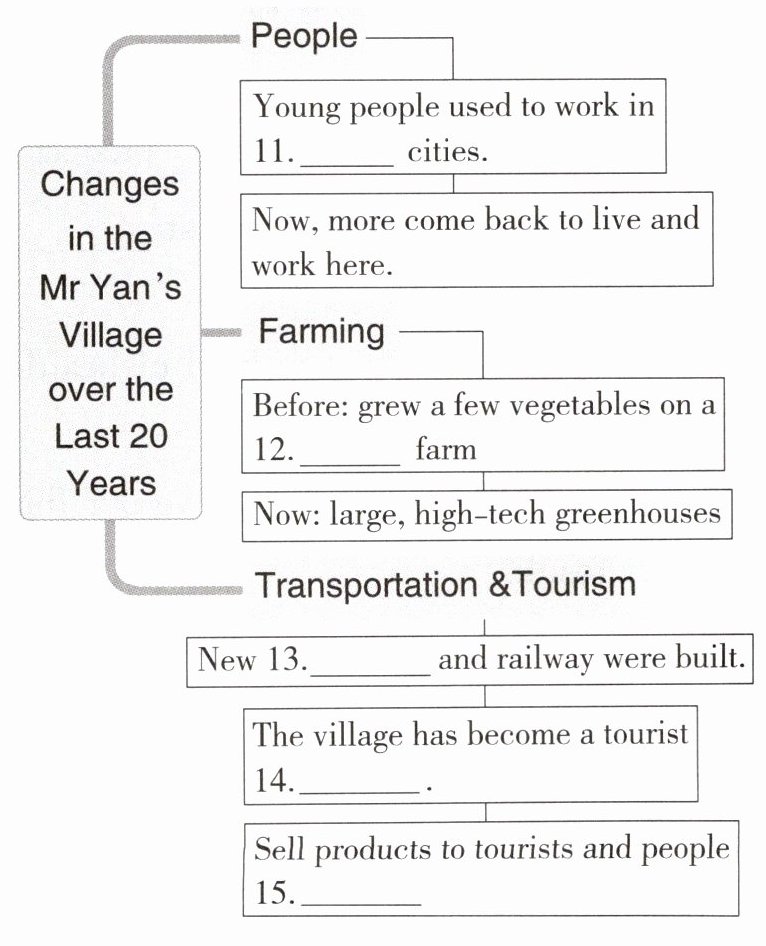
Now: large, high-tech greenhouses
Transportation &Tourism
New 13.
The village has become a tourist 14.
Sell products to tourists and people 15.
Changes in the Mr Yan’s Village over the Last 20 Years
People
Young people used to work in 11.
big
cities.Now, more come back to live and work here.
Farming
Before: grew a few vegetables on a 12.
small
farm Now: large, high-tech greenhouses
Transportation &Tourism
New 13.
highway
and railway were built.The village has become a tourist 14.
attraction
.Sell products to tourists and people 15.
online
答案
11. big
12. small
13. highway
14. attraction
15. online
12. small
13. highway
14. attraction
15. online
解析
【分析】本题为根据教材3a课文内容完成思维导图的填空题,需结合课文中严先生村庄20年来在人口、农业、交通与旅游业方面的变化细节,匹配每个空的语境填写对应词汇,核心是对课文细节的掌握。
【解析】11. 课文提到年轻人过去常在大城市工作,故填big;12. 之前在小农场种少量蔬菜,故填small;13. 交通方面新公路和铁路被修建,故填highway;14. 村庄发展后成为旅游景点,故填attraction;15. 产品卖给游客和网上的人,故填online。
【答案】11. big;12. small;13. highway;14. attraction;15. online
【知识点】英语课文理解;词汇运用;细节填空
【点评】本题通过思维导图梳理村庄变化,考查对教材课文细节的掌握,帮助学生巩固相关词汇,理解生活变化的主题。
【难度系数】0.3
【解析】11. 课文提到年轻人过去常在大城市工作,故填big;12. 之前在小农场种少量蔬菜,故填small;13. 交通方面新公路和铁路被修建,故填highway;14. 村庄发展后成为旅游景点,故填attraction;15. 产品卖给游客和网上的人,故填online。
【答案】11. big;12. small;13. highway;14. attraction;15. online
【知识点】英语课文理解;词汇运用;细节填空
【点评】本题通过思维导图梳理村庄变化,考查对教材课文细节的掌握,帮助学生巩固相关词汇,理解生活变化的主题。
【难度系数】0.3
Ⅳ.短文阅读
When I was very young, people in our village lived by planting fruit trees. My grandmother always took me to the orchard(果园)on the hill. At that time, they had to carry water from the river at the foot of the hill to halfway up the hill. Even though they worked so hard, the production of fruit was still low because there was a shortage of water there.
One day, two young men led a group of workers to our village. After learning about our difficulty, they started building a canal(灌溉渠)in our village. “Who are they?” I asked. “They are good men from our government,” my grandma replied.
Then, I moved to another city for my middle school. During one summer holiday, I came back to my hometown with my parents. When we arrived there, we were astonished because everything had changed. We saw the canal run through every orchard. And my grandma told us that after the canal project was finished, villagers didn't have to go up and down the hill to carry water anymore. And more and more people started planting fruit and the production increased(增长)a lot.
Thanks to the government's canal project, our village has developed greatly. Nowadays, people work hard and live in big cities. However, we should not forget our hometown—it's our roots.
(
A. By feeding animals.
B. By planting fruit trees.
C. By growing vegetables.
(
A. There wasn't enough water in the orchard.
B. They didn't have money to build the canal project.
C. They couldn't make people working in big cities come back.
(
A. Worried. B. Afraid.
C. Surprised.
(
① A canal project started in the village.
②The village has changed greatly because of the canal project.
③The writer moved to another city for his or her middle school.
④The villagers had to go up and down the hill to carry water.
A. ④③①② B. ④①③②
C. ③②①④
When I was very young, people in our village lived by planting fruit trees. My grandmother always took me to the orchard(果园)on the hill. At that time, they had to carry water from the river at the foot of the hill to halfway up the hill. Even though they worked so hard, the production of fruit was still low because there was a shortage of water there.
One day, two young men led a group of workers to our village. After learning about our difficulty, they started building a canal(灌溉渠)in our village. “Who are they?” I asked. “They are good men from our government,” my grandma replied.
Then, I moved to another city for my middle school. During one summer holiday, I came back to my hometown with my parents. When we arrived there, we were astonished because everything had changed. We saw the canal run through every orchard. And my grandma told us that after the canal project was finished, villagers didn't have to go up and down the hill to carry water anymore. And more and more people started planting fruit and the production increased(增长)a lot.
Thanks to the government's canal project, our village has developed greatly. Nowadays, people work hard and live in big cities. However, we should not forget our hometown—it's our roots.
(
B
)16. How did people make money in the village when the writer was young?A. By feeding animals.
B. By planting fruit trees.
C. By growing vegetables.
(
A
)17. What was the difficulty of the villagers?A. There wasn't enough water in the orchard.
B. They didn't have money to build the canal project.
C. They couldn't make people working in big cities come back.
(
C
)18. What does the underlined word "astonished" in Paragraph 3 probably mean?A. Worried. B. Afraid.
C. Surprised.
(
B
)19. What is the correct order of the following things?① A canal project started in the village.
②The village has changed greatly because of the canal project.
③The writer moved to another city for his or her middle school.
④The villagers had to go up and down the hill to carry water.
A. ④③①② B. ④①③②
C. ③②①④
答案
16. B
17. A
18. C
19. B
17. A
18. C
19. B
解析
【分析】
本题为英语阅读理解题,解题思路如下:1. 针对细节题(16、17题),需先提取题干关键词,再回原文定位对应语句,匹配选项;2. 针对词义猜测题(18题),需结合上下文语境推断单词含义;3. 针对事件排序题(19题),需梳理原文中各事件的时间先后顺序,再匹配选项。
【解析】
16题:根据题干关键词“when the writer was young”“make money”,定位原文第一段第一句“When I was very young, people in our village lived by planting fruit trees.”,可知村民靠种植果树谋生,对应选项B。
17题:根据题干关键词“difficulty of the villagers”,定位原文第一段最后“because there was a shortage of water there”,shortage意为“短缺”,即果园缺水,对应选项A。
18题:根据题干关键词“astonished”,结合第三段语境:作者返乡后看到村庄从需挑水变为有灌溉渠的巨大变化,由此推断“astonished”意为“惊讶的”,对应选项C。
19题:梳理原文事件顺序:④(小时候村民上下山挑水)→①(修建灌溉渠)→③(作者去另一城市上中学)→②(村庄因灌溉渠项目发生巨大变化),对应选项B。
【答案】
16.B 17.A 18.C 19.B
【知识点】
英语阅读理解、细节理解、词义猜测
【点评】
本题侧重考查学生对英语阅读原文信息的定位、词义推断及逻辑梳理能力,题型基础,难度适中,适合初中阶段学生巩固阅读技能。
【难度系数】
0.6
本题为英语阅读理解题,解题思路如下:1. 针对细节题(16、17题),需先提取题干关键词,再回原文定位对应语句,匹配选项;2. 针对词义猜测题(18题),需结合上下文语境推断单词含义;3. 针对事件排序题(19题),需梳理原文中各事件的时间先后顺序,再匹配选项。
【解析】
16题:根据题干关键词“when the writer was young”“make money”,定位原文第一段第一句“When I was very young, people in our village lived by planting fruit trees.”,可知村民靠种植果树谋生,对应选项B。
17题:根据题干关键词“difficulty of the villagers”,定位原文第一段最后“because there was a shortage of water there”,shortage意为“短缺”,即果园缺水,对应选项A。
18题:根据题干关键词“astonished”,结合第三段语境:作者返乡后看到村庄从需挑水变为有灌溉渠的巨大变化,由此推断“astonished”意为“惊讶的”,对应选项C。
19题:梳理原文事件顺序:④(小时候村民上下山挑水)→①(修建灌溉渠)→③(作者去另一城市上中学)→②(村庄因灌溉渠项目发生巨大变化),对应选项B。
【答案】
16.B 17.A 18.C 19.B
【知识点】
英语阅读理解、细节理解、词义猜测
【点评】
本题侧重考查学生对英语阅读原文信息的定位、词义推断及逻辑梳理能力,题型基础,难度适中,适合初中阶段学生巩固阅读技能。
【难度系数】
0.6
