

 登录
登录
Ⅰ. Join the sentences with the words in brackets.
1. They left early this morning. They wanted to catch the earliest train. (to)
2. Our team trained harder. We hoped to win the football match. (in order to)
3. She reads English aloud every morning. She needs to improve her speaking skills. (so as to)
1. They left early this morning. They wanted to catch the earliest train. (to)
They left early this morning to catch the earliest train. / To catch the earliest train, they left early this morning.
2. Our team trained harder. We hoped to win the football match. (in order to)
Our team trained harder in order to win the football match. / In order to win the football match, our team trained harder.
3. She reads English aloud every morning. She needs to improve her speaking skills. (so as to)
She reads English aloud every morning so as to improve her speaking skills.
答案
1. They left early this morning to catch the earliest train. / To catch the earliest train, they left early this morning.
2. Our team trained harder in order to win the football match. / In order to win the football match, our team trained harder.
3. She reads English aloud every morning so as to improve her speaking skills.
2. Our team trained harder in order to win the football match. / In order to win the football match, our team trained harder.
3. She reads English aloud every morning so as to improve her speaking skills.
解析
【分析】
首先明确题目要求:用括号内的词连接两个句子,括号中的to、in order to、so as to均用于引导目的状语,需将后一句转换为目的状语部分,结合句子结构调整位置(可置于句首或句末,不改变原意),确保语法正确。
【解析】
1. 括号内的to可引导目的状语,将“想要赶最早的火车”转换为目的状语,可置于句末或句首,故有两种正确表达:They left early this morning to catch the earliest train. 或 To catch the earliest train, they left early this morning.
2. in order to用于引导目的状语,将“希望赢得足球赛”转换为目的状语,可置于句末或句首,正确表达为:Our team trained harder in order to win the football match. 或 In order to win the football match, our team trained harder.
3. so as to用于引导目的状语,结合参考答案要求,此处将“需要提高口语技能”转换为目的状语置于句末,故表达为:She reads English aloud every morning so as to improve her speaking skills.
【答案】
1. They left early this morning to catch the earliest train. / To catch the earliest train, they left early this morning.
2. Our team trained harder in order to win the football match. / In order to win the football match, our team trained harder.
3. She reads English aloud every morning so as to improve her speaking skills.
【知识点】
动词不定式作目的状语;in order to的用法;so as to的用法
【点评】
本题考查目的状语的句型转换,要求学生掌握用不定式相关短语连接句子表目的的用法,属于基础英语句型题,难度适中。
【难度系数】
0.6
首先明确题目要求:用括号内的词连接两个句子,括号中的to、in order to、so as to均用于引导目的状语,需将后一句转换为目的状语部分,结合句子结构调整位置(可置于句首或句末,不改变原意),确保语法正确。
【解析】
1. 括号内的to可引导目的状语,将“想要赶最早的火车”转换为目的状语,可置于句末或句首,故有两种正确表达:They left early this morning to catch the earliest train. 或 To catch the earliest train, they left early this morning.
2. in order to用于引导目的状语,将“希望赢得足球赛”转换为目的状语,可置于句末或句首,正确表达为:Our team trained harder in order to win the football match. 或 In order to win the football match, our team trained harder.
3. so as to用于引导目的状语,结合参考答案要求,此处将“需要提高口语技能”转换为目的状语置于句末,故表达为:She reads English aloud every morning so as to improve her speaking skills.
【答案】
1. They left early this morning to catch the earliest train. / To catch the earliest train, they left early this morning.
2. Our team trained harder in order to win the football match. / In order to win the football match, our team trained harder.
3. She reads English aloud every morning so as to improve her speaking skills.
【知识点】
动词不定式作目的状语;in order to的用法;so as to的用法
【点评】
本题考查目的状语的句型转换,要求学生掌握用不定式相关短语连接句子表目的的用法,属于基础英语句型题,难度适中。
【难度系数】
0.6
Ⅱ. Complete the passage with the proper form of the words and expression in the box.
respect behind mess protect avoid station belt so as to
Rules are everywhere in our life, guiding us to do the right things.
• At a train 1.
Passengers should stand 2.
• On a coach
In order to 4.
• In parks and squares
We should 6.
We must obey the public rules 8.
respect behind mess protect avoid station belt so as to
Rules are everywhere in our life, guiding us to do the right things.
• At a train 1.
station
Passengers should stand 2.
behind
the yellow line while waiting for the train. 3. To avoid
possible accidents, this simple rule must be followed strictly.• On a coach
In order to 4.
protect
themselves if there are sudden stops or accidents, passengers should always fasten their seat 5. belts
.• In parks and squares
We should 6.
respect
the environment. Don’t step on the grass or pick flowers. Do not litter. Littering makes a 7. mess
and spreads diseases.We must obey the public rules 8.
so as to
keep our life safe and beautiful.答案
1. station 2. behind 3. To avoid 4. protect 5. belts 6. respect 7. mess 8. so as to
解析
【分析】
首先通读全文,明确各段落对应的场景(火车站、长途汽车、公园广场),结合句子逻辑和固定搭配,从方框内选词并注意词形变化(如名词复数、不定式形式)。每空需匹配语境:1. 火车站对应固定搭配train station;2. 等火车时站在黄线后用介词behind;3. 表目的避免事故用不定式To avoid;4. 长途汽车上保护自己用动词protect;5. 安全带需用复数形式belts;6. 尊重环境用动词respect;7. 固定搭配make a mess表“乱糟糟”;8. 表目的用短语so as to。
【解析】
1. 固定搭配train station意为“火车站”,故填station;
2. 结合常识,乘客等火车时需站在黄线后方,填介词behind;
3. 此处表目的,用不定式To avoid(避免),句首首字母大写;
4. 长途汽车上为保护自身安全,填动词protect;
5. 固定搭配seat belt意为“安全带”,此处指复数概念,填belts;
6. 结合语境,应尊重公共环境,填动词respect;
7. 固定搭配make a mess意为“制造混乱”,填mess;
8. 表目的“为了”,填短语so as to。
【答案】
1. station 2. behind 3. To avoid 4. protect 5. belts 6. respect 7. mess 8. so as to
【知识点】
词汇运用、固定搭配、目的状语
【点评】
本题为语境填词题,考查基础词汇的运用及常用固定搭配,需结合场景逻辑判断词义,难度适中,适合初中英语基础巩固练习。
【难度系数】
0.5
首先通读全文,明确各段落对应的场景(火车站、长途汽车、公园广场),结合句子逻辑和固定搭配,从方框内选词并注意词形变化(如名词复数、不定式形式)。每空需匹配语境:1. 火车站对应固定搭配train station;2. 等火车时站在黄线后用介词behind;3. 表目的避免事故用不定式To avoid;4. 长途汽车上保护自己用动词protect;5. 安全带需用复数形式belts;6. 尊重环境用动词respect;7. 固定搭配make a mess表“乱糟糟”;8. 表目的用短语so as to。
【解析】
1. 固定搭配train station意为“火车站”,故填station;
2. 结合常识,乘客等火车时需站在黄线后方,填介词behind;
3. 此处表目的,用不定式To avoid(避免),句首首字母大写;
4. 长途汽车上为保护自身安全,填动词protect;
5. 固定搭配seat belt意为“安全带”,此处指复数概念,填belts;
6. 结合语境,应尊重公共环境,填动词respect;
7. 固定搭配make a mess意为“制造混乱”,填mess;
8. 表目的“为了”,填短语so as to。
【答案】
1. station 2. behind 3. To avoid 4. protect 5. belts 6. respect 7. mess 8. so as to
【知识点】
词汇运用、固定搭配、目的状语
【点评】
本题为语境填词题,考查基础词汇的运用及常用固定搭配,需结合场景逻辑判断词义,难度适中,适合初中英语基础巩固练习。
【难度系数】
0.5
Ⅲ. Answer the questions according to Exercise Ⅱ.
1. What should we do while waiting for the train? Why?
2. What should passengers always do on a coach? Why?
3. What else should we do to keep our life safe and beautiful? (No more than 20 words)
Ⅳ. Read and complete the tasks.
Welcome to four short, funny stories about breaking the rules! Each one tells a different tale of what happens when someone (or something) breaks the rules.
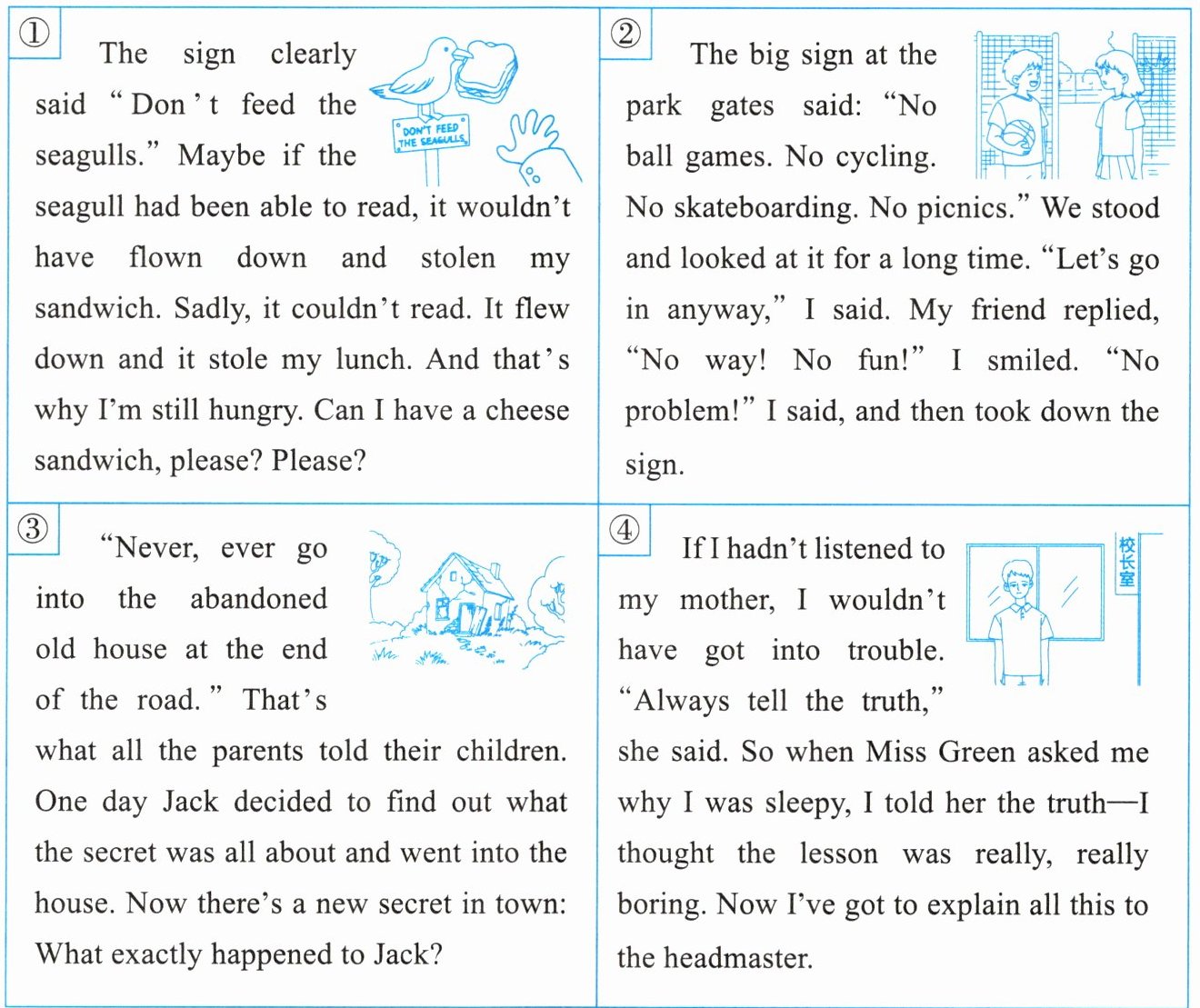
A. Match the stories (①-④) to the titles. There is one title you won’t need.
a. Where can we play?
b. A long wait
c. A question with no answer
d. Birds don’t read
e. Trouble at school
B. Answer the questions.
Some people are talking about these stories. Do you agree with their ideas? Please choose one and give your reason.
A. “Sometimes it’s a good idea not to tell the truth.”
B. “I would never go into a place like that.”
C. “We need to find a way to keep birds away from people.”
D. “It’s crazy for public places to have so many rules.”
1. What should we do while waiting for the train? Why?
2. What should passengers always do on a coach? Why?
3. What else should we do to keep our life safe and beautiful? (No more than 20 words)
Ⅳ. Read and complete the tasks.
Welcome to four short, funny stories about breaking the rules! Each one tells a different tale of what happens when someone (or something) breaks the rules.
A. Match the stories (①-④) to the titles. There is one title you won’t need.
a. Where can we play?
b. A long wait
c. A question with no answer
d. Birds don’t read
e. Trouble at school
B. Answer the questions.
Some people are talking about these stories. Do you agree with their ideas? Please choose one and give your reason.
A. “Sometimes it’s a good idea not to tell the truth.”
B. “I would never go into a place like that.”
C. “We need to find a way to keep birds away from people.”
D. “It’s crazy for public places to have so many rules.”
答案
1. We should stand behind the yellow line while waiting for the train. To avoid possible accidents.
2. They should always fasten their seat belts. In order to protect themselves if there are sudden stops or accidents.
3. One possible version: We should stop at red lights.
Ⅳ. A. a—②, b多余, c—③, d—①, e—④
B. One possible version: I partly agree with A. Being honest is important, but we should speak politely. We shouldn’t say something rude even if it is true.
2. They should always fasten their seat belts. In order to protect themselves if there are sudden stops or accidents.
3. One possible version: We should stop at red lights.
Ⅳ. A. a—②, b多余, c—③, d—①, e—④
B. One possible version: I partly agree with A. Being honest is important, but we should speak politely. We shouldn’t say something rude even if it is true.
解析
【分析】
首先,Ⅲ部分需结合四个故事的核心内容,回答关于遵守规则的问题;Ⅳ部分A需抓住每个故事的关键信息匹配对应标题,如故事②是公园活动规则对应“Where can we play”,故事③结尾是无答案的问题对应“A question with no answer”,故事①核心是海鸥不识字对应“Birds don’t read”,故事④是学校相关的麻烦对应“Trouble at school”,b无对应故事;Ⅳ部分B需选择一个观点,结合故事内容给出合理的英语理由。
【解析】
Ⅲ.
1. 根据安全规则常识,等火车时站黄线后可避免事故,符合问题要求。
2. 长途汽车上系安全带能在突发情况时保护自身安全,是乘客需遵守的规则。
3. 结合生活安全规则,如红灯停,符合字数限制。
Ⅳ. A. 匹配时,故事②是公园的活动规则,对应a;故事③结尾是无答案的问题,对应c;故事①核心是海鸥不识字,对应d;故事④是学校的麻烦,对应e;b无对应故事,故匹配结果为a—②,c—③,d—①,e—④。
B. 选观点A,理由:诚实很重要,但表达需注意方式,不能说粗鲁的话,即使是事实也应委婉表达,符合要求。
【答案】
1. We should stand behind the yellow line while waiting for the train. To avoid possible accidents.
2. They should always fasten their seat belts. In order to protect themselves if there are sudden stops or accidents.
3. One possible version: We should stop at red lights.
Ⅳ. A. a—②, c—③, d—①, e—④
B. One possible version: I partly agree with A. Being honest is important, but we should speak politely. We shouldn’t say something rude even if it is true.
【知识点】
阅读理解、英语问答、规则类英语表达
【点评】
本题围绕规则主题,通过四个小故事考查学生的阅读理解、信息匹配及语言表达能力,题目设置基础且灵活,能有效检验学生对文本的理解与应用能力。
【难度系数】
0.6
首先,Ⅲ部分需结合四个故事的核心内容,回答关于遵守规则的问题;Ⅳ部分A需抓住每个故事的关键信息匹配对应标题,如故事②是公园活动规则对应“Where can we play”,故事③结尾是无答案的问题对应“A question with no answer”,故事①核心是海鸥不识字对应“Birds don’t read”,故事④是学校相关的麻烦对应“Trouble at school”,b无对应故事;Ⅳ部分B需选择一个观点,结合故事内容给出合理的英语理由。
【解析】
Ⅲ.
1. 根据安全规则常识,等火车时站黄线后可避免事故,符合问题要求。
2. 长途汽车上系安全带能在突发情况时保护自身安全,是乘客需遵守的规则。
3. 结合生活安全规则,如红灯停,符合字数限制。
Ⅳ. A. 匹配时,故事②是公园的活动规则,对应a;故事③结尾是无答案的问题,对应c;故事①核心是海鸥不识字,对应d;故事④是学校的麻烦,对应e;b无对应故事,故匹配结果为a—②,c—③,d—①,e—④。
B. 选观点A,理由:诚实很重要,但表达需注意方式,不能说粗鲁的话,即使是事实也应委婉表达,符合要求。
【答案】
1. We should stand behind the yellow line while waiting for the train. To avoid possible accidents.
2. They should always fasten their seat belts. In order to protect themselves if there are sudden stops or accidents.
3. One possible version: We should stop at red lights.
Ⅳ. A. a—②, c—③, d—①, e—④
B. One possible version: I partly agree with A. Being honest is important, but we should speak politely. We shouldn’t say something rude even if it is true.
【知识点】
阅读理解、英语问答、规则类英语表达
【点评】
本题围绕规则主题,通过四个小故事考查学生的阅读理解、信息匹配及语言表达能力,题目设置基础且灵活,能有效检验学生对文本的理解与应用能力。
【难度系数】
0.6
