

 登录
登录
9. 在$△ ABC$中,已知$AB=10,AC=17$,边$BC$上的高$AD=8$,求$BC$的长.
答案
9. 如图(1),当高在三角形内部时,
在 $\mathrm{Rt}△ABD$ 中,由勾股定理,得 $BD^2=AB^2-AD^2=10^2-8^2=36$,所以 $BD=6.$
在 $\mathrm{Rt}△ACD$ 中,由勾股定理,得 $CD^2=AC^2-AD^2=17^2-8^2=225$,所以 $CD=15.$
所以 $BC=BD+CD=6+15=21$;
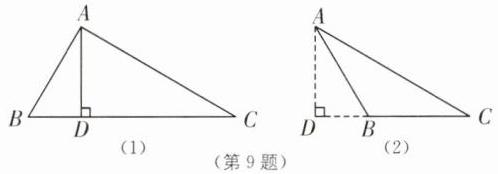
如图(2),当高在三角形外部时,
在 $\mathrm{Rt}△ABD$ 中,由勾股定理,得 $BD^2=AB^2-AD^2=10^2-8^2=36$,所以 $BD=6.$
在 $\mathrm{Rt}△ACD$ 中,由勾股定理,得 $CD^2=AC^2-AD^2=17^2-8^2=225$,所以 $CD=15.$
所以 $BC=CD-BD=15-6=9.$
故 $BC$ 的长为 21 或 9.
10. 如图,已知 $AC$ 平分 $∠ BAD,CE ⊥ AB$ 于点 $E,CF ⊥ AD$ 于点 $F$,且 $BC=CD$.
(1)求证:$△ BCE ≌ △ DCF$;
(2)若 $AB=21,AD=9,BC=CD=10$,求 $AC$ 的长.
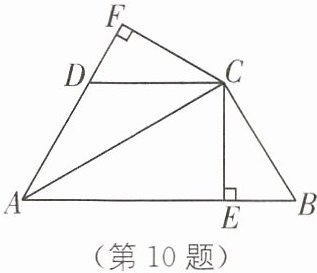
(1)求证:$△ BCE ≌ △ DCF$;
(2)若 $AB=21,AD=9,BC=CD=10$,求 $AC$ 的长.
答案
10. (1)$\because AC$ 平分$∠BAD$,$CE⊥AB$ 于点 $E$,$CF⊥AD$ 于点 $F$,
$\therefore ∠CEB=∠CFD=90^{\circ },CE=CF.$
又 $BC=DC$,$\therefore \mathrm{Rt}△BCE≌\mathrm{Rt}△DCF(\mathrm{HL}).$
(2)由(1),得 $\mathrm{Rt}△BCE≌\mathrm{Rt}△DCF$,
$\therefore DF=BE$. 设 $DF=BE=x.$
$\because ∠CFA=∠CEA=90^{\circ },CF=CE,AC=AC,$
$\therefore \mathrm{Rt}△AFC≌\mathrm{Rt}△AEC(\mathrm{HL}),$
$\therefore AF=AE$,即 $AD+DF=AB-BE.$
$\because AB=21,AD=9,DF=BE=x,$
$\therefore 9+x=21-x$,解得 $x=6.$
在 $\mathrm{Rt}△DCF$ 中,$\because DF=6,CD=10,$
$\therefore CF=8.$
在 $\mathrm{Rt}△AFC$ 中,$AC^2=CF^2+AF^2=8^2+(9+6)^2=289,$
$\therefore AC=17$. 故 $AC$ 的长为 17.
$\therefore ∠CEB=∠CFD=90^{\circ },CE=CF.$
又 $BC=DC$,$\therefore \mathrm{Rt}△BCE≌\mathrm{Rt}△DCF(\mathrm{HL}).$
(2)由(1),得 $\mathrm{Rt}△BCE≌\mathrm{Rt}△DCF$,
$\therefore DF=BE$. 设 $DF=BE=x.$
$\because ∠CFA=∠CEA=90^{\circ },CF=CE,AC=AC,$
$\therefore \mathrm{Rt}△AFC≌\mathrm{Rt}△AEC(\mathrm{HL}),$
$\therefore AF=AE$,即 $AD+DF=AB-BE.$
$\because AB=21,AD=9,DF=BE=x,$
$\therefore 9+x=21-x$,解得 $x=6.$
在 $\mathrm{Rt}△DCF$ 中,$\because DF=6,CD=10,$
$\therefore CF=8.$
在 $\mathrm{Rt}△AFC$ 中,$AC^2=CF^2+AF^2=8^2+(9+6)^2=289,$
$\therefore AC=17$. 故 $AC$ 的长为 17.
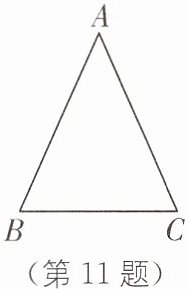
11. 中考新考法 探究不同条件下线段的数量关系 如图,在$△ ABC$中,$AB=AC.$
(1)若$ P $为$ BC $的中点,求证:$AB^{2}-AP^{2}=PB· PC;$
(2)若$ P $为$ BC $上的任意一点,判断(1)中的结论是否成立,请证明;
(3)若$ P $为$ BC $延长线上一点,探究$ AB,AP,$$PB,PC $之间的数量关系.
精题详解
(1)若$ P $为$ BC $的中点,求证:$AB^{2}-AP^{2}=PB· PC;$
(2)若$ P $为$ BC $上的任意一点,判断(1)中的结论是否成立,请证明;
(3)若$ P $为$ BC $延长线上一点,探究$ AB,AP,$$PB,PC $之间的数量关系.
精题详解
答案
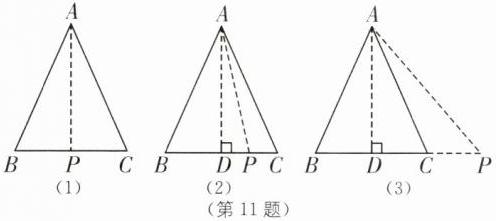
11. (1)如图(1),连接 $AP$. $\because AB=AC$,$P$ 是 $BC$ 的中点,
$\therefore AP⊥BC,PB=PC.$
在 $\mathrm{Rt}△ABP$ 中,$AB^2=BP^2+AP^2$,
$\therefore AB^2-AP^2=BP^2.$
又 $PB=PC$,$\therefore PB·PC=BP^2$,
$\therefore AB^2-AP^2=PB·PC.$
(2)结论成立.证明如下:
如图(2),连接 $AP$,过点 $A$ 作 $AD⊥BC$ 交 $BC$ 于点 $D$.
$\because AB=AC,AD⊥BC,\therefore BD=CD.$
在 $\mathrm{Rt}△ABD$ 中,$AB^2=AD^2+BD^2$,
同理 $AP^2=AD^2+DP^2$,$\therefore AB^2-AP^2=AD^2+BD^2-(AD^2+DP^2)=BD^2-DP^2$. 又 $PB=BD+DP,PC=CD-DP=BD-DP$,$\therefore PB·PC=(BD+DP)(BD-DP)=BD^2-DP^2$,$\therefore AB^2-AP^2=PB·PC.$
(3)$AP^2-AB^2=PB·PC$. 理由如下:
如图(3),连接 $AP$,过点 $A$ 作 $AD⊥BC$ 交 $BC$ 于点 $D$.
$\because AB=AC,AD⊥BC,\therefore BD=CD.$
在 $\mathrm{Rt}△ABD$ 中,$AB^2=AD^2+BD^2$,
在 $\mathrm{Rt}△ADP$ 中,$AP^2=AD^2+DP^2$,
$\therefore AP^2-AB^2=(AD^2+DP^2)-(AD^2+BD^2)=DP^2-BD^2.$
又 $PB=DP+BD,PC=DP-CD=DP-BD$,
$\therefore PB·PC=(DP+BD)(DP-BD)=DP^2-BD^2$,
$\therefore AP^2-AB^2=PB·PC.$
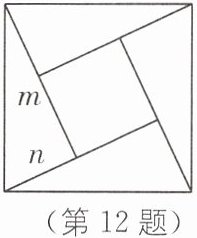
12. 传统文化 赵爽弦图 (2024·南通中考)“赵爽弦图”巧妙利用面积关系证明了勾股定理. 如图所示的“赵爽弦图”是由四个全等直角三角形和中间的小正方形拼成的一个大正方形. 设直角三角形的两条直角边长分别为 $m,n$ $(m>n)$. 若小正方形面积为 $5$,$(m+n)^2=21$,则大正方形面积为(
A.12
B.13
C.14
D.15
B
).A.12
B.13
C.14
D.15
答案
12. B [解析]由题意可知,中间小正方形的边长为 $m-n$,
$\therefore (m-n)^2=5$,即 $m^2+n^2-2mn=5$. ①
$\because (m+n)^2=21,\therefore m^2+n^2+2mn=21$,②
由①+②,得 $2(m^2+n^2)=26$,
$\therefore$ 大正方形的面积为 $m^2+n^2=13$. 故选 B.
$\therefore (m-n)^2=5$,即 $m^2+n^2-2mn=5$. ①
$\because (m+n)^2=21,\therefore m^2+n^2+2mn=21$,②
由①+②,得 $2(m^2+n^2)=26$,
$\therefore$ 大正方形的面积为 $m^2+n^2=13$. 故选 B.
