

 登录
登录
D 核心素养 中华优秀传统文化
[2026 菏泽期末]“Little children, little children, don't be greedy(馋). Soon after Laba is the new year.” The Laba Festival is known to our Chinese people. It marks a special day. 16.
17.
On the night before the festival, mothers are busy preparing their porridge. 18.
Another custom at the Laba Festival is to prepare Laba garlic(蒜) for dumplings on Chinese New Year's Eve. People peel garlic and put it into a jar filled with vinegar. 19.
The Laba Festival is a time for our Chinese to hope for the harvest and good luck in the coming year. 20.
A. People eat Laba porridge on that day.
B. I think it's delicious to have Laba porridge.
C. It falls on the 8th day of the 12th lunar month.
D. They cook it over a slow fire from midnight until the next morning.
E. As the days go by, the garlic turns green and gets a special flavor(味道).
F. After the Laba Festival, Chinese people start to prepare for the traditional Spring Festival.
[2026 菏泽期末]“Little children, little children, don't be greedy(馋). Soon after Laba is the new year.” The Laba Festival is known to our Chinese people. It marks a special day. 16.
C
17.
A
The porridge is also called “eight-treasure porridge”, because it usually has at least eight things.On the night before the festival, mothers are busy preparing their porridge. 18.
D
Another custom at the Laba Festival is to prepare Laba garlic(蒜) for dumplings on Chinese New Year's Eve. People peel garlic and put it into a jar filled with vinegar. 19.
E
Some people also like to pickle(腌渍) meat at the Laba Festival.The Laba Festival is a time for our Chinese to hope for the harvest and good luck in the coming year. 20.
F
A. People eat Laba porridge on that day.
B. I think it's delicious to have Laba porridge.
C. It falls on the 8th day of the 12th lunar month.
D. They cook it over a slow fire from midnight until the next morning.
E. As the days go by, the garlic turns green and gets a special flavor(味道).
F. After the Laba Festival, Chinese people start to prepare for the traditional Spring Festival.
答案
16. C 前句介绍“它标志着一个特殊的日子”,后句需补充节日的具体时间信息,选项 C“It falls on the 8th day of the 12th lunar month.”直接点明腊八节的日期,与 special day 呼应,逻辑连贯。
17. A 后句的核心话题是“腊八粥”,选项 A“People eat Laba porridge on that day.”引出节日核心习俗,自然过渡到对腊八粥的介绍,符合上下文逻辑。
18. D 前句提到“从节日的前一天晚上开始准备粥”,选项 D“They cook it over a slow fire from midnight until the next morning.”承接“准备粥”的动作,解释了熬粥的过程。
19. E 前句介绍了“泡腊八蒜”的习俗,选项 E“As the days go by, the garlic turns green and gets a special flavor.”描述了蒜泡制后的变化,是对这一习俗的补充说明,逻辑通顺。
20. F 前句总结腊八节的文化寓意,选项 F“After the Laba Festival, Chinese people start to prepare for the traditional Spring Festival.”承接节日时间线,呼应开头童谣“过了腊八就是年”,完美收尾全文。
17. A 后句的核心话题是“腊八粥”,选项 A“People eat Laba porridge on that day.”引出节日核心习俗,自然过渡到对腊八粥的介绍,符合上下文逻辑。
18. D 前句提到“从节日的前一天晚上开始准备粥”,选项 D“They cook it over a slow fire from midnight until the next morning.”承接“准备粥”的动作,解释了熬粥的过程。
19. E 前句介绍了“泡腊八蒜”的习俗,选项 E“As the days go by, the garlic turns green and gets a special flavor.”描述了蒜泡制后的变化,是对这一习俗的补充说明,逻辑通顺。
20. F 前句总结腊八节的文化寓意,选项 F“After the Laba Festival, Chinese people start to prepare for the traditional Spring Festival.”承接节日时间线,呼应开头童谣“过了腊八就是年”,完美收尾全文。
解析
【分析】
首先通读全文,明确文章围绕中国传统节日腊八节的习俗展开,需结合上下文的关键词、逻辑关系(如时间顺序、话题衔接)来选择合适的句子补全文章。16空前提到腊八节标志特殊日子,需补充节日具体日期;17空后核心话题是腊八粥,需引出吃腊八粥的习俗;18空前说准备粥,需承接熬粥的过程;19空前讲泡腊八蒜,需说明蒜泡制后的变化;20空前总结腊八节寓意,需承接节日后的活动,呼应开头“过了腊八就是年”的童谣。
【解析】
16. 前文提到“它标志着一个特殊的日子”,选项C点明腊八节的具体日期“农历十二月初八”,补充了特殊日子的具体信息,逻辑连贯,故选C。
17. 后文核心话题是“腊八粥”,选项A“人们在那天吃腊八粥”引出节日核心习俗,自然过渡到对腊八粥的介绍,符合上下文逻辑,故选A。
18. 前文提到“节日前一天晚上开始准备粥”,选项D“他们从午夜到第二天早上用小火熬粥”承接“准备粥”的动作,解释了熬粥的具体过程,故选D。
19. 前文介绍“泡腊八蒜”的习俗,选项E“随着时间推移,蒜变绿并获得特殊味道”描述了蒜泡制后的变化,是对这一习俗的补充说明,逻辑通顺,故选E。
20. 前文总结腊八节的文化寓意,选项F“腊八节后,中国人开始为传统春节做准备”承接节日时间线,呼应开头童谣“过了腊八就是年”,完美收尾全文,故选F。
【答案】
16.C 17.A 18.D 19.E 20.F
【知识点】
阅读理解(七选五)、中华传统文化
【点评】
本题结合中国传统节日腊八节的文化背景,考查学生的语篇逻辑衔接能力,要求学生能通过上下文的关键词、话题关联和时间顺序等线索选择合适的句子,既考查语言运用能力,又渗透了传统文化教育。
【难度系数】
0.6
首先通读全文,明确文章围绕中国传统节日腊八节的习俗展开,需结合上下文的关键词、逻辑关系(如时间顺序、话题衔接)来选择合适的句子补全文章。16空前提到腊八节标志特殊日子,需补充节日具体日期;17空后核心话题是腊八粥,需引出吃腊八粥的习俗;18空前说准备粥,需承接熬粥的过程;19空前讲泡腊八蒜,需说明蒜泡制后的变化;20空前总结腊八节寓意,需承接节日后的活动,呼应开头“过了腊八就是年”的童谣。
【解析】
16. 前文提到“它标志着一个特殊的日子”,选项C点明腊八节的具体日期“农历十二月初八”,补充了特殊日子的具体信息,逻辑连贯,故选C。
17. 后文核心话题是“腊八粥”,选项A“人们在那天吃腊八粥”引出节日核心习俗,自然过渡到对腊八粥的介绍,符合上下文逻辑,故选A。
18. 前文提到“节日前一天晚上开始准备粥”,选项D“他们从午夜到第二天早上用小火熬粥”承接“准备粥”的动作,解释了熬粥的具体过程,故选D。
19. 前文介绍“泡腊八蒜”的习俗,选项E“随着时间推移,蒜变绿并获得特殊味道”描述了蒜泡制后的变化,是对这一习俗的补充说明,逻辑通顺,故选E。
20. 前文总结腊八节的文化寓意,选项F“腊八节后,中国人开始为传统春节做准备”承接节日时间线,呼应开头童谣“过了腊八就是年”,完美收尾全文,故选F。
【答案】
16.C 17.A 18.D 19.E 20.F
【知识点】
阅读理解(七选五)、中华传统文化
【点评】
本题结合中国传统节日腊八节的文化背景,考查学生的语篇逻辑衔接能力,要求学生能通过上下文的关键词、话题关联和时间顺序等线索选择合适的句子,既考查语言运用能力,又渗透了传统文化教育。
【难度系数】
0.6
三、补全对话(有两项多余)。(每小题1.5分,共7.5分)
A: Hey, Mona! What's this?
B: Oh, it's my new computer. 1.
A: Well, the computer is really a great invention.
B: Yes, it is. It has changed our life a lot.
A: 2.
B: Yes. It was invented in 1946 in America.
3.
A: Yes, it was as big as a house. By the way, what do you usually do on your computer?
B: 4.
A: Great. What are you going to be when you grow up?
B: 5.
A: Great!
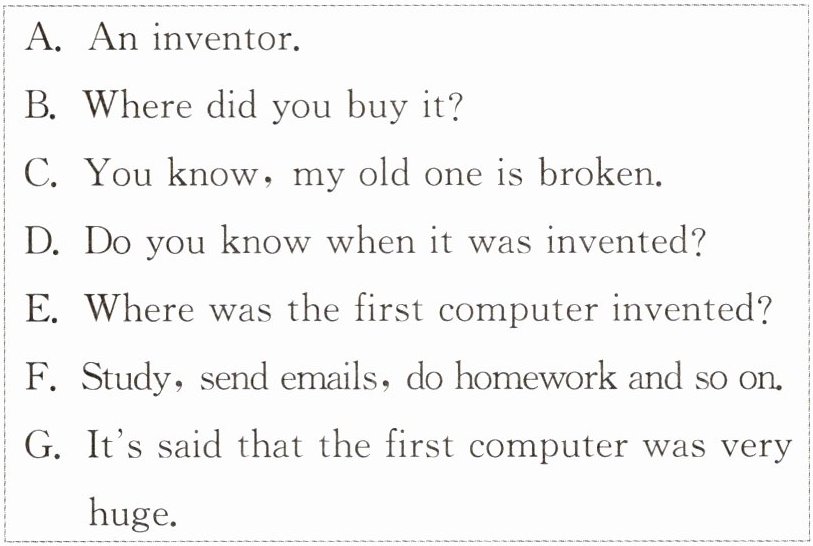
A. An inventor.
B. Where did you buy it?
C. You know, my old one is broken.
D. Do you know when it was invented?
E. Where was the first computer invented?
F. Study, send emails, do homework and so on.
G. It's said that the first computer was very huge.
A: Hey, Mona! What's this?
B: Oh, it's my new computer. 1.
C
A: Well, the computer is really a great invention.
B: Yes, it is. It has changed our life a lot.
A: 2.
D
B: Yes. It was invented in 1946 in America.
3.
G
A: Yes, it was as big as a house. By the way, what do you usually do on your computer?
B: 4.
F
A: Great. What are you going to be when you grow up?
B: 5.
A
A: Great!
A. An inventor.
B. Where did you buy it?
C. You know, my old one is broken.
D. Do you know when it was invented?
E. Where was the first computer invented?
F. Study, send emails, do homework and so on.
G. It's said that the first computer was very huge.
答案
1~5. CDGFA
解析
【分析】本题为补全对话题型,需结合上下文语境与问答逻辑匹配选项:第1空前提到“新电脑”,需说明换电脑的原因,对应选项C;第2空后回答电脑的发明时间,对应询问发明时间的选项D;第3空后提到电脑“像房子一样大”,对应描述第一台电脑巨大的选项G;第4空前问用电脑做什么,对应说明用途的选项F;第5空前问长大后的职业,对应职业选项A,因此依次选C、D、G、F、A,即CDGFA。
【解析】1. 空格前B说明是新电脑,选项C“你知道,我的旧的坏了”合理解释购买新电脑的原因,故1选C;2. 空格后回答发明时间,选项D“Do you know when it was invented?”符合问答逻辑,故2选D;3. 空格后提到电脑“像房子一样大”,选项G“It's said that the first computer was very huge.”与之呼应,故3选G;4. 空格前询问用电脑做什么,选项F“Study, send emails, do homework and so on.”是具体用途,故4选F;5. 空格前问长大后想做什么,选项A“An inventor.”是职业,故5选A,因此答案为CDGFA。
【答案】CDGFA
【知识点】补全对话、情景交际
【点评】本题考查日常情景对话的补全,需结合上下文语境匹配选项,是初中英语常见题型,难度适中。
【难度系数】0.5
【解析】1. 空格前B说明是新电脑,选项C“你知道,我的旧的坏了”合理解释购买新电脑的原因,故1选C;2. 空格后回答发明时间,选项D“Do you know when it was invented?”符合问答逻辑,故2选D;3. 空格后提到电脑“像房子一样大”,选项G“It's said that the first computer was very huge.”与之呼应,故3选G;4. 空格前询问用电脑做什么,选项F“Study, send emails, do homework and so on.”是具体用途,故4选F;5. 空格前问长大后想做什么,选项A“An inventor.”是职业,故5选A,因此答案为CDGFA。
【答案】CDGFA
【知识点】补全对话、情景交际
【点评】本题考查日常情景对话的补全,需结合上下文语境匹配选项,是初中英语常见题型,难度适中。
【难度系数】0.5
四、时事聚焦 语法填空。(每小题1分,共10分)
In early 2026, a short video made the 2017 documentary Return to the Wolves become popular again online. In the video, a wolf called Green 1.
The real story happened in 2010. Li was a 3.
Now the number of 8.
In early 2026, a short video made the 2017 documentary Return to the Wolves become popular again online. In the video, a wolf called Green 1.
helped
(help) his keeper Li Weiyi out of a frozen lake. It quickly spread online and got millions 2. of
likes.The real story happened in 2010. Li was a 3.
painter
(paint) and when she was painting on the grassland, she found a weak baby wolf. The little wolf's parents died 4. because
of illegal hunting. Li decided 5. to look
(look) after him. She named the cub "Green" and raised him, but soon she realized that wild creatures belong to the wilderness rather than 6. cities
(city). As a result, she teamed up with director Yi Feng to take Green back to the grassland for wildness training. After months of tough work, Green became the first human-bred wolf 7. successfully
(success) accepted by a wild wolf pack worldwide.Now the number of 8.
wolves
(wolf) is becoming smaller. Wolves are protected animals in our country, but we still need to do 9. more
(much) to protect them. It is said that 10. the
wolf king Green has passed away, but so far there has been no exact news.答案
1. helped 2. of 3. painter 4. because 5. to look 6. cities 7. successfully 8. wolves 9. more 10. the
解析
【分析】
本题为语法填空,需结合句子时态、固定搭配、词性转换、名词用法、冠词等知识点逐一分析:
1. 第1空描述视频中过去发生的动作,需用一般过去时;
2. 第2空考查固定搭配;
3. 第3空需转换词性表示职业;
4. 第4空表原因需用连词;
5. 第5空考查固定搭配;
6. 第6空泛指城市需用名词复数;
7. 第7空修饰动词需用副词;
8. 第8空the number of后接名词复数;
9. 第9空需用形容词比较级;
10. 第10空特指某只狼需用定冠词。
【解析】
1. 考查一般过去时:句中描述视频里过去发生的动作,help的过去式为helped,故填helped;
2. 考查固定搭配:millions of是固定短语,意为“数百万的”,故填of;
3. 考查词性转换:此处指人的职业,paint(绘画)对应的名词是painter(画家),故填painter;
4. 考查连词:此处表原因,说明狼父母死亡的原因是非法狩猎,用because引导原因状语从句,故填because;
5. 考查固定搭配:decide to do sth是固定用法,意为“决定做某事”,故填to look;
6. 考查名词单复数:此处泛指各类城市,city的复数形式为cities,故填cities;
7. 考查副词用法:此处修饰动词accepted,需用副词,success的副词形式是successfully,故填successfully;
8. 考查名词单复数:the number of后接可数名词复数,wolf的复数是wolves,故填wolves;
9. 考查形容词比较级:此处表示“需要做更多保护工作”,用much的比较级more,故填more;
10. 考查冠词:此处特指那只叫Green的狼王,用定冠词the,故填the。
【答案】
1. helped 2. of 3. painter 4. because 5. to look 6. cities 7. successfully 8. wolves 9. more 10. the
【知识点】
一般过去时、固定搭配、词性转换
【点评】
本题结合时事热点考查语法填空,涵盖基础语法规则和常用词汇运用,题型常规,侧重考查学生对核心语法点的掌握与灵活运用能力。
【难度系数】
0.6
本题为语法填空,需结合句子时态、固定搭配、词性转换、名词用法、冠词等知识点逐一分析:
1. 第1空描述视频中过去发生的动作,需用一般过去时;
2. 第2空考查固定搭配;
3. 第3空需转换词性表示职业;
4. 第4空表原因需用连词;
5. 第5空考查固定搭配;
6. 第6空泛指城市需用名词复数;
7. 第7空修饰动词需用副词;
8. 第8空the number of后接名词复数;
9. 第9空需用形容词比较级;
10. 第10空特指某只狼需用定冠词。
【解析】
1. 考查一般过去时:句中描述视频里过去发生的动作,help的过去式为helped,故填helped;
2. 考查固定搭配:millions of是固定短语,意为“数百万的”,故填of;
3. 考查词性转换:此处指人的职业,paint(绘画)对应的名词是painter(画家),故填painter;
4. 考查连词:此处表原因,说明狼父母死亡的原因是非法狩猎,用because引导原因状语从句,故填because;
5. 考查固定搭配:decide to do sth是固定用法,意为“决定做某事”,故填to look;
6. 考查名词单复数:此处泛指各类城市,city的复数形式为cities,故填cities;
7. 考查副词用法:此处修饰动词accepted,需用副词,success的副词形式是successfully,故填successfully;
8. 考查名词单复数:the number of后接可数名词复数,wolf的复数是wolves,故填wolves;
9. 考查形容词比较级:此处表示“需要做更多保护工作”,用much的比较级more,故填more;
10. 考查冠词:此处特指那只叫Green的狼王,用定冠词the,故填the。
【答案】
1. helped 2. of 3. painter 4. because 5. to look 6. cities 7. successfully 8. wolves 9. more 10. the
【知识点】
一般过去时、固定搭配、词性转换
【点评】
本题结合时事热点考查语法填空,涵盖基础语法规则和常用词汇运用,题型常规,侧重考查学生对核心语法点的掌握与灵活运用能力。
【难度系数】
0.6
