

 登录
登录
24(12分)(1)如图1,在$△ ABC$中,E是AB上一点,过点E作BC的平行线交AC于点F,点D是BC上任意一点,连接AD交EF于点G,求证:$\frac{EG}{GF}=\frac{BD}{DC}$;
(2)如图2,在(1)的条件下,连接BF、DF,若$∠ C=30°$,FE、FB恰好将$∠ AFD$三等分,求$\frac{EG}{FG}$的值;
(3)如图3,在等边三角形ABC中,$BD=4DC$,连接AD,点E在AD上,若$∠ BEC=120°$,求$\frac{BE}{BC}$的值.

(2)如图2,在(1)的条件下,连接BF、DF,若$∠ C=30°$,FE、FB恰好将$∠ AFD$三等分,求$\frac{EG}{FG}$的值;
(3)如图3,在等边三角形ABC中,$BD=4DC$,连接AD,点E在AD上,若$∠ BEC=120°$,求$\frac{BE}{BC}$的值.
答案
24.(1)证明:$ \because EG // BD $,
$ \therefore △ AEG ∽ △ ABD, \therefore \frac{EG}{BD}=\frac{AG}{AD} $,
同理得 $ \frac{GF}{DC}=\frac{AG}{AD}, \therefore \frac{EG}{BD}=\frac{GF}{DC}, \therefore \frac{EG}{GF}=\frac{BD}{DC} $.
(2)解:$ \because EF // BC $,
$ \therefore ∠ AFE=∠ C=30°,∠ EFB=∠ FBD $.
$ \because EF $、$ BF $ 恰好将 $ ∠ AFD $ 三等分,
$ \therefore ∠ AFE=∠ EFB=∠ BFD=30° $,
$ \therefore ∠ AFD=∠ DFC=90° $.
$ \because ∠ EFB=∠ FBD=∠ DFB, \therefore DF=BD $.
在 $ \mathrm{Rt} △ DFC $ 中,$ DF=\frac{1}{2}DC, \therefore \frac{BD}{DC}=\frac{1}{2} $,
根据(1)得 $ \frac{EG}{FG}=\frac{BD}{DC}=\frac{1}{2} $.
(3)解:如图,过点 E 作 BC 的平行线,分别交 AB、AC 于 G、H.

$ \because △ ABC $ 是等边三角形,
$ \therefore ∠ ABC=∠ ACB=∠ BAC=60°,AB=AC $.
$ \because GH // BC, \therefore ∠ AGH=∠ AHG=∠ BAC=60° $,
$ \therefore △ AGH $ 也是等边三角形,
$ \therefore AG=AH, \therefore BG=CH, ∠ BGE=∠ CHE=120° $.
又 $ \because ∠ BEC=120°, \therefore ∠ CEH+∠ ECH=60°=∠ CEH+∠ BEG $,
$ \therefore ∠ ECH=∠ BEG, \therefore △ GEB ∽ △ HCE $,
$ \therefore \frac{GE}{CH}=\frac{BG}{EH} $,即 $ \frac{GE}{BG}=\frac{BG}{EH}, \therefore GE · EH=BG^2 $.
由(1)和 $ BD=4DC $,得 $ \frac{GE}{EH}=\frac{BD}{DC}=4 $,
设 $ EH=a $,则 $ GE=4a $,
$ \therefore BG^2=a · 4a,AG=GH=5a, \therefore BG=CH=2a $,
$ \therefore AC=BC=AB=7a $.
$ \because GH // BC, \therefore ∠ GEB=∠ EBC $.
$ \because ∠ BGE=∠ CEB=120°, \therefore △ GEB ∽ △ EBC $,
$ \therefore \frac{EG}{BE}=\frac{BE}{BC}, \therefore BE^2=EG · BC=4a · 7a=28a^2 $,
$ \therefore BE=2\sqrt{7}a, \therefore \frac{BE}{BC}=\frac{2\sqrt{7}}{7} $.
解析
【分析】
(1) 要证明线段比例关系,结合EF//BC的条件,可利用平行线判定三角形相似:先证△AEG∽△ABD得到$\frac{EG}{BD}$与$\frac{AG}{AD}$的关系,再证△AGF∽△ADC得到$\frac{GF}{DC}$与$\frac{AG}{AD}$的关系,通过公共比$\frac{AG}{AD}$等量代换即可推导得证。
(2) 先利用平行线的同位角性质得∠AFE=∠C=30°,结合三等分角的条件可得三个等分角均为30°,进而推出∠DFC=90°,再通过等角对等边得DF=BD,在Rt△DFC中利用30°角的直角三角形性质得到DF与DC的关系,即可得到BD与DC的比值,最后代入(1)的结论即可求出$\frac{EG}{FG}$的值。
(3) 先作辅助线:过E作GH//BC分别交AB、AC于G、H,利用等边三角形的性质可证△AGH为等边三角形,再通过角的推导证明△GEB∽△HCE,得到边的乘积关系;结合(1)的结论和BD=4DC得到GE与EH的比例,设参数计算出BG、BC的长度,再证明△GEB∽△EBC,推导得到BE与EG、BC的关系,最终求出BE与BC的比值。
【解析】
(1) 证明:
$\because EG // BD$,
$\therefore △ AEG ∽ △ ABD$,$\therefore \frac{EG}{BD}=\frac{AG}{AD}$,
同理,$GF // DC$,可得$△ AGF ∽ △ ADC$,
$\therefore \frac{GF}{DC}=\frac{AG}{AD}$,
$\therefore \frac{EG}{BD}=\frac{GF}{DC}$,$\therefore \frac{EG}{GF}=\frac{BD}{DC}$。
(2) 解:
$\because EF // BC$,
$\therefore ∠AFE=∠C=30°,∠EFB=∠FBD$。
$\because EF$、$BF$恰好将$∠AFD$三等分,
$\therefore ∠AFE=∠EFB=∠BFD=30°$,
$\therefore ∠AFD=90°,∠DFC=90°$。
$\because ∠EFB=∠FBD=∠DFB, \therefore DF=BD$。
在$\mathrm{Rt} △ DFC$中,$∠C=30°$,$\therefore DF=\frac{1}{2}DC$,
$\therefore \frac{BD}{DC}=\frac{1}{2}$,
根据(1)的结论$\frac{EG}{FG}=\frac{BD}{DC}$,得$\frac{EG}{FG}=\frac{1}{2}$。
(3) 解:如图,过点E作BC的平行线,分别交AB、AC于G、H。
$\because △ ABC$是等边三角形,
$\therefore ∠ABC=∠ACB=∠BAC=60°,AB=AC$。
$\because GH // BC, \therefore ∠AGH=∠AHG=∠BAC=60°$,
$\therefore △ AGH$也是等边三角形,
$\therefore AG=AH, \therefore BG=CH, ∠BGE=∠CHE=120°$。
又$\because ∠BEC=120°, \therefore ∠CEH+∠ECH=60°=∠CEH+∠BEG$,
$\therefore ∠ECH=∠BEG, \therefore △ GEB ∽ △ HCE$,
$\therefore \frac{GE}{CH}=\frac{BG}{EH}$,即$\frac{GE}{BG}=\frac{BG}{EH}, \therefore GE·EH=BG^2$。
由(1)和$BD=4DC$,得$\frac{GE}{EH}=\frac{BD}{DC}=4$,
设$EH=a$,则$GE=4a$,
$\therefore BG^2=a·4a,AG=GH=5a, \therefore BG=CH=2a$,
$\therefore AC=BC=AB=7a$。
$\because GH // BC, \therefore ∠GEB=∠EBC$。
$\because ∠BGE=∠CEB=120°, \therefore △ GEB ∽ △ EBC$,
$\therefore \frac{EG}{BE}=\frac{BE}{BC}, \therefore BE^2=EG·BC=4a·7a=28a^2$,
$\therefore BE=2\sqrt{7}a, \therefore \frac{BE}{BC}=\frac{2\sqrt{7}a}{7a}=\frac{2\sqrt{7}}{7}$。
【答案】
(1) 证明见解析;
(2) $\frac{1}{2}$;
(3) 辅助线如图,$\frac{2\sqrt{7}}{7}$。
【知识点】
相似三角形的判定与性质、平行线的性质、等边三角形的性质
【点评】
本题是层层递进的几何综合题,第一问的结论可直接作为后两问的求解依据,既考查了基础几何性质的应用,也考查了辅助线构造、参数法求比例的能力,对逻辑推理和知识迁移能力有一定要求。
【难度系数】
0.3
(1) 要证明线段比例关系,结合EF//BC的条件,可利用平行线判定三角形相似:先证△AEG∽△ABD得到$\frac{EG}{BD}$与$\frac{AG}{AD}$的关系,再证△AGF∽△ADC得到$\frac{GF}{DC}$与$\frac{AG}{AD}$的关系,通过公共比$\frac{AG}{AD}$等量代换即可推导得证。
(2) 先利用平行线的同位角性质得∠AFE=∠C=30°,结合三等分角的条件可得三个等分角均为30°,进而推出∠DFC=90°,再通过等角对等边得DF=BD,在Rt△DFC中利用30°角的直角三角形性质得到DF与DC的关系,即可得到BD与DC的比值,最后代入(1)的结论即可求出$\frac{EG}{FG}$的值。
(3) 先作辅助线:过E作GH//BC分别交AB、AC于G、H,利用等边三角形的性质可证△AGH为等边三角形,再通过角的推导证明△GEB∽△HCE,得到边的乘积关系;结合(1)的结论和BD=4DC得到GE与EH的比例,设参数计算出BG、BC的长度,再证明△GEB∽△EBC,推导得到BE与EG、BC的关系,最终求出BE与BC的比值。
【解析】
(1) 证明:
$\because EG // BD$,
$\therefore △ AEG ∽ △ ABD$,$\therefore \frac{EG}{BD}=\frac{AG}{AD}$,
同理,$GF // DC$,可得$△ AGF ∽ △ ADC$,
$\therefore \frac{GF}{DC}=\frac{AG}{AD}$,
$\therefore \frac{EG}{BD}=\frac{GF}{DC}$,$\therefore \frac{EG}{GF}=\frac{BD}{DC}$。
(2) 解:
$\because EF // BC$,
$\therefore ∠AFE=∠C=30°,∠EFB=∠FBD$。
$\because EF$、$BF$恰好将$∠AFD$三等分,
$\therefore ∠AFE=∠EFB=∠BFD=30°$,
$\therefore ∠AFD=90°,∠DFC=90°$。
$\because ∠EFB=∠FBD=∠DFB, \therefore DF=BD$。
在$\mathrm{Rt} △ DFC$中,$∠C=30°$,$\therefore DF=\frac{1}{2}DC$,
$\therefore \frac{BD}{DC}=\frac{1}{2}$,
根据(1)的结论$\frac{EG}{FG}=\frac{BD}{DC}$,得$\frac{EG}{FG}=\frac{1}{2}$。
(3) 解:如图,过点E作BC的平行线,分别交AB、AC于G、H。
$\because △ ABC$是等边三角形,
$\therefore ∠ABC=∠ACB=∠BAC=60°,AB=AC$。
$\because GH // BC, \therefore ∠AGH=∠AHG=∠BAC=60°$,
$\therefore △ AGH$也是等边三角形,
$\therefore AG=AH, \therefore BG=CH, ∠BGE=∠CHE=120°$。
又$\because ∠BEC=120°, \therefore ∠CEH+∠ECH=60°=∠CEH+∠BEG$,
$\therefore ∠ECH=∠BEG, \therefore △ GEB ∽ △ HCE$,
$\therefore \frac{GE}{CH}=\frac{BG}{EH}$,即$\frac{GE}{BG}=\frac{BG}{EH}, \therefore GE·EH=BG^2$。
由(1)和$BD=4DC$,得$\frac{GE}{EH}=\frac{BD}{DC}=4$,
设$EH=a$,则$GE=4a$,
$\therefore BG^2=a·4a,AG=GH=5a, \therefore BG=CH=2a$,
$\therefore AC=BC=AB=7a$。
$\because GH // BC, \therefore ∠GEB=∠EBC$。
$\because ∠BGE=∠CEB=120°, \therefore △ GEB ∽ △ EBC$,
$\therefore \frac{EG}{BE}=\frac{BE}{BC}, \therefore BE^2=EG·BC=4a·7a=28a^2$,
$\therefore BE=2\sqrt{7}a, \therefore \frac{BE}{BC}=\frac{2\sqrt{7}a}{7a}=\frac{2\sqrt{7}}{7}$。
【答案】
(1) 证明见解析;
(2) $\frac{1}{2}$;
(3) 辅助线如图
,$\frac{2\sqrt{7}}{7}$。【知识点】
相似三角形的判定与性质、平行线的性质、等边三角形的性质
【点评】
本题是层层递进的几何综合题,第一问的结论可直接作为后两问的求解依据,既考查了基础几何性质的应用,也考查了辅助线构造、参数法求比例的能力,对逻辑推理和知识迁移能力有一定要求。
【难度系数】
0.3
25(14分)如图,在$△ ABC$中,$AB=AC=4\sqrt{5}\ \mathrm{cm}$,$BC=16\ \mathrm{cm}$,$AD⊥ BC$于点$D$,点$E$从点$B$出发,沿着射线$BC$运动,速度为$4\ \mathrm{cm/s}$,点$F$从点$C$同时出发,沿$CA$、$AB$向终点$B$运动,速度为$\sqrt{5}\ \mathrm{cm/s}$,当点$F$到达点$B$时,点$E$也停止运动,设运动时间为$t\ \mathrm{s}$.
(1)求$t$为何值时,$△ EFC$和$△ ACD$相似;
(2)设$△ EFC$的面积为$S$,求$S$与$t$的函数表达式;
(3)是否存在某一时刻,使得$△ EFD$被$AD$分得的两部分面积之比为$1:3$?若存在,求出$t$的值;若不存在,请说明理由.

(1)求$t$为何值时,$△ EFC$和$△ ACD$相似;
(2)设$△ EFC$的面积为$S$,求$S$与$t$的函数表达式;
(3)是否存在某一时刻,使得$△ EFD$被$AD$分得的两部分面积之比为$1:3$?若存在,求出$t$的值;若不存在,请说明理由.
答案
25.解:(1)$ \because AB=AC=4\sqrt{5}\ \mathrm{cm},BC=16\ \mathrm{cm},AD ⊥ BC $ 于 D,$ \therefore BD=CD=\frac{1}{2}BC=8\ \mathrm{cm} $,
$ \therefore AD=\sqrt{AB^2-BD^2}=\sqrt{(4\sqrt{5})^2-8^2}=4(\mathrm{cm}) $.
由题意得 $ BE=4t\ \mathrm{cm} $,
当 $ 0 ≤ t ≤4 $ 时,点 E 在线段 BC 上,$ CE=(16-4t)\ \mathrm{cm} $,点 F 在 AC 上,$ CF=\sqrt{5}t\ \mathrm{cm} $;
当 $ 4<t ≤8 $ 时,点 E 在线段 BC 的延长线上,$ CE=(4t-16)\ \mathrm{cm} $,点 F 在 AB 上,$ BF=(8\sqrt{5}-\sqrt{5}t)\ \mathrm{cm} $.
①若 $ △ ECF ∽ △ ACD $,如图 1,则 $ \frac{CE}{AC}=\frac{CF}{CD} $,
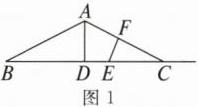
$ \therefore \frac{16-4t}{4\sqrt{5}}=\frac{\sqrt{5}t}{8} $,解得 $ t=\frac{32}{13} $;
②若 $ △ FCE ∽ △ ACD $,如图 2,则 $ \frac{FC}{AC}=\frac{EC}{CD} $,
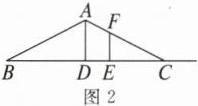
$ \therefore \frac{\sqrt{5}t}{4\sqrt{5}}=\frac{16-4t}{8} $,解得 $ t=\frac{8}{3} $.
综上,当 t 的值为 $ \frac{32}{13} $ 或 $ \frac{8}{3} $ 时,$ △ EFC $ 和 $ △ ACD $ 相似.
(2)过点 F 作 $ FG ⊥ BC $ 于点 G,
①如图 3,当 $ 0<t<4 $ 时,$ △ FCG ∽ △ ACD $,
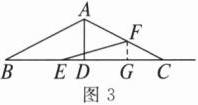
$ \therefore \frac{FG}{AD}=\frac{CF}{AC}, \therefore FG=\frac{AD · CF}{AC}=\frac{4 · \sqrt{5}t}{4\sqrt{5}}=t(\mathrm{cm}) $,
$ \therefore S=\frac{1}{2}CE · FG=\frac{1}{2}(16-4t) · t=(-2t^2+8t)\ \mathrm{cm}^2 $;
②当 $ t=4 $ 时,点 F 与点 A 重合,点 E 与点 C 重合,不能构成三角形.
③如图 4,当 $ 4<t<8 $ 时,$ △ BFG ∽ △ BAD $,
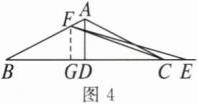
$ \therefore \frac{FG}{AD}=\frac{BF}{AB} $,
$ \therefore FG=\frac{AD · BF}{AB}=\frac{4(8\sqrt{5}-\sqrt{5}t)}{4\sqrt{5}}=(8-t)\ \mathrm{cm} $,
$ \therefore S=\frac{1}{2}CE · FG=\frac{1}{2}(4t-16)(8-t)=(-2t^2+24t-64)\ \mathrm{cm}^2 $.
④当 $ t=8 $ 时,点 F 与点 B 重合,点 C 在 EF 上,不能构成三角形.
$ \therefore S= \begin{cases} -2t^2+8t(0<t<4), \\ -2t^2+24t-64(4<t<8). \end{cases} $
(3)存在.过点 F 作 $ FG ⊥ BC $ 于点 G,设 EF 与 AD 交点为 H.
①如图 5,当点 E 在 BD 上,点 F 在 AC 上时,$ 0<t<2 $,

由 $ △ FGC ∽ △ ADC $,得 $ \frac{FG}{AD}=\frac{CG}{DC}=\frac{FC}{AC} $,
$ \therefore FG=t\ \mathrm{cm},CG=2t\ \mathrm{cm}. \because BE=4t\ \mathrm{cm} $,
$ \therefore DE=(8-4t)\ \mathrm{cm},EG=16-4t-2t=(16-6t)\ \mathrm{cm} $.
$ \because HD // FG, \therefore △ EHD ∽ △ EFG, \therefore \frac{ED}{EG}=\frac{HD}{FG} $.
(ⅰ)若 $ S_{△ EHD}:S_{△ HDF}=1:3 $,
则 $ S_{△ EHD}:S_{△ EFD}=1:4 $,
$ \therefore \frac{ED}{EG}=\frac{HD}{FG}=\frac{1}{4}, \therefore \frac{8-4t}{16-6t}=\frac{1}{4} $,解得 $ t=\frac{8}{5} $;
(ⅱ)若 $ S_{△ EHD}:S_{△ HDF}=3:1 $,则 $ S_{△ EHD}:S_{△ EFD}=3:4 $,
$ \therefore \frac{ED}{EG}=\frac{HD}{FG}=\frac{3}{4}, \therefore \frac{8-4t}{16-6t}=\frac{3}{4} $,
解得 $ t=8 $(不符合题意,舍去);
②如图 6,当点 E 在 BC 的延长线上,点 F 在 AB 上时,$ 4<t<8 $,

由 $ △ BFG ∽ △ BAD $ 得 $ \frac{FG}{AD}=\frac{BG}{BD}=\frac{BF}{AB} $,
$ \therefore FG=(8-t)\ \mathrm{cm},BG=2(8-t)\ \mathrm{cm} $.
$ \because BE=4t\ \mathrm{cm}, \therefore DE=BE-BD=(4t-8)\ \mathrm{cm} $,
$ EG=BE-BG=4t-2(8-t)=(6t-16)\ \mathrm{cm} $.
$ \because HD // FG, \therefore △ EHD ∽ △ EFG, \therefore \frac{ED}{EG}=\frac{HD}{FG} $.
(ⅰ)若 $ S_{△ EHD}:S_{△ HDF}=1:3 $,
则 $ S_{△ EHD}:S_{△ EFD}=1:4 $,
$ \therefore \frac{ED}{EG}=\frac{HD}{FG}=\frac{1}{4}, \therefore \frac{4t-8}{6t-16}=\frac{1}{4} $,
解得 $ t=\frac{8}{5} $(不符合题意,舍去);
(ⅱ)若 $ S_{△ EHD}:S_{△ HDF}=3:1 $,则 $ S_{△ EHD}:S_{△ EFD}=3:4, \therefore \frac{ED}{EG}=\frac{HD}{FG}=\frac{3}{4}, \therefore \frac{4t-8}{6t-16}=\frac{3}{4} $,
解得 $ t=8 $(不符合题意,舍去).
综上所述,当 t 的值为 $ \frac{8}{5} $ 时,使得 $ △ EFD $ 被 AD 分得的两部分面积之比为 1:3.
解析
【分析】
本题是动点类几何综合题,解题思路如下:
1. 先由等腰三角形三线合一性质,求出AD、CD的长度,得到Rt△ACD的各边边长,作为后续计算的基础;
2. 第(1)问判断相似时,先根据动点的运动速度和时间t,分阶段表示出CE、CF的长度,由于△EFC和△ACD都含公共角∠C,且都是直角三角形,分两种对应顶点的相似情况列比例式求解,注意解要符合对应阶段t的取值范围;
3. 第(2)问求面积函数式,过点F作BC的垂线FG,利用相似三角形求出FG的长度,再结合不同阶段CE的长度,用三角形面积公式写出S关于t的表达式,排除不能构成三角形的t值;
4. 第(3)问探究面积比时,设EF与AD交于H,由AD//FG可得△EHD∽△EFG,被AD分成的两个三角形同高,面积比等于底的比,结合相似三角形的线段比例列方程求解,舍去不符合取值范围的解。
【解析】
(1) $\because AB=AC=4\sqrt{5}\ \mathrm{cm}$,$BC=16\ \mathrm{cm}$,$AD⊥BC$于$D$,$\therefore BD=CD=\frac{1}{2}BC=8\ \mathrm{cm}$,
$\therefore AD=\sqrt{AB^2-BD^2}=\sqrt{(4\sqrt{5})^2-8^2}=4(\mathrm{cm})$。
由题意得$BE=4t\ \mathrm{cm}$,
当$0 ≤ t ≤4$时,点E在线段BC上,$CE=(16-4t)\ \mathrm{cm}$,点F在AC上,$CF=\sqrt{5}t\ \mathrm{cm}$;
当$4<t ≤8$时,点E在线段BC的延长线上,$CE=(4t-16)\ \mathrm{cm}$,点F在AB上,$BF=(8\sqrt{5}-\sqrt{5}t)\ \mathrm{cm}$。
①若$△ ECF ∽ △ ACD$,如图1,则$\frac{CE}{AC}=\frac{CF}{CD}$,
$\therefore \frac{16-4t}{4\sqrt{5}}=\frac{\sqrt{5}t}{8}$,解得$t=\frac{32}{13}$;
②若$△ FCE ∽ △ ACD$,如图2,则$\frac{FC}{AC}=\frac{EC}{CD}$,
$\therefore \frac{\sqrt{5}t}{4\sqrt{5}}=\frac{16-4t}{8}$,解得$t=\frac{8}{3}$。
综上,当t的值为$\frac{32}{13}$或$\frac{8}{3}$时,$△ EFC$和$△ ACD$相似。
(2) 过点F作$FG ⊥ BC$于点G,
①如图3,当$0<t<4$时,$△ FCG ∽ △ ACD$,
$\therefore \frac{FG}{AD}=\frac{CF}{AC}, \therefore FG=\frac{AD · CF}{AC}=\frac{4 · \sqrt{5}t}{4\sqrt{5}}=t(\mathrm{cm})$,
$\therefore S=\frac{1}{2}CE · FG=\frac{1}{2}(16-4t) · t=(-2t^2+8t)\ \mathrm{cm}^2$;
②当$t=4$时,点F与点A重合,点E与点C重合,不能构成三角形;
③如图4,当$4<t<8$时,$△ BFG ∽ △ BAD$,
$\therefore \frac{FG}{AD}=\frac{BF}{AB}$,
$\therefore FG=\frac{AD · BF}{AB}=\frac{4(8\sqrt{5}-\sqrt{5}t)}{4\sqrt{5}}=(8-t)\ \mathrm{cm}$,
$\therefore S=\frac{1}{2}CE · FG=\frac{1}{2}(4t-16)(8-t)=(-2t^2+24t-64)\ \mathrm{cm}^2$;
④当$t=8$时,点F与点B重合,点C在EF上,不能构成三角形。
$\therefore S= \begin{cases} -2t^2+8t(0<t<4), \\ -2t^2+24t-64(4<t<8). \end{cases}$
(3) 存在。过点F作$FG ⊥ BC$于点G,设EF与AD交点为H。
①如图5,当点E在BD上,点F在AC上时,$0<t<2$,
由$△ FGC ∽ △ ADC$,得$\frac{FG}{AD}=\frac{CG}{DC}=\frac{FC}{AC}$,
$\therefore FG=t\ \mathrm{cm},CG=2t\ \mathrm{cm}. \because BE=4t\ \mathrm{cm}$,
$\therefore DE=(8-4t)\ \mathrm{cm},EG=16-4t-2t=(16-6t)\ \mathrm{cm}$。
$\because HD // FG, \therefore △ EHD ∽ △ EFG, \therefore \frac{ED}{EG}=\frac{HD}{FG}$。
(ⅰ)若$S_{△ EHD}:S_{△ HDF}=1:3$,
则$S_{△ EHD}:S_{△ EFD}=1:4$,
$\therefore \frac{ED}{EG}=\frac{HD}{FG}=\frac{1}{4}, \therefore \frac{8-4t}{16-6t}=\frac{1}{4}$,解得$t=\frac{8}{5}$;
(ⅱ)若$S_{△ EHD}:S_{△ HDF}=3:1$,则$S_{△ EHD}:S_{△ EFD}=3:4$,
$\therefore \frac{ED}{EG}=\frac{HD}{FG}=\frac{3}{4}, \therefore \frac{8-4t}{16-6t}=\frac{3}{4}$,
解得$t=8$(不符合题意,舍去);
②如图6,当点E在BC的延长线上,点F在AB上时,$4<t<8$,
由$△ BFG ∽ △ BAD$得$\frac{FG}{AD}=\frac{BG}{BD}=\frac{BF}{AB}$,
$\therefore FG=(8-t)\ \mathrm{cm},BG=2(8-t)\ \mathrm{cm}$。
$\because BE=4t\ \mathrm{cm}, \therefore DE=BE-BD=(4t-8)\ \mathrm{cm}$,
$EG=BE-BG=4t-2(8-t)=(6t-16)\ \mathrm{cm}$。
$\because HD // FG, \therefore △ EHD ∽ △ EFG, \therefore \frac{ED}{EG}=\frac{HD}{FG}$。
(ⅰ)若$S_{△ EHD}:S_{△ HDF}=1:3$,
则$S_{△ EHD}:S_{△ EFD}=1:4$,
$\therefore \frac{ED}{EG}=\frac{HD}{FG}=\frac{1}{4}, \therefore \frac{4t-8}{6t-16}=\frac{1}{4}$,
解得$t=\frac{8}{5}$(不符合题意,舍去);
(ⅱ)若$S_{△ EHD}:S_{△ HDF}=3:1$,则$S_{△ EHD}:S_{△ EFD}=3:4, \therefore \frac{ED}{EG}=\frac{HD}{FG}=\frac{3}{4}, \therefore \frac{4t-8}{6t-16}=\frac{3}{4}$,
解得$t=8$(不符合题意,舍去)。
综上所述,当t的值为$\frac{8}{5}$时,使得$△ EFD$被AD分得的两部分面积之比为$1:3$。
【答案】
(1) $t=\frac{32}{13}$或$t=\frac{8}{3}$;
(2) $S=\begin{cases} -2t^2+8t & (0<t<4) \\ -2t^2+24t-64 & (4<t<8) \end{cases}$;
(3) 存在,$t=\frac{8}{5}$。
【知识点】
1. 等腰三角形三线合一
2. 相似三角形的判定与性质
3. 动点分类讨论
【点评】
本题是动态几何综合题,融合了等腰三角形、相似三角形、分段函数求解等多个考点,重点考查分类讨论思想,解题时需注意动点在不同运动阶段对应的图形特征,结合取值范围验证解的合理性,避免漏解或错解。
【难度系数】
0.3
本题是动点类几何综合题,解题思路如下:
1. 先由等腰三角形三线合一性质,求出AD、CD的长度,得到Rt△ACD的各边边长,作为后续计算的基础;
2. 第(1)问判断相似时,先根据动点的运动速度和时间t,分阶段表示出CE、CF的长度,由于△EFC和△ACD都含公共角∠C,且都是直角三角形,分两种对应顶点的相似情况列比例式求解,注意解要符合对应阶段t的取值范围;
3. 第(2)问求面积函数式,过点F作BC的垂线FG,利用相似三角形求出FG的长度,再结合不同阶段CE的长度,用三角形面积公式写出S关于t的表达式,排除不能构成三角形的t值;
4. 第(3)问探究面积比时,设EF与AD交于H,由AD//FG可得△EHD∽△EFG,被AD分成的两个三角形同高,面积比等于底的比,结合相似三角形的线段比例列方程求解,舍去不符合取值范围的解。
【解析】
(1) $\because AB=AC=4\sqrt{5}\ \mathrm{cm}$,$BC=16\ \mathrm{cm}$,$AD⊥BC$于$D$,$\therefore BD=CD=\frac{1}{2}BC=8\ \mathrm{cm}$,
$\therefore AD=\sqrt{AB^2-BD^2}=\sqrt{(4\sqrt{5})^2-8^2}=4(\mathrm{cm})$。
由题意得$BE=4t\ \mathrm{cm}$,
当$0 ≤ t ≤4$时,点E在线段BC上,$CE=(16-4t)\ \mathrm{cm}$,点F在AC上,$CF=\sqrt{5}t\ \mathrm{cm}$;
当$4<t ≤8$时,点E在线段BC的延长线上,$CE=(4t-16)\ \mathrm{cm}$,点F在AB上,$BF=(8\sqrt{5}-\sqrt{5}t)\ \mathrm{cm}$。
①若$△ ECF ∽ △ ACD$,如图1,则$\frac{CE}{AC}=\frac{CF}{CD}$,
$\therefore \frac{16-4t}{4\sqrt{5}}=\frac{\sqrt{5}t}{8}$,解得$t=\frac{32}{13}$;
②若$△ FCE ∽ △ ACD$,如图2,则$\frac{FC}{AC}=\frac{EC}{CD}$,
$\therefore \frac{\sqrt{5}t}{4\sqrt{5}}=\frac{16-4t}{8}$,解得$t=\frac{8}{3}$。
综上,当t的值为$\frac{32}{13}$或$\frac{8}{3}$时,$△ EFC$和$△ ACD$相似。
(2) 过点F作$FG ⊥ BC$于点G,
①如图3,当$0<t<4$时,$△ FCG ∽ △ ACD$,
$\therefore \frac{FG}{AD}=\frac{CF}{AC}, \therefore FG=\frac{AD · CF}{AC}=\frac{4 · \sqrt{5}t}{4\sqrt{5}}=t(\mathrm{cm})$,
$\therefore S=\frac{1}{2}CE · FG=\frac{1}{2}(16-4t) · t=(-2t^2+8t)\ \mathrm{cm}^2$;
②当$t=4$时,点F与点A重合,点E与点C重合,不能构成三角形;
③如图4,当$4<t<8$时,$△ BFG ∽ △ BAD$,
$\therefore \frac{FG}{AD}=\frac{BF}{AB}$,
$\therefore FG=\frac{AD · BF}{AB}=\frac{4(8\sqrt{5}-\sqrt{5}t)}{4\sqrt{5}}=(8-t)\ \mathrm{cm}$,
$\therefore S=\frac{1}{2}CE · FG=\frac{1}{2}(4t-16)(8-t)=(-2t^2+24t-64)\ \mathrm{cm}^2$;
④当$t=8$时,点F与点B重合,点C在EF上,不能构成三角形。
$\therefore S= \begin{cases} -2t^2+8t(0<t<4), \\ -2t^2+24t-64(4<t<8). \end{cases}$
(3) 存在。过点F作$FG ⊥ BC$于点G,设EF与AD交点为H。
①如图5,当点E在BD上,点F在AC上时,$0<t<2$,
由$△ FGC ∽ △ ADC$,得$\frac{FG}{AD}=\frac{CG}{DC}=\frac{FC}{AC}$,
$\therefore FG=t\ \mathrm{cm},CG=2t\ \mathrm{cm}. \because BE=4t\ \mathrm{cm}$,
$\therefore DE=(8-4t)\ \mathrm{cm},EG=16-4t-2t=(16-6t)\ \mathrm{cm}$。
$\because HD // FG, \therefore △ EHD ∽ △ EFG, \therefore \frac{ED}{EG}=\frac{HD}{FG}$。
(ⅰ)若$S_{△ EHD}:S_{△ HDF}=1:3$,
则$S_{△ EHD}:S_{△ EFD}=1:4$,
$\therefore \frac{ED}{EG}=\frac{HD}{FG}=\frac{1}{4}, \therefore \frac{8-4t}{16-6t}=\frac{1}{4}$,解得$t=\frac{8}{5}$;
(ⅱ)若$S_{△ EHD}:S_{△ HDF}=3:1$,则$S_{△ EHD}:S_{△ EFD}=3:4$,
$\therefore \frac{ED}{EG}=\frac{HD}{FG}=\frac{3}{4}, \therefore \frac{8-4t}{16-6t}=\frac{3}{4}$,
解得$t=8$(不符合题意,舍去);
②如图6,当点E在BC的延长线上,点F在AB上时,$4<t<8$,
由$△ BFG ∽ △ BAD$得$\frac{FG}{AD}=\frac{BG}{BD}=\frac{BF}{AB}$,
$\therefore FG=(8-t)\ \mathrm{cm},BG=2(8-t)\ \mathrm{cm}$。
$\because BE=4t\ \mathrm{cm}, \therefore DE=BE-BD=(4t-8)\ \mathrm{cm}$,
$EG=BE-BG=4t-2(8-t)=(6t-16)\ \mathrm{cm}$。
$\because HD // FG, \therefore △ EHD ∽ △ EFG, \therefore \frac{ED}{EG}=\frac{HD}{FG}$。
(ⅰ)若$S_{△ EHD}:S_{△ HDF}=1:3$,
则$S_{△ EHD}:S_{△ EFD}=1:4$,
$\therefore \frac{ED}{EG}=\frac{HD}{FG}=\frac{1}{4}, \therefore \frac{4t-8}{6t-16}=\frac{1}{4}$,
解得$t=\frac{8}{5}$(不符合题意,舍去);
(ⅱ)若$S_{△ EHD}:S_{△ HDF}=3:1$,则$S_{△ EHD}:S_{△ EFD}=3:4, \therefore \frac{ED}{EG}=\frac{HD}{FG}=\frac{3}{4}, \therefore \frac{4t-8}{6t-16}=\frac{3}{4}$,
解得$t=8$(不符合题意,舍去)。
综上所述,当t的值为$\frac{8}{5}$时,使得$△ EFD$被AD分得的两部分面积之比为$1:3$。
【答案】
(1) $t=\frac{32}{13}$或$t=\frac{8}{3}$;
(2) $S=\begin{cases} -2t^2+8t & (0<t<4) \\ -2t^2+24t-64 & (4<t<8) \end{cases}$;
(3) 存在,$t=\frac{8}{5}$。
【知识点】
1. 等腰三角形三线合一
2. 相似三角形的判定与性质
3. 动点分类讨论
【点评】
本题是动态几何综合题,融合了等腰三角形、相似三角形、分段函数求解等多个考点,重点考查分类讨论思想,解题时需注意动点在不同运动阶段对应的图形特征,结合取值范围验证解的合理性,避免漏解或错解。
【难度系数】
0.3
