

 登录
登录
四、信息还原。(共4小题;每小题1.5分,满分6分)
阅读下面短文,从短文后所给的六个选项中选出四个可填入空白处的最佳选项。
Xu Yaxuan, 29, is from Hami, Xinjiang. As a boy, he dreamt of seeing the world. He used to work for a foreign company and went to places like Egypt and Singapore. 31
Then in 2024, he left the company and returned to Hami and learnt to grow apricots(杏) and cotton. 32 So he learnt from experienced farmers and used AI tools. If he didn't understand what the farmers said, he asked them to explain it again until he got it. Farming is harder than he thought. From the blooming(开花) of apricot flowers to the harvest season, he had to put his whole heart into it. He often worked from 6 a.m. to midnight.
Later, he even helped his family sell apricots online. 33 People loved the taste, and he sold 1.5 tons in 38 days. “It encourages me to bring Xinjiang’s fruits to more people,” Xu said. This year, he sold out all his apricots in two weeks, with online orders making up 20 per cent of the sales.
Now he often shares his daily work of growing crops online. 34 “Maybe my stories will encourage more young people to return to Xinjiang,” Xu said. In the future, Xu plans to create his own store brand to let more people know about Xinjiang.
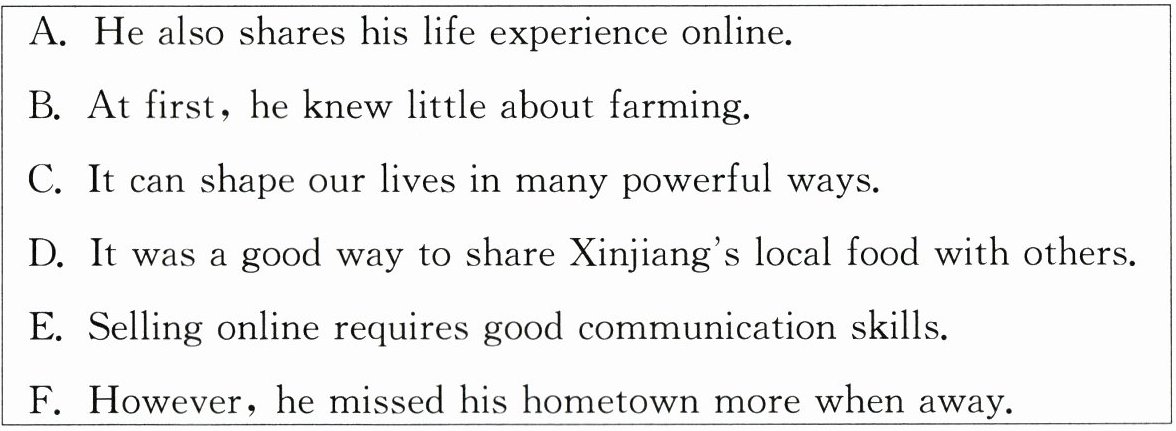
31.
阅读下面短文,从短文后所给的六个选项中选出四个可填入空白处的最佳选项。
Xu Yaxuan, 29, is from Hami, Xinjiang. As a boy, he dreamt of seeing the world. He used to work for a foreign company and went to places like Egypt and Singapore. 31
Then in 2024, he left the company and returned to Hami and learnt to grow apricots(杏) and cotton. 32 So he learnt from experienced farmers and used AI tools. If he didn't understand what the farmers said, he asked them to explain it again until he got it. Farming is harder than he thought. From the blooming(开花) of apricot flowers to the harvest season, he had to put his whole heart into it. He often worked from 6 a.m. to midnight.
Later, he even helped his family sell apricots online. 33 People loved the taste, and he sold 1.5 tons in 38 days. “It encourages me to bring Xinjiang’s fruits to more people,” Xu said. This year, he sold out all his apricots in two weeks, with online orders making up 20 per cent of the sales.
Now he often shares his daily work of growing crops online. 34 “Maybe my stories will encourage more young people to return to Xinjiang,” Xu said. In the future, Xu plans to create his own store brand to let more people know about Xinjiang.
31.
F
32. B
33. D
34. A
答案
31.F 32.B 33.D 34.A
解析
【分析】
本题为英语信息还原题,解题思路是先通读全文把握主旨(讲述新疆青年徐亚轩返乡种杏、线上销售并分享经历的故事),再逐个分析每个空的前后语境,通过逻辑衔接(转折、顺承、解释等)匹配选项:
1. 31题:前文提到徐亚轩曾在外工作,后文说他返乡,需转折说明返乡原因,对应选项F;
2. 32题:后文提到他向农民学习农业知识,需说明他起初不懂农业,对应选项B;
3. 33题:前文提到线上卖杏,后文说销量好,需解释线上卖杏的意义,对应选项D;
4. 34题:前文提到他分享农活在线,需承接分享行为,对应选项A。
【解析】
31题:前文叙述徐亚轩曾在外地工作的经历,后文转折说明他2024年返乡,F选项“However, he missed his hometown more when away”(然而,他在外时更想念家乡)符合逻辑衔接,故31选F;
32题:后文提到他向有经验的农民学习、用AI工具,说明他起初对农业不熟悉,B选项“At first, he knew little about farming”(起初,他对农业知之甚少)与后文衔接自然,故32选B;
33题:前文提到他帮家里线上卖杏,后文说人们喜欢杏的味道且销量可观,D选项“It was a good way to share Xinjiang’s local food with others”(这是和他人分享新疆当地食物的好方法)解释了线上卖杏的价值,衔接上下文,故33选D;
34题:前文提到他在线分享日常农活,后文说希望鼓励年轻人返乡,A选项“He also shares his life experience online”(他也在线分享自己的生活经历)承接前文的分享行为,故34选A。
【答案】
31.F 32.B 33.D 34.A
【知识点】
英语语篇逻辑衔接、信息还原、语境匹配
【点评】
本题考查英语语篇的上下文逻辑理解能力,属于常见的信息还原题型,需学生把握转折、顺承等逻辑关系,难度适中,是初中英语的常考题型。
【难度系数】
0.6
本题为英语信息还原题,解题思路是先通读全文把握主旨(讲述新疆青年徐亚轩返乡种杏、线上销售并分享经历的故事),再逐个分析每个空的前后语境,通过逻辑衔接(转折、顺承、解释等)匹配选项:
1. 31题:前文提到徐亚轩曾在外工作,后文说他返乡,需转折说明返乡原因,对应选项F;
2. 32题:后文提到他向农民学习农业知识,需说明他起初不懂农业,对应选项B;
3. 33题:前文提到线上卖杏,后文说销量好,需解释线上卖杏的意义,对应选项D;
4. 34题:前文提到他分享农活在线,需承接分享行为,对应选项A。
【解析】
31题:前文叙述徐亚轩曾在外地工作的经历,后文转折说明他2024年返乡,F选项“However, he missed his hometown more when away”(然而,他在外时更想念家乡)符合逻辑衔接,故31选F;
32题:后文提到他向有经验的农民学习、用AI工具,说明他起初对农业不熟悉,B选项“At first, he knew little about farming”(起初,他对农业知之甚少)与后文衔接自然,故32选B;
33题:前文提到他帮家里线上卖杏,后文说人们喜欢杏的味道且销量可观,D选项“It was a good way to share Xinjiang’s local food with others”(这是和他人分享新疆当地食物的好方法)解释了线上卖杏的价值,衔接上下文,故33选D;
34题:前文提到他在线分享日常农活,后文说希望鼓励年轻人返乡,A选项“He also shares his life experience online”(他也在线分享自己的生活经历)承接前文的分享行为,故34选A。
【答案】
31.F 32.B 33.D 34.A
【知识点】
英语语篇逻辑衔接、信息还原、语境匹配
【点评】
本题考查英语语篇的上下文逻辑理解能力,属于常见的信息还原题型,需学生把握转折、顺承等逻辑关系,难度适中,是初中英语的常考题型。
【难度系数】
0.6
五、阅读短文,回答问题。(共4小题;分别为1、1、1、2分,满分5分)
第35—37题的答案不超过10个单词,第38题的答案词数不限。
新素材 国学典故 During the Warring States Period(475—221 BC), Shang Yang, a reformer(改革家) in the State of Qin, wanted to carry out new laws. However, people didn't trust the government's orders(命令) at that time. To build trust, Shang Yang came up with a clever idea.
He ordered his men to put a three-zhang-long wooden pole(竹竿) at the south gate of the capital's
market. Then he announced to people, “Whoever can carry this pole to the north gate will get ten pieces of gold.” Everyone felt doubtful and no one was brave enough to try. They thought the reward was too good to be true.
Seeing this, Shang Yang raised the reward to 50 pieces of gold. Finally, a brave man stepped forward. He carried the pole to the north gate easily. Shang Yang gave him the 50 pieces of gold as promised right away. People were shocked(震惊的)—they realized the government kept its word.
After this, Shang Yang put his new laws into practice. People believed the laws would be carried out strictly, so they followed them closely. The reforms made Qin stronger and helped it become the ruler of all China later. This story is known as “Moving the Wood to Build Trust” and has been passed down to teach people the importance of honesty.
35. When did Shang Yang's story happen?
36. What did Shang Yang wish people to do with the wooden pole?
37. What was the real purpose of Shang Yang's wooden pole test?
38. 新考法 开放性设问 Do you think this story is still meaningful in today's modern society? Why or why not?
第35—37题的答案不超过10个单词,第38题的答案词数不限。
新素材 国学典故 During the Warring States Period(475—221 BC), Shang Yang, a reformer(改革家) in the State of Qin, wanted to carry out new laws. However, people didn't trust the government's orders(命令) at that time. To build trust, Shang Yang came up with a clever idea.
He ordered his men to put a three-zhang-long wooden pole(竹竿) at the south gate of the capital's
market. Then he announced to people, “Whoever can carry this pole to the north gate will get ten pieces of gold.” Everyone felt doubtful and no one was brave enough to try. They thought the reward was too good to be true.
Seeing this, Shang Yang raised the reward to 50 pieces of gold. Finally, a brave man stepped forward. He carried the pole to the north gate easily. Shang Yang gave him the 50 pieces of gold as promised right away. People were shocked(震惊的)—they realized the government kept its word.
After this, Shang Yang put his new laws into practice. People believed the laws would be carried out strictly, so they followed them closely. The reforms made Qin stronger and helped it become the ruler of all China later. This story is known as “Moving the Wood to Build Trust” and has been passed down to teach people the importance of honesty.
35. When did Shang Yang's story happen?
During the Warring States Period.
36. What did Shang Yang wish people to do with the wooden pole?
To carry/move it to the north gate.
37. What was the real purpose of Shang Yang's wooden pole test?
To build trust (before changing laws).
38. 新考法 开放性设问 Do you think this story is still meaningful in today's modern society? Why or why not?
Yes. Because it teaches us that keeping promises builds trust, and trust is important everywhere.(言之有理即可)
答案
35. During the Warring States Period.
36. To carry/move it to the north gate.
37. To build trust (before changing laws).
38. Yes. Because it teaches us that keeping promises builds trust, and trust is important everywhere.(言之有理即可)
36. To carry/move it to the north gate.
37. To build trust (before changing laws).
38. Yes. Because it teaches us that keeping promises builds trust, and trust is important everywhere.(言之有理即可)
解析
【分析】
做本题需先通读短文把握“徙木立信”的典故内容,再根据各问题的关键词定位原文对应信息:35题问时间,定位短文开头的时间表述;36题问对竹竿的要求,定位第二段商鞅的宣布内容;37题问真实目的,定位第一段商鞅的初衷;38题为开放性设问,需结合故事核心(诚信的重要性)联系现代社会作答,言之有理即可。
【解析】
35题:根据短文第一段第一句“During the Warring States Period(475—221 BC), Shang Yang, a reformer in the State of Qin, wanted to carry out new laws.”可知,商鞅的故事发生在战国时期,故答案为During the Warring States Period.
36题:根据短文第二段“Then he announced to people, “Whoever can carry this pole to the north gate will get ten pieces of gold.””可知,商鞅希望人们把竹竿搬到北门,故答案为To carry/move it to the north gate.
37题:根据短文第一段“To build trust, Shang Yang came up with a clever idea.”可知,商鞅此举的真实目的是建立信任(为推行新法做准备),故答案为To build trust (before changing laws).
38题:本题为开放性设问,结合故事传递的“守诺建信任”的核心,联系现代社会对信任的需求,言之有理即可,示例答案为Yes. Because it teaches us that keeping promises builds trust, and trust is important everywhere.
【答案】
35. During the Warring States Period.
36. To carry/move it to the north gate.
37. To build trust (before changing laws).
38. Yes. Because it teaches us that keeping promises builds trust, and trust is important everywhere.(言之有理即可)
【知识点】
英语阅读理解、细节理解、开放性设问
【点评】
本题以国学典故“徙木立信”为阅读材料,既考查学生英语阅读的信息定位能力,又渗透了诚信的德育教育,开放性设问能激发学生的思辨能力,符合英语学科核心素养的培养要求。
【难度系数】
0.6
做本题需先通读短文把握“徙木立信”的典故内容,再根据各问题的关键词定位原文对应信息:35题问时间,定位短文开头的时间表述;36题问对竹竿的要求,定位第二段商鞅的宣布内容;37题问真实目的,定位第一段商鞅的初衷;38题为开放性设问,需结合故事核心(诚信的重要性)联系现代社会作答,言之有理即可。
【解析】
35题:根据短文第一段第一句“During the Warring States Period(475—221 BC), Shang Yang, a reformer in the State of Qin, wanted to carry out new laws.”可知,商鞅的故事发生在战国时期,故答案为During the Warring States Period.
36题:根据短文第二段“Then he announced to people, “Whoever can carry this pole to the north gate will get ten pieces of gold.””可知,商鞅希望人们把竹竿搬到北门,故答案为To carry/move it to the north gate.
37题:根据短文第一段“To build trust, Shang Yang came up with a clever idea.”可知,商鞅此举的真实目的是建立信任(为推行新法做准备),故答案为To build trust (before changing laws).
38题:本题为开放性设问,结合故事传递的“守诺建信任”的核心,联系现代社会对信任的需求,言之有理即可,示例答案为Yes. Because it teaches us that keeping promises builds trust, and trust is important everywhere.
【答案】
35. During the Warring States Period.
36. To carry/move it to the north gate.
37. To build trust (before changing laws).
38. Yes. Because it teaches us that keeping promises builds trust, and trust is important everywhere.(言之有理即可)
【知识点】
英语阅读理解、细节理解、开放性设问
【点评】
本题以国学典故“徙木立信”为阅读材料,既考查学生英语阅读的信息定位能力,又渗透了诚信的德育教育,开放性设问能激发学生的思辨能力,符合英语学科核心素养的培养要求。
【难度系数】
0.6
