

 登录
Ⅰ. Match the expressions with the explanations.
(
(
(
(
(
(
C
)1. wish list A. a container for saving coins(
D
)2. dream tin B. a journey to a foreign country(
B
)3. trip abroad C. a list of things you hope to get or achieve(
A
)4. money box D. a tin where you put money for a specific dream(
E
)5. pocket money E. money that parents give to their children regularly答案
1. C 2. D 3. B 4. A 5. E
解析
【分析】这是一道英语短语与释义的匹配题,解题时需先准确理解每个英语短语的含义,再将其与对应的中文解释一一对应,最后核对匹配结果即可。
【解析】1. wish list意为“愿望清单”,对应选项C“你希望得到或实现的事物清单”;2. dream tin指“梦想储蓄罐”,对应选项D“为特定梦想存钱的罐子”;3. trip abroad意为“国外旅行”,对应选项B“去外国的旅行”;4. money box是“存钱罐”,对应选项A“存放硬币的容器”;5. pocket money指“零花钱”,对应选项E“父母定期给孩子的钱”。
【答案】1.C 2.D 3.B 4.A 5.E
【知识点】英语短语释义匹配
【点评】本题考查基础英语短语的含义,题型简单,只要掌握常见短语的意思就能轻松完成,适合基础薄弱的学生练习。
【难度系数】0.8
【解析】1. wish list意为“愿望清单”,对应选项C“你希望得到或实现的事物清单”;2. dream tin指“梦想储蓄罐”,对应选项D“为特定梦想存钱的罐子”;3. trip abroad意为“国外旅行”,对应选项B“去外国的旅行”;4. money box是“存钱罐”,对应选项A“存放硬币的容器”;5. pocket money指“零花钱”,对应选项E“父母定期给孩子的钱”。
【答案】1.C 2.D 3.B 4.A 5.E
【知识点】英语短语释义匹配
【点评】本题考查基础英语短语的含义,题型简单,只要掌握常见短语的意思就能轻松完成,适合基础薄弱的学生练习。
【难度系数】0.8
Ⅱ. Complete the sentences with the expressions in Exercise Ⅰ.
1. Betty's first wish was to go on a
2. My little sister keeps her pocket money in a
3. My parents give me 20 yuan a week as my
4. Mandy told Kira to prepare a
5. Ella made a
1. Betty's first wish was to go on a
trip abroad
.2. My little sister keeps her pocket money in a
money box
.3. My parents give me 20 yuan a week as my
pocket money
.4. Mandy told Kira to prepare a
dream tin
for each of her dreams.5. Ella made a
wish list
: a watch, a birthday party and a family outing.答案
1. trip abroad 2. money box 3. pocket money 4. dream tin 5. wish list
解析
【分析】
这是一道短语语境填空题,需先理解每个句子的语义,再匹配对应的短语完成句子。先明确各句子的核心语境:1. 表达“去国外旅行”的愿望;2. 存放零花钱的容器;3. 父母给的每周零花钱;4. 为梦想准备的物品;5. 列出的愿望内容,再对应合适的短语即可。
【解析】
1. 句子语义为“Betty的第一个愿望是去国外旅行”,对应短语trip abroad;
2. 句子语义为“妹妹把零花钱存放在存钱罐里”,对应短语money box;
3. 句子语义为“父母每周给我20元作为零花钱”,对应短语pocket money;
4. 句子语义为“Mandy让Kira为每个梦想准备梦想罐”,对应短语dream tin;
5. 句子语义为“Ella列了愿望清单:一块手表、一场生日派对和一次家庭出游”,对应短语wish list。
【答案】
1. trip abroad 2. money box 3. pocket money 4. dream tin 5. wish list
【知识点】
短语运用、语境匹配
【点评】
本题考查常用短语在具体语境中的运用,需结合句子语义匹配对应短语,属于基础题型,难度较低。
【难度系数】
0.3
Ⅲ. Read and complete the tasks.
There was once a man who tried every way to keep his money. After years of hard work, he collected a large bag of gold coins. He was so afraid of losing his money that he hardly spent any of it. He did not buy nicer food, better clothes, or anything that could make his life easier.
Instead, he dug a deep hole in the ground and hid his gold coins there. Every day, he went to the hole, took out the bag and counted his coins. He felt proud and thought he was very rich.
One day, a neighbour saw the man visiting the hole secretly. He watched and waited, and when the man left, he dug up the gold coins and took them away.
The next day, the man came as usual. When he found the gold coins gone, he fell to the ground and cried loudly. A friend heard him and came to ask what was wrong.
“I have lost all my gold!” he shouted. “My life is over!”
The friend said calmly, “Why are you so sad? You never spent the money. You never helped anyone or made yourself happier. If you just leave the money lying there, it is no different from a useless stone.”
Money is not truly wealth if we do not use it wisely. Wealth is not about keeping money; it is about using it to live a better and more meaningful life.
A. Complete the table.
The miser’s experience of 1.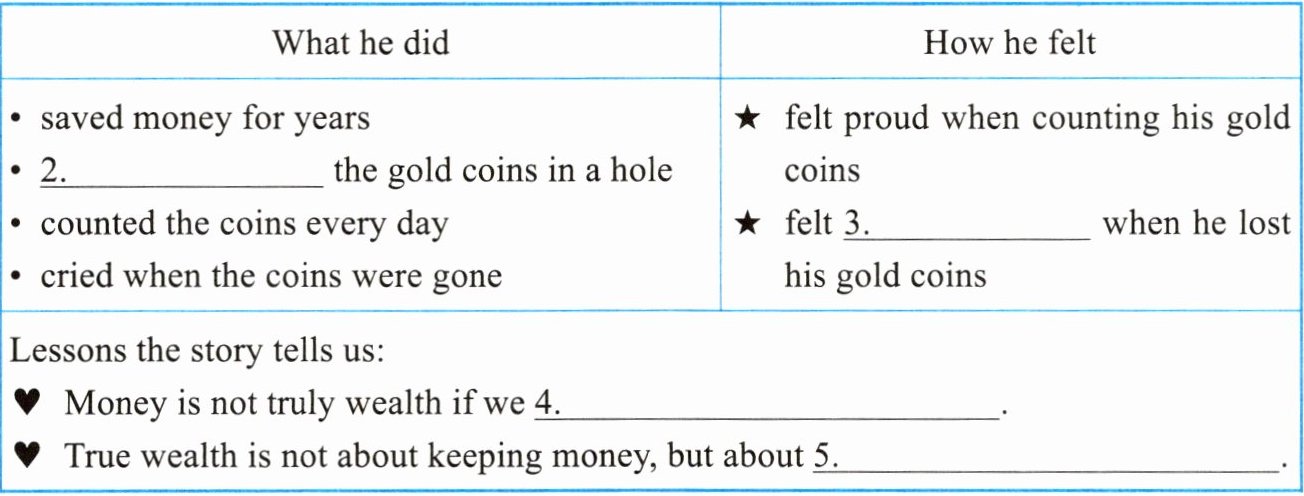
B. Answer the questions.
(
A. He saved them for future use.
B. He was too afraid of losing his money.
C. He thought his life was good enough.
D. He wanted to help his friend with them.
(
A. A fool and his money are soon parted.
B. If money goes before, all ways do lie open.
C. A thousand gold coins spent, more will turn up again.
D. Don’t keep money. Keep good friends to help you in times of need.
3. What do you want to say to the miser?
There was once a man who tried every way to keep his money. After years of hard work, he collected a large bag of gold coins. He was so afraid of losing his money that he hardly spent any of it. He did not buy nicer food, better clothes, or anything that could make his life easier.
Instead, he dug a deep hole in the ground and hid his gold coins there. Every day, he went to the hole, took out the bag and counted his coins. He felt proud and thought he was very rich.
One day, a neighbour saw the man visiting the hole secretly. He watched and waited, and when the man left, he dug up the gold coins and took them away.
The next day, the man came as usual. When he found the gold coins gone, he fell to the ground and cried loudly. A friend heard him and came to ask what was wrong.
“I have lost all my gold!” he shouted. “My life is over!”
The friend said calmly, “Why are you so sad? You never spent the money. You never helped anyone or made yourself happier. If you just leave the money lying there, it is no different from a useless stone.”
Money is not truly wealth if we do not use it wisely. Wealth is not about keeping money; it is about using it to live a better and more meaningful life.
A. Complete the table.
The miser’s experience of 1.
B. Answer the questions.
(
B
)1. Why did the man hardly spend any of his gold coins?A. He saved them for future use.
B. He was too afraid of losing his money.
C. He thought his life was good enough.
D. He wanted to help his friend with them.
(
A
)2. Which saying does the story show?A. A fool and his money are soon parted.
B. If money goes before, all ways do lie open.
C. A thousand gold coins spent, more will turn up again.
D. Don’t keep money. Keep good friends to help you in times of need.
3. What do you want to say to the miser?
You should use your money wisely instead of only keeping it.
答案
A. 1. saving money / keeping money 2. hid 3. sad 4. do not use it wisely
5. using it to live a better and more meaningful life
B. 1. B 2. A
3. One possible version: You should use your money wisely instead of only keeping it.
5. using it to live a better and more meaningful life
B. 1. B 2. A
3. One possible version: You should use your money wisely instead of only keeping it.
解析
【分析】
本题为阅读理解题,分为A部分的表格填空和B部分的选择、开放问答。解题思路如下:
1. A部分:需根据短文内容定位对应信息,完成表格。第2空对应“把金币藏在洞里”的动作,第3空对应丢失金币的情绪,第4、5空对应故事主旨句;
2. B部分:第1题找原文中“几乎不花钱”的原因,第2题匹配与故事主旨相关的谚语,第3题围绕“合理用钱”的主旨作答。
【解析】
A. 表格填空:
1. 结合短文核心内容,该部分是吝啬鬼“攒钱/守钱”的经历,故填saving money / keeping money;
2. 原文提到“dug a deep hole in the ground and hid his gold coins there”,对应动作是hid;
3. 原文中吝啬鬼丢钱后“cried loudly”,结合朋友的话可知他的感受是sad;
4. 原文最后一段明确“Money is not truly wealth if we do not use it wisely”,故填do not use it wisely;
5. 原文最后一句“it is about using it to live a better and more meaningful life”,直接提取即可。
B. 选择题与开放题:
1. 原文“He was so afraid of losing his money that he hardly spent any of it”说明原因是怕丢钱,选B;
2. 故事中吝啬鬼守着金币最终丢失,对应谚语“A fool and his money are soon parted”,选A;
3. 围绕“合理使用金钱而非仅储存”的主旨作答,示例符合要求。
【答案】
A. 1. saving money / keeping money 2. hid 3. sad 4. do not use it wisely 5. using it to live a better and more meaningful life
B. 1. B 2. A
3. One possible version: You should use your money wisely instead of only keeping it.
【知识点】
阅读理解信息匹配、细节理解、主旨大意、开放表达
【点评】
本题为记叙文阅读,考查学生从原文提取信息、理解主旨的能力,开放题也围绕核心观点作答,整体难度适中。
【难度系数】
0.6
