

 登录
Ⅳ. Read and complete the tasks.
Do you ever find yourself forgetting what you just read? Or losing your place in the middle of a task? You’re not alone. Many teenagers have trouble with working memory—the part of the brain that holds information for a short time. The good news is that you can train your working memory. Here are some simple but helpful strategies.
Remove the extra. Teenagers often try to do too many things at once: too many tabs open on the computer, too many messages on the phone, and too much noise in the room. Try this: close unnecessary apps, turn off notifications, clear your desk, and focus on one task at a time.
Check your feelings. Working memory becomes weaker when you feel worried, angry, or sad. These feelings take up mental space that should be used for thinking. Before you start studying, ask yourself: “How am I feeling right now?” Naming your feeling can help calm your brain down.
Follow the 5-minute rule. Many students say, “I can’t start.” The solution? Make the task smaller. Tell yourself: “I only need to work for five minutes.” Write the title. Open the document. Read the first question. That’s it.
Know the signs. How can you tell if your working memory is too full? Watch for these signs: losing your place, forgetting instructions right after hearing them, or saying “I knew this earlier.” These are not signs of laziness. They are signs that your brain needs a rest.
Working memory works best when we reduce distractions and take breaks. Try just one of these strategies this week and see what happens!
A. Match the strategies with their main ideas.
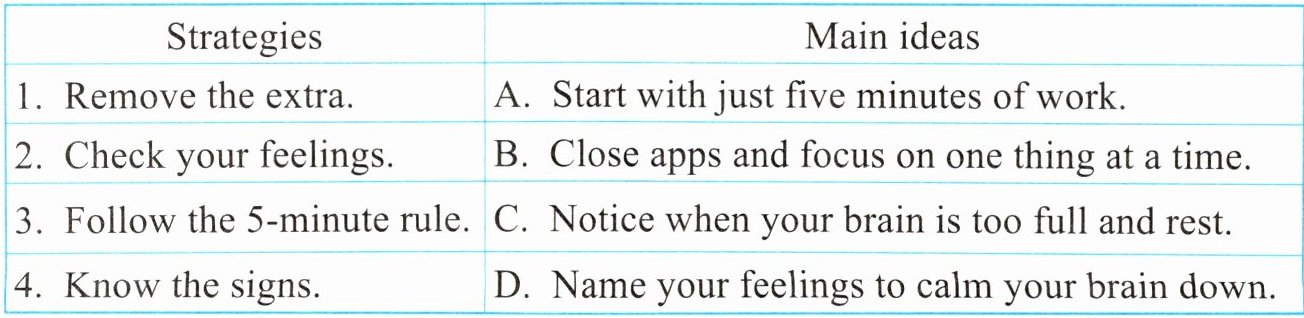
1.
B. Answer the questions.
(
A. Memorizing long speeches.
B. The brain’s short-term storage.
C. The brain’s long-term storage.
D. Remembering what you learnt.
(
A. Having a clean desk.
B. Feeling worried or sad.
C. Taking a short break.
D. Closing unnecessary apps.
(
A. Waiting until you feel better.
B. Asking your teacher for help.
C. Working for only five minutes.
D. Taking a long break before starting.
(
A. They only happen to teenagers.
B. They are a sign of a serious illness.
C. They show that you need to take a rest.
D. They mean you are not working hard enough.
Do you ever find yourself forgetting what you just read? Or losing your place in the middle of a task? You’re not alone. Many teenagers have trouble with working memory—the part of the brain that holds information for a short time. The good news is that you can train your working memory. Here are some simple but helpful strategies.
Remove the extra. Teenagers often try to do too many things at once: too many tabs open on the computer, too many messages on the phone, and too much noise in the room. Try this: close unnecessary apps, turn off notifications, clear your desk, and focus on one task at a time.
Check your feelings. Working memory becomes weaker when you feel worried, angry, or sad. These feelings take up mental space that should be used for thinking. Before you start studying, ask yourself: “How am I feeling right now?” Naming your feeling can help calm your brain down.
Follow the 5-minute rule. Many students say, “I can’t start.” The solution? Make the task smaller. Tell yourself: “I only need to work for five minutes.” Write the title. Open the document. Read the first question. That’s it.
Know the signs. How can you tell if your working memory is too full? Watch for these signs: losing your place, forgetting instructions right after hearing them, or saying “I knew this earlier.” These are not signs of laziness. They are signs that your brain needs a rest.
Working memory works best when we reduce distractions and take breaks. Try just one of these strategies this week and see what happens!
A. Match the strategies with their main ideas.
1.
B
2. D
3. A
4. C
B. Answer the questions.
(
B
)1. What is working memory?A. Memorizing long speeches.
B. The brain’s short-term storage.
C. The brain’s long-term storage.
D. Remembering what you learnt.
(
B
)2. According to the passage, which will make working memory weaker?A. Having a clean desk.
B. Feeling worried or sad.
C. Taking a short break.
D. Closing unnecessary apps.
(
C
)3. What does the writer suggest when you feel you can’t start studying?A. Waiting until you feel better.
B. Asking your teacher for help.
C. Working for only five minutes.
D. Taking a long break before starting.
(
C
)4. What can we learn about the signs of a full working memory?A. They only happen to teenagers.
B. They are a sign of a serious illness.
C. They show that you need to take a rest.
D. They mean you are not working hard enough.
答案
Ⅳ. A. 1. B 2. D 3. A 4. C
B. 1. B 2. B 3. C 4. C
B. 1. B 2. B 3. C 4. C
解析
【分析】
本题分为信息匹配(A部分)和细节选择(B部分),解题思路如下:
1. A部分:需将左侧策略与右侧主旨匹配,核心是找到策略与主旨的同义关联,需对应原文各策略的具体描述:
策略1“Remove the extra”对应原文“close unnecessary apps, focus on one task”,匹配主旨B;
策略2“Check your feelings”对应原文“naming your feeling can help calm your brain down”,匹配主旨D;
策略3“Follow the 5-minute rule”对应原文“Tell yourself: ‘I only need to work for five minutes’”,匹配主旨A;
策略4“Know the signs”对应原文“signs that your brain needs a rest”,匹配主旨C。
2. B部分:为细节选择题,需回到原文定位每个问题的对应信息,逐一匹配选项即可得出答案。
【解析】
A. 信息匹配:
1. “Remove the extra”的核心是减少干扰、专注单一任务,对应B选项“Close apps and focus on one thing at a time”;
2. “Check your feelings”的核心是命名情绪来平静大脑,对应D选项“Name your feelings to calm your brain down”;
3. “Follow the 5-minute rule”的核心是从5分钟任务开始,对应A选项“Start with just five minutes of work”;
4. “Know the signs”的核心是识别大脑满负荷的信号,对应C选项“Notice when your brain is too full and rest”。
B. 细节选择:
1. 原文第一段明确“working memory—the part of the brain that holds information for a short time”,对应B选项;
2. 原文第三段指出“Working memory becomes weaker when you feel worried, angry, or sad”,对应B选项;
3. 原文第四段提到不能开始任务时用5分钟规则,即“work for only five minutes”,对应C选项;
4. 原文第五段说明工作记忆满负荷的信号是大脑需要休息,对应C选项。
【答案】
A. 1.B 2.D 3.A 4.C
B. 1.B 2.B 3.C 4.C
【知识点】
英语阅读理解、信息匹配、细节理解题
【点评】
本题围绕“工作记忆”展开,分为信息匹配和细节选择两类题型,重点考查学生快速定位原文信息的能力,整体难度适中,只要仔细对应原文即可完成解答。
【难度系数】
0.6
