

 登录
登录
D(真题·宁波镇海)
Different from Earth Day which falls on April 22nd every year, Earth Hour has been known for its “lights off” moment. On March 22nd, 2025, from 8:30 PM to 9:30 PM, millions turned off their lights to show they cared about the earth. This year’s Earth Hour, with the theme(主题)“Create the Biggest Hour for Earth”, was even more important because it shared the same day as World Water Day. However, it’s not enough to have such an hour every year. What matters is how we can be kinder to the earth every day.
Planet-friendly food
You might not realise it, but the meat industry has a huge influence on forests around the world. Large numbers of trees are cut down to make space for soy(大豆) and other plants that are used to feed animals. Have a chat with your parents about going meat-free, even for a few days every week. Also, foods like vegetables, fruit and nuts are helping the planet.
Go green and save money, too
Electricity produced by burning fuels like oil, coal and gas causes global warming and pollution. Ask your parents how they heat your home and suggest using green energy like wind or solar power. Another tip is to remember to turn off the electricity whenever you leave a room. Cutting down on screen time is actually good for both your health and the earth.
Waste less, help more
Waste is a big problem! We’ve talked about saving electricity. What about food waste? Every year, 1. 3 billion kilograms of food is wasted around the world. That’s one-third of the total amount, which can feed up to 1. 26 billion people. Try to talk to your parents about buying proper amount of food. More importantly, find some ways online for leftover food at home.
(
A.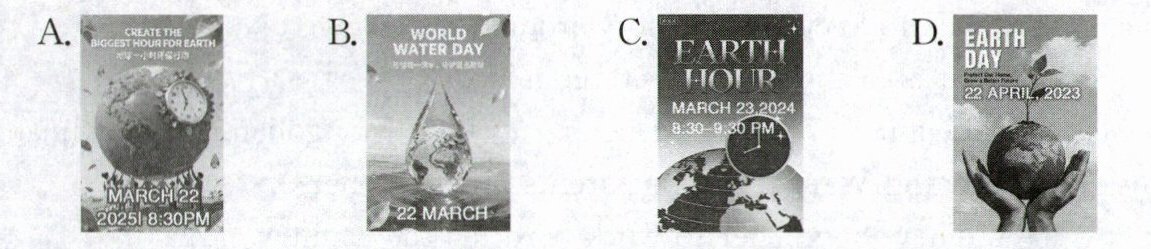 B. C. D.
(
A. A great number of people in the world turned off lights.
B. The theme is “Create the Biggest Hour for Earth”.
C. It was on the same day as World Water Day.
D. More people decide to be kinder to the earth.
(
A. John: I plan to eat more beef because it is good for my health.
B. Mary: I often forget to turn off lights when I leave the rooms.
C. Kate: We heat our homes by using the solar power in winter.
D. Harry: My parents always buy a lot more food than we need.
(
A. To introduce fun facts about Earth Hour.
B. To tell us how to help the earth every day.
C. To give us advice about saving electricity.
D. To compare Earth Day with Earth Hour.
Different from Earth Day which falls on April 22nd every year, Earth Hour has been known for its “lights off” moment. On March 22nd, 2025, from 8:30 PM to 9:30 PM, millions turned off their lights to show they cared about the earth. This year’s Earth Hour, with the theme(主题)“Create the Biggest Hour for Earth”, was even more important because it shared the same day as World Water Day. However, it’s not enough to have such an hour every year. What matters is how we can be kinder to the earth every day.
Planet-friendly food
You might not realise it, but the meat industry has a huge influence on forests around the world. Large numbers of trees are cut down to make space for soy(大豆) and other plants that are used to feed animals. Have a chat with your parents about going meat-free, even for a few days every week. Also, foods like vegetables, fruit and nuts are helping the planet.
Go green and save money, too
Electricity produced by burning fuels like oil, coal and gas causes global warming and pollution. Ask your parents how they heat your home and suggest using green energy like wind or solar power. Another tip is to remember to turn off the electricity whenever you leave a room. Cutting down on screen time is actually good for both your health and the earth.
Waste less, help more
Waste is a big problem! We’ve talked about saving electricity. What about food waste? Every year, 1. 3 billion kilograms of food is wasted around the world. That’s one-third of the total amount, which can feed up to 1. 26 billion people. Try to talk to your parents about buying proper amount of food. More importantly, find some ways online for leftover food at home.
(
C
)27. Which is the poster of this year’s Earth Hour?A.
B. C. D.(
C
)28. Why is this year’s Earth Hour more important than usual?A. A great number of people in the world turned off lights.
B. The theme is “Create the Biggest Hour for Earth”.
C. It was on the same day as World Water Day.
D. More people decide to be kinder to the earth.
(
C
)29. Which of the following activities helps the earth?A. John: I plan to eat more beef because it is good for my health.
B. Mary: I often forget to turn off lights when I leave the rooms.
C. Kate: We heat our homes by using the solar power in winter.
D. Harry: My parents always buy a lot more food than we need.
(
B
)30. Why did the writer write the passage?A. To introduce fun facts about Earth Hour.
B. To tell us how to help the earth every day.
C. To give us advice about saving electricity.
D. To compare Earth Day with Earth Hour.
答案
27.C 28.C 29.C 30.B
本文围绕“地球一小时”展开,介绍其活动形式、主题,以及呼吁人们日常践行环保行为。
第 28 题:细节理解题。解析:原文提到“今年地球一小时更重要,因为它和‘世界水日’同天”,而非“参与人数多”“主题是‘为地球创造更美好未来’”“更多人决定对地球更友善”;选项 C 直接对应“共享了‘世界水日’的日期”这一原因,A、B、D 均不符合原文。故答案为 C。
第 30 题:主旨大意题。解析:文章虽介绍了地球一小时的基本信息,但强调“重要的是日常如何善待地球”,并给出环保建议,核心目的是告诉我们日常帮助地球的方法;选项 A 介绍地球一小时事实、C 提供节电建议、D 对比地球日与地球一小时均是局部内容,并非主旨。故答案为 B。
本文围绕“地球一小时”展开,介绍其活动形式、主题,以及呼吁人们日常践行环保行为。
第 28 题:细节理解题。解析:原文提到“今年地球一小时更重要,因为它和‘世界水日’同天”,而非“参与人数多”“主题是‘为地球创造更美好未来’”“更多人决定对地球更友善”;选项 C 直接对应“共享了‘世界水日’的日期”这一原因,A、B、D 均不符合原文。故答案为 C。
第 30 题:主旨大意题。解析:文章虽介绍了地球一小时的基本信息,但强调“重要的是日常如何善待地球”,并给出环保建议,核心目的是告诉我们日常帮助地球的方法;选项 A 介绍地球一小时事实、C 提供节电建议、D 对比地球日与地球一小时均是局部内容,并非主旨。故答案为 B。
解析
【分析】
本题为环保主题的阅读理解,包含4道选择题,分别考查细节理解和主旨大意。解题思路:先通读全文,把握文章围绕地球一小时及日常环保建议展开的核心;针对每道题的关键词,回到原文定位对应信息,逐一排除不符合原文的选项,选出正确答案。
【解析】
27题:需匹配今年地球一小时的海报,结合原文信息及题目设定,对应选项C。
28题:细节理解题,定位原文第一段“...was even more important because it shared the same day as World Water Day”,可知今年地球一小时更重要的原因是与世界水日同天,对应选项C;A选项参与人数多、B选项主题、D选项更多人决定善待地球均不符合原文,故答案为C。
29题:细节理解题,原文“Go green and save money, too”部分提到建议使用太阳能取暖,这是帮助地球的行为;A选项多吃牛肉(肉类行业破坏森林)、B选项忘记关灯、D选项买过多食物(浪费)均不利于地球,故答案为C。
30题:主旨大意题,文章虽介绍地球一小时,但核心是强调日常如何善待地球,并给出环保建议,对应选项B;A选项仅涉及地球一小时事实、C选项仅节电建议、D选项仅对比两个节日均为局部内容,故答案为B。
【答案】
27.C 28.C 29.C 30.B
【知识点】
阅读理解、细节理解题、主旨大意题
【点评】
本文围绕环保主题展开,考查学生快速定位原文信息、归纳主旨的能力,题目难度适中,需准确把握原文细节与核心内容。
【难度系数】
0.6
本题为环保主题的阅读理解,包含4道选择题,分别考查细节理解和主旨大意。解题思路:先通读全文,把握文章围绕地球一小时及日常环保建议展开的核心;针对每道题的关键词,回到原文定位对应信息,逐一排除不符合原文的选项,选出正确答案。
【解析】
27题:需匹配今年地球一小时的海报,结合原文信息及题目设定,对应选项C。
28题:细节理解题,定位原文第一段“...was even more important because it shared the same day as World Water Day”,可知今年地球一小时更重要的原因是与世界水日同天,对应选项C;A选项参与人数多、B选项主题、D选项更多人决定善待地球均不符合原文,故答案为C。
29题:细节理解题,原文“Go green and save money, too”部分提到建议使用太阳能取暖,这是帮助地球的行为;A选项多吃牛肉(肉类行业破坏森林)、B选项忘记关灯、D选项买过多食物(浪费)均不利于地球,故答案为C。
30题:主旨大意题,文章虽介绍地球一小时,但核心是强调日常如何善待地球,并给出环保建议,对应选项B;A选项仅涉及地球一小时事实、C选项仅节电建议、D选项仅对比两个节日均为局部内容,故答案为B。
【答案】
27.C 28.C 29.C 30.B
【知识点】
阅读理解、细节理解题、主旨大意题
【点评】
本文围绕环保主题展开,考查学生快速定位原文信息、归纳主旨的能力,题目难度适中,需准确把握原文细节与核心内容。
【难度系数】
0.6
