

 登录
三、传统文化 句子还原。(每小题5分,共20分)
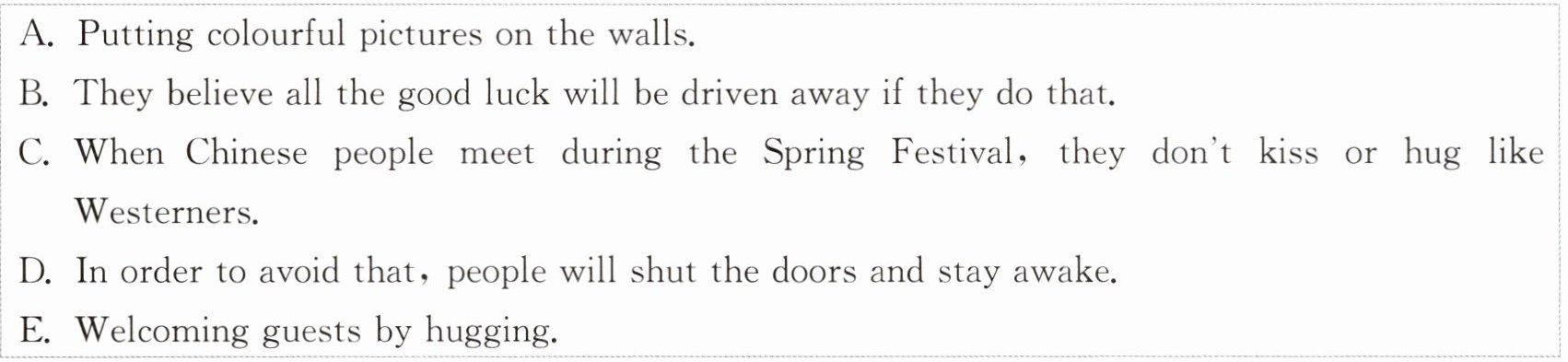
根据短文内容,从方框内的选项中选出能填入空白处的最佳选项(有一项多余)。
[2025齐齐哈尔、黑河、大兴安岭中考改编]As the most important festival in China, the Spring Festival is connected with many traditions and customs.
Greeting the family elders. 1.
Staying up on New Year's Eve. It is said that the dangerous monster Nian would come to harm people and animals on the eve. 2.
No sweeping on Chinese New Year. On the first day of the festival, people are not allowed to throw away rubbish or clean the rooms. 3.
4.
The opening-door fireworks. On the early morning of Chinese New Year's Day, people set off fireworks. They wish to welcome the good luck inside when they open their doors in the morning.
情境四 为了拓宽同学们对异国特色节日的认知,老师介绍了泰国猴子自助餐节,同学们可以深入了解这个新奇节日的由来与庆祝方式,还可以在班级里分享自己发现的其他国家的趣味节日。
根据短文内容,从方框内的选项中选出能填入空白处的最佳选项(有一项多余)。
[2025齐齐哈尔、黑河、大兴安岭中考改编]As the most important festival in China, the Spring Festival is connected with many traditions and customs.
Greeting the family elders. 1.
C
The first thing for the Chinese New Year visit is to bow to the elders to show their respect.Staying up on New Year's Eve. It is said that the dangerous monster Nian would come to harm people and animals on the eve. 2.
D
No sweeping on Chinese New Year. On the first day of the festival, people are not allowed to throw away rubbish or clean the rooms. 3.
B
4.
A
As the Chinese New Year arrives, every family puts up New Year paintings in order to say goodbye to the past and welcome the future.The opening-door fireworks. On the early morning of Chinese New Year's Day, people set off fireworks. They wish to welcome the good luck inside when they open their doors in the morning.
情境四 为了拓宽同学们对异国特色节日的认知,老师介绍了泰国猴子自助餐节,同学们可以深入了解这个新奇节日的由来与庆祝方式,还可以在班级里分享自己发现的其他国家的趣味节日。
答案
三、1. C 根据空格前的主题句“Greeting the family elders.”以及空格后的内容“春节拜年的第一件事是向长辈鞠躬以示尊敬”可知,此处需要与“拜年的礼仪方式”相衔接,选项 C 既引出了中式拜年的独特礼仪,又和后文的鞠躬形成呼应。
2. D 根据空格前的内容“传说年兽会在除夕夜出来伤害人畜”可知,此处需要说明人们应对年兽的办法,选项 D 符合题意。
3. B 根据空格前的主题句“No sweeping on Chinese New Year.”以及“人们不能扔垃圾、打扫房间”可知,此处需要解释这个习俗的原因,选项 B 符合题意。
4. A 根据空格后的内容“春节来临,家家户户都会贴年画,辞旧迎新”可知,此处需要填入该习俗的主题句,选项 A 直接对应后文的 New Year paintings,可以作为该段的主题句。
2. D 根据空格前的内容“传说年兽会在除夕夜出来伤害人畜”可知,此处需要说明人们应对年兽的办法,选项 D 符合题意。
3. B 根据空格前的主题句“No sweeping on Chinese New Year.”以及“人们不能扔垃圾、打扫房间”可知,此处需要解释这个习俗的原因,选项 B 符合题意。
4. A 根据空格后的内容“春节来临,家家户户都会贴年画,辞旧迎新”可知,此处需要填入该习俗的主题句,选项 A 直接对应后文的 New Year paintings,可以作为该段的主题句。
解析
【分析】
本题是句子还原题,需结合段落主题、空格前后内容匹配选项。解题思路:先通读全文,明确每个段落的核心主题;再分析每个空格前后的语境,找到与语境衔接的选项;最后排除多余选项,确定答案。
【解析】
1. 空格前主题为“问候长辈”,后文提到春节拜年要向长辈鞠躬示尊敬,选项C“中国人春节见面时,不像西方人那样亲吻或拥抱”,既引出中式拜年的独特礼仪,又与后文鞠躬的内容呼应,故选C。
2. 空格前提到年兽会在除夕夜伤害人畜,选项D“为了避免(年兽),人们会关上门并熬夜”,对应应对年兽的办法,符合语境,故选D。
3. 空格前主题为“春节不扫地”,提到不能扔垃圾、打扫房间,选项B“他们相信那样做会赶走所有好运”,解释了不扫地习俗的原因,故选B。
4. 空格后提到家家户户贴年画辞旧迎新,选项A“在墙上贴彩色的画”,直接对应贴年画的习俗,可作为该段主题句,故选A。
【答案】
1. C 2. D 3. B 4. A
【知识点】
英语阅读理解、中国传统文化习俗、句子衔接
【点评】
本题结合中国传统文化考查句子还原能力,需学生理解春节相关习俗的英文表达,掌握语境衔接技巧,难度适中。
【难度系数】
0.6
四、用所给单词的适当形式完成短文。(每小题1.5分,共15分)
Do you know the Monkey Buffet Festival in Thailand? It is 1.
On that day every year, people put lots of fruit, vegetables, cakes 5.
Monkeys always live in groups. Most of them live in the trees. They are good at running and jumping. They eat fruit, vegetables, and 10.
Do you know the Monkey Buffet Festival in Thailand? It is 1.
usually
(usual) on the last Sunday of November. It is a great day for 2. monkeys
(monkey) in Thailand. The festival has 3. a
history of about 37 years. People there think monkeys can bring good 4. luck
(lucky) to them. So, to thank monkeys, they have this special festival.On that day every year, people put lots of fruit, vegetables, cakes 5.
and
even drinks on the tables outside. 6. They
(them) are all for monkeys. Many people come to see the monkeys on that day. During the festival, there 7. are
(be) a lot of interesting activities about monkeys. Young people always 8. dress
(dress) themselves like monkeys. They sing, dance and 9. laugh
(laugh) on the street.Monkeys always live in groups. Most of them live in the trees. They are good at running and jumping. They eat fruit, vegetables, and 10.
birds'
(bird) eggs. Monkeys are clever. Do you think so?答案
四、1. usually 2. monkeys 3. a 4. luck 5. and
6. They 7. are 8. dress 9. laugh 10. birds'
6. They 7. are 8. dress 9. laugh 10. birds'
解析
【分析】本题为英语短文填空,需结合语境、语法规则及固定搭配确定所给词的适当形式。解题思路:1. 分析句子结构,判断所需词性;2. 结合语境(如泛指、特指)确定名词单复数;3. 牢记固定搭配(如a history of);4. 注意代词的主宾格、there be句型的主谓一致、并列结构的动词形式等。
【解析】1. 此处修饰be动词is,需用形容词usual的副词形式usually,表“通常”;2. 此处指泰国的猴子群体,可数名词monkey用复数monkeys;3. 固定搭配“a history of”表示“……的历史”,故填不定冠词a;4. 形容词good后需接名词,lucky的名词形式为luck,表“好运”;5. 连接并列的名词短语,用并列连词and;6. 此处作主语,需用宾格them对应的主格形式They;7. there be句型遵循就近原则,后面主语为复数名词activities,故be动词用are;8. 主语young people为复数,一般现在时谓语动词用原形dress;9. 与sing、dance并列,作谓语,用动词原形laugh;10. 表示“鸟的蛋”,需用名词所有格,bird复数为birds,所有格为birds'。
【答案】1. usually 2. monkeys 3. a 4. luck 5. and 6. They 7. are 8. dress 9. laugh 10. birds'
【知识点】词性转换、冠词用法、主谓一致
【点评】本题围绕泰国猴子自助餐节展开,考查基础词汇的形式变化及常用语法,题型贴近学生学习内容,难度适中,需学生掌握词汇的词性转换规则和基本语法结构。
【难度系数】0.6
