

 登录
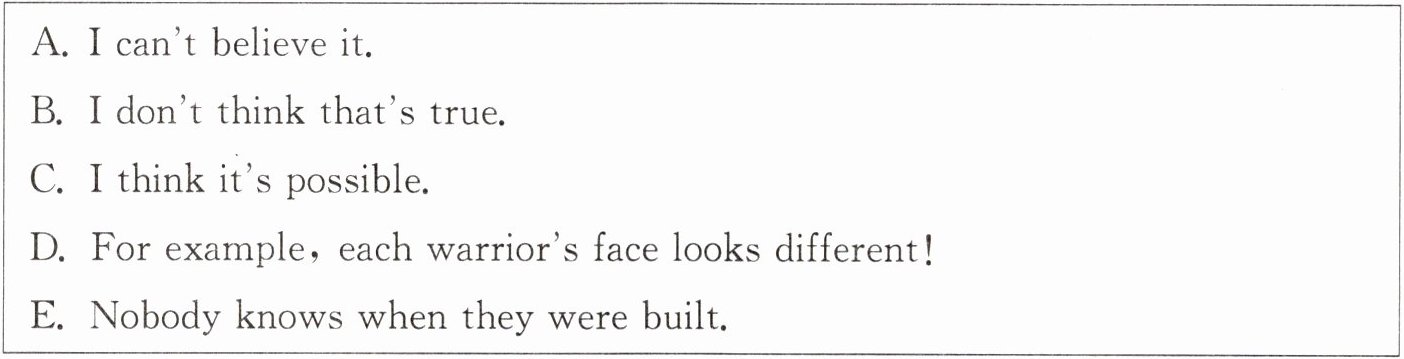
Ⅲ. Choose the proper sentences from A—E to complete the dialogue below (Each sentence can be used only once), then answer the question.
A: Have you ever learned about the Terracotta Warriors and Horses?
B: Yes, I've read lots of articles about them.
A: The Terracotta Warriors and Horses are full of mysteries.
B: What?
A: According to researchers, the craftsmen used real soldiers as models.
B:
A: Well, other scientists say they used molds(模具) to make basic heads first, and then carved(雕刻) different faces and expressions by hand.
B:
A: Exactly. They made such wonderful works without modern machines.
B: Millions of visitors come to Xi'an to see them every year. It's really a treasure of Chinese history.
5. How did craftsmen make different faces of the warriors? What do you think of these ancient craftsmen?
A: Have you ever learned about the Terracotta Warriors and Horses?
B: Yes, I've read lots of articles about them.
A: The Terracotta Warriors and Horses are full of mysteries.
D
1B: What?
A
2 There are thousands of them.A: According to researchers, the craftsmen used real soldiers as models.
B:
B
3 It would take too much time!A: Well, other scientists say they used molds(模具) to make basic heads first, and then carved(雕刻) different faces and expressions by hand.
B:
C
4 Ancient people were so clever!A: Exactly. They made such wonderful works without modern machines.
B: Millions of visitors come to Xi'an to see them every year. It's really a treasure of Chinese history.
5. How did craftsmen make different faces of the warriors? What do you think of these ancient craftsmen?
They used molds to make basic heads first and carved different faces by hand.
I think they are very clever and great.(观点言之有理即可)
答案
1. D 2. A 3. B 4. C
5. They used molds to make basic heads first and carved different faces by hand. I think they are very clever and great.(观点言之有理即可)
5. They used molds to make basic heads first and carved different faces by hand. I think they are very clever and great.(观点言之有理即可)
解析
【分析】
这是一道英语补全对话并回答问题的题目,解题思路如下:1. 先通读对话,明确话题围绕兵马俑的制作工艺展开;2. 分析每个空缺处的前后语境,结合选项的语义和逻辑关系,选择匹配的句子;3. 最后根据对话中的关键信息回答问题,注意提取准确内容并合理表达观点。
【解析】
1. 空缺处前A提到兵马俑充满神秘,后B问“What?”,选项D“For example, each warrior's face looks different!”举例说明兵马俑的神秘之处,符合语境,故选D。
2. 空缺处后B提到“有成千上万的兵马俑”,结合A后续说的“工匠用真实士兵当模型”,B对此表示不敢相信,选项A“I can't believe it.”符合反应,故选A。
3. 空缺处前A说“工匠用真实士兵当模型”,后B说“那太费时间”,说明B不同意该说法,选项B“I don't think that's true.”符合语境,故选B。
4. 空缺处前A说“用模具做基础头,再手工雕刻不同的脸”,后B感叹古代人聪明,说明B认可该说法的可能性,选项C“I think it's possible.”符合,故选C。
5. 根据对话中A的表述“other scientists say they used molds to make basic heads first, and then carved different faces and expressions by hand.”提取制作方法,再结合对话中“Ancient people were so clever!”等内容,表达对古代工匠的评价,言之有理即可。
【答案】
1. D 2. A 3. B 4. C
5. They used molds to make basic heads first and carved different faces by hand. I think they are very clever and great.
【知识点】
补全对话、信息提取、观点表达
【点评】
本题结合中国文化常识(兵马俑),考查学生的语境理解、逻辑推理和信息整合能力,题型常见,贴近学生生活。
【难度系数】
0.6
Ⅳ. Read the passage and finish the two tasks below.
The Longmen Grottoes(石窟): A Great Stone Treasure in China
The Longmen Grottoes are one of China's most important old cultural sites.
They sit in Luoyang, Henan Province. People call them a huge open-air museum full of stone carvings.
There are 2,345 small caves here. Visitors can see more than 100,000 stone statues, together with over 2,800 stone tablets(石碑) with old words on them. It is the world's biggest treasure house of stone carving art with so many statues.
People first started to carve the grottoes more than 1,500 years ago. It was before the year 493 AD, when Emperor Xiaowen of Northern Wei moved the country's capital to Luoyang. Workers kept making new carvings for more than 1,400 years. The work went through more than ten dynasties, so it has the longest building time among all grottoes around the world.
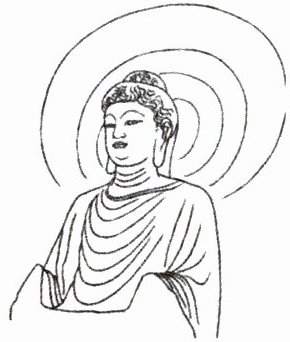
The grottoes are famous for wonderful Buddhist art(佛教艺术). The stone statues show how carving styles changed through different times. Statues from Northern Wei look thin and elegant. Those made in the Tang Dynasty look full and gentle. The most well-known work is the Grand Vairocana Buddha in Fengxian Temple. It stands 17.14 metres tall, with a soft, quiet smile. Lots of tourists call it the "Eastern Mona Lisa".
The Longmen Grottoes are not only beautiful but also very valuable for history and culture. It holds thousands of materials about old religions, arts and daily life. These things help people learn about the politics and culture of ancient China. UNESCO once gave it a great name — the "peak of Chinese stone carving art".
▶Task 1 Short summary. Fill each blank only with numbers.
The Longmen Grottoes lie in Luoyang. There are 1.
▶Task 2 Information table. Fill in each blank with at most four words.
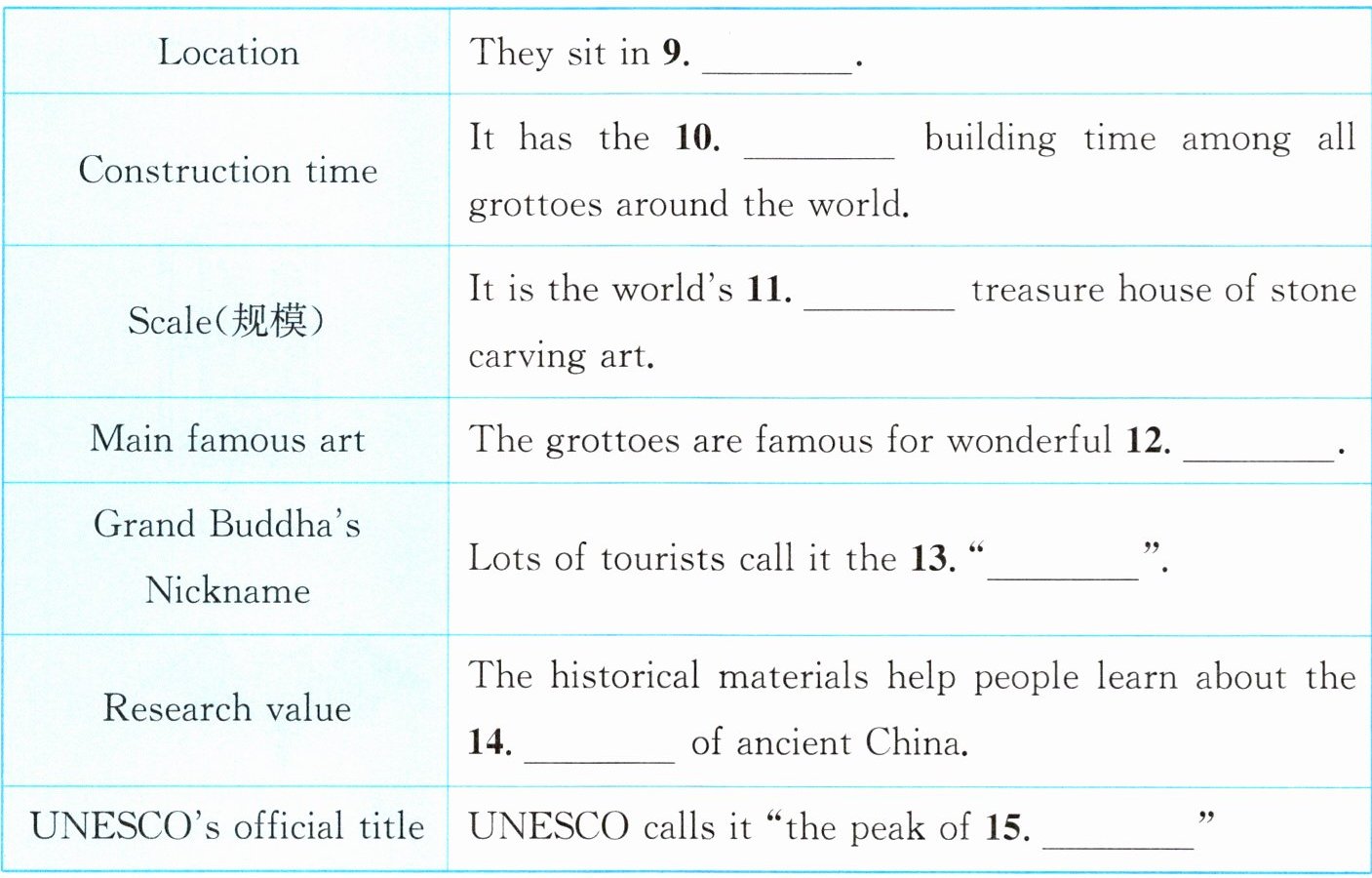
| Location | They sit in 9.
| Construction time | It has the 10.
| Scale(规模) | It is the world's 11.
| Main famous art | The grottoes are famous for wonderful 12.
| Grand Buddha's Nickname | Lots of tourists call it the 13. "
| Research value | The historical materials help people learn about the 14.
| UNESCO's official title | UNESCO calls it "the peak of 15.
The Longmen Grottoes(石窟): A Great Stone Treasure in China
The Longmen Grottoes are one of China's most important old cultural sites.
They sit in Luoyang, Henan Province. People call them a huge open-air museum full of stone carvings.
There are 2,345 small caves here. Visitors can see more than 100,000 stone statues, together with over 2,800 stone tablets(石碑) with old words on them. It is the world's biggest treasure house of stone carving art with so many statues.
People first started to carve the grottoes more than 1,500 years ago. It was before the year 493 AD, when Emperor Xiaowen of Northern Wei moved the country's capital to Luoyang. Workers kept making new carvings for more than 1,400 years. The work went through more than ten dynasties, so it has the longest building time among all grottoes around the world.
The grottoes are famous for wonderful Buddhist art(佛教艺术). The stone statues show how carving styles changed through different times. Statues from Northern Wei look thin and elegant. Those made in the Tang Dynasty look full and gentle. The most well-known work is the Grand Vairocana Buddha in Fengxian Temple. It stands 17.14 metres tall, with a soft, quiet smile. Lots of tourists call it the "Eastern Mona Lisa".
The Longmen Grottoes are not only beautiful but also very valuable for history and culture. It holds thousands of materials about old religions, arts and daily life. These things help people learn about the politics and culture of ancient China. UNESCO once gave it a great name — the "peak of Chinese stone carving art".
▶Task 1 Short summary. Fill each blank only with numbers.
The Longmen Grottoes lie in Luoyang. There are 1.
2,345
caves, more than 2. 100,000
stone statues and over 3. 2,800
stone tablets. People began carving them over 4. 1,500
years ago, before 5. 493
AD. The whole carving work lasted more than 6. 14
hundred years and covered over 7. 10
dynasties. The Grand Vairocana Buddha is 8. 17.14
metres high.▶Task 2 Information table. Fill in each blank with at most four words.
| Location | They sit in 9.
Luoyang, Henan province
. || Construction time | It has the 10.
longest
building time among all grottoes around the world. || Scale(规模) | It is the world's 11.
biggest
treasure house of stone carving art. || Main famous art | The grottoes are famous for wonderful 12.
Buddhist art
. || Grand Buddha's Nickname | Lots of tourists call it the 13. "
Eastern Mona Lisa
". || Research value | The historical materials help people learn about the 14.
politics and culture
of ancient China. || UNESCO's official title | UNESCO calls it "the peak of 15.
Chinese stone carving art
" |答案
1. 2,345 2. 100,000 3. 2,800 4. 1,500 5. 493 6. 14 7. 10 8. 17.14
9. Luoyang, Henan province 10. longest 11. biggest 12. Buddhist art
13. Eastern Mona Lisa 14. politics and culture 15. Chinese stone carving art
9. Luoyang, Henan province 10. longest 11. biggest 12. Buddhist art
13. Eastern Mona Lisa 14. politics and culture 15. Chinese stone carving art
解析
【分析】
本题为说明文类阅读理解的细节信息提取题,需先通读短文,再针对Task1(填数字)和Task2(填最多四个词)的每个空,精准定位短文中对应位置的信息,提取匹配内容即可。
【解析】
Task1(填数字)
1. 定位短文第三段第一句“There are 2,345 small caves here.”,提取数字2,345;
2. 同段“more than 100,000 stone statues”,提取数字100,000;
3. 同段“over 2,800 stone tablets”,提取数字2,800;
4. 第四段第一句“more than 1,500 years ago”,提取数字1,500;
5. 第四段“before the year 493 AD”,提取数字493;
6. 第四段“kept making new carvings for more than 1,400 years”,1400年对应14个百年,提取14;
7. 第四段“went through more than ten dynasties”,提取数字10;
8. 第五段“stands 17.14 metres tall”,提取数字17.14。
Task2(填最多四个词)
9. 定位短文第二段“They sit in Luoyang, Henan Province.”,提取地点信息;
10. 第四段最后一句“has the longest building time among all grottoes around the world.”,提取形容词longest;
11. 第三段最后一句“world's biggest treasure house of stone carving art.”,提取形容词biggest;
12. 第五段第一句“famous for wonderful Buddhist art.”,提取核心名词短语Buddhist art;
13. 第五段最后一句“call it the 'Eastern Mona Lisa'.”,提取昵称;
14. 第六段最后一句“learn about the politics and culture of ancient China.”,提取短语politics and culture;
15. 第六段最后一句“peak of Chinese stone carving art.”,提取核心名词短语Chinese stone carving art。
【答案】
1. 2,345 2. 100,000 3. 2,800 4. 1,500 5. 493 6. 14 7. 10 8. 17.14
9. Luoyang, Henan province 10. longest 11. biggest 12. Buddhist art
13. Eastern Mona Lisa 14. politics and culture 15. Chinese stone carving art
【知识点】
阅读理解,细节信息提取
【点评】
本题为基础的说明文细节查找题,主要考查学生快速定位文本信息的能力,难度较低,适合巩固信息提取的解题方法。
【难度系数】
0.8
