

 登录
三、阅读教材 P92 ~ P93 的课文,完成短文填空
请从方框内选择适当的词并用其正确形式填空,使文章完整连贯。注意每空一词,每词仅用一次,有两词为多余选项。
loudly but in what proud report a throw noisy industry litter village
After the storm passed, the sky turned blue. While the villagers were discussing 1 to do, they found a dark and deep hole in the ground. One woman suggested it might be a fox’s hole. A young man then shouted 2 into the hole, “Hey! Come on out!” But nothing appeared. He threw 3 stone into it but couldn’t hear it land.
The next day, reporters and scientists arrived. A 4 lowered a weight into the hole to measure its depth, but the rope wasn’t long enough. A scientist played loud noises into it 5 heard no echo(回声). She simply suggested filling the hole.
A businessman offered to do it, saying he would fill it 6. He started a hole-filling company. Trucks brought 7 waste from everywhere. As the company grew, it built a road connecting the city with the village. Then people began throwing dead animals and 8 into it—the hole accepted everything.
This gave everyone peace of mind. No one considered the consequences(后果)of their actions. The hole cleaned the city. The sea and sky became clear as glass. People became 9 of their city. Businesses created tall buildings while 10 waste into the hole.
One day, a worker on top of a building heard a strange cry from the clear sky: “Hey! Come on out!” Then he saw a stone fall from the sky.
1.
6.
请从方框内选择适当的词并用其正确形式填空,使文章完整连贯。注意每空一词,每词仅用一次,有两词为多余选项。
loudly but in what proud report a throw noisy industry litter village
After the storm passed, the sky turned blue. While the villagers were discussing 1 to do, they found a dark and deep hole in the ground. One woman suggested it might be a fox’s hole. A young man then shouted 2 into the hole, “Hey! Come on out!” But nothing appeared. He threw 3 stone into it but couldn’t hear it land.
The next day, reporters and scientists arrived. A 4 lowered a weight into the hole to measure its depth, but the rope wasn’t long enough. A scientist played loud noises into it 5 heard no echo(回声). She simply suggested filling the hole.
A businessman offered to do it, saying he would fill it 6. He started a hole-filling company. Trucks brought 7 waste from everywhere. As the company grew, it built a road connecting the city with the village. Then people began throwing dead animals and 8 into it—the hole accepted everything.
This gave everyone peace of mind. No one considered the consequences(后果)of their actions. The hole cleaned the city. The sea and sky became clear as glass. People became 9 of their city. Businesses created tall buildings while 10 waste into the hole.
One day, a worker on top of a building heard a strange cry from the clear sky: “Hey! Come on out!” Then he saw a stone fall from the sky.
1.
what
2. loudly
3. a
4. reporter
5. but
6.
in
7. industrial
8. litter
9. proud
10. throwing
答案
1. what
2. loudly
3. a
4. reporter
5. but
6. in
7. industrial
8. litter
9. proud
10. throwing
2. loudly
3. a
4. reporter
5. but
6. in
7. industrial
8. litter
9. proud
10. throwing
解析
【分析】
这是一道短文选词填空题,要求从给定词汇中选适当词并用正确形式填空,需结合每空的语境、语法结构(如词性、搭配、时态、从句引导等)分析,同时注意每词仅用一次。具体思路:1. 分析从句结构确定引导词;2. 分析动词修饰词确定副词;3. 分析名词泛指用法确定冠词;4. 结合前文人物信息确定名词;5. 分析分句逻辑确定连词;6. 依据固定搭配确定介词;7. 分析名词修饰词确定形容词;8. 结合并列成分确定名词;9. 依据固定短语确定形容词;10. 分析时态结构确定动词形式。
【解析】
1. 空格作discussing的宾语,是宾语从句引导词,表“什么”,故填what;
2. 空格修饰动词shouted,需用副词,方框中loudly为副词,符合语境,故填loudly;
3. stone是可数名词单数,表泛指“一块”,且以辅音音素开头,用不定冠词a,故填a;
4. 前文提到reporters,此处指“一名记者”,需用名词,方框中reporter符合,故填reporter;
5. 前后分句“播放噪音”和“没听到回声”为转折关系,需用连词but,故填but;
6. 固定搭配fill in意为“填充”,符合语境,故填in;
7. 空格修饰名词waste,需用形容词,方框中industrial(工业的)符合,industrial waste指工业垃圾,故填industrial;
8. 空格与dead animals并列,指垃圾,方框中litter符合,故填litter;
9. 固定短语be proud of意为“为……感到骄傲”,符合语境,故填proud;
10. 时态为过去进行时,结构为“was/were + 现在分词”,空格与creating并列,需用现在分词,方框中throwing符合,故填throwing。
【答案】
1. what
2. loudly
3. a
4. reporter
5. but
6. in
7. industrial
8. litter
9. proud
10. throwing
【知识点】选词填空;词汇运用;固定搭配
【点评】本题为短文选词填空,考查学生对词汇的词义、词性、语境及语法知识的综合运用能力,需结合上下文逻辑和固定搭配解题,难度适中,能有效检验学生的语言基础。
【难度系数】
0.5
一 loudly, loud 与 aloud 的区别
A young man shouted loudly into the hole, "Hey! Come on out!" 一个年轻人对着洞大声喊道:“喂!出来!”(教材 P92)
比较项 | 含义及用法 | 举 例
loudly | 作副词,意为“响亮地,大声地”,可与任何发出声响的动词连用,如 knock, talk, explain 等,常带有嘈杂、吵闹、刺耳的感情色彩 | Don’t talk loudly in public. 不要在公共场合大声交谈。
续表
比较项 | 含义及用法 | 举 例
loud | 作形容词,意为“大声的;喧闹的” | The book fell to the floor with a loud bang. 书砰的一声掉落到地上。
loud | 作副词,意为“大声地;喧闹地”,常指声音响亮、高声说话,常用来修饰 talk, speak, sin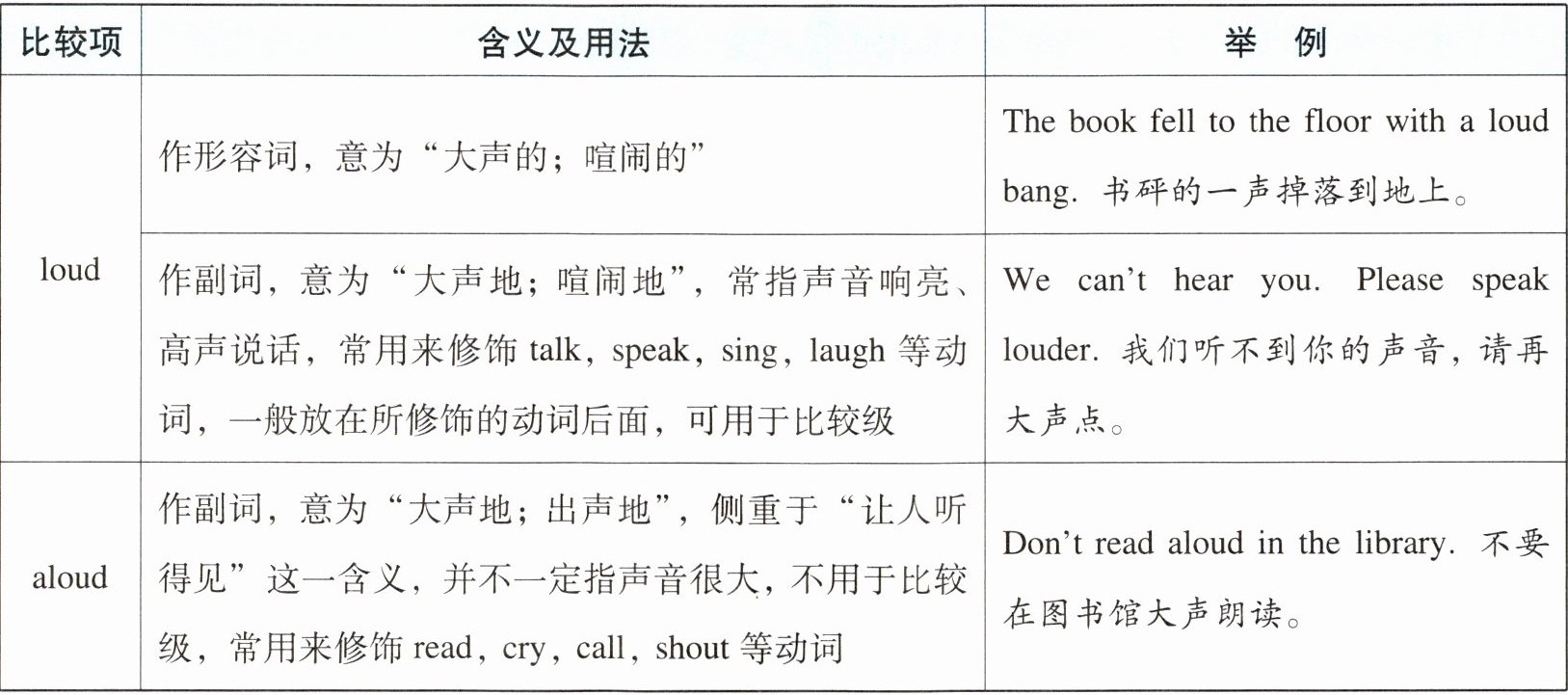 laugh 等动词,一般放在所修饰的动词后面,可用于比较级 | We can’t hear you. Please speak louder. 我们听不到你的声音,请再大声点。
aloud | 作副词,意为“大声地;出声地”,侧重于“让人听得见”这一含义,并不一定指声音很大,不用于比较级,常用来修饰 read, cry, call, shout 等动词 | Don’t read aloud in the library. 不要在图书馆大声朗读。
专练 用 loudly, loud 或 aloud 的适当形式填空
1. Reading
2. Can you speak a bit
3. I heard someone knocking
4. The man always speaks in a
A young man shouted loudly into the hole, "Hey! Come on out!" 一个年轻人对着洞大声喊道:“喂!出来!”(教材 P92)
比较项 | 含义及用法 | 举 例
loudly | 作副词,意为“响亮地,大声地”,可与任何发出声响的动词连用,如 knock, talk, explain 等,常带有嘈杂、吵闹、刺耳的感情色彩
| Don’t talk loudly in public. 不要在公共场合大声交谈。续表
比较项 | 含义及用法 | 举 例
loud | 作形容词,意为“大声的;喧闹的” | The book fell to the floor with a loud bang. 书砰的一声掉落到地上。
loud | 作副词,意为“大声地;喧闹地”,常指声音响亮、高声说话,常用来修饰 talk, speak, sin
laugh 等动词,一般放在所修饰的动词后面,可用于比较级 | We can’t hear you. Please speak louder. 我们听不到你的声音,请再大声点。aloud | 作副词,意为“大声地;出声地”,侧重于“让人听得见”这一含义,并不一定指声音很大,不用于比较级,常用来修饰 read, cry, call, shout 等动词 | Don’t read aloud in the library. 不要在图书馆大声朗读。
专练 用 loudly, loud 或 aloud 的适当形式填空
1. Reading
aloud
is a good way to learn English.2. Can you speak a bit
louder
?3. I heard someone knocking
loudly
at the door.4. The man always speaks in a
loud
voice.答案
1. aloud
2. louder
3. loudly
4. loud
2. louder
3. loudly
4. loud
