

 登录
登录
五 根据图片、首字母或上下文提示补全对话,每空一词。
Mum: It is 1.
Leo: Great! We 3.
Dad: Yes. What 4.
Lily: I'd 5.
Dad: What 7.
Max: I want 8.
Dad: OK. Here you are.
Mum: Remember to 9.
Children: Hooray!
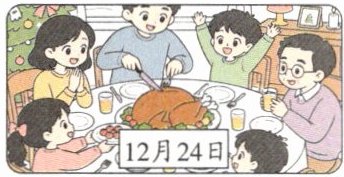
Mum: It is 1.
Christmas
Eve. Time 2. for
lunch.Leo: Great! We 3.
have
a big lunch today.Dad: Yes. What 4.
would
you like, Lily?Lily: I'd 5.
like
the 6. turkey
.Dad: What 7.
about
you, Max?Max: I want 8.
to
eat the Christmas pudding.Dad: OK. Here you are.
Mum: Remember to 9.
hang
your stockings on your 10. beds
. You will see the gifts tomorrow.Children: Hooray!
答案
1. Christmas 2. for 3. have 4. would 5. like 6. turkey 7. about 8. to 9. hang 10. beds
解析
【分析】
先观察图片,图中是12月24日的家庭聚餐场景,有火鸡,结合对话语境可知是圣诞节前夕(平安夜)的对话。解题时需结合图片信息、固定搭配和常用表达补全每空:1. 由节日场景和日期可知是平安夜,对应Christmas Eve;2. “Time for + 名词”是固定句型,表示“到做某事的时间了”;3. “have a big lunch”是常用表达,意为“吃一顿丰盛的午餐”;4. 结合答语的“I'd like...”,问句用“What would you like?”询问想要的食物;5. I'd like是I would like的缩写,是表达想要的常用结构;6. 图片中有火鸡,且首字母为t,对应turkey;7. 反问对方的常用表达“What about you?”;8. “want to do sth.”是固定搭配,意为“想要做某事”;9. 平安夜的习俗是挂袜子,对应hang;10. 袜子通常挂在床上,用复数beds。
【解析】
1. 结合图片的节日场景,12月24日是平安夜,填Christmas;
2. 固定句型“Time for + 名词”,表示“到吃午餐的时间了”,填for;
3. 表达“吃午餐”用have,填have;
4. 根据答语的would like,问句用would,填would;
5. I'd like是固定表达,填like;
6. 图片中的火鸡首字母为t,填turkey;
7. 反问对方的常用表达“What about you?”,填about;
8. want to do sth.是固定搭配,填to;
9. 平安夜挂袜子,填hang;
10. 袜子挂在床上,用复数beds,填beds。
【答案】
1. Christmas 2. for 3. have 4. would 5. like 6. turkey 7. about 8. to 9. hang 10. beds
【知识点】
固定句型、常用表达、节日词汇
【点评】
本题结合图片和节日场景,考查日常对话中的固定搭配和常用表达,需要学生掌握节日相关词汇和常用句型,难度适中。
【难度系数】
0.5
先观察图片,图中是12月24日的家庭聚餐场景,有火鸡,结合对话语境可知是圣诞节前夕(平安夜)的对话。解题时需结合图片信息、固定搭配和常用表达补全每空:1. 由节日场景和日期可知是平安夜,对应Christmas Eve;2. “Time for + 名词”是固定句型,表示“到做某事的时间了”;3. “have a big lunch”是常用表达,意为“吃一顿丰盛的午餐”;4. 结合答语的“I'd like...”,问句用“What would you like?”询问想要的食物;5. I'd like是I would like的缩写,是表达想要的常用结构;6. 图片中有火鸡,且首字母为t,对应turkey;7. 反问对方的常用表达“What about you?”;8. “want to do sth.”是固定搭配,意为“想要做某事”;9. 平安夜的习俗是挂袜子,对应hang;10. 袜子通常挂在床上,用复数beds。
【解析】
1. 结合图片的节日场景,12月24日是平安夜,填Christmas;
2. 固定句型“Time for + 名词”,表示“到吃午餐的时间了”,填for;
3. 表达“吃午餐”用have,填have;
4. 根据答语的would like,问句用would,填would;
5. I'd like是固定表达,填like;
6. 图片中的火鸡首字母为t,填turkey;
7. 反问对方的常用表达“What about you?”,填about;
8. want to do sth.是固定搭配,填to;
9. 平安夜挂袜子,填hang;
10. 袜子挂在床上,用复数beds,填beds。
【答案】
1. Christmas 2. for 3. have 4. would 5. like 6. turkey 7. about 8. to 9. hang 10. beds
【知识点】
固定句型、常用表达、节日词汇
【点评】
本题结合图片和节日场景,考查日常对话中的固定搭配和常用表达,需要学生掌握节日相关词汇和常用句型,难度适中。
【难度系数】
0.5
六 新情境 传统文化 阅读短文,完成任务。
1. 图文匹配。
A. Nian was a monster. He lived in the hills. In the past, at the end of every year, he went into the village and ate people!
B. One day, an old man came to the village. He told the people something about Nian.
C. Soon it was the last day of the year. Nian came down from the hills. He saw red paper on the doors and windows. He also saw red firecrackers. He felt afraid and ran back into the hills.
D. From then on, the people in the village didn't see Nian any longer. So they used red things and lighted firecrackers to scare(使……害怕) Nian at the Spring Festival every year.

(
2. 根据以上内容完成短文。
I'm Nian. I live in the
1. 图文匹配。
A. Nian was a monster. He lived in the hills. In the past, at the end of every year, he went into the village and ate people!
B. One day, an old man came to the village. He told the people something about Nian.
C. Soon it was the last day of the year. Nian came down from the hills. He saw red paper on the doors and windows. He also saw red firecrackers. He felt afraid and ran back into the hills.
D. From then on, the people in the village didn't see Nian any longer. So they used red things and lighted firecrackers to scare(使……害怕) Nian at the Spring Festival every year.
(
B
) (D
) (A
) (C
)2. 根据以上内容完成短文。
I'm Nian. I live in the
hills
. It's the end of the year. I'm hungry. I'm going to the village
. I want to eat
people. But I see many red
things in the village. I'm afraid
. So I go back to the hills.答案
1. B D A C 2. hills; village; eat; red; afraid
解析
【分析】
第1题图文匹配需先理解每个选项的核心内容,再结合插图场景对应:先明确各选项描述,再匹配插图对应的情节;第2题填空需从短文中提取关键信息,结合语境填写合适词汇。
【解析】
1. 图文匹配:
插图1:老人向村民讲解年的相关内容,对应选项B(一位老人来到村里,告诉人们关于年的事);
插图2:村民贴红色装饰、放鞭炮,对应选项D(人们每年春节用红色物品和鞭炮驱赶年);
插图3:年的怪兽形象,对应选项A(年是住在山里的怪兽,年末会进村吃人);
插图4:孩子们放鞭炮驱赶年,对应选项C(年看到红色和鞭炮后害怕跑回山里)。
因此匹配结果为B、D、A、C。
2. 短文填空:
根据短文内容,“I'm Nian. I live in the hills.” 填hills;“he went into the village” 填village;“ate people” 填eat;“He saw red paper on the doors and windows. He also saw red firecrackers.” 填red;“He felt afraid” 填afraid。
【答案】
1. B D A C
2. hills; village; eat; red; afraid
【知识点】
传统文化(春节)、阅读理解、词汇运用
【点评】
本题结合春节传统文化设计,既考察英语阅读理解能力,又传递了年兽的传说知识,题型基础,侧重短文细节信息的提取。
【难度系数】
0.6
第1题图文匹配需先理解每个选项的核心内容,再结合插图场景对应:先明确各选项描述,再匹配插图对应的情节;第2题填空需从短文中提取关键信息,结合语境填写合适词汇。
【解析】
1. 图文匹配:
插图1:老人向村民讲解年的相关内容,对应选项B(一位老人来到村里,告诉人们关于年的事);
插图2:村民贴红色装饰、放鞭炮,对应选项D(人们每年春节用红色物品和鞭炮驱赶年);
插图3:年的怪兽形象,对应选项A(年是住在山里的怪兽,年末会进村吃人);
插图4:孩子们放鞭炮驱赶年,对应选项C(年看到红色和鞭炮后害怕跑回山里)。
因此匹配结果为B、D、A、C。
2. 短文填空:
根据短文内容,“I'm Nian. I live in the hills.” 填hills;“he went into the village” 填village;“ate people” 填eat;“He saw red paper on the doors and windows. He also saw red firecrackers.” 填red;“He felt afraid” 填afraid。
【答案】
1. B D A C
2. hills; village; eat; red; afraid
【知识点】
传统文化(春节)、阅读理解、词汇运用
【点评】
本题结合春节传统文化设计,既考察英语阅读理解能力,又传递了年兽的传说知识,题型基础,侧重短文细节信息的提取。
【难度系数】
0.6
