登录
登录
2. 如图,已知$△ ABC$,$BC$边的中点$M$.
(1)分别以$AB$和$AC$为腰,向$△ ABC$的外侧作等腰三角形,其中$AD=AB$,$AC=AE$,且$∠ BAE=∠ DAC=90°$,如图①所示.
①若$∠ BAC=70°$,求$∠ DAE$的度数;
②求证:$DE=2AM$.
(2)分别以$AB$和$AC$为斜边,向$△ ABC$的外侧作等腰直角三角形,其中$∠ ADB=∠ AEC=90°$,如图②所示,连接$MD$和$ME$,则$MD$和$ME$具有怎样的数量和位置关系?请给出证明过程.
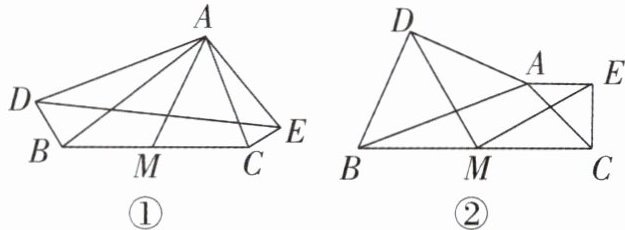
(1)分别以$AB$和$AC$为腰,向$△ ABC$的外侧作等腰三角形,其中$AD=AB$,$AC=AE$,且$∠ BAE=∠ DAC=90°$,如图①所示.
①若$∠ BAC=70°$,求$∠ DAE$的度数;
②求证:$DE=2AM$.
(2)分别以$AB$和$AC$为斜边,向$△ ABC$的外侧作等腰直角三角形,其中$∠ ADB=∠ AEC=90°$,如图②所示,连接$MD$和$ME$,则$MD$和$ME$具有怎样的数量和位置关系?请给出证明过程.
答案
(1)①$\because ∠ DAC=∠ BAE=90°,∠ BAC=70°,\therefore ∠ DAB=∠ CAE=20°,\therefore ∠ DAE=∠ DAB+∠ BAE=110°.$
②如图①,延长 $AM$ 到 $R$,使得 $MR=AM$,连接 $BR,CR.\because AM=RM,∠ AMC=∠ RMB,CM=BM,\therefore △ AMC≌ △ RMB(SAS),$ $\therefore AC=BR,∠ MAC=∠ MRB,\therefore AC// BR,\therefore ∠ ABR=180°-∠ BAC.\because ∠ DAE=180°-∠ BAC,\therefore ∠ DAE=∠ ABR.\because AD=AB,AE=AC,\therefore AE=BR,\therefore △ DAE≌ △ ABR(SAS),\therefore DE=AR.$ $\because AR=2AM,\therefore DE=2AM.$
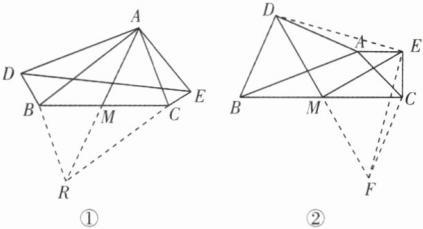
(2)$MD=ME,MD⊥ ME.$ 证明:如图②,延长 $DM$ 至 $F$,使得 $MF=MD$.连接 $ED,EF,CF,\because M$ 是 $BC$ 的中点,$\therefore △ MBD≌ △ MCF(SAS),\therefore BD=CF=DA,∠ DBM=∠ MCF,$ 设$∠ ABC=x,$ $∠ ACB=y,\therefore ∠ BAC=180°-x-y,\therefore ∠ EAD=360°-45°-45°-(180°-x-y)=90°+x+y.\because ∠ MCF=∠ DBM=45°+x,\therefore ∠ ECF=45°+x+y+45°=90°+x+y,\therefore ∠ EAD=∠ ECF,\therefore △ EAD≌ △ ECF(SAS),\therefore ED=EF,∠ DEA=∠ FEC,\therefore ∠ DEF=∠ AEC=90°,$ $\therefore △ EDF$ 是等腰直角三角形. $\because MF=MD,\therefore MD=ME,$ $MD⊥ ME.$
3. 如图①,在$△ ABC$中,$∠ ACB=90°$,$BC=AC$,点$D$在$AB$上,$DE ⊥ AB$交$BC$于$E$,点$F$是$AE$的中点.
(1)线段$FD$与线段$FC$的数量关系为________,位置关系为________.
(2)如图②,将$△ BDE$绕点$B$逆时针旋转$α(0°<α<90°)$,其他条件不变,线段$FD$与线段$FC$的关系是否变化?写出你的结论并证明.
(3)将$△ BDE$绕点$B$逆时针旋转一周,如果$BA=4$,$BE=2$,直接写出线段$BF$的取值范围.
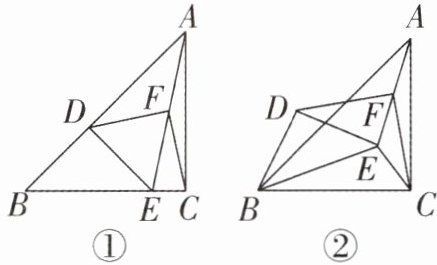
(1)线段$FD$与线段$FC$的数量关系为________,位置关系为________.
(2)如图②,将$△ BDE$绕点$B$逆时针旋转$α(0°<α<90°)$,其他条件不变,线段$FD$与线段$FC$的关系是否变化?写出你的结论并证明.
(3)将$△ BDE$绕点$B$逆时针旋转一周,如果$BA=4$,$BE=2$,直接写出线段$BF$的取值范围.
答案
(1)$FD=FC$,$FD⊥ FC$ 解析: $\because ∠ ADE=∠ ACE=90°,AF=FE,\therefore DF=AF=EF=CF,\therefore ∠ FAD=∠ FDA,∠ FAC=∠ FCA,\therefore ∠ DFE=∠ FDA+∠ FAD=2∠ FAD,∠ EFC=∠ FAC+∠ FCA=2∠ FAC.\because CA=CB,∠ ACB=90°,\therefore ∠ BAC=45°,$ $\therefore ∠ DFC=∠ DFE+∠ EFC=2(∠ FAD+∠ FAC)=90°,\therefore FD=FC,FD⊥ FC.$
(2)结论不变.证明:如图①,延长 $DF$,截取 $FG=FD$,连接 $AG,CG,CD$,延长 $DE$ 交 $AC$ 于点 $K.\because EF=AF,DF=FG,$ $∠ DFE=∠ AFG,\therefore △ DEF≌ △ GAF(SAS),\therefore AG=ED,∠ AGF=∠ EDF,$ $\therefore AG// DE,\therefore ∠ GAC=∠ AKD.$
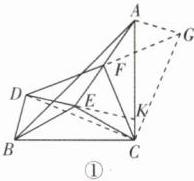
$\because ∠ BDE=∠ ACB=90°,\therefore ∠ DKC+∠ DBC=360°-90°-90°=180°.$ 又$\because ∠ DKC+∠ DKA=180°,$ $\therefore ∠ DKA=∠ DBC,\therefore ∠ DBC=∠ GAC.$ 又$\because BD=DE=AG,$ $BC=AC,\therefore △ BCD≌ △ ACG(SAS).\therefore CD=CG,∠ BCD=∠ ACG,$ $\therefore ∠ DCG=∠ DCA+∠ ACG=∠ DCA+∠ BCD=90°,\therefore △ DCG$ 是等腰直角三角形.又$\because$ 点 $F$ 是 $DG$ 的中点,$\therefore FD=FC,FD⊥ FC.$
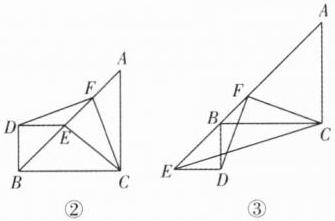
(3)$1≤ BF≤ 3.$ 解析:如图②,当点 $E$ 落在 $AB$ 上时,$BF$ 的长最大,最大值$=3$;如图③,当点 $E$ 落在 $AB$ 的延长线上时,$BF$ 的值最小,最小值$=1$.综上所述,$BF$ 的取值范围为$1≤ BF≤ 3.$