

 登录
登录
情境2 人类对月球的探索有很多里程碑,那么科学家究竟在探索中发现了什么?让我们一起看看。
任务二 新体裁·实验说明书 阅读理解A(10分)
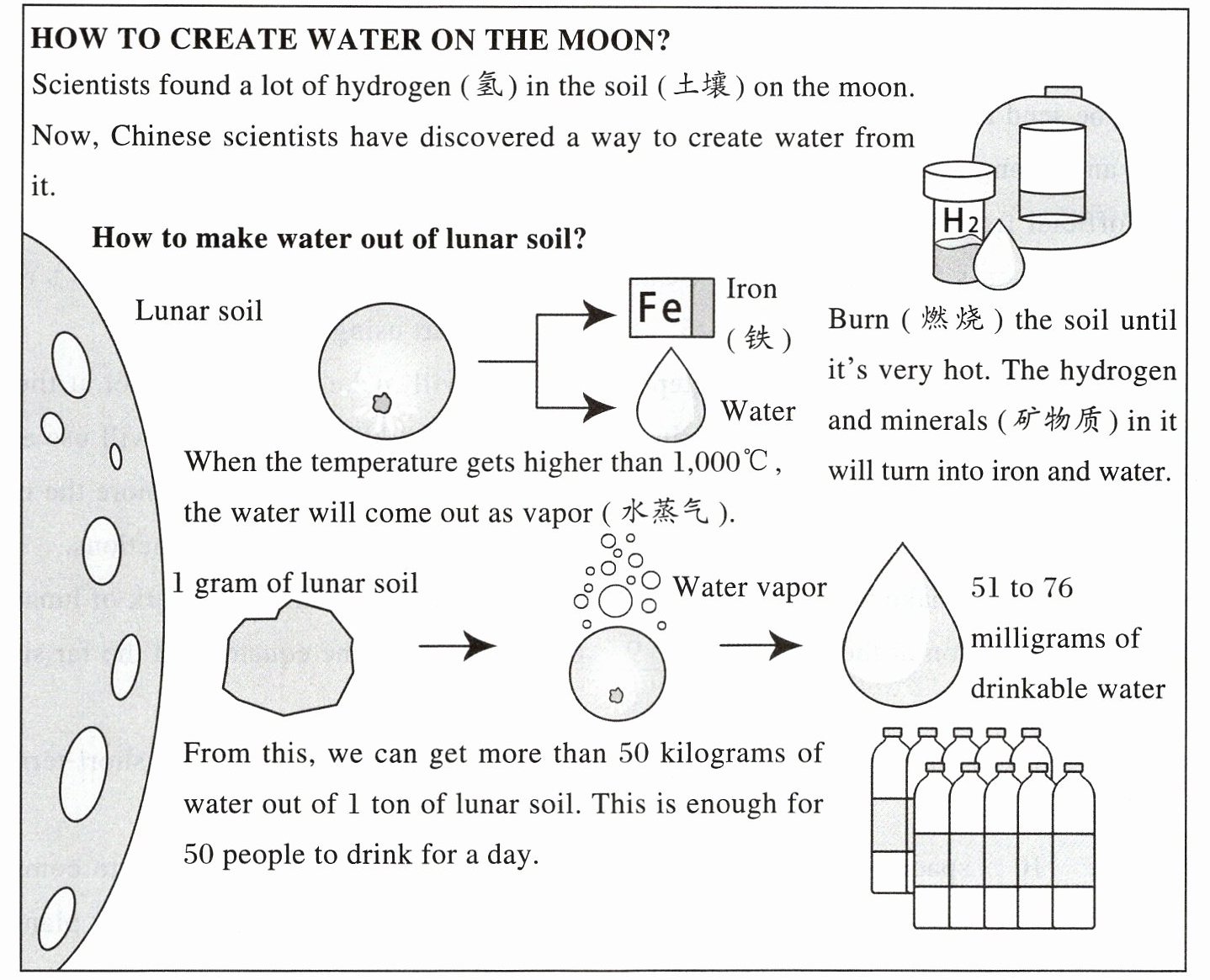
HOW TO CREATE WATER ON THE MOON?
Scientists found a lot of hydrogen (氢) in the soil (土壤) on the moon.
Now, Chinese scientists have discovered a way to create water from it.
How to make water out of lunar soil?
Lunar soil
When the temperature gets higher than 1,000℃, the water will come out as vapor (水蒸气).
Burn (燃烧) the soil until it’s very hot. The hydrogen and minerals (矿物质) in it will turn into iron and water.
1 gram of lunar soil
From this, we can get more than 50 kilograms of water out of 1 ton of lunar soil. This is enough for 50 people to drink for a day.
(
A. Water. B. Oxygen. C. Carbon dioxide. D. Hydrogen.
(
A. American scientists. B. European scientists.
C. Chinese scientists. D. Japanese scientists.
(
A. Adding oxygen. B. Burning the soil until it’s very hot.
C. Mixing the soil with other elements. D. Cooling down the soil.
(
A. 500℃. B. 750℃. C. 900℃. D. Over 1,000℃.
(
A. Science Study. B. Star Stories. C. School Time. D. Your Voice.
任务二 新体裁·实验说明书 阅读理解A(10分)
HOW TO CREATE WATER ON THE MOON?
Scientists found a lot of hydrogen (氢) in the soil (土壤) on the moon.
Now, Chinese scientists have discovered a way to create water from it.
How to make water out of lunar soil?
Lunar soil
When the temperature gets higher than 1,000℃, the water will come out as vapor (水蒸气).
Burn (燃烧) the soil until it’s very hot. The hydrogen and minerals (矿物质) in it will turn into iron and water.
1 gram of lunar soil
From this, we can get more than 50 kilograms of water out of 1 ton of lunar soil. This is enough for 50 people to drink for a day.
(
D
)16. What did scientists find in lunar soil?A. Water. B. Oxygen. C. Carbon dioxide. D. Hydrogen.
(
C
)17. Who discovered a way to create water from lunar soil?A. American scientists. B. European scientists.
C. Chinese scientists. D. Japanese scientists.
(
B
)18. What is the first step in making water out of lunar soil according to the poster?A. Adding oxygen. B. Burning the soil until it’s very hot.
C. Mixing the soil with other elements. D. Cooling down the soil.
(
D
)19. At what temperature does water come out as vapor from lunar soil?A. 500℃. B. 750℃. C. 900℃. D. Over 1,000℃.
(
A
)20. In which section of a newspaper can we probably read the passage?A. Science Study. B. Star Stories. C. School Time. D. Your Voice.
答案
任务二 答案速查 16.D 17.C 18.B 19.D 20.A
【主旨大意】本文主要介绍了中国科学家从月球土壤中制造水的相关情况,包括发现的物质、制造方法及产水量等内容。
16. D 【点拨】细节理解题。根据“Scientists found a lot of hydrogen (氢) in the soil (土壤) on the moon.”可知,科学家在月球土壤中发现了氢。
17. C 【点拨】细节理解题。根据“Now, Chinese scientists have discovered a way to create water from it.”可知,是中国科学家发现了从月球土壤中制造水的方法。
18. B 【点拨】细节理解题。根据“How to make water out of lunar soil?”和“Burn (燃烧) the soil until it's very hot.”可知,用月球土壤制造水的第一步是燃烧土壤直到它变得很热。
19. D 【点拨】细节理解题。根据“When the temperature gets higher than 1,000 ℃, the water will come out as vapor (水蒸气).”可知,当温度高于1000摄氏度时,水会以水蒸气的形式从月球土壤中出来。
20. A 【点拨】推理判断题。本文主要讲的是从月球土壤中制造水的科学知识,属于科学研究范畴,所以可能在报纸的“Science Study”版块读到这篇文章。
【主旨大意】本文主要介绍了中国科学家从月球土壤中制造水的相关情况,包括发现的物质、制造方法及产水量等内容。
16. D 【点拨】细节理解题。根据“Scientists found a lot of hydrogen (氢) in the soil (土壤) on the moon.”可知,科学家在月球土壤中发现了氢。
17. C 【点拨】细节理解题。根据“Now, Chinese scientists have discovered a way to create water from it.”可知,是中国科学家发现了从月球土壤中制造水的方法。
18. B 【点拨】细节理解题。根据“How to make water out of lunar soil?”和“Burn (燃烧) the soil until it's very hot.”可知,用月球土壤制造水的第一步是燃烧土壤直到它变得很热。
19. D 【点拨】细节理解题。根据“When the temperature gets higher than 1,000 ℃, the water will come out as vapor (水蒸气).”可知,当温度高于1000摄氏度时,水会以水蒸气的形式从月球土壤中出来。
20. A 【点拨】推理判断题。本文主要讲的是从月球土壤中制造水的科学知识,属于科学研究范畴,所以可能在报纸的“Science Study”版块读到这篇文章。
解析
【分析】
本题为科普类阅读理解,共5道小题,其中16-19题为细节理解题,需通过题干关键词定位原文对应信息;20题为推理判断题,需结合文章主题判断所属版块。解题时先明确题干要求,再到原文中查找相关内容,逐一匹配选项即可得出答案。
【解析】
16. 细节理解题:根据原文“Scientists found a lot of hydrogen (氢) in the soil (土壤) on the moon.”可知,科学家在月球土壤中发现了氢,对应选项D。
17. 细节理解题:根据原文“Now, Chinese scientists have discovered a way to create water from it.”可知,中国科学家发现了从月球土壤中制造水的方法,对应选项C。
18. 细节理解题:根据原文“How to make water out of lunar soil?”下的“Burn (燃烧) the soil until it’s very hot.”可知,用月球土壤制水的第一步是燃烧土壤至高温,对应选项B。
19. 细节理解题:根据原文“When the temperature gets higher than 1,000 ℃, the water will come out as vapor (水蒸气).”可知,温度高于1000℃时水以水蒸气形式析出,对应选项D。
20. 推理判断题:文章主要介绍从月球土壤制水的科学研究内容,属于科学学习范畴,因此可能出现在报纸的“Science Study”版块,对应选项A。
【答案】
16.D 17.C 18.B 19.D 20.A
【知识点】
细节理解题、推理判断题、科普阅读理解
【点评】
本题围绕月球制水的科普内容设题,侧重考查学生的信息定位与推理判断能力,题目难度不大,只要仔细阅读原文、找准对应信息即可完成解答,体现了英语阅读在科普知识传播中的作用。
【难度系数】
0.8
本题为科普类阅读理解,共5道小题,其中16-19题为细节理解题,需通过题干关键词定位原文对应信息;20题为推理判断题,需结合文章主题判断所属版块。解题时先明确题干要求,再到原文中查找相关内容,逐一匹配选项即可得出答案。
【解析】
16. 细节理解题:根据原文“Scientists found a lot of hydrogen (氢) in the soil (土壤) on the moon.”可知,科学家在月球土壤中发现了氢,对应选项D。
17. 细节理解题:根据原文“Now, Chinese scientists have discovered a way to create water from it.”可知,中国科学家发现了从月球土壤中制造水的方法,对应选项C。
18. 细节理解题:根据原文“How to make water out of lunar soil?”下的“Burn (燃烧) the soil until it’s very hot.”可知,用月球土壤制水的第一步是燃烧土壤至高温,对应选项B。
19. 细节理解题:根据原文“When the temperature gets higher than 1,000 ℃, the water will come out as vapor (水蒸气).”可知,温度高于1000℃时水以水蒸气形式析出,对应选项D。
20. 推理判断题:文章主要介绍从月球土壤制水的科学研究内容,属于科学学习范畴,因此可能出现在报纸的“Science Study”版块,对应选项A。
【答案】
16.D 17.C 18.B 19.D 20.A
【知识点】
细节理解题、推理判断题、科普阅读理解
【点评】
本题围绕月球制水的科普内容设题,侧重考查学生的信息定位与推理判断能力,题目难度不大,只要仔细阅读原文、找准对应信息即可完成解答,体现了英语阅读在科普知识传播中的作用。
【难度系数】
0.8
