

 登录
登录
三、 前沿科技 脑科学与艺术 无锡期中 阅读理解
主题:人与社会——审美与艺术欣赏 学科素养:文化意识 词数:约370 建议用时:10分钟
Artwork is lovely to look at, and it has the power to make people feel and think differently. But do you know that when people see a real work of art, rather than just looking at a photo of it, they are likely to experience stronger emotions (情绪)?
Scientists recently carried out a study at the Mauritshuis museum in The Hague, in the Netherlands. The museum is home to Girl with a Pearl Earring, a very famous painting by Dutch artist Johannes Vermeer. It was painted in 1665.

① The researchers used eye-tracking equipment and a brain scanner to watch how people reacted to several paintings. First, the volunteers were asked to look at the real paintings on display, and then at photos of the artworks in the museum shop.
② It was shown that their emotional reactions were 10 times stronger when they looked at the real paintings. The most active part of the brain while looking at the artworks was the area that controls people’s personal identity (身份) and consciousness (意识).
③ How did that happen? By study, people may experience something called a “sustained attentional loop” when they watched a certain painting. The volunteers’ attention was first drawn to the girl’s left eye, then her mouth, then to her pearl earring. This certain order of eye movements repeated in a continuous loop. Each time they completed the cycle, their focus became stronger and their connection with Girl with a Pearl Earring was deeper, which meant that people stared at the painting for longer. Martin de Munnik, one of the researchers in this study, said, “That means you have to pay attention whether you want to or not.” It was as if the painting itself had a power to hold the viewers’ attention and guide their eye movement in a very involuntary (无意识的) way.
④ The director of the Mauritshuis, Martine Gosselink, said that the study shows how important it is to go and see art in real life, whether it’s paintings, photography or dancing. She added, “It really helps develop your brain.” The researchers are now eager to broaden their study, planning to visit other museums and do similar experiments on works like the Mona Lisa by Leonardo da Vinci.
(
A. ① B. ② C. ③ D. ④
(
A. By giving an example. B. By telling a story.
C. By listing numbers. D. By offering advice.
(
A. To introduce a world-famous artwork. B. To explain the plan for further research.
C. To show the researchers’ love for it. D. To prove its influence on people’s brain.
(
A. The Power of Real Works of Art B. Lessons from Real Works of Art
C. The Way to Enjoy Real Works of Art D. A Visit to Real Works of Art
主题:人与社会——审美与艺术欣赏 学科素养:文化意识 词数:约370 建议用时:10分钟
Artwork is lovely to look at, and it has the power to make people feel and think differently. But do you know that when people see a real work of art, rather than just looking at a photo of it, they are likely to experience stronger emotions (情绪)?
Scientists recently carried out a study at the Mauritshuis museum in The Hague, in the Netherlands. The museum is home to Girl with a Pearl Earring, a very famous painting by Dutch artist Johannes Vermeer. It was painted in 1665.
① The researchers used eye-tracking equipment and a brain scanner to watch how people reacted to several paintings. First, the volunteers were asked to look at the real paintings on display, and then at photos of the artworks in the museum shop.
② It was shown that their emotional reactions were 10 times stronger when they looked at the real paintings. The most active part of the brain while looking at the artworks was the area that controls people’s personal identity (身份) and consciousness (意识).
③ How did that happen? By study, people may experience something called a “sustained attentional loop” when they watched a certain painting. The volunteers’ attention was first drawn to the girl’s left eye, then her mouth, then to her pearl earring. This certain order of eye movements repeated in a continuous loop. Each time they completed the cycle, their focus became stronger and their connection with Girl with a Pearl Earring was deeper, which meant that people stared at the painting for longer. Martin de Munnik, one of the researchers in this study, said, “That means you have to pay attention whether you want to or not.” It was as if the painting itself had a power to hold the viewers’ attention and guide their eye movement in a very involuntary (无意识的) way.
④ The director of the Mauritshuis, Martine Gosselink, said that the study shows how important it is to go and see art in real life, whether it’s paintings, photography or dancing. She added, “It really helps develop your brain.” The researchers are now eager to broaden their study, planning to visit other museums and do similar experiments on works like the Mona Lisa by Leonardo da Vinci.
(
C
)1. 新考法+内容还原 We can put the following sentence “The team also found that the group reacted even more strongly to Girl with a Pearl Earring.” in .A. ① B. ② C. ③ D. ④
(
A
)2. How does the writer introduce the “sustained attentional loop”?A. By giving an example. B. By telling a story.
C. By listing numbers. D. By offering advice.
(
B
)3. Why was Mona Lisa mentioned at the end of the passage?A. To introduce a world-famous artwork. B. To explain the plan for further research.
C. To show the researchers’ love for it. D. To prove its influence on people’s brain.
(
A
)4. What is the best title of the passage?A. The Power of Real Works of Art B. Lessons from Real Works of Art
C. The Way to Enjoy Real Works of Art D. A Visit to Real Works of Art
答案
【主旨大意】本文介绍一项科学研究,发现人们欣赏真实画作时情绪感受远强于观看照片,并以《戴珍珠耳环的少女》为例,解释背后的注意力循环原理,还提及研究者计划在其他博物馆开展进一步实验。
1. C 【点拨】第五段开始探讨人们对画作产生强烈反应的原因,插入句“该团队还发现,对于《戴珍珠耳环的少女》这幅画,该群体的反应甚至更为强烈”能很好地引出后文以《戴珍珠耳环的少女》为例的阐述,使上下文逻辑更连贯,所以插入句适合放在③处。
2. A 【点拨】根据“The volunteers’ attention was first drawn to the girl’s left eye, then her mouth, then to her pearl earring. This certain order of eye movements repeated in a continuous loop.”可知,作者以这一具体观看过程为例,介绍了“持续注意循环”。
3. B 【点拨】根据“The researchers are now eager to broaden their study, planning to visit other museums and do similar experiments on works like the Mona Lisa by Leonardo da Vinci.”可知,提到《蒙娜丽莎》是为了具体说明未来研究的拓展对象,从而解释研究的下一步计划。
4. A
解析
【分析】
本题为阅读理解题,需结合文章内容逐一分析各题:
1. 第1题是句子还原题,需判断插入句与段落的逻辑衔接:插入句提到对《戴珍珠耳环的少女》反应更强,段落③开始探讨反应的原因,且后续以该画为例说明注意力循环,因此适合放在③处。
2. 第2题考查说明方法,需定位“sustained attentional loop”的介绍部分,原文通过志愿者看画时眼睛移动的具体例子说明该概念,因此选举例子。
3. 第3题是细节理解题,需定位《蒙娜丽莎》的相关内容:原文最后提到研究者计划拓展研究,以《蒙娜丽莎》为例说明进一步研究的对象,因此选B。
4. 第4题是主旨大意题,需概括全文核心:文章围绕真实艺术作品比照片更能触动情绪、吸引注意力展开,核心是真实艺术作品的力量,因此选A。
【解析】
1. 句子还原题:插入句“该团队还发现,对于《戴珍珠耳环的少女》这幅画,该群体的反应甚至更为强烈”,需匹配段落逻辑。段落③承接前文“真实画作情绪反应更强”,进一步以《戴珍珠耳环的少女》为例说明反应的具体情况,因此插入句适合放在③处,选C。
2. 说明方法题:定位“sustained attentional loop”的介绍,原文通过“志愿者的注意力先被左眼吸引,再到嘴、珍珠耳环,这种眼动顺序循环”的具体例子说明该概念,因此选A(举例子)。
3. 细节理解题:定位《蒙娜丽莎》的相关内容,原文最后一句“研究者计划拓展研究,对《蒙娜丽莎》等作品做类似实验”,说明提到《蒙娜丽莎》是为了解释进一步研究的计划,选B。
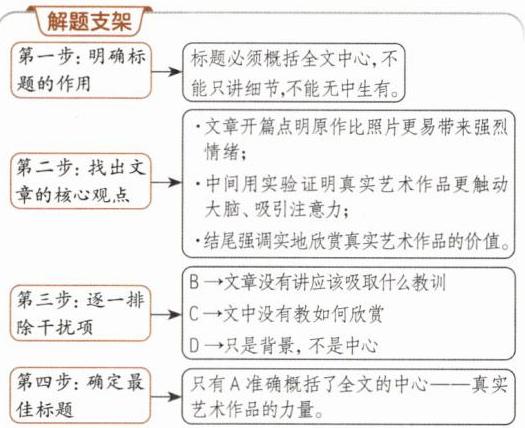
4. 主旨大意题:文章开篇点明真实艺术作品比照片更易带来强烈情绪,中间用实验证明真实作品更触动大脑,结尾强调实地欣赏真实作品的价值,核心是真实艺术作品的力量,因此选A。
【答案】
1.C 2.A 3.B 4.A
【知识点】
阅读理解、句子还原、主旨大意
【点评】
本题是结合脑科学与艺术的阅读理解题,涵盖句子还原、说明方法、细节理解、主旨大意等考点,需学生理清段落逻辑,把握文章核心观点,难度适中,符合期中测试的考查要求。
【难度系数】
0.6
本题为阅读理解题,需结合文章内容逐一分析各题:
1. 第1题是句子还原题,需判断插入句与段落的逻辑衔接:插入句提到对《戴珍珠耳环的少女》反应更强,段落③开始探讨反应的原因,且后续以该画为例说明注意力循环,因此适合放在③处。
2. 第2题考查说明方法,需定位“sustained attentional loop”的介绍部分,原文通过志愿者看画时眼睛移动的具体例子说明该概念,因此选举例子。
3. 第3题是细节理解题,需定位《蒙娜丽莎》的相关内容:原文最后提到研究者计划拓展研究,以《蒙娜丽莎》为例说明进一步研究的对象,因此选B。
4. 第4题是主旨大意题,需概括全文核心:文章围绕真实艺术作品比照片更能触动情绪、吸引注意力展开,核心是真实艺术作品的力量,因此选A。
【解析】
1. 句子还原题:插入句“该团队还发现,对于《戴珍珠耳环的少女》这幅画,该群体的反应甚至更为强烈”,需匹配段落逻辑。段落③承接前文“真实画作情绪反应更强”,进一步以《戴珍珠耳环的少女》为例说明反应的具体情况,因此插入句适合放在③处,选C。
2. 说明方法题:定位“sustained attentional loop”的介绍,原文通过“志愿者的注意力先被左眼吸引,再到嘴、珍珠耳环,这种眼动顺序循环”的具体例子说明该概念,因此选A(举例子)。
3. 细节理解题:定位《蒙娜丽莎》的相关内容,原文最后一句“研究者计划拓展研究,对《蒙娜丽莎》等作品做类似实验”,说明提到《蒙娜丽莎》是为了解释进一步研究的计划,选B。
4. 主旨大意题:文章开篇点明真实艺术作品比照片更易带来强烈情绪,中间用实验证明真实作品更触动大脑,结尾强调实地欣赏真实作品的价值,核心是真实艺术作品的力量,因此选A。
【答案】
1.C 2.A 3.B 4.A
【知识点】
阅读理解、句子还原、主旨大意
【点评】
本题是结合脑科学与艺术的阅读理解题,涵盖句子还原、说明方法、细节理解、主旨大意等考点,需学生理清段落逻辑,把握文章核心观点,难度适中,符合期中测试的考查要求。
【难度系数】
0.6
