

 登录
登录
4.(淮北期中)一列长为 500 m 的火车匀速穿过一条长 1 500 m 的隧道,测得火车完全通过隧道需 200 s。求:
(1)火车运行的速度。
(2)火车全部在隧道内的运行时间。
(1)火车运行的速度。
(2)火车全部在隧道内的运行时间。
答案
(1)火车完全通过隧道行驶的路程$s_1=L_{\mathrm{隧道}}+L_{\mathrm{车}}=1\ 500\ \mathrm{m}+500\ \mathrm{m}=2\ 000\ \mathrm{m}$,根据$v=\frac{s}{t}$得,火车运行的速度$v_1=\frac{s_1}{t_1}=\frac{2\ 000\ \mathrm{m}}{200\ \mathrm{s}}=10\ \mathrm{m/s}$
(2)火车全部在隧道内运行的路程$s_2=L_{\mathrm{隧道}}-L_{\mathrm{车}}=1\ 500\ \mathrm{m}-500\ \mathrm{m}=1\ 000\ \mathrm{m}$,根据$v=\frac{s}{t}$得,火车全部在隧道内的运行时间$t_2=\frac{s_2}{v_1}=\frac{1\ 000\ \mathrm{m}}{10\ \mathrm{m/s}}=100\ \mathrm{s}$
(2)火车全部在隧道内运行的路程$s_2=L_{\mathrm{隧道}}-L_{\mathrm{车}}=1\ 500\ \mathrm{m}-500\ \mathrm{m}=1\ 000\ \mathrm{m}$,根据$v=\frac{s}{t}$得,火车全部在隧道内的运行时间$t_2=\frac{s_2}{v_1}=\frac{1\ 000\ \mathrm{m}}{10\ \mathrm{m/s}}=100\ \mathrm{s}$
解析
【分析】
解决本题的关键是明确火车两种运动状态下的行驶路程:①火车完全通过隧道时,行驶路程为隧道长度与火车自身长度之和(车头进隧道到车尾出隧道);②火车全部在隧道内时,行驶路程为隧道长度与火车自身长度之差(车尾进隧道到车头出隧道)。再结合速度公式$v=\frac{s}{t}$,先计算火车速度,再利用速度求解火车全部在隧道内的运行时间。
【解析】
(1) 火车完全通过隧道行驶的路程:
$s_1 = L_{\mathrm{隧道}} + L_{\mathrm{车}} = 1500\ \mathrm{m} + 500\ \mathrm{m} = 2000\ \mathrm{m}$
根据速度公式$v=\frac{s}{t}$,火车运行的速度:
$v = \frac{s_1}{t_1} = \frac{2000\ \mathrm{m}}{200\ \mathrm{s}} = 10\ \mathrm{m/s}$
(2) 火车全部在隧道内运行的路程:
$s_2 = L_{\mathrm{隧道}} - L_{\mathrm{车}} = 1500\ \mathrm{m} - 500\ \mathrm{m} = 1000\ \mathrm{m}$
由于火车匀速行驶,速度不变,根据$v=\frac{s}{t}$,火车全部在隧道内的运行时间:
$t_2 = \frac{s_2}{v} = \frac{1000\ \mathrm{m}}{10\ \mathrm{m/s}} = 100\ \mathrm{s}$
【答案】
(1) 火车运行的速度为$10\ \mathrm{m/s}$;(2) 火车全部在隧道内的运行时间为$100\ \mathrm{s}$
【知识点】
匀速直线运动、速度公式应用、火车过隧道的路程计算
【点评】
本题是匀速直线运动的基础应用题,核心是准确区分火车“完全通过隧道”和“全部在隧道内”两种场景的行驶路程,只要掌握路程与速度、时间的关系,即可顺利解题,难度适中。
【难度系数】
0.6
解决本题的关键是明确火车两种运动状态下的行驶路程:①火车完全通过隧道时,行驶路程为隧道长度与火车自身长度之和(车头进隧道到车尾出隧道);②火车全部在隧道内时,行驶路程为隧道长度与火车自身长度之差(车尾进隧道到车头出隧道)。再结合速度公式$v=\frac{s}{t}$,先计算火车速度,再利用速度求解火车全部在隧道内的运行时间。
【解析】
(1) 火车完全通过隧道行驶的路程:
$s_1 = L_{\mathrm{隧道}} + L_{\mathrm{车}} = 1500\ \mathrm{m} + 500\ \mathrm{m} = 2000\ \mathrm{m}$
根据速度公式$v=\frac{s}{t}$,火车运行的速度:
$v = \frac{s_1}{t_1} = \frac{2000\ \mathrm{m}}{200\ \mathrm{s}} = 10\ \mathrm{m/s}$
(2) 火车全部在隧道内运行的路程:
$s_2 = L_{\mathrm{隧道}} - L_{\mathrm{车}} = 1500\ \mathrm{m} - 500\ \mathrm{m} = 1000\ \mathrm{m}$
由于火车匀速行驶,速度不变,根据$v=\frac{s}{t}$,火车全部在隧道内的运行时间:
$t_2 = \frac{s_2}{v} = \frac{1000\ \mathrm{m}}{10\ \mathrm{m/s}} = 100\ \mathrm{s}$
【答案】
(1) 火车运行的速度为$10\ \mathrm{m/s}$;(2) 火车全部在隧道内的运行时间为$100\ \mathrm{s}$
【知识点】
匀速直线运动、速度公式应用、火车过隧道的路程计算
【点评】
本题是匀速直线运动的基础应用题,核心是准确区分火车“完全通过隧道”和“全部在隧道内”两种场景的行驶路程,只要掌握路程与速度、时间的关系,即可顺利解题,难度适中。
【难度系数】
0.6
5.(泸州期中)港珠澳大桥全长 55 km,是世界上最长的跨海大桥,由引桥、跨海桥、海底隧道三部分组成,其中跨海桥长 22.9 km,海底隧道长 6.7 km,图甲是港珠澳大桥的限速牌。请根据以上信息,求:
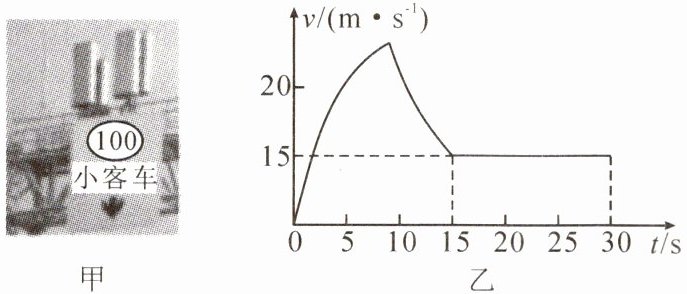
(1)一辆小客车匀速通过大桥用时 40 min,该小客车是否超速。
(2)一辆汽车由静止开始驶入大桥,其速度与时间的关系如图乙所示,经 15 s 行驶0.3 km后,开始做匀速直线运动,求在这 30 s 内汽车的平均速度。
(3)一车队以 90 km/h 的速度完全通过海底隧道,所用时间为 280 s,求该车队的长度。
(1)一辆小客车匀速通过大桥用时 40 min,该小客车是否超速。
(2)一辆汽车由静止开始驶入大桥,其速度与时间的关系如图乙所示,经 15 s 行驶0.3 km后,开始做匀速直线运动,求在这 30 s 内汽车的平均速度。
(3)一车队以 90 km/h 的速度完全通过海底隧道,所用时间为 280 s,求该车队的长度。
答案
(1)由题意可知,小客车通过的路程$s=55\ \mathrm{km}$,匀速通过大桥用时40 min,平均速度$v=\frac{s}{t}=\frac{55\ \mathrm{km}}{\frac{40}{60}\ \mathrm{h}}=82.5\ \mathrm{km/h}<100\ \mathrm{km/h}$,所以小客车没有超速
(2)由图像知汽车匀速行驶的速度$v_2=15\ \mathrm{m/s}$,汽车匀速行驶的时间$t_2=t_{\mathrm{总}}-t_1=30\ \mathrm{s}-15\ \mathrm{s}=15\ \mathrm{s}$,汽车匀速行驶的路程$s_2=v_2t_2=15\ \mathrm{m/s}×15\ \mathrm{s}=225\ \mathrm{m}$,汽车行驶的总路程$s_{\mathrm{总}}=s_1+s_2=0.3×10^3\ \mathrm{m}+225\ \mathrm{m}=525\ \mathrm{m}$,则在这30 s内,汽车的平均速度$v_{\mathrm{平均}}=\frac{s_{\mathrm{总}}}{t_{\mathrm{总}}}=\frac{525\ \mathrm{m}}{30\ \mathrm{s}}=17.5\ \mathrm{m/s}$
(3)车队完全通过海底隧道行驶的路程$s_{\mathrm{总}}'=v't'=90×\frac{1}{3.6}\ \mathrm{m/s}×280\ \mathrm{s}=7\ 000\ \mathrm{m}$,该车队的长度$L=s_{\mathrm{总}}'-L_{\mathrm{隧道}}=7\ 000\ \mathrm{m}-6.7×10^3\ \mathrm{m}=300\ \mathrm{m}$
(2)由图像知汽车匀速行驶的速度$v_2=15\ \mathrm{m/s}$,汽车匀速行驶的时间$t_2=t_{\mathrm{总}}-t_1=30\ \mathrm{s}-15\ \mathrm{s}=15\ \mathrm{s}$,汽车匀速行驶的路程$s_2=v_2t_2=15\ \mathrm{m/s}×15\ \mathrm{s}=225\ \mathrm{m}$,汽车行驶的总路程$s_{\mathrm{总}}=s_1+s_2=0.3×10^3\ \mathrm{m}+225\ \mathrm{m}=525\ \mathrm{m}$,则在这30 s内,汽车的平均速度$v_{\mathrm{平均}}=\frac{s_{\mathrm{总}}}{t_{\mathrm{总}}}=\frac{525\ \mathrm{m}}{30\ \mathrm{s}}=17.5\ \mathrm{m/s}$
(3)车队完全通过海底隧道行驶的路程$s_{\mathrm{总}}'=v't'=90×\frac{1}{3.6}\ \mathrm{m/s}×280\ \mathrm{s}=7\ 000\ \mathrm{m}$,该车队的长度$L=s_{\mathrm{总}}'-L_{\mathrm{隧道}}=7\ 000\ \mathrm{m}-6.7×10^3\ \mathrm{m}=300\ \mathrm{m}$
解析
【分析】
本题包含三个小问题,解题思路如下:
(1) 判断小客车是否超速,需利用平均速度公式计算其通过大桥的平均速度,再与限速100 km/h比较,计算时注意将时间单位“分钟”换算为“小时”;
(2) 求30 s内的平均速度,需先计算总路程:前15 s行驶0.3 km,后15 s为匀速运动,匀速速度可从v-t图像中读取,算出后段路程后,总路程除以总时间30 s即为平均速度,计算时需统一单位;
(3) 车队完全通过海底隧道的路程等于隧道长度加车队长度,先根据速度公式计算车队行驶的总路程,再减去隧道长度,即可得到车队长度,计算时需将速度单位“km/h”换算为“m/s”。
【解析】
(1) 小客车通过大桥的路程$s=55\ \mathrm{km}$,行驶时间$t=40\ \mathrm{min}=\frac{40}{60}\ \mathrm{h}=\frac{2}{3}\ \mathrm{h}$,
根据平均速度公式$v=\frac{s}{t}$,得小客车的平均速度:
$v=\frac{55\ \mathrm{km}}{\frac{2}{3}\ \mathrm{h}}=82.5\ \mathrm{km/h}$,
因为$82.5\ \mathrm{km/h}<100\ \mathrm{km/h}$,所以小客车没有超速。
(2) 由图乙可知,汽车后15 s匀速行驶的速度$v_2=15\ \mathrm{m/s}$,
匀速行驶的时间$t_2=30\ \mathrm{s}-15\ \mathrm{s}=15\ \mathrm{s}$,
匀速行驶的路程$s_2=v_2t_2=15\ \mathrm{m/s}×15\ \mathrm{s}=225\ \mathrm{m}$,
汽车行驶的总路程$s_{\mathrm{总}}=s_1+s_2=0.3×10^3\ \mathrm{m}+225\ \mathrm{m}=525\ \mathrm{m}$,
则30 s内汽车的平均速度:
$v_{\mathrm{平均}}=\frac{s_{\mathrm{总}}}{t_{\mathrm{总}}}=\frac{525\ \mathrm{m}}{30\ \mathrm{s}}=17.5\ \mathrm{m/s}$。
(3) 车队的速度$v'=90\ \mathrm{km/h}=90×\frac{1}{3.6}\ \mathrm{m/s}=25\ \mathrm{m/s}$,
车队完全通过隧道行驶的总路程$s_{\mathrm{总}}'=v't'=25\ \mathrm{m/s}×280\ \mathrm{s}=7000\ \mathrm{m}$,
海底隧道长$L_{\mathrm{隧道}}=6.7\ \mathrm{km}=6700\ \mathrm{m}$,
则车队的长度$L=s_{\mathrm{总}}'-L_{\mathrm{隧道}}=7000\ \mathrm{m}-6700\ \mathrm{m}=300\ \mathrm{m}$。
【答案】
(1) 小客车没有超速;(2) $17.5\ \mathrm{m/s}$;(3) $300\ \mathrm{m}$
【知识点】
速度计算、平均速度、路程与速度时间关系
【点评】
本题结合实际交通场景考查运动学基础计算,涉及单位换算、v-t图像的应用、“完全通过隧道”的路程理解,是初中物理的常规题型,需注意公式应用和单位统一。
【难度系数】
0.6
本题包含三个小问题,解题思路如下:
(1) 判断小客车是否超速,需利用平均速度公式计算其通过大桥的平均速度,再与限速100 km/h比较,计算时注意将时间单位“分钟”换算为“小时”;
(2) 求30 s内的平均速度,需先计算总路程:前15 s行驶0.3 km,后15 s为匀速运动,匀速速度可从v-t图像中读取,算出后段路程后,总路程除以总时间30 s即为平均速度,计算时需统一单位;
(3) 车队完全通过海底隧道的路程等于隧道长度加车队长度,先根据速度公式计算车队行驶的总路程,再减去隧道长度,即可得到车队长度,计算时需将速度单位“km/h”换算为“m/s”。
【解析】
(1) 小客车通过大桥的路程$s=55\ \mathrm{km}$,行驶时间$t=40\ \mathrm{min}=\frac{40}{60}\ \mathrm{h}=\frac{2}{3}\ \mathrm{h}$,
根据平均速度公式$v=\frac{s}{t}$,得小客车的平均速度:
$v=\frac{55\ \mathrm{km}}{\frac{2}{3}\ \mathrm{h}}=82.5\ \mathrm{km/h}$,
因为$82.5\ \mathrm{km/h}<100\ \mathrm{km/h}$,所以小客车没有超速。
(2) 由图乙可知,汽车后15 s匀速行驶的速度$v_2=15\ \mathrm{m/s}$,
匀速行驶的时间$t_2=30\ \mathrm{s}-15\ \mathrm{s}=15\ \mathrm{s}$,
匀速行驶的路程$s_2=v_2t_2=15\ \mathrm{m/s}×15\ \mathrm{s}=225\ \mathrm{m}$,
汽车行驶的总路程$s_{\mathrm{总}}=s_1+s_2=0.3×10^3\ \mathrm{m}+225\ \mathrm{m}=525\ \mathrm{m}$,
则30 s内汽车的平均速度:
$v_{\mathrm{平均}}=\frac{s_{\mathrm{总}}}{t_{\mathrm{总}}}=\frac{525\ \mathrm{m}}{30\ \mathrm{s}}=17.5\ \mathrm{m/s}$。
(3) 车队的速度$v'=90\ \mathrm{km/h}=90×\frac{1}{3.6}\ \mathrm{m/s}=25\ \mathrm{m/s}$,
车队完全通过隧道行驶的总路程$s_{\mathrm{总}}'=v't'=25\ \mathrm{m/s}×280\ \mathrm{s}=7000\ \mathrm{m}$,
海底隧道长$L_{\mathrm{隧道}}=6.7\ \mathrm{km}=6700\ \mathrm{m}$,
则车队的长度$L=s_{\mathrm{总}}'-L_{\mathrm{隧道}}=7000\ \mathrm{m}-6700\ \mathrm{m}=300\ \mathrm{m}$。
【答案】
(1) 小客车没有超速;(2) $17.5\ \mathrm{m/s}$;(3) $300\ \mathrm{m}$
【知识点】
速度计算、平均速度、路程与速度时间关系
【点评】
本题结合实际交通场景考查运动学基础计算,涉及单位换算、v-t图像的应用、“完全通过隧道”的路程理解,是初中物理的常规题型,需注意公式应用和单位统一。
【难度系数】
0.6
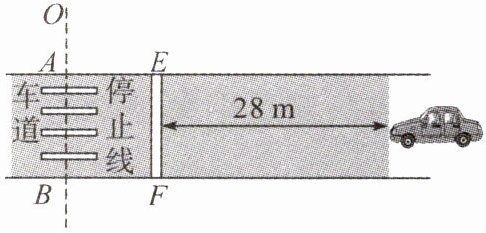
6.某地实施的新交规如下:当该车道斑马线上有行人时,机动车车头不得越过停止线。如图,小明到达O点的同时,轿车车头与停止线的距离是28 m。此时,司机发现了小明。司机反应了0.3 s之后开始刹车减速,在小明到达B点时汽车车头刚好到达停止线EF上。已知小明以1 m/s的速度沿垂直于车道的虚线OAB匀速穿过该车道,汽车在减速过程中的平均速度为6.1 m/s,O、A相距0.55 m,A、B相距3.75 m。求:
(1)小明从O点走到B点所需的时间。
(2)汽车刹车后通过的路程。
(3)若汽车在司机反应过程中保持匀速直线运动,求汽车匀速行驶时的速度。
(1)小明从O点走到B点所需的时间。
(2)汽车刹车后通过的路程。
(3)若汽车在司机反应过程中保持匀速直线运动,求汽车匀速行驶时的速度。
答案
(1)由题知从O点到B点的路程$s_{OB}=s_{OA}+s_{AB}=0.55\ \mathrm{m}+3.75\ \mathrm{m}=4.3\ \mathrm{m}$,小明的速度$v_{\mathrm{人}}=1\ \mathrm{m/s}$,由$v=\frac{s}{t}$可知,小明从O点到达B点的时间$t_{OB}=\frac{s_{OB}}{v_{\mathrm{人}}}=\frac{4.3\ \mathrm{m}}{1\ \mathrm{m/s}}=4.3\ \mathrm{s}$
(2)由题可知,汽车司机从发现小明到到达停止线上所用的时间$t_1=t_{OB}=4.3\ \mathrm{s}$,司机的反应时间$\Delta t=0.3\ \mathrm{s}$,则汽车从刹车开始到停止线上所用的时间$t_2=t_1-\Delta t=4.3\ \mathrm{s}-0.3\ \mathrm{s}=4\ \mathrm{s}$,汽车减速过程中的平均速度$v=6.1\ \mathrm{m/s}$,由$v=\frac{s}{t}$可知汽车刹车后通过的路程$s=vt_2=6.1\ \mathrm{m/s}×4\ \mathrm{s}=24.4\ \mathrm{m}$
(3)汽车司机在反应过程中通过的路程$s'=28\ \mathrm{m}-24.4\ \mathrm{m}=3.6\ \mathrm{m}$,由$v=\frac{s}{t}$可知,汽车在反应过程中匀速行驶的速度$v'=\frac{s'}{\Delta t}=\frac{3.6\ \mathrm{m}}{0.3\ \mathrm{s}}=12\ \mathrm{m/s}$
(2)由题可知,汽车司机从发现小明到到达停止线上所用的时间$t_1=t_{OB}=4.3\ \mathrm{s}$,司机的反应时间$\Delta t=0.3\ \mathrm{s}$,则汽车从刹车开始到停止线上所用的时间$t_2=t_1-\Delta t=4.3\ \mathrm{s}-0.3\ \mathrm{s}=4\ \mathrm{s}$,汽车减速过程中的平均速度$v=6.1\ \mathrm{m/s}$,由$v=\frac{s}{t}$可知汽车刹车后通过的路程$s=vt_2=6.1\ \mathrm{m/s}×4\ \mathrm{s}=24.4\ \mathrm{m}$
(3)汽车司机在反应过程中通过的路程$s'=28\ \mathrm{m}-24.4\ \mathrm{m}=3.6\ \mathrm{m}$,由$v=\frac{s}{t}$可知,汽车在反应过程中匀速行驶的速度$v'=\frac{s'}{\Delta t}=\frac{3.6\ \mathrm{m}}{0.3\ \mathrm{s}}=12\ \mathrm{m/s}$
解析
【分析】
要解决这三个问题,需利用速度公式$v=\frac{s}{t}$及其变形公式分析各物理量的关系:首先计算小明从O到B的总路程,结合小明的速度求出其运动时间;汽车从发现小明到到达停止线的总时间与小明的运动时间相等,减去反应时间得到刹车时间,再用刹车平均速度乘刹车时间得到刹车路程;反应过程的路程为初始距离减去刹车路程,除以反应时间得到反应时的匀速速度。
【解析】
(1) 小明从O点到B点的总路程:$s_{OB}=s_{OA}+s_{AB}=0.55\ \mathrm{m}+3.75\ \mathrm{m}=4.3\ \mathrm{m}$,根据速度公式$v=\frac{s}{t}$,小明从O到B的时间:$t_{OB}=\frac{s_{OB}}{v_{人}}=\frac{4.3\ \mathrm{m}}{1\ \mathrm{m/s}}=4.3\ \mathrm{s}$。
(2) 汽车从发现小明到到达停止线的总时间等于小明从O到B的时间,即$t_{总}=t_{OB}=4.3\ \mathrm{s}$,司机反应时间$\Delta t=0.3\ \mathrm{s}$,则刹车时间:$t_{刹}=t_{总}-\Delta t=4.3\ \mathrm{s}-0.3\ \mathrm{s}=4\ \mathrm{s}$,已知刹车平均速度$v_{刹}=6.1\ \mathrm{m/s}$,所以刹车后通过的路程:$s_{刹}=v_{刹}t_{刹}=6.1\ \mathrm{m/s}×4\ \mathrm{s}=24.4\ \mathrm{m}$。
(3) 汽车反应过程中行驶的路程:$s_{反}=28\ \mathrm{m}-s_{刹}=28\ \mathrm{m}-24.4\ \mathrm{m}=3.6\ \mathrm{m}$,反应时间$\Delta t=0.3\ \mathrm{s}$,则反应时的匀速速度:$v_{反}=\frac{s_{反}}{\Delta t}=\frac{3.6\ \mathrm{m}}{0.3\ \mathrm{s}}=12\ \mathrm{m/s}$。
【答案】
(1) 4.3 s;(2) 24.4 m;(3) 12 m/s
【知识点】
速度公式应用、匀速直线运动、平均速度
【点评】
本题结合实际交通场景考查速度公式的基础应用,关键是理清各物理量的时间、路程关联,属于常规运动学计算题,难度适中。
【难度系数】
0.7
要解决这三个问题,需利用速度公式$v=\frac{s}{t}$及其变形公式分析各物理量的关系:首先计算小明从O到B的总路程,结合小明的速度求出其运动时间;汽车从发现小明到到达停止线的总时间与小明的运动时间相等,减去反应时间得到刹车时间,再用刹车平均速度乘刹车时间得到刹车路程;反应过程的路程为初始距离减去刹车路程,除以反应时间得到反应时的匀速速度。
【解析】
(1) 小明从O点到B点的总路程:$s_{OB}=s_{OA}+s_{AB}=0.55\ \mathrm{m}+3.75\ \mathrm{m}=4.3\ \mathrm{m}$,根据速度公式$v=\frac{s}{t}$,小明从O到B的时间:$t_{OB}=\frac{s_{OB}}{v_{人}}=\frac{4.3\ \mathrm{m}}{1\ \mathrm{m/s}}=4.3\ \mathrm{s}$。
(2) 汽车从发现小明到到达停止线的总时间等于小明从O到B的时间,即$t_{总}=t_{OB}=4.3\ \mathrm{s}$,司机反应时间$\Delta t=0.3\ \mathrm{s}$,则刹车时间:$t_{刹}=t_{总}-\Delta t=4.3\ \mathrm{s}-0.3\ \mathrm{s}=4\ \mathrm{s}$,已知刹车平均速度$v_{刹}=6.1\ \mathrm{m/s}$,所以刹车后通过的路程:$s_{刹}=v_{刹}t_{刹}=6.1\ \mathrm{m/s}×4\ \mathrm{s}=24.4\ \mathrm{m}$。
(3) 汽车反应过程中行驶的路程:$s_{反}=28\ \mathrm{m}-s_{刹}=28\ \mathrm{m}-24.4\ \mathrm{m}=3.6\ \mathrm{m}$,反应时间$\Delta t=0.3\ \mathrm{s}$,则反应时的匀速速度:$v_{反}=\frac{s_{反}}{\Delta t}=\frac{3.6\ \mathrm{m}}{0.3\ \mathrm{s}}=12\ \mathrm{m/s}$。
【答案】
(1) 4.3 s;(2) 24.4 m;(3) 12 m/s
【知识点】
速度公式应用、匀速直线运动、平均速度
【点评】
本题结合实际交通场景考查速度公式的基础应用,关键是理清各物理量的时间、路程关联,属于常规运动学计算题,难度适中。
【难度系数】
0.7
