

 登录
登录
C
①Chinese scientists are trying ways to build houses on the moon using bricks(砖) made from artificial(人造的) lunar soil(土). These bricks were sent to China's space station on the Tianzhou-8 cargo spaceship. The team working on this project plans to shape the bricks using mortise and tenon joints(榫卯结构), a method from ancient buildings, to build an egg-shaped house on the moon, according to a CCTV report.
②The moon has always been an important goal for space exploration(探索). Many countries have made long-term plans for human activities on the moon. China hopes to send astronauts there by 2030 and build a research station by 2035. A lab in Wuhan, China, has created a sandbox to show how a future moon base might be built.
③Ding Lieyun, the leader of the team making the lunar soil bricks, said building on the moon is very hard. The moon has difficult conditions, including no water, low gravity(重力), big temperature changes, and frequent small earthquakes(地震). These make the building process very difficult.
④After many tests, the team chose a two-layer dome design called the "lunar pot", This design is light, uses fewer materials, and works well for keeping warm and staying strong. Inside, the house will have two levels: one for working and one for resting.
⑤The bricks will be made using a method from ancient Chinese building styles. Robots will put the bricks together, and 3D printing will make the structure stronger. These ideas are based on data from China's Chang'e-5 moon mission.
⑥The bricks made from artificial moon soil are now being tested in space to see if they can go through the difficult conditions. The first brick returned to Earth at the end of 2025, bringing us closer to building homes on the moon.
(

(
A. The lunar soil bricks.
B. Difficult conditions.
C. Big temperature changes.
D. Small earthquakes.
(
A. Building houses on the moon is a difficult task that Chinese scientists have already completed.
B. The lunar bricks are already used to build a complete house on the moon.
C. China is making some improvements in building houses on the moon.
D. Many countries show great interest in building houses on Mars.
(
(
A. Building houses on the moon with lunar soil.
B. How robots remove the houses on the moon.
C. The history of lunar exploration.
D. How scientists work at the space station.
①Chinese scientists are trying ways to build houses on the moon using bricks(砖) made from artificial(人造的) lunar soil(土). These bricks were sent to China's space station on the Tianzhou-8 cargo spaceship. The team working on this project plans to shape the bricks using mortise and tenon joints(榫卯结构), a method from ancient buildings, to build an egg-shaped house on the moon, according to a CCTV report.
②The moon has always been an important goal for space exploration(探索). Many countries have made long-term plans for human activities on the moon. China hopes to send astronauts there by 2030 and build a research station by 2035. A lab in Wuhan, China, has created a sandbox to show how a future moon base might be built.
③Ding Lieyun, the leader of the team making the lunar soil bricks, said building on the moon is very hard. The moon has difficult conditions, including no water, low gravity(重力), big temperature changes, and frequent small earthquakes(地震). These make the building process very difficult.
④After many tests, the team chose a two-layer dome design called the "lunar pot", This design is light, uses fewer materials, and works well for keeping warm and staying strong. Inside, the house will have two levels: one for working and one for resting.
⑤The bricks will be made using a method from ancient Chinese building styles. Robots will put the bricks together, and 3D printing will make the structure stronger. These ideas are based on data from China's Chang'e-5 moon mission.
⑥The bricks made from artificial moon soil are now being tested in space to see if they can go through the difficult conditions. The first brick returned to Earth at the end of 2025, bringing us closer to building homes on the moon.
(
D
)26. Which of the following is the RIGHT shape of the house on the moon?(
B
)27. What does the underlined word "These" refer to in Paragraph 3?A. The lunar soil bricks.
B. Difficult conditions.
C. Big temperature changes.
D. Small earthquakes.
(
C
)28. What can we infer from the passage?A. Building houses on the moon is a difficult task that Chinese scientists have already completed.
B. The lunar bricks are already used to build a complete house on the moon.
C. China is making some improvements in building houses on the moon.
D. Many countries show great interest in building houses on Mars.
(
D
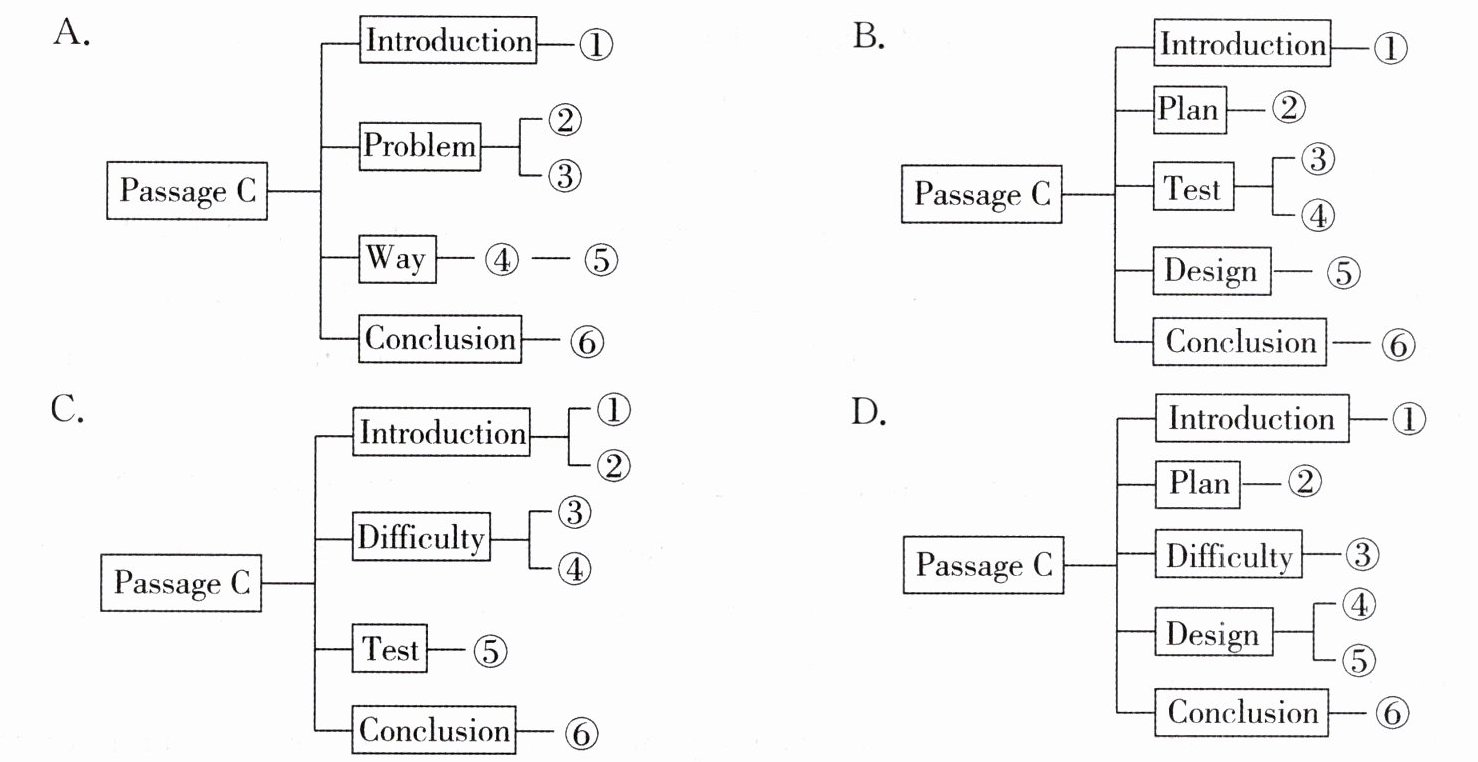
)29. Which of the following best describes the structure of the passage?(
A
)30. What's the passage mainly about?A. Building houses on the moon with lunar soil.
B. How robots remove the houses on the moon.
C. The history of lunar exploration.
D. How scientists work at the space station.
答案
C
【文章大意】本文是一篇说明文,主要介绍了中国科学家正在尝试用月球土壤制造的砖块在月球上建造房屋。
26. D 图示理解题。根据第一段最后一句中的“The team working on this project... to build an egg - shaped house on the moon”可知,月球上房子的形状是蛋形的,类似于球形,故选 D。
27. B 代词指代题。根据第三段第二句“The moon has difficult conditions, including no water, low gravity, big temperature changes, and frequent small earthquakes.”可知,本句列举了月球上的困难的环境,画线的“These”指的是这些困难的环境,故选 B。
28. C 推理判断题。根据文章第一段“人造月壤砖已送天舟八号货运飞船”、第四段“选定‘月球锅’双层穹顶设计”、第六段“人造月壤砖正在太空测试,首块 2025 年底返地球”等信息可推断,中国在月球建房方面已取得一定进展,故选 C。选项 A:原文第三段明确月球建房“难度大”,第六段提到尚未完成,“已完成”与原文矛盾,故排除;选项 B:原文仅提及计划用砖块建房,砖块仍在测试,未“建成完整房屋”,故排除;选项 D:全文围绕“月球建房”展开,未提及“火星”及各国对火星建房的兴趣,故排除。
29. D 篇章结构题。根据文章内容可知,文章第一段介绍了中国科学家正在尝试用人造月球土壤制造的砖块在月球上建造房屋,第二段介绍了月球是太空探索的重要目标,第三段介绍了月球上的艰苦环境,第四段介绍了房子的形状和所用的材料,第五段介绍了建造方法,第四段和第五段都属于“设计”的内容,第六段进行总结。故选 D。
30. A 主旨大意题。文章开篇点明“中国科学家尝试用人造月壤砖在月球建房”,后续段落分别介绍月球探索背景、建房难度、房屋设计、砖块工艺及测试进展,核心是“用人造月壤在月球建房”,故选 A。选项 B:文中仅提到“机器人组装砖块”,未提及“拆除月球房屋”,故排除;选项 C:“月球探索史”仅在第二段作为背景简要提及,非全文核心,故排除;选项 D:文中仅提到“砖块送空间站”,未涉及“科学家在空间站的工作方式”,故排除。
【文章大意】本文是一篇说明文,主要介绍了中国科学家正在尝试用月球土壤制造的砖块在月球上建造房屋。
26. D 图示理解题。根据第一段最后一句中的“The team working on this project... to build an egg - shaped house on the moon”可知,月球上房子的形状是蛋形的,类似于球形,故选 D。
27. B 代词指代题。根据第三段第二句“The moon has difficult conditions, including no water, low gravity, big temperature changes, and frequent small earthquakes.”可知,本句列举了月球上的困难的环境,画线的“These”指的是这些困难的环境,故选 B。
28. C 推理判断题。根据文章第一段“人造月壤砖已送天舟八号货运飞船”、第四段“选定‘月球锅’双层穹顶设计”、第六段“人造月壤砖正在太空测试,首块 2025 年底返地球”等信息可推断,中国在月球建房方面已取得一定进展,故选 C。选项 A:原文第三段明确月球建房“难度大”,第六段提到尚未完成,“已完成”与原文矛盾,故排除;选项 B:原文仅提及计划用砖块建房,砖块仍在测试,未“建成完整房屋”,故排除;选项 D:全文围绕“月球建房”展开,未提及“火星”及各国对火星建房的兴趣,故排除。
29. D 篇章结构题。根据文章内容可知,文章第一段介绍了中国科学家正在尝试用人造月球土壤制造的砖块在月球上建造房屋,第二段介绍了月球是太空探索的重要目标,第三段介绍了月球上的艰苦环境,第四段介绍了房子的形状和所用的材料,第五段介绍了建造方法,第四段和第五段都属于“设计”的内容,第六段进行总结。故选 D。
30. A 主旨大意题。文章开篇点明“中国科学家尝试用人造月壤砖在月球建房”,后续段落分别介绍月球探索背景、建房难度、房屋设计、砖块工艺及测试进展,核心是“用人造月壤在月球建房”,故选 A。选项 B:文中仅提到“机器人组装砖块”,未提及“拆除月球房屋”,故排除;选项 C:“月球探索史”仅在第二段作为背景简要提及,非全文核心,故排除;选项 D:文中仅提到“砖块送空间站”,未涉及“科学家在空间站的工作方式”,故排除。
解析
【分析】
首先拿到这篇科普说明文阅读,先快速通读全文明确核心主题:我国正尝试用人造月壤砖在月球建造房屋,后续内容围绕该项目的背景、难点、设计、工艺、测试进展展开。逐题解题思路如下:
1. 26题是图示细节题,直接定位第一段末尾的描述,找到房屋形状的关键词,匹配对应图示即可;
2. 27题是代词指代题,按照"就近往前找指代内容"的原则,定位划线词所在的第三段,梳理前文列举的内容,判断these的指代对象;
3. 28题是推理判断题,将每个选项和原文内容逐一比对,排除与原文矛盾、无中生有的错误选项,选出符合逻辑的推断结果;
4. 29题是篇章结构题,逐段概括段落大意,梳理段落之间的逻辑关系,划分出"引入话题-背景铺垫-细节展开-收尾总结"的层级,匹配对应结构;
5. 30题是主旨大意题,抓住文章开篇点明的核心论述对象,排除偏离核心主题的干扰项,选出最贴合全文内容的选项。
【解析】
26. 细节理解题:根据原文第一段最后一句"to build an egg-shaped house on the moon",可知月球房屋为蛋形,对应选项D的图示,其余图示不符合蛋形的描述,因此选D。
27. 代词指代题:定位第三段,前文提到"The moon has difficult conditions, including no water, low gravity, big temperature changes, and frequent small earthquakes",列举的所有内容都属于月球的恶劣条件,划线词These指代前文提到的月球上的各类困难环境,A选项月壤砖和语境无关,C、D都只是困难条件的其中一项,指代片面,因此选B。
28. 推理判断题:
A选项:原文明确月球建房难度极大,且砖块仍在测试中,项目尚未完成,表述错误;
B选项:目前月壤砖还未用于在月球建造完整房屋,仍处于测试阶段,表述错误;
C选项:从月壤砖送入空间站、选定专属房屋设计、砖块即将返回地球等进展,可推断我国在月球建房领域已经取得一定进展,表述正确;
D选项:全文围绕月球探索展开,从未提及火星相关内容,属于无中生有,表述错误。因此选C。
29. 篇章结构题:梳理全文逻辑:第①段引出"我国尝试用月壤砖建月球屋"的核心话题;第②段铺垫全球月球探索的大背景;第③-⑤段分别介绍月球建房的难点、房屋设计、建造工艺,属于核心内容的细节展开;第⑥段介绍项目最新测试进展,收尾全文,对应选项D的结构。
30. 主旨大意题:全文围绕"用人造月壤在月球建造房屋"展开论述,B选项"拆除月球房屋"原文未提及,C选项"月球探索史"仅作为背景简要提及,不是核心内容,D选项"空间站内科学家的工作方式"完全偏离主题,因此选A。
【答案】
26.D 27.B 28.C 29.D 30.A
【知识点】
细节理解,代词指代,主旨大意
【点评】
本题属于科技类说明文阅读,贴合我国航天前沿热点,考点覆盖中学英语阅读常见的全部题型,解题核心是准确定位原文对应语句,仔细比对选项和原文的差异,排除偷换概念、无中生有的干扰项,梳理段落逻辑即可顺利得出答案,同时能帮助学生了解我国航天领域的最新进展。
【难度系数】
0.7
首先拿到这篇科普说明文阅读,先快速通读全文明确核心主题:我国正尝试用人造月壤砖在月球建造房屋,后续内容围绕该项目的背景、难点、设计、工艺、测试进展展开。逐题解题思路如下:
1. 26题是图示细节题,直接定位第一段末尾的描述,找到房屋形状的关键词,匹配对应图示即可;
2. 27题是代词指代题,按照"就近往前找指代内容"的原则,定位划线词所在的第三段,梳理前文列举的内容,判断these的指代对象;
3. 28题是推理判断题,将每个选项和原文内容逐一比对,排除与原文矛盾、无中生有的错误选项,选出符合逻辑的推断结果;
4. 29题是篇章结构题,逐段概括段落大意,梳理段落之间的逻辑关系,划分出"引入话题-背景铺垫-细节展开-收尾总结"的层级,匹配对应结构;
5. 30题是主旨大意题,抓住文章开篇点明的核心论述对象,排除偏离核心主题的干扰项,选出最贴合全文内容的选项。
【解析】
26. 细节理解题:根据原文第一段最后一句"to build an egg-shaped house on the moon",可知月球房屋为蛋形,对应选项D的图示,其余图示不符合蛋形的描述,因此选D。
27. 代词指代题:定位第三段,前文提到"The moon has difficult conditions, including no water, low gravity, big temperature changes, and frequent small earthquakes",列举的所有内容都属于月球的恶劣条件,划线词These指代前文提到的月球上的各类困难环境,A选项月壤砖和语境无关,C、D都只是困难条件的其中一项,指代片面,因此选B。
28. 推理判断题:
A选项:原文明确月球建房难度极大,且砖块仍在测试中,项目尚未完成,表述错误;
B选项:目前月壤砖还未用于在月球建造完整房屋,仍处于测试阶段,表述错误;
C选项:从月壤砖送入空间站、选定专属房屋设计、砖块即将返回地球等进展,可推断我国在月球建房领域已经取得一定进展,表述正确;
D选项:全文围绕月球探索展开,从未提及火星相关内容,属于无中生有,表述错误。因此选C。
29. 篇章结构题:梳理全文逻辑:第①段引出"我国尝试用月壤砖建月球屋"的核心话题;第②段铺垫全球月球探索的大背景;第③-⑤段分别介绍月球建房的难点、房屋设计、建造工艺,属于核心内容的细节展开;第⑥段介绍项目最新测试进展,收尾全文,对应选项D的结构。
30. 主旨大意题:全文围绕"用人造月壤在月球建造房屋"展开论述,B选项"拆除月球房屋"原文未提及,C选项"月球探索史"仅作为背景简要提及,不是核心内容,D选项"空间站内科学家的工作方式"完全偏离主题,因此选A。
【答案】
26.D 27.B 28.C 29.D 30.A
【知识点】
细节理解,代词指代,主旨大意
【点评】
本题属于科技类说明文阅读,贴合我国航天前沿热点,考点覆盖中学英语阅读常见的全部题型,解题核心是准确定位原文对应语句,仔细比对选项和原文的差异,排除偷换概念、无中生有的干扰项,梳理段落逻辑即可顺利得出答案,同时能帮助学生了解我国航天领域的最新进展。
【难度系数】
0.7
