

 登录
登录
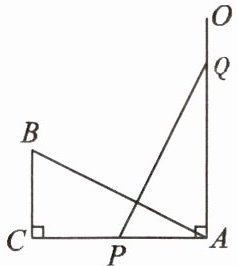
10. 如图,在$Rt△ ABC$中,$∠ C=90°,AC=16\ \mathrm{cm},BC=8\ \mathrm{cm}$,线段$PQ=AB,P,Q$两点分别在$AC$和过点$A$且垂直于$AC$的射线$AO$上运动,点$P$从点$A$运动到点$C$,点$P$的运动速度为$2\ \mathrm{cm/s}$,当运动时间为多少秒时,$△ ABC$和$△ PQA$全等.
答案
10.$\because \quad ∠C=90°,AO⊥AC,$
$\therefore \quad ∠C=∠QAP=90°.$
①当 $AP=8\ \mathrm{cm}=BC$ 时,
在 $\mathrm{Rt}△ACB$ 和 $\mathrm{Rt}△QAP$ 中,
$\begin{cases}AB=QP, \\BC=PA,\end{cases}$
$\therefore \quad \mathrm{Rt}△ACB ≌ \mathrm{Rt}△QAP(\mathrm{HL}).$
$\because \quad$ 点 $P$ 从点 $A$ 运动到点 $C$,点 $P$ 的运动速度为 $2\ \mathrm{cm/s}$,
$\therefore \quad 8÷2=4$,
即运动时间为 $4\ \mathrm{s}$;
②当 $AP=16\ \mathrm{cm}=AC$ 时,
在 $\mathrm{Rt}△ACB$ 和 $\mathrm{Rt}△PAQ$ 中,
$\begin{cases}AB=PQ, \\AC=PA,\end{cases}$
$\therefore \quad \mathrm{Rt}△ACB ≌ \mathrm{Rt}△PAQ(\mathrm{HL}).$
$\because \quad$ 点 $P$ 从点 $A$ 运动到点 $C$,点 $P$ 的运动速度为 $2\ \mathrm{cm/s}$,
$\therefore \quad 16÷2=8$,
即运动时间为 $8\ \mathrm{s}.$
综上,当运动时间为 $4\ \mathrm{s}$ 或 $8\ \mathrm{s}$ 时,$△ABC$ 和 $△PQA$ 全等.
$\therefore \quad ∠C=∠QAP=90°.$
①当 $AP=8\ \mathrm{cm}=BC$ 时,
在 $\mathrm{Rt}△ACB$ 和 $\mathrm{Rt}△QAP$ 中,
$\begin{cases}AB=QP, \\BC=PA,\end{cases}$
$\therefore \quad \mathrm{Rt}△ACB ≌ \mathrm{Rt}△QAP(\mathrm{HL}).$
$\because \quad$ 点 $P$ 从点 $A$ 运动到点 $C$,点 $P$ 的运动速度为 $2\ \mathrm{cm/s}$,
$\therefore \quad 8÷2=4$,
即运动时间为 $4\ \mathrm{s}$;
②当 $AP=16\ \mathrm{cm}=AC$ 时,
在 $\mathrm{Rt}△ACB$ 和 $\mathrm{Rt}△PAQ$ 中,
$\begin{cases}AB=PQ, \\AC=PA,\end{cases}$
$\therefore \quad \mathrm{Rt}△ACB ≌ \mathrm{Rt}△PAQ(\mathrm{HL}).$
$\because \quad$ 点 $P$ 从点 $A$ 运动到点 $C$,点 $P$ 的运动速度为 $2\ \mathrm{cm/s}$,
$\therefore \quad 16÷2=8$,
即运动时间为 $8\ \mathrm{s}.$
综上,当运动时间为 $4\ \mathrm{s}$ 或 $8\ \mathrm{s}$ 时,$△ABC$ 和 $△PQA$ 全等.
解析
【分析】
本题是结合动点的直角三角形全等判定问题,解题思路如下:首先明确两个三角形均为直角三角形,且已知斜边$PQ=AB$,根据直角三角形全等的HL判定定理,只需再有一组直角边对应相等即可判定两三角形全等。由于对应边存在两种不同的对应情况,因此需要分类讨论:①$AP$与$BC$对应相等;②$AP$与$AC$对应相等。再结合点P的运动速度,用“时间=路程÷速度”分别计算两种情况的运动时间,最后验证结果是否符合点P的运动范围即可。
【解析】
$\because ∠ C=90°,AO⊥ AC$,
$\therefore ∠ C=∠ QAP=90°$,$△ ABC$和$△ PQA$均为直角三角形。
①当$AP=8\ \mathrm{cm}=BC$时,
在$\mathrm{Rt}△ACB$和$\mathrm{Rt}△QAP$中,
$\begin{cases}AB=QP, \\BC=PA,\end{cases}$
$\therefore \mathrm{Rt}△ACB ≌ \mathrm{Rt}△QAP(\mathrm{HL})$。
$\because$点P的运动速度为$2\ \mathrm{cm/s}$,
$\therefore$运动时间为$8÷2=4\ \mathrm{s}$;
②当$AP=16\ \mathrm{cm}=AC$时,
在$\mathrm{Rt}△ACB$和$\mathrm{Rt}△PAQ$中,
$\begin{cases}AB=PQ, \\AC=PA,\end{cases}$
$\therefore \mathrm{Rt}△ACB ≌ \mathrm{Rt}△PAQ(\mathrm{HL})$。
$\because$点P的运动速度为$2\ \mathrm{cm/s}$,
$\therefore$运动时间为$16÷2=8\ \mathrm{s}$。
综上,当运动时间为$4\ \mathrm{s}$或$8\ \mathrm{s}$时,$△ ABC$和$△ PQA$全等。
【答案】
$4\ \mathrm{s}$或$8\ \mathrm{s}$
【知识点】
HL全等判定,分类讨论,动点计算
【点评】
本题重点考查直角三角形全等的HL判定,解题时需注意全等三角形对应边的不确定性,要分情况讨论避免漏解,同时要结合动点的运动范围判断所得解是否符合题意。
【难度系数】
0.6
本题是结合动点的直角三角形全等判定问题,解题思路如下:首先明确两个三角形均为直角三角形,且已知斜边$PQ=AB$,根据直角三角形全等的HL判定定理,只需再有一组直角边对应相等即可判定两三角形全等。由于对应边存在两种不同的对应情况,因此需要分类讨论:①$AP$与$BC$对应相等;②$AP$与$AC$对应相等。再结合点P的运动速度,用“时间=路程÷速度”分别计算两种情况的运动时间,最后验证结果是否符合点P的运动范围即可。
【解析】
$\because ∠ C=90°,AO⊥ AC$,
$\therefore ∠ C=∠ QAP=90°$,$△ ABC$和$△ PQA$均为直角三角形。
①当$AP=8\ \mathrm{cm}=BC$时,
在$\mathrm{Rt}△ACB$和$\mathrm{Rt}△QAP$中,
$\begin{cases}AB=QP, \\BC=PA,\end{cases}$
$\therefore \mathrm{Rt}△ACB ≌ \mathrm{Rt}△QAP(\mathrm{HL})$。
$\because$点P的运动速度为$2\ \mathrm{cm/s}$,
$\therefore$运动时间为$8÷2=4\ \mathrm{s}$;
②当$AP=16\ \mathrm{cm}=AC$时,
在$\mathrm{Rt}△ACB$和$\mathrm{Rt}△PAQ$中,
$\begin{cases}AB=PQ, \\AC=PA,\end{cases}$
$\therefore \mathrm{Rt}△ACB ≌ \mathrm{Rt}△PAQ(\mathrm{HL})$。
$\because$点P的运动速度为$2\ \mathrm{cm/s}$,
$\therefore$运动时间为$16÷2=8\ \mathrm{s}$。
综上,当运动时间为$4\ \mathrm{s}$或$8\ \mathrm{s}$时,$△ ABC$和$△ PQA$全等。
【答案】
$4\ \mathrm{s}$或$8\ \mathrm{s}$
【知识点】
HL全等判定,分类讨论,动点计算
【点评】
本题重点考查直角三角形全等的HL判定,解题时需注意全等三角形对应边的不确定性,要分情况讨论避免漏解,同时要结合动点的运动范围判断所得解是否符合题意。
【难度系数】
0.6
11. 如图,在$△ ABC$中,$∠ C=90°$,$AD$是$△ ABC$的角平分线,$DE ⊥ AB$于点$E$,点$F$在边$AC$上,连接$DF$.
(1)求证$AC=AE$;
(2)若$DF=DB$,试说明$∠ B$与$∠ AFD$的数量关系;
(3)在(2)的条件下,若$AB=m$,$AF=n$,求$EB$的长(用含$m,n$的代数式表示).
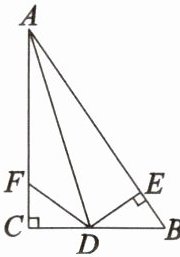
(1)求证$AC=AE$;
(2)若$DF=DB$,试说明$∠ B$与$∠ AFD$的数量关系;
(3)在(2)的条件下,若$AB=m$,$AF=n$,求$EB$的长(用含$m,n$的代数式表示).
答案
11.(1)$\because \quad ∠C=90°,DE⊥AB,$
$\therefore \quad ∠C=∠AED=90°.$
$\because \quad AD$ 是 $△ABC$ 的角平分线,
$\therefore \quad ∠CAD=∠EAD.$
在 $△ACD$ 和 $△AED$ 中,
$\begin{cases}∠C=∠AED, \\∠CAD=∠EAD, \\AD=AD,\end{cases}$
$\therefore \quad △ACD ≌ △AED(\mathrm{AAS}).$
$\therefore \quad AC=AE.$
(2)$∠B+∠AFD=180°$.理由如下:
由(1)知 $△ACD ≌ △AED$,
$\therefore \quad DC=DE.$
在 $\mathrm{Rt}△CDF$ 和 $\mathrm{Rt}△EDB$ 中,
$\begin{cases}DC=DE, \\DF=DB,\end{cases}$
$\therefore \quad \mathrm{Rt}△CDF ≌ \mathrm{Rt}△EDB(\mathrm{HL}).$
$\therefore \quad ∠CFD=∠B.$
$\because \quad ∠CFD+∠AFD=180°,$
$\therefore \quad ∠B+∠AFD=180°.$
(3)由(2)知,$\mathrm{Rt}△CDF ≌ \mathrm{Rt}△EDB$,
$\therefore \quad CF=EB.$
由(1)知 $AC=AE.$
$\because \quad AB=AE+EB,$
$\therefore \quad AB=AC+EB.$
$\because \quad AC=AF+CF,$
$\therefore \quad AB=AF+2EB.$
$\because \quad AB=m,AF=n,$
$\therefore \quad EB=\dfrac{1}{2}(m-n).$
$\therefore \quad ∠C=∠AED=90°.$
$\because \quad AD$ 是 $△ABC$ 的角平分线,
$\therefore \quad ∠CAD=∠EAD.$
在 $△ACD$ 和 $△AED$ 中,
$\begin{cases}∠C=∠AED, \\∠CAD=∠EAD, \\AD=AD,\end{cases}$
$\therefore \quad △ACD ≌ △AED(\mathrm{AAS}).$
$\therefore \quad AC=AE.$
(2)$∠B+∠AFD=180°$.理由如下:
由(1)知 $△ACD ≌ △AED$,
$\therefore \quad DC=DE.$
在 $\mathrm{Rt}△CDF$ 和 $\mathrm{Rt}△EDB$ 中,
$\begin{cases}DC=DE, \\DF=DB,\end{cases}$
$\therefore \quad \mathrm{Rt}△CDF ≌ \mathrm{Rt}△EDB(\mathrm{HL}).$
$\therefore \quad ∠CFD=∠B.$
$\because \quad ∠CFD+∠AFD=180°,$
$\therefore \quad ∠B+∠AFD=180°.$
(3)由(2)知,$\mathrm{Rt}△CDF ≌ \mathrm{Rt}△EDB$,
$\therefore \quad CF=EB.$
由(1)知 $AC=AE.$
$\because \quad AB=AE+EB,$
$\therefore \quad AB=AC+EB.$
$\because \quad AC=AF+CF,$
$\therefore \quad AB=AF+2EB.$
$\because \quad AB=m,AF=n,$
$\therefore \quad EB=\dfrac{1}{2}(m-n).$
解析
【分析】
(1)要证AC=AE,可通过证明△ACD和△AED全等实现:已知AD是角平分线可得∠CAD=∠EAD,又有∠C和∠AED都是直角,加上公共边AD,满足AAS全等判定条件,证得全等后即可推出对应边相等。
(2)要探究∠B和∠AFD的数量关系,结合已知DF=DB,由(1)的全等可得DC=DE,可先通过HL证明Rt△CDF和Rt△EDB全等,得到∠CFD=∠B,再利用∠CFD与∠AFD互为邻补角,即可推出两角的数量关系。
(3)求EB的长,可通过线段等量代换推导:由(2)的全等得CF=EB,由(1)得AC=AE,将AB拆分为AE+EB=AC+EB,再将AC替换为AF+CF=AF+EB,整理后即可得到EB与m、n的关系。
【解析】
(1)证明:$\because \quad ∠C=90°,DE⊥AB,$
$\therefore \quad ∠C=∠AED=90°.$
$\because \quad AD$ 是 $△ABC$ 的角平分线,
$\therefore \quad ∠CAD=∠EAD.$
在 $△ACD$ 和 $△AED$ 中,
$\begin{cases}∠C=∠AED, \\∠CAD=∠EAD, \\AD=AD,\end{cases}$
$\therefore \quad △ACD ≌ △AED(\mathrm{AAS}).$
$\therefore \quad AC=AE.$
(2)$∠B+∠AFD=180°$,理由如下:
由(1)知 $△ACD ≌ △AED$,
$\therefore \quad DC=DE.$
在 $\mathrm{Rt}△CDF$ 和 $\mathrm{Rt}△EDB$ 中,
$\begin{cases}DC=DE, \\DF=DB,\end{cases}$
$\therefore \quad \mathrm{Rt}△CDF ≌ \mathrm{Rt}△EDB(\mathrm{HL}).$
$\therefore \quad ∠CFD=∠B.$
$\because \quad ∠CFD+∠AFD=180°,$
$\therefore \quad ∠B+∠AFD=180°.$
(3)由(2)知,$\mathrm{Rt}△CDF ≌ \mathrm{Rt}△EDB$,
$\therefore \quad CF=EB.$
由(1)知 $AC=AE.$
$\because \quad AB=AE+EB,$
$\therefore \quad AB=AC+EB.$
$\because \quad AC=AF+CF,$
$\therefore \quad AB=AF+2EB.$
$\because \quad AB=m,AF=n,$
$\therefore \quad EB=\dfrac{1}{2}(m-n).$
【答案】
(1)证明见解析;(2)$\boldsymbol{∠B+∠AFD=180°}$;(3)$\boldsymbol{EB=\dfrac{m-n}{2}}$
【知识点】
角平分线的性质;全等三角形的判定与性质;直角三角形全等的判定(HL)
【点评】
本题是三角形综合类基础题,三个小问层层递进,解题时要注意承接前一问的结论,通过全等三角形完成角、线段的等量转换,重点考查逻辑推理能力和等量代换思想的应用。
【难度系数】
0.6
(1)要证AC=AE,可通过证明△ACD和△AED全等实现:已知AD是角平分线可得∠CAD=∠EAD,又有∠C和∠AED都是直角,加上公共边AD,满足AAS全等判定条件,证得全等后即可推出对应边相等。
(2)要探究∠B和∠AFD的数量关系,结合已知DF=DB,由(1)的全等可得DC=DE,可先通过HL证明Rt△CDF和Rt△EDB全等,得到∠CFD=∠B,再利用∠CFD与∠AFD互为邻补角,即可推出两角的数量关系。
(3)求EB的长,可通过线段等量代换推导:由(2)的全等得CF=EB,由(1)得AC=AE,将AB拆分为AE+EB=AC+EB,再将AC替换为AF+CF=AF+EB,整理后即可得到EB与m、n的关系。
【解析】
(1)证明:$\because \quad ∠C=90°,DE⊥AB,$
$\therefore \quad ∠C=∠AED=90°.$
$\because \quad AD$ 是 $△ABC$ 的角平分线,
$\therefore \quad ∠CAD=∠EAD.$
在 $△ACD$ 和 $△AED$ 中,
$\begin{cases}∠C=∠AED, \\∠CAD=∠EAD, \\AD=AD,\end{cases}$
$\therefore \quad △ACD ≌ △AED(\mathrm{AAS}).$
$\therefore \quad AC=AE.$
(2)$∠B+∠AFD=180°$,理由如下:
由(1)知 $△ACD ≌ △AED$,
$\therefore \quad DC=DE.$
在 $\mathrm{Rt}△CDF$ 和 $\mathrm{Rt}△EDB$ 中,
$\begin{cases}DC=DE, \\DF=DB,\end{cases}$
$\therefore \quad \mathrm{Rt}△CDF ≌ \mathrm{Rt}△EDB(\mathrm{HL}).$
$\therefore \quad ∠CFD=∠B.$
$\because \quad ∠CFD+∠AFD=180°,$
$\therefore \quad ∠B+∠AFD=180°.$
(3)由(2)知,$\mathrm{Rt}△CDF ≌ \mathrm{Rt}△EDB$,
$\therefore \quad CF=EB.$
由(1)知 $AC=AE.$
$\because \quad AB=AE+EB,$
$\therefore \quad AB=AC+EB.$
$\because \quad AC=AF+CF,$
$\therefore \quad AB=AF+2EB.$
$\because \quad AB=m,AF=n,$
$\therefore \quad EB=\dfrac{1}{2}(m-n).$
【答案】
(1)证明见解析;(2)$\boldsymbol{∠B+∠AFD=180°}$;(3)$\boldsymbol{EB=\dfrac{m-n}{2}}$
【知识点】
角平分线的性质;全等三角形的判定与性质;直角三角形全等的判定(HL)
【点评】
本题是三角形综合类基础题,三个小问层层递进,解题时要注意承接前一问的结论,通过全等三角形完成角、线段的等量转换,重点考查逻辑推理能力和等量代换思想的应用。
【难度系数】
0.6
12. 如图,在平面直角坐标系中,$P(4,4)$.
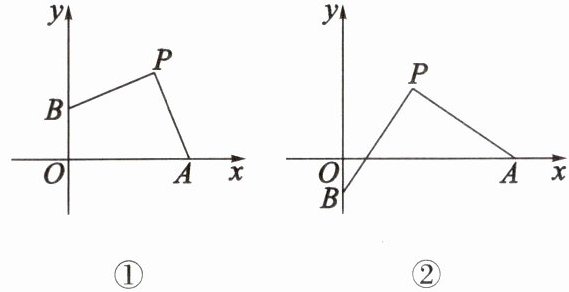
(1)如图①,点A在x轴的正半轴上,点B在y轴的正半轴上,且$PA=PB$.
①求证 $PA ⊥ PB$;
②求 $OA+OB$ 的值.
(2)如图②,点A在x轴的正半轴上,点B在y轴的负半轴上,且$PA=PB$,请直接写出$OA-OB$的值.
(1)如图①,点A在x轴的正半轴上,点B在y轴的正半轴上,且$PA=PB$.
①求证 $PA ⊥ PB$;
②求 $OA+OB$ 的值.
(2)如图②,点A在x轴的正半轴上,点B在y轴的负半轴上,且$PA=PB$,请直接写出$OA-OB$的值.
答案
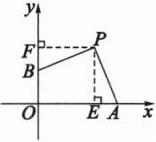
12.(1)①如图,过点 $P$ 作 $PE⊥x$ 轴于点 $E$,$PF⊥y$ 轴于点 $F$,
$\therefore \quad ∠PEO=∠PFO=90°.$
$\because \quad ∠EOF=90°,∠PEO+∠PFO+∠EOF+∠EPF=360°,$
$\therefore \quad ∠EPF=90°.$
$\because \quad P(4,4),$
$\therefore \quad OE=OF=PE=PF=4.$
在 $\mathrm{Rt}△APE$ 和 $\mathrm{Rt}△BPF$ 中,
$\begin{cases}PA=PB, \\PE=PF,\end{cases}$
$\therefore \quad \mathrm{Rt}△APE ≌ \mathrm{Rt}△BPF(\mathrm{HL}).$
$\therefore \quad ∠APE=∠BPF.$
$\therefore \quad ∠APB = ∠APE + ∠BPE = ∠BPF + ∠BPE = ∠EPF=90°.$
$\therefore \quad PA⊥PB.$
②$\because \quad \mathrm{Rt}△APE ≌ \mathrm{Rt}△BPF,$
$\therefore \quad AE=BF.$
$\because \quad OA=OE+AE,OB=OF-BF,$
$\therefore \quad OA+OB=OE+AE+OF-BF=OE+OF=4+4=8.$
(2)$OA-OB=8.$
解析
【分析】
(1)①要证$PA⊥PB$,即证$∠APB=90°$。已知$P(4,4)$,可过点$P$分别作$x$轴、$y$轴的垂线,得到$PE=PF=4$且$∠EPF=90°$,结合已知$PA=PB$,可通过HL定理证明$\mathrm{Rt}△APE≌\mathrm{Rt}△BPF$,得到对应角相等,通过角的转化即可证得$∠APB=90°$;
②要求$OA+OB$的值,利用全等三角形对应边相等得$AE=BF$,将$OA$、$OB$拆分为含$OE$、$OF$、$AE$、$BF$的式子,代入后消去$AE$、$BF$即可求出两线段的和。
(2)与(1)的解题思路一致,同样作辅助线构造全等三角形,将$OA$、$OB$用相等线段替换,即可求出$OA-OB$的定值。
【解析】
(1)①过点 $P$ 作 $PE⊥x$ 轴于点 $E$,$PF⊥y$ 轴于点 $F$,
$\therefore \quad ∠PEO=∠PFO=90°.$
$\because \quad ∠EOF=90°,∠PEO+∠PFO+∠EOF+∠EPF=360°,$
$\therefore \quad ∠EPF=90°.$
$\because \quad P(4,4),$
$\therefore \quad OE=OF=PE=PF=4.$
在 $\mathrm{Rt}△APE$ 和 $\mathrm{Rt}△BPF$ 中,
$\begin{cases}PA=PB, \\PE=PF,\end{cases}$
$\therefore \quad \mathrm{Rt}△APE ≌ \mathrm{Rt}△BPF(\mathrm{HL}).$
$\therefore \quad ∠APE=∠BPF.$
$\therefore \quad ∠APB = ∠APE + ∠BPE = ∠BPF + ∠BPE = ∠EPF=90°.$
$\therefore \quad PA⊥PB.$
②$\because \quad \mathrm{Rt}△APE ≌ \mathrm{Rt}△BPF,$
$\therefore \quad AE=BF.$
$\because \quad OA=OE+AE,OB=OF-BF,$
$\therefore \quad OA+OB=OE+AE+OF-BF=OE+OF=4+4=8.$
(2)同理可证$\mathrm{Rt}△APE ≌ \mathrm{Rt}△BPF$,得$AE=BF$,
$\because OA=OE+AE$,$OB=BF-OF$,
$\therefore OA-OB=(OE+AE)-(BF-OF)=OE+OF=4+4=8$。
【答案】
(1)①证明成立;②$\boldsymbol{OA+OB=8}$;(2)$\boldsymbol{OA-OB=8}$
【知识点】
HL判定三角形全等、全等三角形的性质、坐标与几何计算
【点评】
本题是平面直角坐标系与几何证明结合的典型题,核心解题思路是通过作垂线构造全等三角形,将未知线段转化为已知长度的线段进行推导,能有效锻炼学生的几何推理能力和线段转化思维。
【难度系数】
0.7
(1)①要证$PA⊥PB$,即证$∠APB=90°$。已知$P(4,4)$,可过点$P$分别作$x$轴、$y$轴的垂线,得到$PE=PF=4$且$∠EPF=90°$,结合已知$PA=PB$,可通过HL定理证明$\mathrm{Rt}△APE≌\mathrm{Rt}△BPF$,得到对应角相等,通过角的转化即可证得$∠APB=90°$;
②要求$OA+OB$的值,利用全等三角形对应边相等得$AE=BF$,将$OA$、$OB$拆分为含$OE$、$OF$、$AE$、$BF$的式子,代入后消去$AE$、$BF$即可求出两线段的和。
(2)与(1)的解题思路一致,同样作辅助线构造全等三角形,将$OA$、$OB$用相等线段替换,即可求出$OA-OB$的定值。
【解析】
(1)①过点 $P$ 作 $PE⊥x$ 轴于点 $E$,$PF⊥y$ 轴于点 $F$,
$\therefore \quad ∠PEO=∠PFO=90°.$
$\because \quad ∠EOF=90°,∠PEO+∠PFO+∠EOF+∠EPF=360°,$
$\therefore \quad ∠EPF=90°.$
$\because \quad P(4,4),$
$\therefore \quad OE=OF=PE=PF=4.$
在 $\mathrm{Rt}△APE$ 和 $\mathrm{Rt}△BPF$ 中,
$\begin{cases}PA=PB, \\PE=PF,\end{cases}$
$\therefore \quad \mathrm{Rt}△APE ≌ \mathrm{Rt}△BPF(\mathrm{HL}).$
$\therefore \quad ∠APE=∠BPF.$
$\therefore \quad ∠APB = ∠APE + ∠BPE = ∠BPF + ∠BPE = ∠EPF=90°.$
$\therefore \quad PA⊥PB.$
②$\because \quad \mathrm{Rt}△APE ≌ \mathrm{Rt}△BPF,$
$\therefore \quad AE=BF.$
$\because \quad OA=OE+AE,OB=OF-BF,$
$\therefore \quad OA+OB=OE+AE+OF-BF=OE+OF=4+4=8.$
(2)同理可证$\mathrm{Rt}△APE ≌ \mathrm{Rt}△BPF$,得$AE=BF$,
$\because OA=OE+AE$,$OB=BF-OF$,
$\therefore OA-OB=(OE+AE)-(BF-OF)=OE+OF=4+4=8$。
【答案】
(1)①证明成立;②$\boldsymbol{OA+OB=8}$;(2)$\boldsymbol{OA-OB=8}$
【知识点】
HL判定三角形全等、全等三角形的性质、坐标与几何计算
【点评】
本题是平面直角坐标系与几何证明结合的典型题,核心解题思路是通过作垂线构造全等三角形,将未知线段转化为已知长度的线段进行推导,能有效锻炼学生的几何推理能力和线段转化思维。
【难度系数】
0.7
