

 登录
登录
1 Complete the summary with the words and expressions in the box. 用方框中的单词和短语补全概要。
voluntary learning recent researcher brain came up with
When a child keeps asking questions, he or she has curiosity and it is important to his or her (1)
voluntary learning recent researcher brain came up with
When a child keeps asking questions, he or she has curiosity and it is important to his or her (1)
brain
development. Curiosity helps us remember things better. In a 2014 study, the (2) researcher
found curious people were more likely to remember facts. Curiosity also helps us create more ideas. In a (3) recent
experiment, curious people (4) came up with
more great ideas about magic tricks. What’s more, curiosity encourages (5) voluntary learning
and helps discover career interests. If a child is crazy about something, he or she probably will study it and become an expert (专家).答案
(1) brain (2) researcher (3) recent (4) came up with (5) voluntary learning
解析
【分析】首先明确方框内单词和短语的含义:voluntary learning(自主学习)、recent(最近的)、researcher(研究者)、brain(大脑)、came up with(想出,提出)。接着结合每个空的语法结构和上下文语境逐一匹配:
1. 空后是名词development(发展),需名词作定语修饰,结合语境“好奇心对孩子的______发育很重要”,brain(大脑)符合;
2. 空前是“2014 study”,空后是动词found(发现),需名词作主语,researcher(研究者)符合“研究者发现”的语境;
3. 空后是名词experiment(实验),需形容词修饰,recent(最近的)符合“在一项近期实验中”的语境;
4. 空后是名词短语more great ideas(更多好主意),需动词短语搭配,came up with(想出)与ideas搭配合理;
5. 空前是动词encourages(鼓励),需名词短语作宾语,voluntary learning(自主学习)符合“好奇心鼓励自主学习”的语境。
【解析】根据句子结构和语境匹配词汇:
(1) 此处需名词作定语修饰development,brain development意为“大脑发育”,符合语境,故填brain;
(2) 此处需名词作主语,结合“2014 study”和“found”,researcher(研究者)符合,故填researcher;
(3) 此处需形容词修饰experiment,recent(最近的)符合,故填recent;
(4) 此处需动词短语作谓语,came up with与ideas搭配表示“想出主意”,符合语境,故填came up with;
(5) 此处需名词短语作encourages的宾语,voluntary learning(自主学习)符合语境,故填voluntary learning。
【答案】(1) brain (2) researcher (3) recent (4) came up with (5) voluntary learning
【知识点】英语词汇运用、完形填空
【点评】本题考查词汇在语境中的灵活运用,难度较低,只需掌握方框内词汇含义并结合句子结构和上下文即可正确作答,适合基础题型练习。
【难度系数】0.8
1. 空后是名词development(发展),需名词作定语修饰,结合语境“好奇心对孩子的______发育很重要”,brain(大脑)符合;
2. 空前是“2014 study”,空后是动词found(发现),需名词作主语,researcher(研究者)符合“研究者发现”的语境;
3. 空后是名词experiment(实验),需形容词修饰,recent(最近的)符合“在一项近期实验中”的语境;
4. 空后是名词短语more great ideas(更多好主意),需动词短语搭配,came up with(想出)与ideas搭配合理;
5. 空前是动词encourages(鼓励),需名词短语作宾语,voluntary learning(自主学习)符合“好奇心鼓励自主学习”的语境。
【解析】根据句子结构和语境匹配词汇:
(1) 此处需名词作定语修饰development,brain development意为“大脑发育”,符合语境,故填brain;
(2) 此处需名词作主语,结合“2014 study”和“found”,researcher(研究者)符合,故填researcher;
(3) 此处需形容词修饰experiment,recent(最近的)符合,故填recent;
(4) 此处需动词短语作谓语,came up with与ideas搭配表示“想出主意”,符合语境,故填came up with;
(5) 此处需名词短语作encourages的宾语,voluntary learning(自主学习)符合语境,故填voluntary learning。
【答案】(1) brain (2) researcher (3) recent (4) came up with (5) voluntary learning
【知识点】英语词汇运用、完形填空
【点评】本题考查词汇在语境中的灵活运用,难度较低,只需掌握方框内词汇含义并结合句子结构和上下文即可正确作答,适合基础题型练习。
【难度系数】0.8
2 Read the stories. 阅读故事。
Shen Kuo was a famous Chinese official and scientist. He was born in Hangzhou in 1031, during the Northern Song dynasty. He was known as a curious and adventurous man.
Here are three stories about Shen Kuo.
Story one
One day, Shen Kuo, as a little boy, read one of Bai Juyi’s poems: “All flowers in late spring have fallen far and wide. But peach blossoms (桃花) are full-blown on the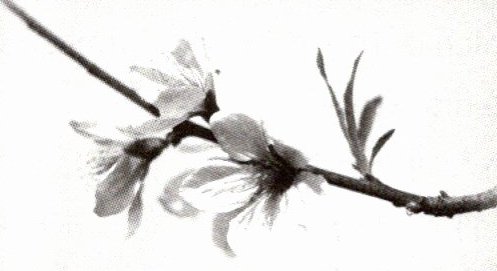
mountainside.” Shen Kuo asked why mountain peach blossoms bloom (开花) later than those below. His mother encouraged him to find answers in nature. When April came, Shen went hiking with friends and felt the colder air higher up on the mountain. “Aha!” he cried. “Higher places are colder, so mountain flowers bloom later!”
Story two
Shen Kuo once heard of a herb called gouwen (钩吻). It could be both a medicine and a poison (毒物). To find out the truth, he asked someone to bring him the whole plant. He studied it closely and wrote down the details carefully. Finally, Shen found that the gouwen used as a medicine was not the same plant as the poisonous gouwen.
Story three
As a governor in Yanzhou, Shen saw villagers burning strange black liquid and it produced thick black smoke. He collected some soot (烟灰) and tried making ink with it. The ink was even better than the one made by pine (松树) soot. Shen then recorded this kind of liquid — shiyou (石油) in his book Brush Talks from Dream Brook (《梦溪笔谈》).
Shen Kuo’s discoveries came not from books, but by questioning, observing (观察) and testing. His adventures and questions always led to fantastic and surprising answers, and deepened his understanding of the world around him.
2-1 Choose the best answer. 选择最恰当的答案。
Which of the following Chinese stanzas (诗节) matches the underlined sentences in the first story?
A.人面不知何处去,桃花依旧笑春风。
B.竹外桃花三两枝,春江水暖鸭先知。
C.人间四月芳菲尽,山寺桃花始盛开。
2-2 Complete the diagram according to the stories. 根据故事内容填写图表。
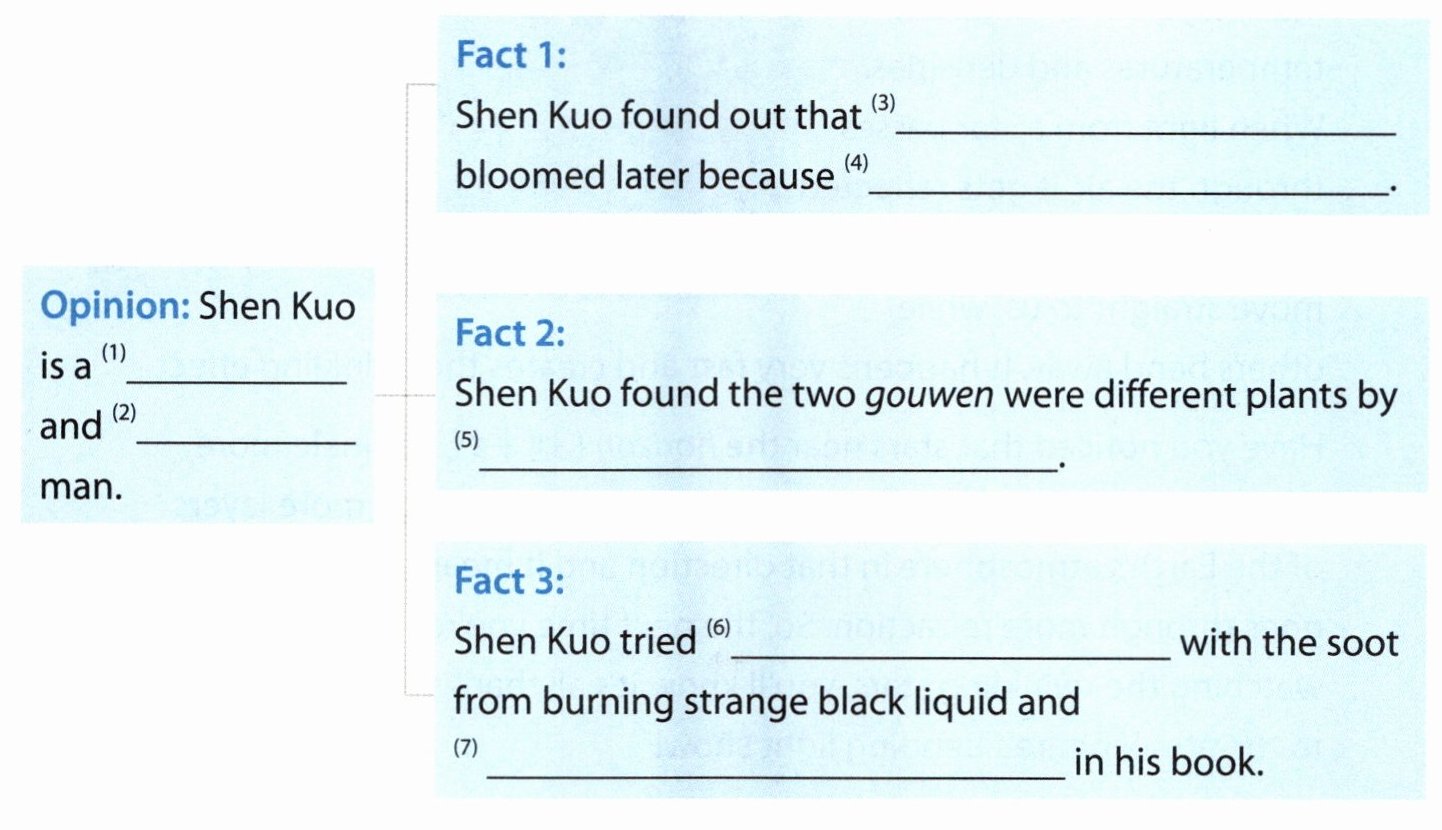
Opinion: Shen Kuo is a (1)
Fact 1:
Shen Kuo found out that (3)
Fact 2:
Shen Kuo found the two gouwen were different plants by (5)
Fact 3:
Shen Kuo tried (6)
Shen Kuo was a famous Chinese official and scientist. He was born in Hangzhou in 1031, during the Northern Song dynasty. He was known as a curious and adventurous man.
Here are three stories about Shen Kuo.
Story one
One day, Shen Kuo, as a little boy, read one of Bai Juyi’s poems: “All flowers in late spring have fallen far and wide. But peach blossoms (桃花) are full-blown on the
mountainside.” Shen Kuo asked why mountain peach blossoms bloom (开花) later than those below. His mother encouraged him to find answers in nature. When April came, Shen went hiking with friends and felt the colder air higher up on the mountain. “Aha!” he cried. “Higher places are colder, so mountain flowers bloom later!”
Story two
Shen Kuo once heard of a herb called gouwen (钩吻). It could be both a medicine and a poison (毒物). To find out the truth, he asked someone to bring him the whole plant. He studied it closely and wrote down the details carefully. Finally, Shen found that the gouwen used as a medicine was not the same plant as the poisonous gouwen.
Story three
As a governor in Yanzhou, Shen saw villagers burning strange black liquid and it produced thick black smoke. He collected some soot (烟灰) and tried making ink with it. The ink was even better than the one made by pine (松树) soot. Shen then recorded this kind of liquid — shiyou (石油) in his book Brush Talks from Dream Brook (《梦溪笔谈》).
Shen Kuo’s discoveries came not from books, but by questioning, observing (观察) and testing. His adventures and questions always led to fantastic and surprising answers, and deepened his understanding of the world around him.
2-1 Choose the best answer. 选择最恰当的答案。
Which of the following Chinese stanzas (诗节) matches the underlined sentences in the first story?
A.人面不知何处去,桃花依旧笑春风。
B.竹外桃花三两枝,春江水暖鸭先知。
C.人间四月芳菲尽,山寺桃花始盛开。
2-2 Complete the diagram according to the stories. 根据故事内容填写图表。
Opinion: Shen Kuo is a (1)
curious
and (2) adventurous
man.Fact 1:
Shen Kuo found out that (3)
mountain flowers
bloomed later because (4) higher places are colder
.Fact 2:
Shen Kuo found the two gouwen were different plants by (5)
studying them closely/carefully
.Fact 3:
Shen Kuo tried (6)
making ink
with the soot from burning strange black liquid and (7) recorded it/recorded this kind of liquid
in his book.答案
2-1
C
2-2
(Answers may vary.)
(1) curious (2) adventurous (3) mountain flowers (4) higher places are colder
(5) studying them closely/carefully (6) making ink (7) recorded it/recorded this kind of liquid
C
2-2
(Answers may vary.)
(1) curious (2) adventurous (3) mountain flowers (4) higher places are colder
(5) studying them closely/carefully (6) making ink (7) recorded it/recorded this kind of liquid
解析
【分析】
2-1题需先理解划线英文诗句的含义,再匹配对应的中文诗句;2-2题需从故事原文中提取关键信息,对应图表的各个空。首先明确2-1划线句的意思,再对比选项诗句的内涵;2-2题则根据故事1-3的内容,定位对应描述提取关键词即可。
【解析】
2-1题:划线英文诗句意为“晚春的花已纷纷落尽,可山腰的桃花却正盛开”。选项A未体现晚春山寺桃花晚开的特点;选项B描写的是早春桃花,不符合;选项C“人间四月芳菲尽,山寺桃花始盛开”正好对应晚春山寺桃花晚开的意思,故选C。
2-2题:(1)(2)从原文“He was known as a curious and adventurous man.”提取;(3)(4)从故事1中Shen Kuo的发现“mountain flowers bloom later because higher places are colder”提取;(5)从故事2中“studied it closely”提取;(6)(7)从故事3中“tried making ink”和“recorded this kind of liquid”提取。
【答案】
2-1 C
2-2 (1) curious (2) adventurous (3) mountain flowers (4) higher places are colder (5) studying them closely/carefully (6) making ink (7) recorded it/recorded this kind of liquid
【知识点】
英语阅读理解 信息提取 诗句匹配
【点评】
本题考查英语阅读理解的内容理解、信息提取及诗句匹配能力,需学生仔细阅读原文并结合诗句含义作答,整体难度适中。
【难度系数】
0.6
2-1题需先理解划线英文诗句的含义,再匹配对应的中文诗句;2-2题需从故事原文中提取关键信息,对应图表的各个空。首先明确2-1划线句的意思,再对比选项诗句的内涵;2-2题则根据故事1-3的内容,定位对应描述提取关键词即可。
【解析】
2-1题:划线英文诗句意为“晚春的花已纷纷落尽,可山腰的桃花却正盛开”。选项A未体现晚春山寺桃花晚开的特点;选项B描写的是早春桃花,不符合;选项C“人间四月芳菲尽,山寺桃花始盛开”正好对应晚春山寺桃花晚开的意思,故选C。
2-2题:(1)(2)从原文“He was known as a curious and adventurous man.”提取;(3)(4)从故事1中Shen Kuo的发现“mountain flowers bloom later because higher places are colder”提取;(5)从故事2中“studied it closely”提取;(6)(7)从故事3中“tried making ink”和“recorded this kind of liquid”提取。
【答案】
2-1 C
2-2 (1) curious (2) adventurous (3) mountain flowers (4) higher places are colder (5) studying them closely/carefully (6) making ink (7) recorded it/recorded this kind of liquid
【知识点】
英语阅读理解 信息提取 诗句匹配
【点评】
本题考查英语阅读理解的内容理解、信息提取及诗句匹配能力,需学生仔细阅读原文并结合诗句含义作答,整体难度适中。
【难度系数】
0.6
