

 登录
登录
3 Read the online article. 阅读网络文章。
Why do stars twinkle(闪烁)at night?
Did you ever wonder why stars twinkle at night?
It’s interesting to know that stars themselves don’t actually twinkle. They seem to twinkle because of the Earth’s atmosphere(大气层).
When light moves from one type of air to another, it bends(弯曲). This bending is called refraction(折射). Refraction happens because light changes speed when it moves between materials of different densities(密度), like going from air into water.
So, how does refraction connect to twinkling stars?
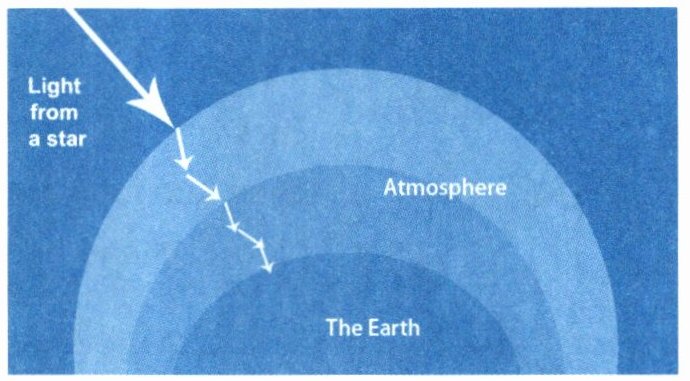
The Earth’s atmosphere has many layers with different temperatures and densities.
When light from a star passes through the air, it gets refracted many times. Some light rays move straight to us, while others bend away. It happens very fast and creates the twinkling effect.
Have you noticed that stars near the horizon(地平线)twinkle more than those overhead? It’s because you’re looking through more layers of the Earth’s atmosphere in that direction and it means the light goes through more refraction. So, the next time you’re watching the twinkling stars, you’ll know it’s all thanks to the atmosphere’s bending light show!
3-1 Choose the best answer. 选择最恰当的答案。
(1) Why do stars appear to twinkle?
A. Because they are moving fast.
B. Because they are actually twinkling.
C. Because the starlight travels through the Earth’s atmosphere.
D. Because the light from the Sun sometimes hides them.
(2) How does the Earth’s atmosphere influence the light from stars?
A. By strengthening(增强)the light.
B. By causing the light to bend.
C. By taking in the light.
D. By changing the light’s colour.
(3) Where do stars appear to twinkle more?
A. In the city centre.
B. In space.
C. Directly overhead.
D. Near the horizon.
3-2 Complete the sentences. 补全句子。
(1) Refraction happens because
(2) When light from a star passes through the air, it will
(3) If you are on the moon, can you see the stars twinkling?
Yes, I can. No, I can’t.
My reason:
Why do stars twinkle(闪烁)at night?
Did you ever wonder why stars twinkle at night?
It’s interesting to know that stars themselves don’t actually twinkle. They seem to twinkle because of the Earth’s atmosphere(大气层).
When light moves from one type of air to another, it bends(弯曲). This bending is called refraction(折射). Refraction happens because light changes speed when it moves between materials of different densities(密度), like going from air into water.
So, how does refraction connect to twinkling stars?
The Earth’s atmosphere has many layers with different temperatures and densities.
When light from a star passes through the air, it gets refracted many times. Some light rays move straight to us, while others bend away. It happens very fast and creates the twinkling effect.
Have you noticed that stars near the horizon(地平线)twinkle more than those overhead? It’s because you’re looking through more layers of the Earth’s atmosphere in that direction and it means the light goes through more refraction. So, the next time you’re watching the twinkling stars, you’ll know it’s all thanks to the atmosphere’s bending light show!
3-1 Choose the best answer. 选择最恰当的答案。
(1) Why do stars appear to twinkle?
A. Because they are moving fast.
B. Because they are actually twinkling.
C. Because the starlight travels through the Earth’s atmosphere.
D. Because the light from the Sun sometimes hides them.
(2) How does the Earth’s atmosphere influence the light from stars?
A. By strengthening(增强)the light.
B. By causing the light to bend.
C. By taking in the light.
D. By changing the light’s colour.
(3) Where do stars appear to twinkle more?
A. In the city centre.
B. In space.
C. Directly overhead.
D. Near the horizon.
3-2 Complete the sentences. 补全句子。
(1) Refraction happens because
light changes speed
when it moves between materials of different densities.(2) When light from a star passes through the air, it will
get refracted many times
.(3) If you are on the moon, can you see the stars twinkling?
Yes, I can. No, I can’t.
My reason:
Because the moon does not have an atmosphere like the Earth.
/Because there's no refraction.
答案
3-1
(1) C (2) B (3) D
3-2
(1) light changes speed
(2) get refracted many times
(3) ☑ No, I can't.
Because the moon does not have an atmosphere like the Earth./Because there's no refraction.
(1) C (2) B (3) D
3-2
(1) light changes speed
(2) get refracted many times
(3) ☑ No, I can't.
Because the moon does not have an atmosphere like the Earth./Because there's no refraction.
解析
【分析】
本题为英语阅读理解题,分为选择和补全句子两部分。解题思路:1. 先通读全文,把握文章核心内容(解释星星闪烁是地球大气层折射星光导致的);2. 针对3-1选择题,根据题干关键词定位原文对应细节,逐一排除错误选项,选出正确答案;3. 针对3-2补全题,依据原文原句或逻辑推导填写内容,最后一题需结合月球无大气层的常识作答。
【解析】
3-1 (1) 题干问星星看似闪烁的原因,原文提到“They seem to twinkle because of the Earth’s atmosphere.”,对应选项C(星光穿过地球大气层),A(星星快速移动)、B(星星实际在闪烁)与原文不符,D(太阳光有时遮挡它们)未提及,故选C。
(2) 题干问地球大气层如何影响星光,原文指出光在不同介质间传播会弯曲(折射),大气层有不同密度层,星光穿过时多次折射,对应选项B(导致光弯曲),A(增强光)、C(吸收光)、D(改变光的颜色)均未提及,故选B。
(3) 题干问哪里星星闪烁更多,原文明确“stars near the horizon twinkle more than those overhead”,对应选项D(地平线附近),A(市中心)、B(太空)、C(正上方)与原文不符,故选D。
3-2 (1) 题干问折射发生的原因,原文直接说明“Refraction happens because light changes speed when it moves between materials of different densities”,故填light changes speed。
(2) 题干问星光穿过空气时会怎样,原文提到“When light from a star passes through the air, it gets refracted many times”,故填get refracted many times。
(3) 题干问在月球上能否看到星星闪烁,月球没有大气层,不会发生折射,因此选No, I can't,原因是月球没有像地球一样的大气层,无折射现象。
【答案】
3-1 (1) C (2) B (3) D
3-2 (1) light changes speed (2) get refracted many times (3) ☑ No, I can't. Because the moon does not have an atmosphere like the Earth./Because there's no refraction.
【知识点】
英语阅读理解、细节理解、科普常识
【点评】
本题结合科普知识考查英语阅读理解能力,侧重细节查找与信息转换,需准确定位原文对应内容,难度适中,适合初中阶段学生练习。
【难度系数】
0.6
本题为英语阅读理解题,分为选择和补全句子两部分。解题思路:1. 先通读全文,把握文章核心内容(解释星星闪烁是地球大气层折射星光导致的);2. 针对3-1选择题,根据题干关键词定位原文对应细节,逐一排除错误选项,选出正确答案;3. 针对3-2补全题,依据原文原句或逻辑推导填写内容,最后一题需结合月球无大气层的常识作答。
【解析】
3-1 (1) 题干问星星看似闪烁的原因,原文提到“They seem to twinkle because of the Earth’s atmosphere.”,对应选项C(星光穿过地球大气层),A(星星快速移动)、B(星星实际在闪烁)与原文不符,D(太阳光有时遮挡它们)未提及,故选C。
(2) 题干问地球大气层如何影响星光,原文指出光在不同介质间传播会弯曲(折射),大气层有不同密度层,星光穿过时多次折射,对应选项B(导致光弯曲),A(增强光)、C(吸收光)、D(改变光的颜色)均未提及,故选B。
(3) 题干问哪里星星闪烁更多,原文明确“stars near the horizon twinkle more than those overhead”,对应选项D(地平线附近),A(市中心)、B(太空)、C(正上方)与原文不符,故选D。
3-2 (1) 题干问折射发生的原因,原文直接说明“Refraction happens because light changes speed when it moves between materials of different densities”,故填light changes speed。
(2) 题干问星光穿过空气时会怎样,原文提到“When light from a star passes through the air, it gets refracted many times”,故填get refracted many times。
(3) 题干问在月球上能否看到星星闪烁,月球没有大气层,不会发生折射,因此选No, I can't,原因是月球没有像地球一样的大气层,无折射现象。
【答案】
3-1 (1) C (2) B (3) D
3-2 (1) light changes speed (2) get refracted many times (3) ☑ No, I can't. Because the moon does not have an atmosphere like the Earth./Because there's no refraction.
【知识点】
英语阅读理解、细节理解、科普常识
【点评】
本题结合科普知识考查英语阅读理解能力,侧重细节查找与信息转换,需准确定位原文对应内容,难度适中,适合初中阶段学生练习。
【难度系数】
0.6
