

 登录
登录
1 如图,在$\mathrm{Rt}△ ABC$中,$∠ C=90°$,$AB=5$,$BC=3$,根据尺规作图的痕迹作射线$AG$,交$BC$于点$D$,则$BD$的长为 (
A.$\dfrac{3}{5}$
B.$\dfrac{3}{4}$
C.$\dfrac{4}{3}$
D.$\dfrac{5}{3}$
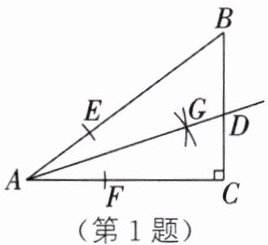 (第1题)
(第1题)
D
)A.$\dfrac{3}{5}$
B.$\dfrac{3}{4}$
C.$\dfrac{4}{3}$
D.$\dfrac{5}{3}$
(第1题)答案
1. D
解析
【分析】
首先在$\mathrm{Rt}△ ABC$中利用勾股定理求出$AC$的长度;再根据尺规作图痕迹判断出$AG$是$∠ BAC$的角平分线,依据角平分线的性质,过$D$作$AB$的垂线即可得到与$DC$长度相等的线段;最后设$BD$的长为未知数,在构造的直角三角形中用勾股定理列方程求解即可。
【解析】
在$\mathrm{Rt}△ ABC$中,$∠ C=90°$,$AB=5$,$BC=3$,由勾股定理得:
$AC=\sqrt{AB^2-BC^2}=\sqrt{5^2-3^2}=\sqrt{16}=4$。
由尺规作图痕迹可知$AD$是$∠ BAC$的角平分线,过点$D$作$DH⊥ AB$于点$H$。
根据角平分线的性质:角平分线上的点到角两边的距离相等,可得$DC=DH$。
在$\mathrm{Rt}△ ACD$和$\mathrm{Rt}△ AHD$中,$\begin{cases}AD=AD\\DC=DH\end{cases}$,
$\therefore \mathrm{Rt}△ ACD≌ \mathrm{Rt}△ AHD(\mathrm{HL})$,
$\therefore AH=AC=4$,
$\therefore BH=AB-AH=5-4=1$。
设$BD=x$,则$DC=3-x$,即$DH=3-x$。
在$\mathrm{Rt}△ BHD$中,由勾股定理得:$BH^2+DH^2=BD^2$,
代入得$1^2+(3-x)^2=x^2$,
展开计算得$1+9-6x+x^2=x^2$,
化简得$10-6x=0$,解得$x=\frac{5}{3}$,即$BD=\frac{5}{3}$。
【答案】
D
【知识点】
勾股定理,角平分线的性质,角平分线的尺规作图
【点评】
本题综合考查了角平分线的作图识别、性质及勾股定理的应用,解题关键是正确识别角平分线的作图痕迹,结合性质构造直角三角形,利用方程思想求解,是几何基础应用的典型题型。
【难度系数】
0.6
首先在$\mathrm{Rt}△ ABC$中利用勾股定理求出$AC$的长度;再根据尺规作图痕迹判断出$AG$是$∠ BAC$的角平分线,依据角平分线的性质,过$D$作$AB$的垂线即可得到与$DC$长度相等的线段;最后设$BD$的长为未知数,在构造的直角三角形中用勾股定理列方程求解即可。
【解析】
在$\mathrm{Rt}△ ABC$中,$∠ C=90°$,$AB=5$,$BC=3$,由勾股定理得:
$AC=\sqrt{AB^2-BC^2}=\sqrt{5^2-3^2}=\sqrt{16}=4$。
由尺规作图痕迹可知$AD$是$∠ BAC$的角平分线,过点$D$作$DH⊥ AB$于点$H$。
根据角平分线的性质:角平分线上的点到角两边的距离相等,可得$DC=DH$。
在$\mathrm{Rt}△ ACD$和$\mathrm{Rt}△ AHD$中,$\begin{cases}AD=AD\\DC=DH\end{cases}$,
$\therefore \mathrm{Rt}△ ACD≌ \mathrm{Rt}△ AHD(\mathrm{HL})$,
$\therefore AH=AC=4$,
$\therefore BH=AB-AH=5-4=1$。
设$BD=x$,则$DC=3-x$,即$DH=3-x$。
在$\mathrm{Rt}△ BHD$中,由勾股定理得:$BH^2+DH^2=BD^2$,
代入得$1^2+(3-x)^2=x^2$,
展开计算得$1+9-6x+x^2=x^2$,
化简得$10-6x=0$,解得$x=\frac{5}{3}$,即$BD=\frac{5}{3}$。
【答案】
D
【知识点】
勾股定理,角平分线的性质,角平分线的尺规作图
【点评】
本题综合考查了角平分线的作图识别、性质及勾股定理的应用,解题关键是正确识别角平分线的作图痕迹,结合性质构造直角三角形,利用方程思想求解,是几何基础应用的典型题型。
【难度系数】
0.6
2 分类讨论思想 如图,在等腰直角三角形ABC中,∠C=90°,AC=3.若P为边BC的三等分点,连接AP,则AP的长为
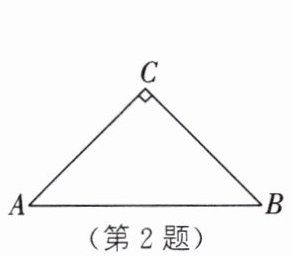
$\sqrt{10}$或$\sqrt{13}$
.答案
2. $\sqrt{10}$或$\sqrt{13}$
【解析】$\because △ABC$ 为等腰直角三角形,$∠ C=90°,AC=3,\therefore BC=AC=3.$ 在 $\mathrm{Rt}△ ACP$ 中,$AP^2 = AC^2+PC^2.\because P$ 为边 $BC$ 的三等分点,$\therefore$ ① 当 $PC=\dfrac{1}{3}BC=1$ 时,$AP=\sqrt{10};$② 当 $PC=\dfrac{2}{3}BC=2$ 时,$AP=\sqrt{13}.$ 综上所述,$AP$ 的长为$\sqrt{10}$或$\sqrt{13}.$
【解析】$\because △ABC$ 为等腰直角三角形,$∠ C=90°,AC=3,\therefore BC=AC=3.$ 在 $\mathrm{Rt}△ ACP$ 中,$AP^2 = AC^2+PC^2.\because P$ 为边 $BC$ 的三等分点,$\therefore$ ① 当 $PC=\dfrac{1}{3}BC=1$ 时,$AP=\sqrt{10};$② 当 $PC=\dfrac{2}{3}BC=2$ 时,$AP=\sqrt{13}.$ 综上所述,$AP$ 的长为$\sqrt{10}$或$\sqrt{13}.$
解析
【分析】
本题首先根据等腰直角三角形的性质确定BC的长度,由于BC边上的三等分点有2个,需分两种情况讨论PC的长度,再结合勾股定理即可分别计算出AP的长度。
【解析】
∵△ABC是等腰直角三角形,∠C=90°,AC=3,
∴BC=AC=3。
在Rt△ACP中,根据勾股定理可得$AP^2=AC^2+PC^2$。
∵P为边BC的三等分点,因此分两种情况讨论:
①当$PC=\frac{1}{3}BC=1$时,$AP=\sqrt{AC^2+PC^2}=\sqrt{3^2+1^2}=\sqrt{10}$;
②当$PC=\frac{2}{3}BC=2$时,$AP=\sqrt{AC^2+PC^2}=\sqrt{3^2+2^2}=\sqrt{13}$。
综上所述,AP的长为$\sqrt{10}$或$\sqrt{13}$。
【答案】
$\sqrt{10}$或$\sqrt{13}$
【知识点】
等腰直角三角形的性质,勾股定理,分类讨论思想
【点评】
本题解题的关键是明确BC的三等分点存在两种位置,易出现漏解的错误,解题时要注意结合分类讨论思想,全面考虑所有可能的情况,再利用勾股定理计算即可。
【难度系数】
0.7
本题首先根据等腰直角三角形的性质确定BC的长度,由于BC边上的三等分点有2个,需分两种情况讨论PC的长度,再结合勾股定理即可分别计算出AP的长度。
【解析】
∵△ABC是等腰直角三角形,∠C=90°,AC=3,
∴BC=AC=3。
在Rt△ACP中,根据勾股定理可得$AP^2=AC^2+PC^2$。
∵P为边BC的三等分点,因此分两种情况讨论:
①当$PC=\frac{1}{3}BC=1$时,$AP=\sqrt{AC^2+PC^2}=\sqrt{3^2+1^2}=\sqrt{10}$;
②当$PC=\frac{2}{3}BC=2$时,$AP=\sqrt{AC^2+PC^2}=\sqrt{3^2+2^2}=\sqrt{13}$。
综上所述,AP的长为$\sqrt{10}$或$\sqrt{13}$。
【答案】
$\sqrt{10}$或$\sqrt{13}$
【知识点】
等腰直角三角形的性质,勾股定理,分类讨论思想
【点评】
本题解题的关键是明确BC的三等分点存在两种位置,易出现漏解的错误,解题时要注意结合分类讨论思想,全面考虑所有可能的情况,再利用勾股定理计算即可。
【难度系数】
0.7
3 整体思想 设a,b是直角三角形的两条直角边的长.若该三角形的周长为6,斜边长为2.5,则ab的值为
3
.答案
3. 3
【解析】根据题意,得 $a+b+2.5=6,$ 即 $a+b=3.5$,$a^2+b^2=2.5^2$①. 将 $a+b=3.5$ 两边平方,得 $a^2+2ab+b^2=12.25$②. 由②$-$①,得 $2ab=6,$即 $ab=3.$
【解析】根据题意,得 $a+b+2.5=6,$ 即 $a+b=3.5$,$a^2+b^2=2.5^2$①. 将 $a+b=3.5$ 两边平方,得 $a^2+2ab+b^2=12.25$②. 由②$-$①,得 $2ab=6,$即 $ab=3.$
解析
【分析】
首先根据直角三角形的周长和已知斜边长,可先算出两条直角边的和$a+b$;再结合勾股定理得到$a^2+b^2$的值;此时要求$ab$的值,观察已知的$a+b$与$a^2+b^2$,可联想到完全平方公式,将$a+b$两边平方后,与勾股定理的式子作差,就能整体求出$ab$的值,不需要单独求解$a$、$b$的具体数值,运用整体思想可简化计算。
【解析】
解:由题意得,直角三角形周长为6,斜边长为2.5
$\therefore a+b+2.5=6$,即$a+b=3.5$
根据勾股定理可得:$a^2+b^2=2.5^2=6.25$ ①
将$a+b=3.5$两边同时平方,得:
$(a+b)^2=3.5^2$,即$a^2+2ab+b^2=12.25$ ②
用②式减去①式,得:
$(a^2+2ab+b^2)-(a^2+b^2)=12.25-6.25$
化简得$2ab=6$
$\therefore ab=3$
【答案】
3
【知识点】
勾股定理;完全平方公式;整体代入求值
【点评】
本题将直角三角形的性质与整式乘法公式结合考查,解题时无需单独求解两条直角边的长度,借助整体思想代入计算即可,有效简化了运算步骤,是几何与代数结合的基础典型题。
【难度系数】
0.7
首先根据直角三角形的周长和已知斜边长,可先算出两条直角边的和$a+b$;再结合勾股定理得到$a^2+b^2$的值;此时要求$ab$的值,观察已知的$a+b$与$a^2+b^2$,可联想到完全平方公式,将$a+b$两边平方后,与勾股定理的式子作差,就能整体求出$ab$的值,不需要单独求解$a$、$b$的具体数值,运用整体思想可简化计算。
【解析】
解:由题意得,直角三角形周长为6,斜边长为2.5
$\therefore a+b+2.5=6$,即$a+b=3.5$
根据勾股定理可得:$a^2+b^2=2.5^2=6.25$ ①
将$a+b=3.5$两边同时平方,得:
$(a+b)^2=3.5^2$,即$a^2+2ab+b^2=12.25$ ②
用②式减去①式,得:
$(a^2+2ab+b^2)-(a^2+b^2)=12.25-6.25$
化简得$2ab=6$
$\therefore ab=3$
【答案】
3
【知识点】
勾股定理;完全平方公式;整体代入求值
【点评】
本题将直角三角形的性质与整式乘法公式结合考查,解题时无需单独求解两条直角边的长度,借助整体思想代入计算即可,有效简化了运算步骤,是几何与代数结合的基础典型题。
【难度系数】
0.7
4 [2025高新区段考]如图,在$Rt△ ABC$中,分别以这个三角形的三边为边长向外侧作正方形,面积分别记为$S_1,S_2,S_3$.若$S_3+S_2-S_1=18$,则涂色部分的面积为
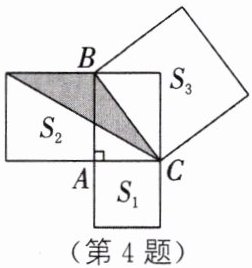
$\dfrac{9}{2}$
.答案
4. $\dfrac{9}{2}$
【解析】在 $\mathrm{Rt}△ ABC$ 中,由勾股定理,得 $AC^2+AB^2=BC^2$,即 $S_1+S_2=S_3.\because S_3+S_2-S_1=18,\therefore S_2=9.$ 由图形可知,涂色部分的面积$=\dfrac{1}{2}S_2,\therefore$ 涂色部分的面积$=\dfrac{9}{2}.$
【解析】在 $\mathrm{Rt}△ ABC$ 中,由勾股定理,得 $AC^2+AB^2=BC^2$,即 $S_1+S_2=S_3.\because S_3+S_2-S_1=18,\therefore S_2=9.$ 由图形可知,涂色部分的面积$=\dfrac{1}{2}S_2,\therefore$ 涂色部分的面积$=\dfrac{9}{2}.$
解析
【分析】
解题时首先观察图形特征:直角三角形三边向外作正方形,因此可以将正方形面积与三角形边长的平方对应,结合勾股定理得到三个正方形面积的关系;再将该关系代入题目给出的等式,即可求出$S_2$的值;最后观察涂色部分的图形特征,推导其与$S_2$的数量关系,代入计算即可得到结果。
【解析】
在$\mathrm{Rt}△ ABC$中,$∠ BAC=90°$,由勾股定理得:$AC^2+AB^2=BC^2$。
∵ 以三角形三边为边长的正方形面积分别为$S_1,S_2,S_3$,
∴ $S_1=AC^2$,$S_2=AB^2$,$S_3=BC^2$,代入勾股定理得:$S_1+S_2=S_3$。
已知$S_3+S_2-S_1=18$,将$S_3=S_1+S_2$代入得:
$S_1+S_2+S_2-S_1=18$,
化简得$2S_2=18$,解得$S_2=9$。
由图形可知,涂色部分的面积为$\dfrac{1}{2}S_2$,
∴ 涂色部分的面积$=\dfrac{1}{2}×9=\dfrac{9}{2}$。
【答案】
$\dfrac{9}{2}$
【知识点】
勾股定理;正方形面积;等积变换
【点评】
本题将勾股定理与图形面积计算结合,解题关键是建立正方形面积和直角三角形三边的对应关系,再结合已知条件求解,需要具备一定的图形观察能力,能快速找到阴影部分与已知正方形面积的数量关系。
【难度系数】
0.7
解题时首先观察图形特征:直角三角形三边向外作正方形,因此可以将正方形面积与三角形边长的平方对应,结合勾股定理得到三个正方形面积的关系;再将该关系代入题目给出的等式,即可求出$S_2$的值;最后观察涂色部分的图形特征,推导其与$S_2$的数量关系,代入计算即可得到结果。
【解析】
在$\mathrm{Rt}△ ABC$中,$∠ BAC=90°$,由勾股定理得:$AC^2+AB^2=BC^2$。
∵ 以三角形三边为边长的正方形面积分别为$S_1,S_2,S_3$,
∴ $S_1=AC^2$,$S_2=AB^2$,$S_3=BC^2$,代入勾股定理得:$S_1+S_2=S_3$。
已知$S_3+S_2-S_1=18$,将$S_3=S_1+S_2$代入得:
$S_1+S_2+S_2-S_1=18$,
化简得$2S_2=18$,解得$S_2=9$。
由图形可知,涂色部分的面积为$\dfrac{1}{2}S_2$,
∴ 涂色部分的面积$=\dfrac{1}{2}×9=\dfrac{9}{2}$。
【答案】
$\dfrac{9}{2}$
【知识点】
勾股定理;正方形面积;等积变换
【点评】
本题将勾股定理与图形面积计算结合,解题关键是建立正方形面积和直角三角形三边的对应关系,再结合已知条件求解,需要具备一定的图形观察能力,能快速找到阴影部分与已知正方形面积的数量关系。
【难度系数】
0.7
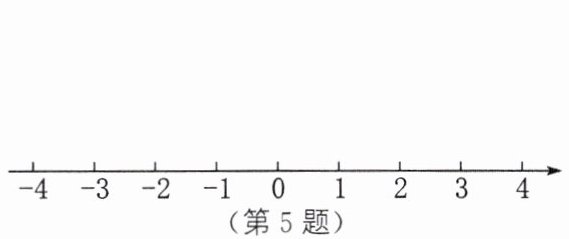
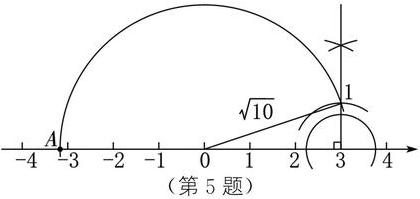
5 用直尺和圆规在如图所示的数轴上作出表示$-\sqrt{10}$的点.
答案
5. 作法不唯一,如图,点 A 即为所求
解析
【分析】
要在数轴上作出表示$-\sqrt{10}$的点,首先需要得到长度为$\sqrt{10}$的线段。根据勾股定理,直角三角形两条直角边的平方和等于斜边的平方,由于$10=3^2+1^2$,因此可以构造直角边分别为3和1的直角三角形,其斜边长即为$\sqrt{10}$。之后以原点为圆心、斜边长为半径画弧,弧与数轴负半轴的交点就是所求的点。
【解析】
作法如下:
1. 在数轴正半轴上找到表示3的点,过该点作数轴的垂线;
2. 在垂线上截取长度为1个单位长度的线段,连接原点与该线段的上端点,由勾股定理可得该线段长度为$\sqrt{3^2+1^2}=\sqrt{10}$;
3. 以原点为圆心,以上述斜边长度为半径画弧,弧与数轴负半轴的交点即为表示$-\sqrt{10}$的点A。
【答案】
作法不唯一,如图,点 A 即为所求
【知识点】
勾股定理;尺规作图;数轴表示实数
【点评】
本题结合勾股定理、尺规作图、数轴与实数的对应关系考查无理数的几何表示方法,解题核心是利用勾股定理构造出与待表示无理数长度相等的线段,再通过圆规将线段长度转移到数轴对应位置。
【难度系数】
0.7
要在数轴上作出表示$-\sqrt{10}$的点,首先需要得到长度为$\sqrt{10}$的线段。根据勾股定理,直角三角形两条直角边的平方和等于斜边的平方,由于$10=3^2+1^2$,因此可以构造直角边分别为3和1的直角三角形,其斜边长即为$\sqrt{10}$。之后以原点为圆心、斜边长为半径画弧,弧与数轴负半轴的交点就是所求的点。
【解析】
作法如下:
1. 在数轴正半轴上找到表示3的点,过该点作数轴的垂线;
2. 在垂线上截取长度为1个单位长度的线段,连接原点与该线段的上端点,由勾股定理可得该线段长度为$\sqrt{3^2+1^2}=\sqrt{10}$;
3. 以原点为圆心,以上述斜边长度为半径画弧,弧与数轴负半轴的交点即为表示$-\sqrt{10}$的点A。
【答案】
作法不唯一,如图,点 A 即为所求
【知识点】
勾股定理;尺规作图;数轴表示实数
【点评】
本题结合勾股定理、尺规作图、数轴与实数的对应关系考查无理数的几何表示方法,解题核心是利用勾股定理构造出与待表示无理数长度相等的线段,再通过圆规将线段长度转移到数轴对应位置。
【难度系数】
0.7
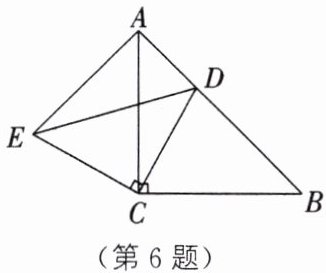
6 如图,△ACB和△ECD都是等腰直角三角形,∠ACB=∠ECD=90°,D为边AB上一点.求证:
(1)△ACE≌△BCD;
(2)AD²+DB²=2CD².
(1)△ACE≌△BCD;
(2)AD²+DB²=2CD².
答案
6. (1) $\because △ ACB$ 和 $△ ECD$ 都是等腰直角三角形,$\therefore AC=BC, CD = CE. \because ∠ ACB = ∠ ECD = 90°, \therefore ∠ BCD+∠ ACD=∠ ACE+∠ ACD,\therefore ∠ BCD=∠ ACE.$ 在 $△ ACE$ 和 $△ BCD$ 中,$\begin{cases} AC=BC, \\ ∠ ACE=∠ BCD, \\ CE=CD, \end{cases}$$\therefore △ ACE≌△ BCD$
(2) $\because △ ACB$ 是等腰直角三角形,$\therefore ∠ B = ∠ BAC = 45°.$
$\because △ ACE ≌ △ BCD, \therefore EA = DB, ∠ CAE = ∠ B = 45°,$
$\therefore ∠ DAE = ∠ CAE + ∠ BAC = 45° + 45° = 90°, \therefore AD^2+EA^2=DE^2,\therefore AD^2+DB^2=DE^2.$ 又 $\because △ ECD$ 是等腰直角三角形,$\therefore CD^2+CE^2=2CD^2=DE^2,\therefore AD^2+DB^2=2CD^2$
(2) $\because △ ACB$ 是等腰直角三角形,$\therefore ∠ B = ∠ BAC = 45°.$
$\because △ ACE ≌ △ BCD, \therefore EA = DB, ∠ CAE = ∠ B = 45°,$
$\therefore ∠ DAE = ∠ CAE + ∠ BAC = 45° + 45° = 90°, \therefore AD^2+EA^2=DE^2,\therefore AD^2+DB^2=DE^2.$ 又 $\because △ ECD$ 是等腰直角三角形,$\therefore CD^2+CE^2=2CD^2=DE^2,\therefore AD^2+DB^2=2CD^2$
解析
【分析】
(1)要证△ACE≌△BCD,先从等腰直角三角形的性质得到两组对应边相等,再结合两个90°角同时减去公共角∠ACD,推导出两组对应边的夹角相等,即可用SAS判定全等。
(2)要证平方和等式,优先考虑勾股定理,借助第一问的全等结论将DB转化为EA,同时推导得到∠DAE为直角,在Rt△ADE中用勾股定理得到AD、DB、DE的关系,再结合等腰直角△ECD的勾股定理结论,等量代换即可得证。
【解析】
(1)证明:
∵△ACB和△ECD都是等腰直角三角形,∠ACB=∠ECD=90°
∴$AC=BC$,$CD = CE$
∵$∠ACB=∠ACE+∠ACD$,$∠ECD=∠BCD+∠ACD$
∴$∠ACE+∠ACD=∠BCD+∠ACD$,即$∠BCD=∠ACE$
在$△ ACE$和$△ BCD$中:
$\begin{cases} AC=BC, \\ ∠ ACE=∠ BCD, \\ CE=CD, \end{cases}$
∴$△ ACE≌△ BCD$(SAS)
(2)证明:
∵△ACB是等腰直角三角形,∠ACB=90°
∴$∠ B = ∠ BAC = 45°$
由(1)得$△ ACE ≌ △ BCD$,
∴$EA = DB$,$∠ CAE = ∠ B = 45°$
∴$∠ DAE = ∠ CAE + ∠ BAC = 45° + 45° = 90°$,即△ADE为直角三角形
在Rt△ADE中,由勾股定理得$AD^2+EA^2=DE^2$,代入$EA=DB$得$AD^2+DB^2=DE^2$
又
∵△ECD是等腰直角三角形,∠ECD=90°
∴由勾股定理得$CD^2+CE^2=DE^2$,结合$CD=CE$得$DE^2=2CD^2$
∴$AD^2+DB^2=2CD^2$
【答案】
(1)$△ ACE≌△ BCD$得证;
(2)$AD²+DB²=2CD²$得证。
【知识点】
等腰直角三角形的性质、全等三角形的判定与性质、勾股定理
【点评】
本题属于全等与勾股定理结合的基础综合题,第一问的全等证明是第二问推导的铺垫,解题核心是通过全等实现边和角的等量转化,构造直角三角形后利用勾股定理完成等式推导,是初中几何的常考题型。
【难度系数】
0.7
(1)要证△ACE≌△BCD,先从等腰直角三角形的性质得到两组对应边相等,再结合两个90°角同时减去公共角∠ACD,推导出两组对应边的夹角相等,即可用SAS判定全等。
(2)要证平方和等式,优先考虑勾股定理,借助第一问的全等结论将DB转化为EA,同时推导得到∠DAE为直角,在Rt△ADE中用勾股定理得到AD、DB、DE的关系,再结合等腰直角△ECD的勾股定理结论,等量代换即可得证。
【解析】
(1)证明:
∵△ACB和△ECD都是等腰直角三角形,∠ACB=∠ECD=90°
∴$AC=BC$,$CD = CE$
∵$∠ACB=∠ACE+∠ACD$,$∠ECD=∠BCD+∠ACD$
∴$∠ACE+∠ACD=∠BCD+∠ACD$,即$∠BCD=∠ACE$
在$△ ACE$和$△ BCD$中:
$\begin{cases} AC=BC, \\ ∠ ACE=∠ BCD, \\ CE=CD, \end{cases}$
∴$△ ACE≌△ BCD$(SAS)
(2)证明:
∵△ACB是等腰直角三角形,∠ACB=90°
∴$∠ B = ∠ BAC = 45°$
由(1)得$△ ACE ≌ △ BCD$,
∴$EA = DB$,$∠ CAE = ∠ B = 45°$
∴$∠ DAE = ∠ CAE + ∠ BAC = 45° + 45° = 90°$,即△ADE为直角三角形
在Rt△ADE中,由勾股定理得$AD^2+EA^2=DE^2$,代入$EA=DB$得$AD^2+DB^2=DE^2$
又
∵△ECD是等腰直角三角形,∠ECD=90°
∴由勾股定理得$CD^2+CE^2=DE^2$,结合$CD=CE$得$DE^2=2CD^2$
∴$AD^2+DB^2=2CD^2$
【答案】
(1)$△ ACE≌△ BCD$得证;
(2)$AD²+DB²=2CD²$得证。
【知识点】
等腰直角三角形的性质、全等三角形的判定与性质、勾股定理
【点评】
本题属于全等与勾股定理结合的基础综合题,第一问的全等证明是第二问推导的铺垫,解题核心是通过全等实现边和角的等量转化,构造直角三角形后利用勾股定理完成等式推导,是初中几何的常考题型。
【难度系数】
0.7
