

 登录
登录
Ⅲ. 根据课本第12~13页的内容,完成下列任务。
任务一:判断下列句子与课文内容是否相符。符合的写“T”,不符合的写“F”,并从课文中摘录关键句子作为依据。
1. (T) Liang Qichao was a famous educator. He cared a lot about young people in China.
Proof(依据): Liang Qichao was a well-known writer and educator in China. He wrote many articles to encourage and guide young people.
2. () Liang believed that young people should take responsibility for China's future.
依据:
3. () The passage uses "if" sentences to show how young people's qualities shape China's future.
依据:
4. () Liang Qichao wrote "The Young China" during a peaceful time in China's history.
依据:
任务二:诗歌用了许多自然界的意象来比喻青年。将左栏的意象与右栏的象征意义用线连起来。
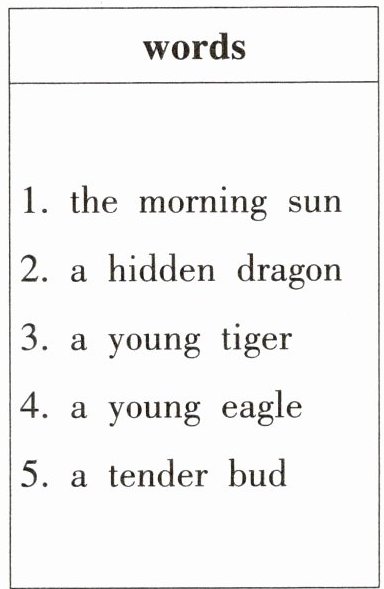
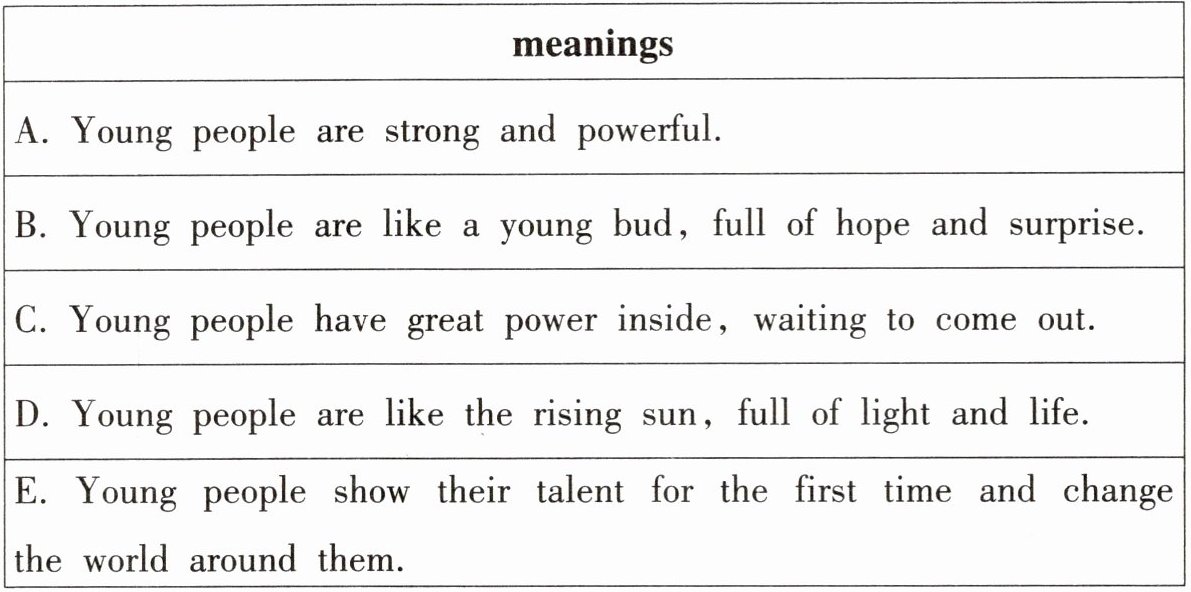
任务三:回答问题。
1. What message did Liang Qichao want to send to Chinese youth?
2. After reading "The Young China", how do you feel and what are you going to do for a better China?(Within 50 words)
任务一:判断下列句子与课文内容是否相符。符合的写“T”,不符合的写“F”,并从课文中摘录关键句子作为依据。
1. (T) Liang Qichao was a famous educator. He cared a lot about young people in China.
Proof(依据): Liang Qichao was a well-known writer and educator in China. He wrote many articles to encourage and guide young people.
2. () Liang believed that young people should take responsibility for China's future.
依据:
3. () The passage uses "if" sentences to show how young people's qualities shape China's future.
依据:
4. () Liang Qichao wrote "The Young China" during a peaceful time in China's history.
依据:
任务二:诗歌用了许多自然界的意象来比喻青年。将左栏的意象与右栏的象征意义用线连起来。
任务三:回答问题。
1. What message did Liang Qichao want to send to Chinese youth?
2. After reading "The Young China", how do you feel and what are you going to do for a better China?(Within 50 words)
答案
任务一:
2. T, 依据:In "The Young China", he called on young people to shoulder the responsibility and take action to make China strong and energetic.
3. T, 依据:If we are wise, China will be wise; ...
4. F, 依据:The turn of the 20th century was China's darkest moment.
任务二:1. D 2. C 3. A 4. E 5. B
任务三:
1. Chinese youth should shoulder the responsibility for China's future. If they are strong, wise, independent, etc., China will be strong.
2. (开放答案) I feel inspired and proud. I will study hard, learn about the culture of my country, and take action to help my community. / I feel proud and excited. I will study hard and shoulder my duty to make China stronger.
2. T, 依据:In "The Young China", he called on young people to shoulder the responsibility and take action to make China strong and energetic.
3. T, 依据:If we are wise, China will be wise; ...
4. F, 依据:The turn of the 20th century was China's darkest moment.
任务二:1. D 2. C 3. A 4. E 5. B
任务三:
1. Chinese youth should shoulder the responsibility for China's future. If they are strong, wise, independent, etc., China will be strong.
2. (开放答案) I feel inspired and proud. I will study hard, learn about the culture of my country, and take action to help my community. / I feel proud and excited. I will study hard and shoulder my duty to make China stronger.
解析
【分析】
本题围绕《少年中国说》相关内容设计,解题思路如下:任务一需判断句子与课文内容是否相符,关键是定位每个句子的核心,匹配课文给出的依据;任务二是意象与象征意义的连线题,需对应固定的匹配关系;任务三为主旨理解和开放表达题,主旨题提炼课文核心观点,开放题结合自身感受作答。
【解析】
任务一:
2. 句子核心为“梁启超认为年轻人应承担中国未来的责任”,对应课文中他在《少年中国说》里号召年轻人担责的内容,故判断为T,依据为指定内容;
3. 课文中确实用多个“if”句体现年轻人品质对中国未来的塑造,故判断为T,依据为指定的if句示例;
4. 梁启超写《少年中国》时是20世纪初中国最黑暗的时期,并非和平时期,故判断为F,依据为指定内容。
任务二:
按课文固定的意象与象征意义对应关系连线,结果为1.D、2.C、3.A、4.E、5.B。
任务三:
1. 主旨题提炼课文核心:年轻人应承担中国未来的责任,其品质决定中国未来;
2. 开放题结合自身感受,围绕“受启发、努力学习、担责任”等方向作答,符合字数要求即可。
【答案】
任务一:
2. T, 依据:In "The Young China", he called on young people to shoulder the responsibility and take action to make China strong and energetic.
3. T, 依据:If we are wise, China will be wise; ...
4. F, 依据:The turn of the 20th century was China's darkest moment.
任务二:1. D 2. C 3. A 4. E 5. B
任务三:
1. Chinese youth should shoulder the responsibility for China's future. If they are strong, wise, independent, etc., China will be strong.
2. I feel inspired and proud. I will study hard, learn about the culture of my country, and take action to help my community.
【知识点】
英语阅读理解、课文内容匹配、主旨大意理解
【点评】
本题紧扣课文内容,既考查对细节的掌握,又兼顾主旨理解与开放表达,能帮助学生巩固课文知识,提升阅读和表达能力。
【难度系数】
0.6
本题围绕《少年中国说》相关内容设计,解题思路如下:任务一需判断句子与课文内容是否相符,关键是定位每个句子的核心,匹配课文给出的依据;任务二是意象与象征意义的连线题,需对应固定的匹配关系;任务三为主旨理解和开放表达题,主旨题提炼课文核心观点,开放题结合自身感受作答。
【解析】
任务一:
2. 句子核心为“梁启超认为年轻人应承担中国未来的责任”,对应课文中他在《少年中国说》里号召年轻人担责的内容,故判断为T,依据为指定内容;
3. 课文中确实用多个“if”句体现年轻人品质对中国未来的塑造,故判断为T,依据为指定的if句示例;
4. 梁启超写《少年中国》时是20世纪初中国最黑暗的时期,并非和平时期,故判断为F,依据为指定内容。
任务二:
按课文固定的意象与象征意义对应关系连线,结果为1.D、2.C、3.A、4.E、5.B。
任务三:
1. 主旨题提炼课文核心:年轻人应承担中国未来的责任,其品质决定中国未来;
2. 开放题结合自身感受,围绕“受启发、努力学习、担责任”等方向作答,符合字数要求即可。
【答案】
任务一:
2. T, 依据:In "The Young China", he called on young people to shoulder the responsibility and take action to make China strong and energetic.
3. T, 依据:If we are wise, China will be wise; ...
4. F, 依据:The turn of the 20th century was China's darkest moment.
任务二:1. D 2. C 3. A 4. E 5. B
任务三:
1. Chinese youth should shoulder the responsibility for China's future. If they are strong, wise, independent, etc., China will be strong.
2. I feel inspired and proud. I will study hard, learn about the culture of my country, and take action to help my community.
【知识点】
英语阅读理解、课文内容匹配、主旨大意理解
【点评】
本题紧扣课文内容,既考查对细节的掌握,又兼顾主旨理解与开放表达,能帮助学生巩固课文知识,提升阅读和表达能力。
【难度系数】
0.6
