

 登录
登录
F
KEY→P39
范畴:人与社会 主题:科学技术 体裁:议论文 难度:★★★ 建议用时:8分钟 评价:/9
阅读下面短文,根据所读内容,在文章后的空格里填入最恰当的内容。注意:第1~8题每个空格只填1个单词,第9题字数不限。
Would you fully trust an AI tool when it gives you advice on shopping or travel? You probably shouldn't. Sometimes, the answers it gives may hide advertisements.
For example, some people use AI to make travel guides. At first, the guides seem helpful. But later, they notice strong recommendations for certain group tours. These tours might come from small travel companies, and the suggested websites could be shopping sites for elderly people. Another example is when you ask about washing machines, the AI might say, "Book through a reliable(可信赖的) platform like XXX." though many people have said bad words about that platform for years.
The same thing happens with AI fortune-telling(占卜). Many people get advice like "Wear a red or purple bracelet(手镯) made of a certain stone for good luck." But if you check online, almost everyone receives the same answer!
Young people might take no notice of these websites by themselves. But when AI gives the same information, it suddenly seems more believable.
Why do people believe AI? They think AI is neutral(中立的). They know AI can make mistakes, but they don't think it tells lies on purpose. They forget that AI learns from the internet, which includes many ads—some clear, some hidden.
People can judge information based on their own experiences. But AI has no real-life experience. It has never joined a group tour or faced pressure(压力) from a tour guide. To AI, everything is just data(数据). That's why its advice might sound right but actually be useless.
In the internet age, be careful with information—especially if it's not from your experience. Don't trust strangers or AI blindly!
| Should we trust AI completely? | |
| ---- | ---- |
| Facts | When asking for travelling and shopping advice, users may get answers with 1.
| Examples | • AI 2.
• AI sometimes shows 3. websites to elderly people.
• AI may provide unreliable booking websites with bad 4.
• AI gives the same fortune-telling advice to everyone. |
| Users' opinions on AI | • They think AI tools are neutral and 5.
• They trust the information from AI more than that from a website. |
(续表)
| Should we trust AI completely? | |
| ---- | ---- |
| Problems and 6.
• AI learns everything from the internet, 8.
| Suggestions/Advice | You'd better be careful with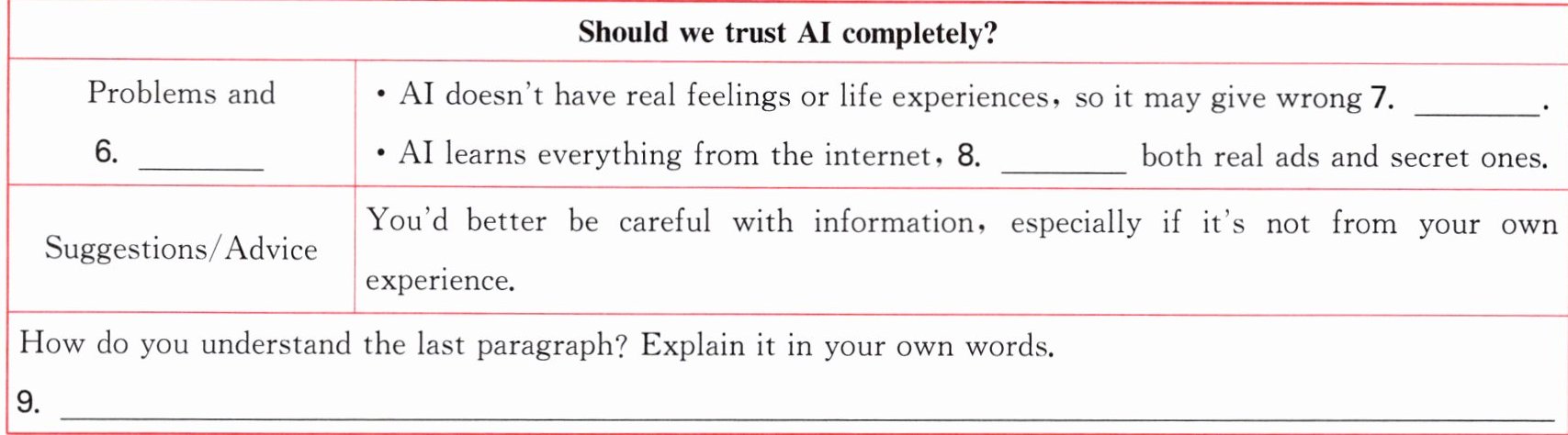 information, especially if it's not from your own experience. |
| How do you understand the last paragraph? Explain it in your own words. | 9.
KEY→P39
范畴:人与社会 主题:科学技术 体裁:议论文 难度:★★★ 建议用时:8分钟 评价:/9
阅读下面短文,根据所读内容,在文章后的空格里填入最恰当的内容。注意:第1~8题每个空格只填1个单词,第9题字数不限。
Would you fully trust an AI tool when it gives you advice on shopping or travel? You probably shouldn't. Sometimes, the answers it gives may hide advertisements.
For example, some people use AI to make travel guides. At first, the guides seem helpful. But later, they notice strong recommendations for certain group tours. These tours might come from small travel companies, and the suggested websites could be shopping sites for elderly people. Another example is when you ask about washing machines, the AI might say, "Book through a reliable(可信赖的) platform like XXX." though many people have said bad words about that platform for years.
The same thing happens with AI fortune-telling(占卜). Many people get advice like "Wear a red or purple bracelet(手镯) made of a certain stone for good luck." But if you check online, almost everyone receives the same answer!
Young people might take no notice of these websites by themselves. But when AI gives the same information, it suddenly seems more believable.
Why do people believe AI? They think AI is neutral(中立的). They know AI can make mistakes, but they don't think it tells lies on purpose. They forget that AI learns from the internet, which includes many ads—some clear, some hidden.
People can judge information based on their own experiences. But AI has no real-life experience. It has never joined a group tour or faced pressure(压力) from a tour guide. To AI, everything is just data(数据). That's why its advice might sound right but actually be useless.
In the internet age, be careful with information—especially if it's not from your experience. Don't trust strangers or AI blindly!
| Should we trust AI completely? | |
| ---- | ---- |
| Facts | When asking for travelling and shopping advice, users may get answers with 1.
hidden
advertisements from AI tools. || Examples | • AI 2.
recommends
certain group tours from small companies.• AI sometimes shows 3.
websites to elderly people.• AI may provide unreliable booking websites with bad 4.
words
.• AI gives the same fortune-telling advice to everyone. |
| Users' opinions on AI | • They think AI tools are neutral and 5.
honest
• They trust the information from AI more than that from a website. |
(续表)
| Should we trust AI completely? | |
| ---- | ---- |
| Problems and 6.
disadvantages
| • AI doesn't have real feelings or life experiences, so it may give wrong 7. advice/suggestions
.• AI learns everything from the internet, 8.
including
both real ads and secret ones. || Suggestions/Advice | You'd better be careful with
information, especially if it's not from your own experience. || How do you understand the last paragraph? Explain it in your own words. | 9.
You'd better not blindly believe in the information provided by AI on the internet.(言之有理即可)
|答案
AI工具在推荐旅行和购物信息时可能隐藏广告,本文提醒读者在互联网时代对未知信息要保持警惕,不要盲目信任AI。
1. hidden 2. recommends 3. shopping 4. words
5. honest 6. disadvantages 7. advice/suggestions
8. including 9. You'd better not blindly believe in the information provided by AI on the internet.(言之有理即可)
1. hidden 2. recommends 3. shopping 4. words
5. honest 6. disadvantages 7. advice/suggestions
8. including 9. You'd better not blindly believe in the information provided by AI on the internet.(言之有理即可)
解析
【分析】
首先通读全文,理解文章主旨是提醒人们不要盲目信任AI,因为AI的建议可能包含隐藏广告,且AI缺乏真实生活经验。解题时需根据每个空格前后的语境,结合原文对应段落的信息,确定所需单词的词性和词义,注意第1-8题需填1个单词,第9题需结合最后一段主旨解释。
【解析】
1. 定位原文第一段最后一句“Sometimes, the answers it gives may hide advertisements.”,此处需形容词修饰advertisements,故填hidden。
2. 定位原文第二段“they notice strong recommendations for certain group tours”,此处主语为AI,需动词第三人称单数形式,recommendation的动词三单为recommends,故填recommends。
3. 定位原文第二段“the suggested websites could be shopping sites for elderly people”,此处需形容词修饰websites,故填shopping。
4. 定位原文第二段“though many people have said bad words about that platform for years”,对应空格处需填words,故填words。
5. 定位原文第五段“They think AI is neutral... but they don't think it tells lies on purpose.”,此处需形容词表示AI的特点,故填honest。
6. 空格处与problems并列,结合后文内容是AI的缺点,故填disadvantages。
7. 定位原文第六段“That's why its advice might sound right but actually be useless.”,此处需填advice或suggestions,故填advice/suggestions。
8. 定位原文第五段“AI learns from the internet, which includes many ads”,此处需现在分词作状语,故填including。
9. 最后一段主旨是提醒人们在互联网时代对非自身经验的信息保持警惕,不要盲目信任AI,解释为:You should be careful with information online, especially when it is not from your own experience, and don't trust AI blindly.(言之有理即可)
【答案】
1. hidden 2. recommends 3. shopping 4. words 5. honest 6. disadvantages 7. advice/suggestions 8. including 9. You should be careful with information online, especially when it is not from your own experience, and don't trust AI blindly.(言之有理即可)
【知识点】
英语任务型阅读,信息定位,词汇运用
【点评】
本题为任务型阅读理解题,考查学生快速定位原文细节、理解文章主旨的能力,要求学生结合语境填写合适单词或解释句子,难度适中,符合初中英语阅读的考查要求。
【难度系数】
0.5
首先通读全文,理解文章主旨是提醒人们不要盲目信任AI,因为AI的建议可能包含隐藏广告,且AI缺乏真实生活经验。解题时需根据每个空格前后的语境,结合原文对应段落的信息,确定所需单词的词性和词义,注意第1-8题需填1个单词,第9题需结合最后一段主旨解释。
【解析】
1. 定位原文第一段最后一句“Sometimes, the answers it gives may hide advertisements.”,此处需形容词修饰advertisements,故填hidden。
2. 定位原文第二段“they notice strong recommendations for certain group tours”,此处主语为AI,需动词第三人称单数形式,recommendation的动词三单为recommends,故填recommends。
3. 定位原文第二段“the suggested websites could be shopping sites for elderly people”,此处需形容词修饰websites,故填shopping。
4. 定位原文第二段“though many people have said bad words about that platform for years”,对应空格处需填words,故填words。
5. 定位原文第五段“They think AI is neutral... but they don't think it tells lies on purpose.”,此处需形容词表示AI的特点,故填honest。
6. 空格处与problems并列,结合后文内容是AI的缺点,故填disadvantages。
7. 定位原文第六段“That's why its advice might sound right but actually be useless.”,此处需填advice或suggestions,故填advice/suggestions。
8. 定位原文第五段“AI learns from the internet, which includes many ads”,此处需现在分词作状语,故填including。
9. 最后一段主旨是提醒人们在互联网时代对非自身经验的信息保持警惕,不要盲目信任AI,解释为:You should be careful with information online, especially when it is not from your own experience, and don't trust AI blindly.(言之有理即可)
【答案】
1. hidden 2. recommends 3. shopping 4. words 5. honest 6. disadvantages 7. advice/suggestions 8. including 9. You should be careful with information online, especially when it is not from your own experience, and don't trust AI blindly.(言之有理即可)
【知识点】
英语任务型阅读,信息定位,词汇运用
【点评】
本题为任务型阅读理解题,考查学生快速定位原文细节、理解文章主旨的能力,要求学生结合语境填写合适单词或解释句子,难度适中,符合初中英语阅读的考查要求。
【难度系数】
0.5
