

 登录
登录
七、信息还原。(2025·江苏徐州期中)
阅读短文,从短文后所给的A~F六个选项中选出五个能填入空白处的最佳选项。
Around the world, people have different ideas about what good manners are.
When you go to restaurants in different parts of the world, it's important to know the right and wrong things to do. 1 In fact, if a restaurant is not noisy or lively, you may think there is something wrong with it. However, in many Western countries, restaurants are quiet places. 2
Paying the bill is also different from country to country. 3 In Western countries, one person pays if he or she is entertaining clients(宴请客户). When friends get together, they usually share the cost. This is "going Dutch". Also, when westerners pay the bill, they usually leave some money for the waiter. This is called "leaving a tip". 4 In the US, it is common to leave tips of 10%, 15%, or 20% of the bill. It is decided by how good the service is. Good waiters can make a lot of money!
The way people eat food is different all over the world. 5 Chinese food and Indian food, for example, are popular all over the world.
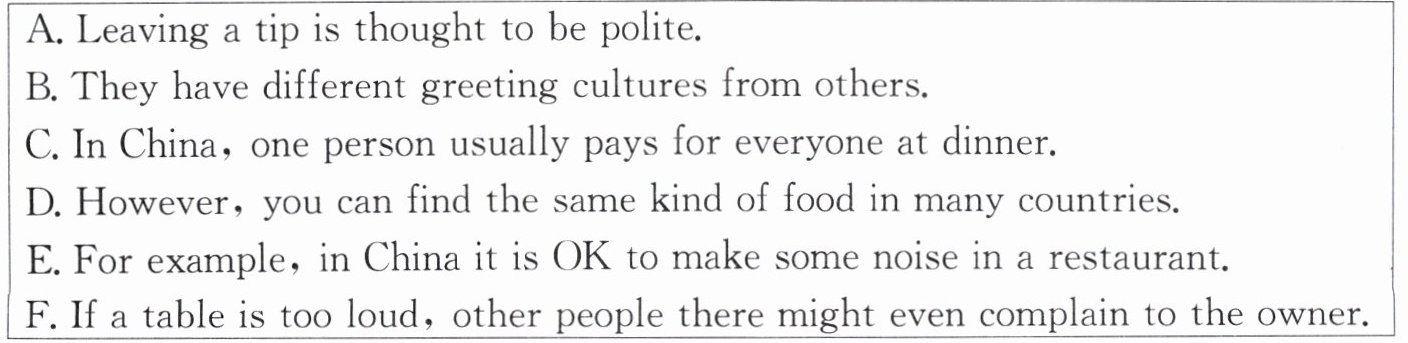
A. Leaving a tip is thought to be polite.
B. They have different greeting cultures from others.
C. In China, one person usually pays for everyone at dinner.
D. However, you can find the same kind of food in many countries.
E. For example, in China it is OK to make some noise in a restaurant.
F. If a table is too loud, other people there might even complain to the owner.
1.
阅读短文,从短文后所给的A~F六个选项中选出五个能填入空白处的最佳选项。
Around the world, people have different ideas about what good manners are.
When you go to restaurants in different parts of the world, it's important to know the right and wrong things to do. 1 In fact, if a restaurant is not noisy or lively, you may think there is something wrong with it. However, in many Western countries, restaurants are quiet places. 2
Paying the bill is also different from country to country. 3 In Western countries, one person pays if he or she is entertaining clients(宴请客户). When friends get together, they usually share the cost. This is "going Dutch". Also, when westerners pay the bill, they usually leave some money for the waiter. This is called "leaving a tip". 4 In the US, it is common to leave tips of 10%, 15%, or 20% of the bill. It is decided by how good the service is. Good waiters can make a lot of money!
The way people eat food is different all over the world. 5 Chinese food and Indian food, for example, are popular all over the world.
A. Leaving a tip is thought to be polite.
B. They have different greeting cultures from others.
C. In China, one person usually pays for everyone at dinner.
D. However, you can find the same kind of food in many countries.
E. For example, in China it is OK to make some noise in a restaurant.
F. If a table is too loud, other people there might even complain to the owner.
1.
E
2. F
3. C
4. A
5. D
答案
1. E 2. F 3. C 4. A 5. D
解析
【分析】
这是一篇介绍不同国家餐饮文化的信息还原题,解题思路是先通读全文明确每段的核心主题,再逐一匹配空格前后的逻辑关系:首先第一段主题是不同国家餐厅的公共礼仪,第二段主题是不同国家的付账文化,第三段主题是不同国家的饮食传播特点,同时可以先直接排除和全文主题完全无关的B选项(全文未提及问候文化),再根据举例、转折、对比的逻辑逐一匹配剩余选项即可。
【解析】
1. 空格1前句点明在不同地区的餐厅要注意行为规范,后句提到“如果餐厅不够热闹有活力,你反而会觉得不对劲”,E选项“例如,在中国的餐厅里制造一些噪音是完全没问题的”刚好对应后句“热闹才正常”的描述,逻辑衔接通顺。
2. 空格2前句说明“在很多西方国家,餐厅是很安静的场所”,F选项“如果一桌客人太吵闹,在场的其他人甚至可能向店主投诉”,刚好承接西方餐厅需要保持安静的规则,前后逻辑连贯。
3. 空格3前句点明不同国家付账单的习惯有区别,后句开始介绍西方的付账规则,C选项“在中国,聚餐时通常一个人会为所有人买单”,刚好形成中西方付账习惯的对比,符合段落的对比逻辑。
4. 空格4前句解释了什么是“留小费”,后句介绍美国小费的常见比例,A选项“留小费被认为是很礼貌的行为”,刚好衔接前后内容,解释了留小费的文化合理性。
5. 空格5前句提到“世界各地人们的用餐方式各不相同”,后句举例中国菜、印度菜在全球都很受欢迎,D选项“然而,你可以在很多国家找到同类的食物”,前后形成转折逻辑,完美匹配后文的举例内容。
【答案】
1. E 2. F 3. C 4. A 5. D
【知识点】
阅读逻辑衔接;跨文化交际常识
【点评】
本题围绕不同国家的餐饮文化展开,没有设置过难的生僻词,核心考点是学生抓取前后句举例、对比、转折逻辑的能力,同时引导学生了解不同国家的文化差异,排除无关选项的难度很低,适合初中低年级学生练习信息还原类题型的解题思路。
【难度系数】
0.7
这是一篇介绍不同国家餐饮文化的信息还原题,解题思路是先通读全文明确每段的核心主题,再逐一匹配空格前后的逻辑关系:首先第一段主题是不同国家餐厅的公共礼仪,第二段主题是不同国家的付账文化,第三段主题是不同国家的饮食传播特点,同时可以先直接排除和全文主题完全无关的B选项(全文未提及问候文化),再根据举例、转折、对比的逻辑逐一匹配剩余选项即可。
【解析】
1. 空格1前句点明在不同地区的餐厅要注意行为规范,后句提到“如果餐厅不够热闹有活力,你反而会觉得不对劲”,E选项“例如,在中国的餐厅里制造一些噪音是完全没问题的”刚好对应后句“热闹才正常”的描述,逻辑衔接通顺。
2. 空格2前句说明“在很多西方国家,餐厅是很安静的场所”,F选项“如果一桌客人太吵闹,在场的其他人甚至可能向店主投诉”,刚好承接西方餐厅需要保持安静的规则,前后逻辑连贯。
3. 空格3前句点明不同国家付账单的习惯有区别,后句开始介绍西方的付账规则,C选项“在中国,聚餐时通常一个人会为所有人买单”,刚好形成中西方付账习惯的对比,符合段落的对比逻辑。
4. 空格4前句解释了什么是“留小费”,后句介绍美国小费的常见比例,A选项“留小费被认为是很礼貌的行为”,刚好衔接前后内容,解释了留小费的文化合理性。
5. 空格5前句提到“世界各地人们的用餐方式各不相同”,后句举例中国菜、印度菜在全球都很受欢迎,D选项“然而,你可以在很多国家找到同类的食物”,前后形成转折逻辑,完美匹配后文的举例内容。
【答案】
1. E 2. F 3. C 4. A 5. D
【知识点】
阅读逻辑衔接;跨文化交际常识
【点评】
本题围绕不同国家的餐饮文化展开,没有设置过难的生僻词,核心考点是学生抓取前后句举例、对比、转折逻辑的能力,同时引导学生了解不同国家的文化差异,排除无关选项的难度很低,适合初中低年级学生练习信息还原类题型的解题思路。
【难度系数】
0.7
