

 登录
登录
三、选词填空
从方框中选择适当的单词或短语并用其正确形式填空,每个单词或短语限用一次。
create spend take place help write early educate close change student
Is Li Hua a familiar name to you? In English exams, students are often asked 1 a letter in the name of Li Hua. In the past few years, the topics of these letters 2, which shows the changes in English education in China.
Tian Lijun was born in the 1970s. She first learned English in middle school. “We used 3 the first year in middle school learning the alphabet (字母表) and simple words,” she recalled. “I had no idea that we were learning an actual foreign language. But I wanted to learn English because I saw changes all around.”
In the following years, English classes began at 4 grades and became more interesting. Younger people like Wang Mengqi, began to learn English even before primary school. “In kindergarten (幼儿园), we had cute textbooks where the letters were drawn in different shapes and colours and words came with pictures, which helped develop our 5,” said Wang, now also an English teacher.
The 6 methods have also varied a lot since the 1980s. For example, Tian's first English teacher taught in Chinese, but Wang shared that she now encourages students to speak only English during class.
With the quick updates (更新) of knowledge, the textbook is really connected to what 7 in the world. Another change in English learning is the focus of 8 writing tasks. Wang said that when she was in school, the writing was usually around helping Li Hua, who needed to write a letter to his foreign pen friend to ask about the local weather and customs. Nowadays, however, students are more likely 9 Li Hua tell Chinese stories to his foreign friends who will visit China.
Wang believes this change in topics of Li Hua's letters is 10 tied to changes in society and the growing cultural confidence of the Chinese people.
1.
6.
从方框中选择适当的单词或短语并用其正确形式填空,每个单词或短语限用一次。
create spend take place help write early educate close change student
Is Li Hua a familiar name to you? In English exams, students are often asked 1 a letter in the name of Li Hua. In the past few years, the topics of these letters 2, which shows the changes in English education in China.
Tian Lijun was born in the 1970s. She first learned English in middle school. “We used 3 the first year in middle school learning the alphabet (字母表) and simple words,” she recalled. “I had no idea that we were learning an actual foreign language. But I wanted to learn English because I saw changes all around.”
In the following years, English classes began at 4 grades and became more interesting. Younger people like Wang Mengqi, began to learn English even before primary school. “In kindergarten (幼儿园), we had cute textbooks where the letters were drawn in different shapes and colours and words came with pictures, which helped develop our 5,” said Wang, now also an English teacher.
The 6 methods have also varied a lot since the 1980s. For example, Tian's first English teacher taught in Chinese, but Wang shared that she now encourages students to speak only English during class.
With the quick updates (更新) of knowledge, the textbook is really connected to what 7 in the world. Another change in English learning is the focus of 8 writing tasks. Wang said that when she was in school, the writing was usually around helping Li Hua, who needed to write a letter to his foreign pen friend to ask about the local weather and customs. Nowadays, however, students are more likely 9 Li Hua tell Chinese stories to his foreign friends who will visit China.
Wang believes this change in topics of Li Hua's letters is 10 tied to changes in society and the growing cultural confidence of the Chinese people.
1.
to write
2. have changed
3. to spend
4. earlier
5. creativity
6.
educational
7. is taking place
8. students'
9. to help
10. closely
答案
【文章大意】本文是一篇记叙文,文章通过李华这一名字在不同年代的英语考试中写信主题的变化,展现了中国英语教育以及社会文化的变迁。
1. to write 2. have changed 3. to spend 4. earlier 5. creativity 6. educational 7. is taking place 8. students' 9. to help 10. closely
1. to write 2. have changed 3. to spend 4. earlier 5. creativity 6. educational 7. is taking place 8. students' 9. to help 10. closely
解析
【分析】
首先通读全文,明确文章围绕中国英语教育的变迁展开,通过不同年代的英语学习情况和李华写信主题的变化来体现。解题时需结合语境、语法规则(时态、词性转换)和固定搭配来逐个确定答案:
1. 先看固定搭配,ask后接不定式作宾语补足语;
2. 根据时间状语判断时态,in the past few years是现在完成时的标志;
3. 结合used to do的固定结构和spend time doing的搭配;
4. 结合语境需要用形容词比较级体现“更早的年级”;
5. 动词develop后需接名词作宾语,进行词性转换;
6. 修饰名词methods需用形容词,转换educate为形容词形式;
7. 结合语境表示“世界上正在发生的事”,用现在进行时;
8. 修饰writing tasks需用名词所有格表示所属关系;
9. 结合be likely to do的固定搭配和help的用法;
10. 修饰形容词tied需用副词,转换close为副词形式。
【解析】
1. 固定搭配“ask sb. to do sth.”表示“要求某人做某事”,此处表示学生被要求以李华的名义写信,故填to write。
2. 时间状语“In the past few years”是现在完成时的标志,主语“the topics”是复数,所以用have changed,表示这些信的主题已经发生了变化。
3. “used to do sth.”表示“过去常常做某事”,且“spend time doing sth.”是固定搭配,表示“花费时间做某事”,此处表示过去第一年花费时间学字母表,故填to spend。
4. 结合语境,和之前的中学开始学英语相比,现在英语课开始的年级更早,所以用early的比较级earlier。
5. 动词develop后接名词作宾语,create的名词形式是creativity,表示培养创造力,故填creativity。
6. 修饰名词methods需要用形容词,educate的形容词形式是educational,表示教育方法,故填educational。
7. 结合语境,课本和世界上正在发生的事相关,用现在进行时is taking place,表示正在发生的情况。
8. 此处表示学生的写作任务,用名词所有格students'来修饰writing tasks,体现所属关系。
9. “be likely to do sth.”是固定搭配,表示“可能做某事”,且“help sb. do sth.”表示“帮助某人做某事”,故填to help。
10. 修饰形容词tied需要用副词,close的副词形式是closely,表示紧密相关,故填closely。
【答案】
1. to write
2. have changed
3. to spend
4. earlier
5. creativity
6. educational
7. is taking place
8. students'
9. to help
10. closely
【知识点】
固定搭配运用、时态判断、词性转换
【点评】
本文以中国英语教育变迁为背景,综合考查了固定搭配、时态、词性转换等多个英语知识点,要求学生既能理解文章语境,又能熟练掌握语法规则,对学生的综合语言运用能力有较高要求。
【难度系数】
0.4
首先通读全文,明确文章围绕中国英语教育的变迁展开,通过不同年代的英语学习情况和李华写信主题的变化来体现。解题时需结合语境、语法规则(时态、词性转换)和固定搭配来逐个确定答案:
1. 先看固定搭配,ask后接不定式作宾语补足语;
2. 根据时间状语判断时态,in the past few years是现在完成时的标志;
3. 结合used to do的固定结构和spend time doing的搭配;
4. 结合语境需要用形容词比较级体现“更早的年级”;
5. 动词develop后需接名词作宾语,进行词性转换;
6. 修饰名词methods需用形容词,转换educate为形容词形式;
7. 结合语境表示“世界上正在发生的事”,用现在进行时;
8. 修饰writing tasks需用名词所有格表示所属关系;
9. 结合be likely to do的固定搭配和help的用法;
10. 修饰形容词tied需用副词,转换close为副词形式。
【解析】
1. 固定搭配“ask sb. to do sth.”表示“要求某人做某事”,此处表示学生被要求以李华的名义写信,故填to write。
2. 时间状语“In the past few years”是现在完成时的标志,主语“the topics”是复数,所以用have changed,表示这些信的主题已经发生了变化。
3. “used to do sth.”表示“过去常常做某事”,且“spend time doing sth.”是固定搭配,表示“花费时间做某事”,此处表示过去第一年花费时间学字母表,故填to spend。
4. 结合语境,和之前的中学开始学英语相比,现在英语课开始的年级更早,所以用early的比较级earlier。
5. 动词develop后接名词作宾语,create的名词形式是creativity,表示培养创造力,故填creativity。
6. 修饰名词methods需要用形容词,educate的形容词形式是educational,表示教育方法,故填educational。
7. 结合语境,课本和世界上正在发生的事相关,用现在进行时is taking place,表示正在发生的情况。
8. 此处表示学生的写作任务,用名词所有格students'来修饰writing tasks,体现所属关系。
9. “be likely to do sth.”是固定搭配,表示“可能做某事”,且“help sb. do sth.”表示“帮助某人做某事”,故填to help。
10. 修饰形容词tied需要用副词,close的副词形式是closely,表示紧密相关,故填closely。
【答案】
1. to write
2. have changed
3. to spend
4. earlier
5. creativity
6. educational
7. is taking place
8. students'
9. to help
10. closely
【知识点】
固定搭配运用、时态判断、词性转换
【点评】
本文以中国英语教育变迁为背景,综合考查了固定搭配、时态、词性转换等多个英语知识点,要求学生既能理解文章语境,又能熟练掌握语法规则,对学生的综合语言运用能力有较高要求。
【难度系数】
0.4
四、任务型阅读
阅读下面短文,并根据所读内容在文章后的思维导图里填入最恰当的单词,每个空格只填一个单词。
Did you know ketchup, the most popular sauce, was invented in China?
It dates back thousands of years. People living along the coasts and rivers of southern China began to make the first ketchup by salting and fermenting (发酵) fish and shrimp. At first, this early ketchup was known only in southern China. After around 200 BCE (Han Dynasty), the fish sauce became popular in the whole country, especially in a place called Fujian. There, the sauce got the name ketchup, which means fish sauce in Hokkien, the language of southern Fujian. Later, people from Fujian began to travel to places like Indonesia, where they built factories for making traditional Chinese sauces like ketchup—and that's where the British first discovered it.
In the early 1600s, British sailors who were travelling to Indonesia began to develop a taste for ketchup. Their food on ships was boring so they put ketchup into it to make it tastier. Before long, they brought lots of ketchup home. But it was expensive, so the British started trying to make their own. A London cookbook from 1742 had a ketchup recipe (配方) with beer, fish, mushrooms, and spices.
It was in the mid-1800s that the British started using tomatoes in ketchup. This was different from the fishy ketchup. Since tomatoes went bad fast, the company, Heinz, began to use vinegar (醋) in ketchup to make sure it could be stored for a long time.
In the late 1800s, ketchup production and popularity began to rise in America. So, the makers in America increased ketchup production, creating recipes to satisfy Americans' taste. It was a bit sweeter and thicker than British ketchup. By around 1910, ketchup began to look like the ketchup we put on some fast food restaurants' fries today.
However, there are also some differences between the ketchup of 1910 and today. In today's ketchup, corn syrup (玉米糖浆) is used, not sugar. What's more, to meet people's needs for a healthy lifestyle, some companies also make healthier ones with no sugar.
From a fishy sauce in ancient Asia to a “goes-great-with-everything” sauce, ketchup has a long history full of changes.
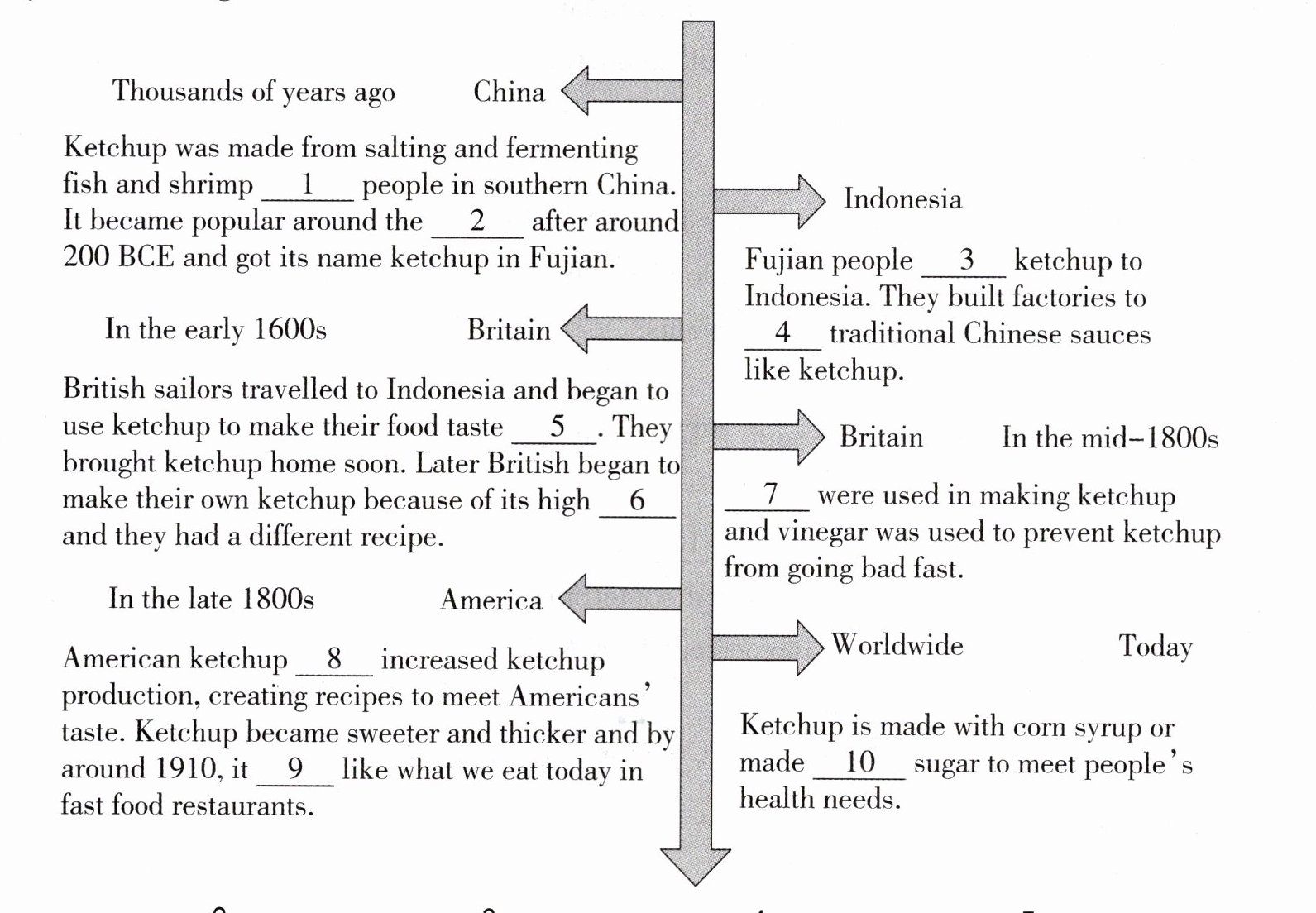
1.
6.
阅读下面短文,并根据所读内容在文章后的思维导图里填入最恰当的单词,每个空格只填一个单词。
Did you know ketchup, the most popular sauce, was invented in China?
It dates back thousands of years. People living along the coasts and rivers of southern China began to make the first ketchup by salting and fermenting (发酵) fish and shrimp. At first, this early ketchup was known only in southern China. After around 200 BCE (Han Dynasty), the fish sauce became popular in the whole country, especially in a place called Fujian. There, the sauce got the name ketchup, which means fish sauce in Hokkien, the language of southern Fujian. Later, people from Fujian began to travel to places like Indonesia, where they built factories for making traditional Chinese sauces like ketchup—and that's where the British first discovered it.
In the early 1600s, British sailors who were travelling to Indonesia began to develop a taste for ketchup. Their food on ships was boring so they put ketchup into it to make it tastier. Before long, they brought lots of ketchup home. But it was expensive, so the British started trying to make their own. A London cookbook from 1742 had a ketchup recipe (配方) with beer, fish, mushrooms, and spices.
It was in the mid-1800s that the British started using tomatoes in ketchup. This was different from the fishy ketchup. Since tomatoes went bad fast, the company, Heinz, began to use vinegar (醋) in ketchup to make sure it could be stored for a long time.
In the late 1800s, ketchup production and popularity began to rise in America. So, the makers in America increased ketchup production, creating recipes to satisfy Americans' taste. It was a bit sweeter and thicker than British ketchup. By around 1910, ketchup began to look like the ketchup we put on some fast food restaurants' fries today.
However, there are also some differences between the ketchup of 1910 and today. In today's ketchup, corn syrup (玉米糖浆) is used, not sugar. What's more, to meet people's needs for a healthy lifestyle, some companies also make healthier ones with no sugar.
From a fishy sauce in ancient Asia to a “goes-great-with-everything” sauce, ketchup has a long history full of changes.
1.
by
2. country
3. brought
4. make
5. better
6.
price
7. Tomatoes
8. makers
9. looked
10. without
答案
【文章大意】本文是一篇说明文,主要介绍了 ketchup 的由来及发展。
1. by 2. country 3. brought 4. make 5. better 6. price 7. Tomatoes 8. makers 9. looked 10. without
1. by 2. country 3. brought 4. make 5. better 6. price 7. Tomatoes 8. makers 9. looked 10. without
解析
【分析】
这是一道任务型阅读思维导图填空题,解题时需先通读全文,梳理番茄酱的起源、传播及发展演变的完整脉络。然后根据思维导图的逻辑框架,逐个定位原文对应信息点:
1. 首先定位番茄酱起源的制作方式,从原文提取表示方式的关键介词;
2. 接着看传播范围的拓展,从南方到全国,提取对应的地点名词;
3. 找到英国水手的行为相关描述,提取对应的动词过去式;
4. 定位英国自制番茄酱的相关内容,提取对应的动词原形;
5. 结合水手用番茄酱改良食物的描述,将“更美味”转换为同义形容词比较级;
6. 根据英国自制的原因(原产品昂贵),提取表示价格的名词;
7. 找到英国在番茄酱中添加新原料的内容,提取对应的原料名词(注意首字母大写);
8. 定位美国发展阶段的主体,提取对应的生产者名词;
9. 结合1910年番茄酱的外观变化描述,提取对应的动词过去式;
10. 根据现代健康番茄酱的特点,将“无糖”转换为对应的介词。
【解析】
1. 根据原文“People living along the coasts and rivers of southern China began to make the first ketchup by salting and fermenting (发酵) fish and shrimp.”,此处表示制作方式,填by。
2. 根据原文“After around 200 BCE (Han Dynasty), the fish sauce became popular in the whole country”,此处指传播到整个国家,填country。
3. 根据原文“Before long, they brought lots of ketchup home.”,此处指英国水手把番茄酱带回本国,填brought。
4. 根据原文“But it was expensive, so the British started trying to make their own.”,此处指英国开始尝试自己制作,填make。
5. 根据原文“Their food on ships was boring so they put ketchup into it to make it tastier.”,tastier与better表意相近,填better。
6. 根据原文“But it was expensive”,昂贵对应价格高,填price。
7. 根据原文“It was in the mid-1800s that the British started using tomatoes in ketchup.”,此处指加入的原料,首字母大写,填Tomatoes。
8. 根据原文“So, the makers in America increased ketchup production”,此处指美国的生产商,填makers。
9. 根据原文“By around 1910, ketchup began to look like the ketchup we put on some fast food restaurants' fries today.”,此处用动词过去式,填looked。
10. 根据原文“some companies also make healthier ones with no sugar.”,no sugar与without sugar表意一致,填without。
【答案】
1. by 2. country 3. brought 4. make 5. better 6. price 7. Tomatoes 8. makers 9. looked 10. without
【知识点】
1. 细节信息定位
2. 同义词汇转换
3. 词性形式辨析
【点评】
本题围绕番茄酱的发展历史展开,考查学生对说明文细节信息的捕捉能力,以及同义转换、词性变形的语言运用能力。解题关键在于理清时间线和传播发展的逻辑,精准匹配原文内容与思维导图的框架。
【难度系数】
0.6
这是一道任务型阅读思维导图填空题,解题时需先通读全文,梳理番茄酱的起源、传播及发展演变的完整脉络。然后根据思维导图的逻辑框架,逐个定位原文对应信息点:
1. 首先定位番茄酱起源的制作方式,从原文提取表示方式的关键介词;
2. 接着看传播范围的拓展,从南方到全国,提取对应的地点名词;
3. 找到英国水手的行为相关描述,提取对应的动词过去式;
4. 定位英国自制番茄酱的相关内容,提取对应的动词原形;
5. 结合水手用番茄酱改良食物的描述,将“更美味”转换为同义形容词比较级;
6. 根据英国自制的原因(原产品昂贵),提取表示价格的名词;
7. 找到英国在番茄酱中添加新原料的内容,提取对应的原料名词(注意首字母大写);
8. 定位美国发展阶段的主体,提取对应的生产者名词;
9. 结合1910年番茄酱的外观变化描述,提取对应的动词过去式;
10. 根据现代健康番茄酱的特点,将“无糖”转换为对应的介词。
【解析】
1. 根据原文“People living along the coasts and rivers of southern China began to make the first ketchup by salting and fermenting (发酵) fish and shrimp.”,此处表示制作方式,填by。
2. 根据原文“After around 200 BCE (Han Dynasty), the fish sauce became popular in the whole country”,此处指传播到整个国家,填country。
3. 根据原文“Before long, they brought lots of ketchup home.”,此处指英国水手把番茄酱带回本国,填brought。
4. 根据原文“But it was expensive, so the British started trying to make their own.”,此处指英国开始尝试自己制作,填make。
5. 根据原文“Their food on ships was boring so they put ketchup into it to make it tastier.”,tastier与better表意相近,填better。
6. 根据原文“But it was expensive”,昂贵对应价格高,填price。
7. 根据原文“It was in the mid-1800s that the British started using tomatoes in ketchup.”,此处指加入的原料,首字母大写,填Tomatoes。
8. 根据原文“So, the makers in America increased ketchup production”,此处指美国的生产商,填makers。
9. 根据原文“By around 1910, ketchup began to look like the ketchup we put on some fast food restaurants' fries today.”,此处用动词过去式,填looked。
10. 根据原文“some companies also make healthier ones with no sugar.”,no sugar与without sugar表意一致,填without。
【答案】
1. by 2. country 3. brought 4. make 5. better 6. price 7. Tomatoes 8. makers 9. looked 10. without
【知识点】
1. 细节信息定位
2. 同义词汇转换
3. 词性形式辨析
【点评】
本题围绕番茄酱的发展历史展开,考查学生对说明文细节信息的捕捉能力,以及同义转换、词性变形的语言运用能力。解题关键在于理清时间线和传播发展的逻辑,精准匹配原文内容与思维导图的框架。
【难度系数】
0.6
