

 登录
登录
任务一:阅读上文,完成下面的思维导图。
Kitty’s trip
Time&Place Today I went on a trip to 1.
Activities Got up 2.
Feeling 4.
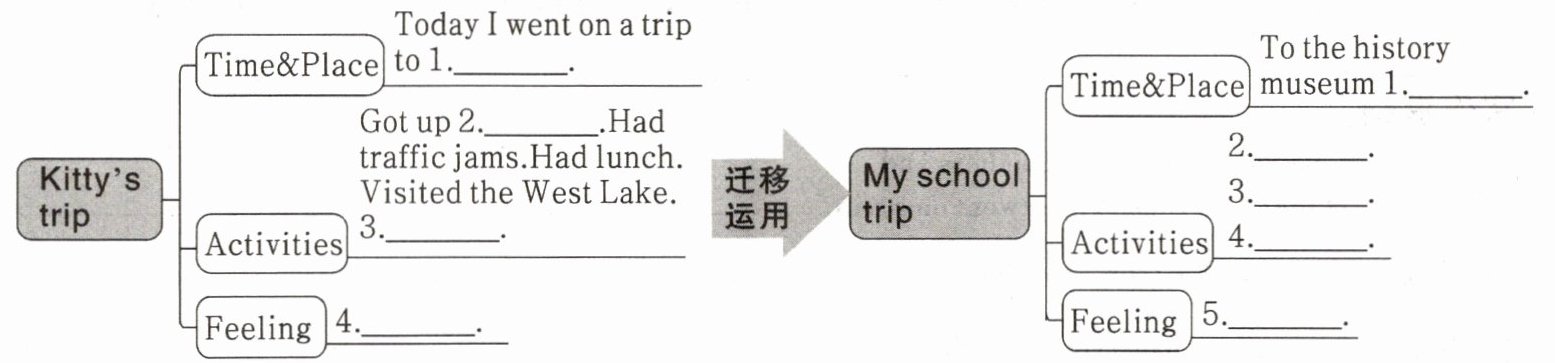
My school trip
Time&Place To the history museum 1.
Activities 2.
3.
4.
Feeling 5.
Kitty’s trip
Time&Place Today I went on a trip to 1.
Hangzhou
.Activities Got up 2.
early
.Had traffic jams.Had lunch.Visited the West Lake.3.Got home
.Feeling 4.
Tired
.My school trip
Time&Place To the history museum 1.
last Sunday
.Activities 2.
Saw many old things
.3.
Listened to the stories behind the old things
.4.
Had lunch
.Feeling 5.
Excited(答案不唯一,仅供参考)
.答案
1. Hangzhou
2. early
3. Got home
4. Tired
1. last Sunday
2. Saw many old things
3. Listened to the stories behind the old things
4. Had lunch
5. Excited(答案不唯一,仅供参考)
2. early
3. Got home
4. Tired
1. last Sunday
2. Saw many old things
3. Listened to the stories behind the old things
4. Had lunch
5. Excited(答案不唯一,仅供参考)
解析
【分析】
本题为英语思维导图填空题,需结合Kitty的旅行信息及迁移运用的学校旅行主题,依据旅行类常用英语表达和语境填写内容。首先梳理Kitty旅行的核心信息:地点对应西湖所在的杭州,起床状态用常用副词,后续活动为回家,感受为疲惫;再结合学校旅行(历史博物馆)的场景,填写时间、参观活动、感受等符合语境的内容,注意答案需贴合旅行主题的常用表达。
【解析】
Kitty’s trip部分:
1. 由“Visited the West Lake(参观西湖)”可知,旅行地点是杭州,故填Hangzhou;
2. 描述起床状态的常用副词是early(早),故填early;
3. 旅行后常用的活动是回家,故填Got home;
4. 旅行后的常见感受是疲惫,故填Tired。
My school trip部分:
1. 历史博物馆旅行的常用时间表达是last Sunday(上周日),故填last Sunday;
2. 参观历史博物馆的常见活动是看到很多旧物品,故填Saw many old things;
3. 还可填写听旧物品背后的故事,故填Listened to the stories behind the old things;
4. 旅行中的活动还可填吃午饭,故填Had lunch;
5. 学校旅行的常见感受是兴奋,故填Excited。
【答案】
Kitty’s trip: 1. Hangzhou 2. early 3. Got home 4. Tired
My school trip: 1. last Sunday 2. Saw many old things 3. Listened to the stories behind the old things 4. Had lunch 5. Excited
【知识点】
英语词汇运用、英语情景表达
【点评】
本题以思维导图形式考查旅行主题的英语基础表达,要求学生完成知识迁移,贴合日常英语运用场景,难度适中,能有效考查学生的基础词汇掌握和语境运用能力。
【难度系数】
0.7
本题为英语思维导图填空题,需结合Kitty的旅行信息及迁移运用的学校旅行主题,依据旅行类常用英语表达和语境填写内容。首先梳理Kitty旅行的核心信息:地点对应西湖所在的杭州,起床状态用常用副词,后续活动为回家,感受为疲惫;再结合学校旅行(历史博物馆)的场景,填写时间、参观活动、感受等符合语境的内容,注意答案需贴合旅行主题的常用表达。
【解析】
Kitty’s trip部分:
1. 由“Visited the West Lake(参观西湖)”可知,旅行地点是杭州,故填Hangzhou;
2. 描述起床状态的常用副词是early(早),故填early;
3. 旅行后常用的活动是回家,故填Got home;
4. 旅行后的常见感受是疲惫,故填Tired。
My school trip部分:
1. 历史博物馆旅行的常用时间表达是last Sunday(上周日),故填last Sunday;
2. 参观历史博物馆的常见活动是看到很多旧物品,故填Saw many old things;
3. 还可填写听旧物品背后的故事,故填Listened to the stories behind the old things;
4. 旅行中的活动还可填吃午饭,故填Had lunch;
5. 学校旅行的常见感受是兴奋,故填Excited。
【答案】
Kitty’s trip: 1. Hangzhou 2. early 3. Got home 4. Tired
My school trip: 1. last Sunday 2. Saw many old things 3. Listened to the stories behind the old things 4. Had lunch 5. Excited
【知识点】
英语词汇运用、英语情景表达
【点评】
本题以思维导图形式考查旅行主题的英语基础表达,要求学生完成知识迁移,贴合日常英语运用场景,难度适中,能有效考查学生的基础词汇掌握和语境运用能力。
【难度系数】
0.7
任务二:在文中找出与下列句子含有相同表达的句子并照其进行仿写。
1.去年夏天,我去了庐山旅行。
I
2.我花了两周的时间计划这次武汉之旅。
I
1.去年夏天,我去了庐山旅行。
I
went on a trip
to Mount Lushan last summer.2.我花了两周的时间计划这次武汉之旅。
I
spent two weeks planning
this trip to Wuhan.答案
1. went on a trip
2. spent two weeks planning
2. spent two weeks planning
解析
【分析】
这两道题考查英语固定短语及一般过去时的运用。第1题,时间状语last summer表明用一般过去时,需对应“去旅行”的英文固定短语;第2题,需运用“花费时间做某事”的固定结构,结合一般过去时的动词形式完成填空。
【解析】
1. 时间状语last summer(去年夏天)提示用一般过去时,“去旅行”的英文固定短语为go on a trip,go的过去式是went,因此填went on a trip。
2. 表达“某人花费时间做某事”用spend time (in) doing sth结构,“两周”是two weeks,“计划”是plan,其动名词形式为planning,spend的过去式是spent,因此填spent two weeks planning。
【答案】
1. went on a trip
2. spent two weeks planning
【知识点】
一般过去时、动词短语、spend的用法
【点评】
本题考查基础英语固定搭配和时态运用,需掌握常用短语及动词过去式变化,属于常规基础题型。
【难度系数】
0.5
这两道题考查英语固定短语及一般过去时的运用。第1题,时间状语last summer表明用一般过去时,需对应“去旅行”的英文固定短语;第2题,需运用“花费时间做某事”的固定结构,结合一般过去时的动词形式完成填空。
【解析】
1. 时间状语last summer(去年夏天)提示用一般过去时,“去旅行”的英文固定短语为go on a trip,go的过去式是went,因此填went on a trip。
2. 表达“某人花费时间做某事”用spend time (in) doing sth结构,“两周”是two weeks,“计划”是plan,其动名词形式为planning,spend的过去式是spent,因此填spent two weeks planning。
【答案】
1. went on a trip
2. spent two weeks planning
【知识点】
一般过去时、动词短语、spend的用法
【点评】
本题考查基础英语固定搭配和时态运用,需掌握常用短语及动词过去式变化,属于常规基础题型。
【难度系数】
0.5
