

 登录
登录
五、连词成句,并组成一段通顺的对话。
A: 1.
B: Yes. I am a good boy. I get up early in the morning.
A: 2.
B: Yes. And I sometimes do sports in the evening.
A: Is your bedroom messy?
B: No. 3.
A: How do you put your school things?
B: 4.
A: Great! You really have good habits.
A: 1.
Do you have any good habits?
[good, do, have, you, habits, any (?)]B: Yes. I am a good boy. I get up early in the morning.
A: 2.
Do you exercise in the morning?
[do, you, exercise, in, morning, the (?)]B: Yes. And I sometimes do sports in the evening.
A: Is your bedroom messy?
B: No. 3.
I often keep my room clean and tidy/tidy and clean.
[keep, clean, I, tidy, often, room, my, and (.)]A: How do you put your school things?
B: 4.
I put them in order every evening.
[I, put, in, every, them, order, evening (.)]A: Great! You really have good habits.
答案
1. Do you have any good habits? 2. Do you exercise in the morning? 3. I often keep my room clean and tidy/tidy and clean. 4. I put them in order every evening.
解析
【分析】
做这类连词成句题,需先判断句子类型(一般疑问句/陈述句),再结合英语句式规则调整语序:1. 给出问号,是一般疑问句,以助动词Do开头,疑问句中用any修饰名词habits;2. 同样是一般疑问句,助动词Do提前,时间状语in the morning放句末;3. 给出句号,是陈述句,副词often需放在实义动词keep前;4. 陈述句中,宾语them需放在谓语put之后,时间状语every evening放句末。
【解析】
1. 该句为一般疑问句,助动词Do提前,主语you,动词have,any修饰good habits,组合为:Do you have any good habits?
2. 该句为一般疑问句,助动词Do提前,主语you,谓语exercise,时间状语in the morning,组合为:Do you exercise in the morning?
3. 该句为陈述句,主语I,副词often置于实义动词keep前,keep my room + 形容词短语clean and tidy,组合为:I often keep my room clean and tidy.(tidy and clean也可)
4. 该句为陈述句,主语I,谓语put,宾语them,介词短语in order,时间状语every evening,组合为:I put them in order every evening.
【答案】
1. Do you have any good habits? 2. Do you exercise in the morning? 3. I often keep my room clean and tidy/tidy and clean. 4. I put them in order every evening.
【知识点】
英语连词成句;一般疑问句构成;陈述句语序
【点评】
本题考查英语基础连词成句,结合对话语境,需掌握一般疑问句、陈述句的语序规则,以及副词、介词短语的位置,是英语学习中的基础题型,难度适中。
【难度系数】
0.6
做这类连词成句题,需先判断句子类型(一般疑问句/陈述句),再结合英语句式规则调整语序:1. 给出问号,是一般疑问句,以助动词Do开头,疑问句中用any修饰名词habits;2. 同样是一般疑问句,助动词Do提前,时间状语in the morning放句末;3. 给出句号,是陈述句,副词often需放在实义动词keep前;4. 陈述句中,宾语them需放在谓语put之后,时间状语every evening放句末。
【解析】
1. 该句为一般疑问句,助动词Do提前,主语you,动词have,any修饰good habits,组合为:Do you have any good habits?
2. 该句为一般疑问句,助动词Do提前,主语you,谓语exercise,时间状语in the morning,组合为:Do you exercise in the morning?
3. 该句为陈述句,主语I,副词often置于实义动词keep前,keep my room + 形容词短语clean and tidy,组合为:I often keep my room clean and tidy.(tidy and clean也可)
4. 该句为陈述句,主语I,谓语put,宾语them,介词短语in order,时间状语every evening,组合为:I put them in order every evening.
【答案】
1. Do you have any good habits? 2. Do you exercise in the morning? 3. I often keep my room clean and tidy/tidy and clean. 4. I put them in order every evening.
【知识点】
英语连词成句;一般疑问句构成;陈述句语序
【点评】
本题考查英语基础连词成句,结合对话语境,需掌握一般疑问句、陈述句的语序规则,以及副词、介词短语的位置,是英语学习中的基础题型,难度适中。
【难度系数】
0.6
六、阅读材料,完成任务。
My good habits
People all over the world have their own habits. Some are good, and some are bad. I have a lot of habits. Here are some of my good habits.
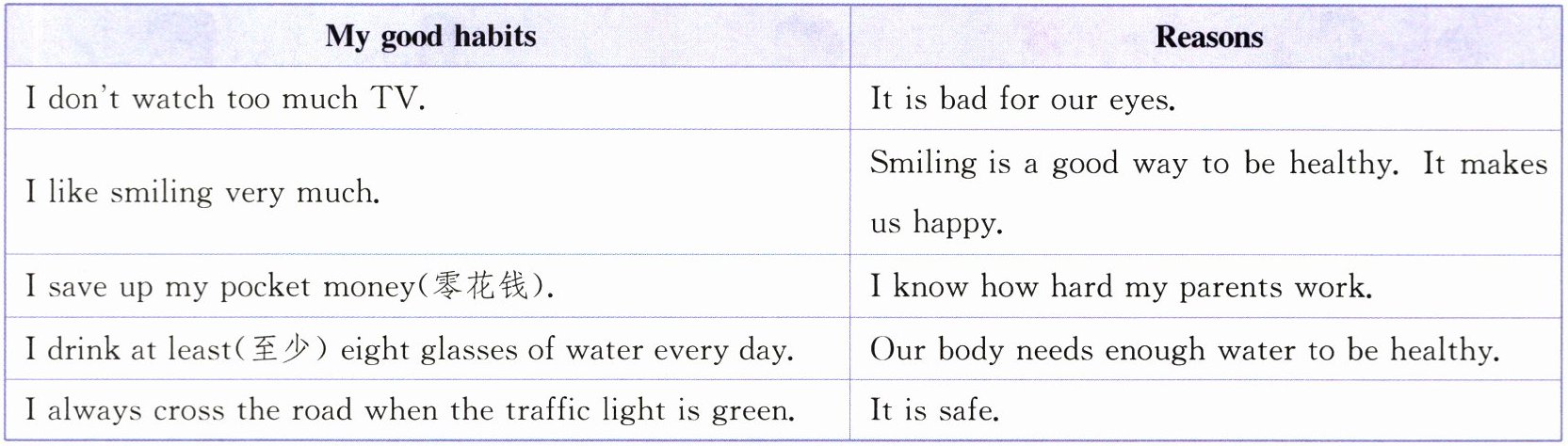
However, I also have some bad habits, so I must correct them. What about you?
任务一:判断正(T)误(F)。
(
(
(
(
(
任务二:根据实际情况,回答问题。
What good habits do you have?
My good habits
People all over the world have their own habits. Some are good, and some are bad. I have a lot of habits. Here are some of my good habits.
However, I also have some bad habits, so I must correct them. What about you?
任务一:判断正(T)误(F)。
(
F
)1. The writer doesn't watch TV at all.(
F
)2. The writer doesn't like smiling.(
F
)3. The writer saves up her money because she doesn't want to buy anything.(
T
)4. The writer drinks at least eight glasses of water every day.(
F
)5. The writer doesn't have any bad habits.任务二:根据实际情况,回答问题。
What good habits do you have?
I often take notes in class.(答案不唯一)
答案
任务一:1. F 2. F 3. F 解析:由表格第四行可知,她节约零用钱是因为她知道父母工作辛苦。
4. T 5. F
任务二: I often take notes in class.(答案不唯一)
4. T 5. F
任务二: I often take notes in class.(答案不唯一)
解析
【分析】
本题分为任务一判断正误和任务二开放性问答。任务一需根据给定表格及短文信息,逐一核对每个小题的表述是否与原文一致:第1题需确认是否为“完全不看电视”,第2题确认是否“不喜欢笑”,第3题确认攒钱的原因,第4题确认每日喝水量,第5题确认是否有坏习惯;任务二需结合自身实际,写出符合要求的好习惯即可。
【解析】
任务一:
1. 原文表格第一行是“I don't watch too much TV.”,意为“我不看太多电视”,并非完全不看电视,故判断为F。
2. 原文表格第二行是“I like smiling very much.”,意为“我非常喜欢笑”,与题目表述相反,故判断为F。
3. 原文表格第三行明确攒钱原因是“I know how hard my parents work.”,并非“不想买任何东西”,故判断为F。
4. 原文表格第四行是“I drink at least eight glasses of water every day.”,与题目表述一致,故判断为T。
5. 原文短文中提到“I also have some bad habits”,说明作者有坏习惯,故判断为F。
任务二:本题为开放性问题,只需结合自身实际写出合理的好习惯即可,答案不唯一,示例为“I often take notes in class.”。
【答案】
任务一:1.F 2.F 3.F 4.T 5.F;任务二:I often take notes in class.(答案不唯一)
【知识点】
英语阅读理解、判断正误题、开放性情景问答
【点评】
本题考查学生的英语阅读理解能力,要求学生准确提取文本关键信息完成判断,同时能结合自身实际进行开放性表达,整体难度适中,适合初中低年级学生练习。
【难度系数】
0.6
本题分为任务一判断正误和任务二开放性问答。任务一需根据给定表格及短文信息,逐一核对每个小题的表述是否与原文一致:第1题需确认是否为“完全不看电视”,第2题确认是否“不喜欢笑”,第3题确认攒钱的原因,第4题确认每日喝水量,第5题确认是否有坏习惯;任务二需结合自身实际,写出符合要求的好习惯即可。
【解析】
任务一:
1. 原文表格第一行是“I don't watch too much TV.”,意为“我不看太多电视”,并非完全不看电视,故判断为F。
2. 原文表格第二行是“I like smiling very much.”,意为“我非常喜欢笑”,与题目表述相反,故判断为F。
3. 原文表格第三行明确攒钱原因是“I know how hard my parents work.”,并非“不想买任何东西”,故判断为F。
4. 原文表格第四行是“I drink at least eight glasses of water every day.”,与题目表述一致,故判断为T。
5. 原文短文中提到“I also have some bad habits”,说明作者有坏习惯,故判断为F。
任务二:本题为开放性问题,只需结合自身实际写出合理的好习惯即可,答案不唯一,示例为“I often take notes in class.”。
【答案】
任务一:1.F 2.F 3.F 4.T 5.F;任务二:I often take notes in class.(答案不唯一)
【知识点】
英语阅读理解、判断正误题、开放性情景问答
【点评】
本题考查学生的英语阅读理解能力,要求学生准确提取文本关键信息完成判断,同时能结合自身实际进行开放性表达,整体难度适中,适合初中低年级学生练习。
【难度系数】
0.6
