

 登录
登录
一、阅读理解
阅读下面四篇语言材料,然后按文后要求做题。
A
Many teenagers find it difficult to study well though they work hard. But why? Maybe you need some smart ways of learning. Here are five tips for you.
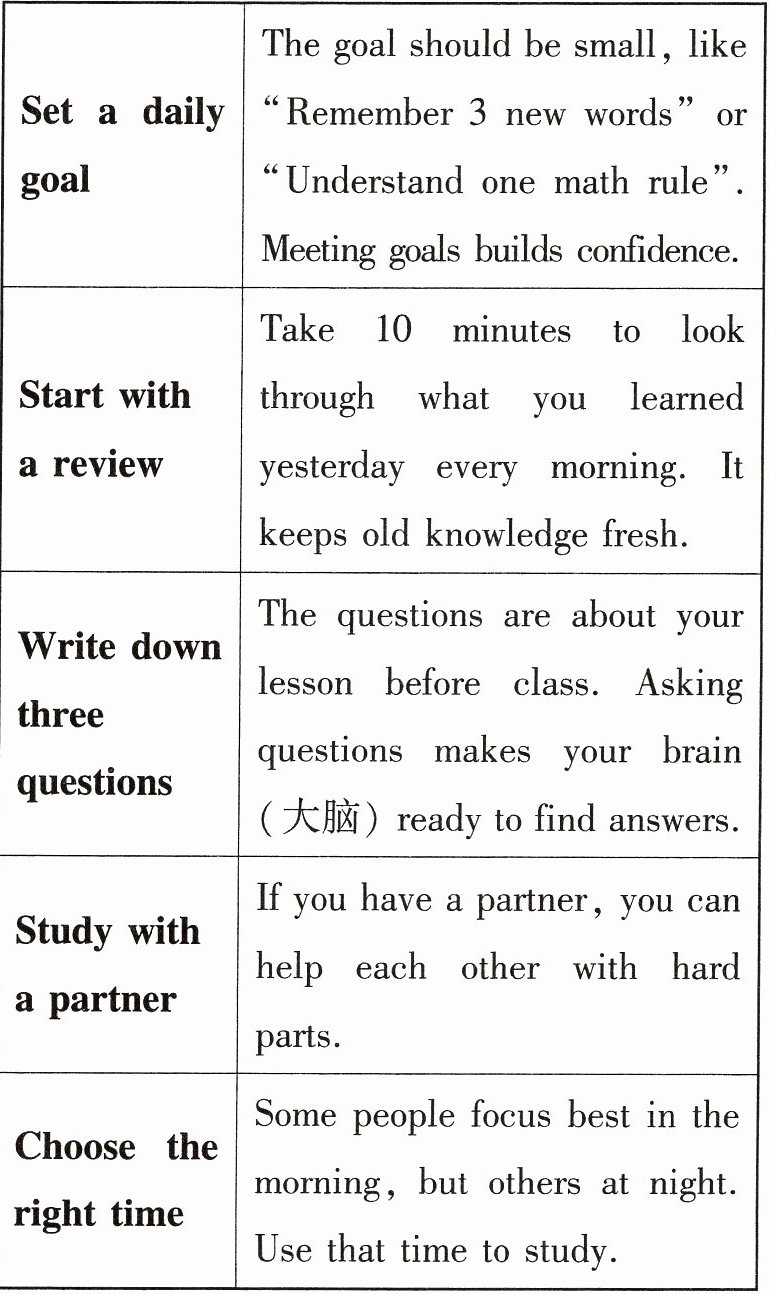
Set a daily goal
The goal should be small, like "Remember 3 new words" or "Understand one math rule". Meeting goals builds confidence.
Start with a review
Take 10 minutes to look through what you learned yesterday every morning. It keeps old knowledge fresh.
Write down three questions
The questions are about your lesson before class. Asking questions makes your brain (大脑) ready to find answers.
Study with a partner
If you have a partner, you can help each other with hard parts.
Choose the right time
Some people focus best in the morning, but others at night. Use that time to study.
Learning takes time. Progress isn't always fast, but every small step counts. You don't need big plans, just small actions. Start with one today.
根据材料内容选择最佳答案。
(
A. Choose the right time.
B. Write down three questions.
C. Set a daily goal.
D. Study with a partner.
(
A. Understand a math rule.
B. Remember 3 new words.
C. Make two English sentences.
D. Read a novel.
(
A. 3 minutes. B. 5 minutes.
C. 10 minutes. D. 15 minutes.
(
A. To focus best.
B. To build confidence.
C. To help each other with hard parts.
D. To calm down.
(
A. A list of tips. B. A story.
C. An introduction. D. A letter.
阅读下面四篇语言材料,然后按文后要求做题。
A
Many teenagers find it difficult to study well though they work hard. But why? Maybe you need some smart ways of learning. Here are five tips for you.
Set a daily goal
The goal should be small, like "Remember 3 new words" or "Understand one math rule". Meeting goals builds confidence.
Start with a review
Take 10 minutes to look through what you learned yesterday every morning. It keeps old knowledge fresh.
Write down three questions
The questions are about your lesson before class. Asking questions makes your brain (大脑) ready to find answers.
Study with a partner
If you have a partner, you can help each other with hard parts.
Choose the right time
Some people focus best in the morning, but others at night. Use that time to study.
Learning takes time. Progress isn't always fast, but every small step counts. You don't need big plans, just small actions. Start with one today.
根据材料内容选择最佳答案。
(
B
)1. Which tip can make your brain ready to find answers?A. Choose the right time.
B. Write down three questions.
C. Set a daily goal.
D. Study with a partner.
(
D
)2. Which of the following isn't suitable as a daily goal according to the text?A. Understand a math rule.
B. Remember 3 new words.
C. Make two English sentences.
D. Read a novel.
(
C
)3. How long does the writer advise to take for a review?A. 3 minutes. B. 5 minutes.
C. 10 minutes. D. 15 minutes.
(
C
)4. Why does the writer advise to study with a partner?A. To focus best.
B. To build confidence.
C. To help each other with hard parts.
D. To calm down.
(
A
)5. What is the text?A. A list of tips. B. A story.
C. An introduction. D. A letter.
答案
A
1. B 根据第三条建议"Asking questions makes your brain ready to find answers."可知,问问题让你的大脑准备好去寻找答案。故选B。
2. D 根据第一条建议"The goal should be small"可知,每日的目标应该是小目标。D选项"读完一部小说是一个较难以完成的目标"。故选D。
3. C 根据第二条建议"Take 10 minutes to look through what you learned yesterday every morning."可知,作者建议每天早晨花10分钟复习昨天学的内容。故选C。
4. C 根据第四条建议"If you have a partner, you can help each other with hard parts."可知,作者认为如果有学习伙伴,可以在困难的部分相互帮助。故选C。
5. A 综合全文可知,本文是一篇有关学习方面的小窍门清单。故选A。
1. B 根据第三条建议"Asking questions makes your brain ready to find answers."可知,问问题让你的大脑准备好去寻找答案。故选B。
2. D 根据第一条建议"The goal should be small"可知,每日的目标应该是小目标。D选项"读完一部小说是一个较难以完成的目标"。故选D。
3. C 根据第二条建议"Take 10 minutes to look through what you learned yesterday every morning."可知,作者建议每天早晨花10分钟复习昨天学的内容。故选C。
4. C 根据第四条建议"If you have a partner, you can help each other with hard parts."可知,作者认为如果有学习伙伴,可以在困难的部分相互帮助。故选C。
5. A 综合全文可知,本文是一篇有关学习方面的小窍门清单。故选A。
解析
【分析】
这是一篇介绍学习方法的说明类阅读,题目以细节理解题为主,解题时可以先浏览题干,带着问题回到原文对应板块定位关键信息,就能快速得到答案:第1题直接定位提到"brain ready to find answers"的内容即可;第2题结合"每日目标要小"的核心要求,对比选项选出不符合小目标设定的内容;第3题定位复习相关的时间描述;第4题定位和学习伙伴相关的说明;第5题综合全文结构判断文章类型即可。
【解析】
1. 细节理解题:根据第三条建议"Write down three questions"板块的内容"Asking questions makes your brain ready to find answers.",可知写下三个问题、主动提问的技巧能让大脑准备好寻找答案,对应选项B。
2. 细节理解题:根据第一条建议"Set a daily goal"板块的内容,明确说明每日目标要足够小,原文给出的示例是"记住3个新单词""理解一条数学规则",选项A、B都是原文给出的合适小目标,C选项造两个英语句子也是容易完成的小任务,只有D选项"读一本小说"是耗时久、难度大的任务,不符合小目标的要求,故选D。
3. 细节理解题:根据第二条建议"Start with a review"板块的内容"Take 10 minutes to look through what you learned yesterday every morning.",可知作者建议每天花10分钟复习之前学过的内容,对应选项C。
4. 细节理解题:根据第四条建议"Study with a partner"板块的内容"If you have a partner, you can help each other with hard parts.",可知和学习伙伴一起学习的作用是在难点部分互相帮助,对应选项C。
5. 主旨判断题:全文开篇点明要给读者介绍5个实用的学习小技巧,分点罗列了5条学习相关的建议,整体是一份学习小贴士清单,对应选项A。
【答案】
1.B 2.D 3.C 4.C 5.A
【知识点】
阅读细节定位,文章体裁判断
【点评】
本题属于低难度的信息类阅读,所有题目都能在原文中直接找到对应依据,主要考察学生快速抓取文本关键信息的能力,同时也能让学生了解实用的高效学习小方法,贴合学生日常学习场景。
【难度系数】
0.9
这是一篇介绍学习方法的说明类阅读,题目以细节理解题为主,解题时可以先浏览题干,带着问题回到原文对应板块定位关键信息,就能快速得到答案:第1题直接定位提到"brain ready to find answers"的内容即可;第2题结合"每日目标要小"的核心要求,对比选项选出不符合小目标设定的内容;第3题定位复习相关的时间描述;第4题定位和学习伙伴相关的说明;第5题综合全文结构判断文章类型即可。
【解析】
1. 细节理解题:根据第三条建议"Write down three questions"板块的内容"Asking questions makes your brain ready to find answers.",可知写下三个问题、主动提问的技巧能让大脑准备好寻找答案,对应选项B。
2. 细节理解题:根据第一条建议"Set a daily goal"板块的内容,明确说明每日目标要足够小,原文给出的示例是"记住3个新单词""理解一条数学规则",选项A、B都是原文给出的合适小目标,C选项造两个英语句子也是容易完成的小任务,只有D选项"读一本小说"是耗时久、难度大的任务,不符合小目标的要求,故选D。
3. 细节理解题:根据第二条建议"Start with a review"板块的内容"Take 10 minutes to look through what you learned yesterday every morning.",可知作者建议每天花10分钟复习之前学过的内容,对应选项C。
4. 细节理解题:根据第四条建议"Study with a partner"板块的内容"If you have a partner, you can help each other with hard parts.",可知和学习伙伴一起学习的作用是在难点部分互相帮助,对应选项C。
5. 主旨判断题:全文开篇点明要给读者介绍5个实用的学习小技巧,分点罗列了5条学习相关的建议,整体是一份学习小贴士清单,对应选项A。
【答案】
1.B 2.D 3.C 4.C 5.A
【知识点】
阅读细节定位,文章体裁判断
【点评】
本题属于低难度的信息类阅读,所有题目都能在原文中直接找到对应依据,主要考察学生快速抓取文本关键信息的能力,同时也能让学生了解实用的高效学习小方法,贴合学生日常学习场景。
【难度系数】
0.9
B
Did you know some traditional skills, like making silk needlework (刺绣) or cutting wooden masks (面具)? They are disappearing because not many people learn them. Soon, they might disappear forever. But they are an important part of Chinese traditional culture, we must take action to stop that.
These skills aren't just "old things." ▲ Silk needlework uses tiny silk to make flowers, animals or other things look real. It shows how creative the Chinese people are. Wooden masks are used in old plays to tell stories. They're also part of our history, like a book written with hands.
Our culture needs these skills. What should we do to protect them as teenagers? A useful way is to advise your schools to invite craftsmen (工匠) to give classes. Save money to buy a small needlework bag or a wooden mask. This helps craftsmen keep working. Also, share videos of these skills online, so more people can see their beauty.
Every time you learn or support a traditional skill, you should hold on to it and pass it on. Don't wait until they disappear. Let's protect them together.
根据材料内容选择最佳答案。
(
A. Creative. B. Patient.
C. Smart. D. Hard-working.
(
A. Making needlework.
B. Cutting paper.
C. Making clay figures.
D. Cutting wooden masks.
(
A. Ask students to sell traditional works.
B. Invite craftsmen to give classes.
C. Stop teaching new skills to students.
D. Buy expensive traditional works for students.
(
A. They are useless for our daily life now.
B. They have important meaning for our culture.
C. Most young people don't like them at all.
D. They are very hard to learn even for adults.
(
A. They will never disappear because many people learn them.
B. They are only important for old people, not young people.
C. They are part of our culture and history and worth protecting.
D. They can only be learned from craftsmen.
Did you know some traditional skills, like making silk needlework (刺绣) or cutting wooden masks (面具)? They are disappearing because not many people learn them. Soon, they might disappear forever. But they are an important part of Chinese traditional culture, we must take action to stop that.
These skills aren't just "old things." ▲ Silk needlework uses tiny silk to make flowers, animals or other things look real. It shows how creative the Chinese people are. Wooden masks are used in old plays to tell stories. They're also part of our history, like a book written with hands.
Our culture needs these skills. What should we do to protect them as teenagers? A useful way is to advise your schools to invite craftsmen (工匠) to give classes. Save money to buy a small needlework bag or a wooden mask. This helps craftsmen keep working. Also, share videos of these skills online, so more people can see their beauty.
Every time you learn or support a traditional skill, you should hold on to it and pass it on. Don't wait until they disappear. Let's protect them together.
根据材料内容选择最佳答案。
(
A
)6. What quality does silk needlework show about Chinese people according to the text?A. Creative. B. Patient.
C. Smart. D. Hard-working.
(
D
)7. What traditional skill is used in old plays according to the text?A. Making needlework.
B. Cutting paper.
C. Making clay figures.
D. Cutting wooden masks.
(
B
)8. What does the writer suggest schools to do to save traditional skills?A. Ask students to sell traditional works.
B. Invite craftsmen to give classes.
C. Stop teaching new skills to students.
D. Buy expensive traditional works for students.
(
B
)9. Which of the following can be put in ▲ ?A. They are useless for our daily life now.
B. They have important meaning for our culture.
C. Most young people don't like them at all.
D. They are very hard to learn even for adults.
(
C
)10. What can we learn about traditional skills from the text?A. They will never disappear because many people learn them.
B. They are only important for old people, not young people.
C. They are part of our culture and history and worth protecting.
D. They can only be learned from craftsmen.
答案
B
6. A 由第二段第四句"It shows how creative the Chinese people are."可知,刺绣体现中国人是富有创造力的。故选A。
7. D 由第二段第五句"Wooden masks are used in old plays to tell stories."可知,木制面具用于古老戏剧。故选D。
8. B 由第三段第三句"... advise your school to invite craftsmen to give classes"可知,作者建议学校邀请工匠来上课。故选B。
9. B 空格前说"这些技艺不只是'旧东西'",空格后举例说明丝绸刺绣和木制面具的意义,B选项"它们对我们的文化有重要意义"承接前文"不只是旧东西",引出后文"具体意义",使逻辑连贯。故选B。
10. C 综合全文内容可知,传统技艺既是中华文化的一部分,也是中国历史的一部分,值得保护。故选C。
6. A 由第二段第四句"It shows how creative the Chinese people are."可知,刺绣体现中国人是富有创造力的。故选A。
7. D 由第二段第五句"Wooden masks are used in old plays to tell stories."可知,木制面具用于古老戏剧。故选D。
8. B 由第三段第三句"... advise your school to invite craftsmen to give classes"可知,作者建议学校邀请工匠来上课。故选B。
9. B 空格前说"这些技艺不只是'旧东西'",空格后举例说明丝绸刺绣和木制面具的意义,B选项"它们对我们的文化有重要意义"承接前文"不只是旧东西",引出后文"具体意义",使逻辑连贯。故选B。
10. C 综合全文内容可知,传统技艺既是中华文化的一部分,也是中国历史的一部分,值得保护。故选C。
解析
【分析】
这是一篇介绍中国传统技艺、呼吁大众保护传统技艺的说明文类阅读,解题时可以先标注每道题干的核心关键词,带着关键词回原文精准定位对应语句:6-8题属于细节类题目,直接找到原文匹配内容就能选出答案;第9题是上下文补全类题目,需要梳理空格前后的逻辑关系,选出能承上启下的句子;第10题是综合理解类题目,结合全文主旨排除和原文表述矛盾的干扰项,就能得到正确答案。
【解析】
6. 细节定位题:回到原文第二段第四句"It shows how creative the Chinese people are.",直接可知刺绣体现了中国人富有创造力的特质,B耐心、C聪明、D勤奋三个特质原文均未提及,因此选A。
7. 细节定位题:回到原文第二段第五句"Wooden masks are used in old plays to tell stories.",可知木雕面具会被用于古代戏剧中,A刺绣、B剪纸、C泥塑均不属于原文提到的古戏剧使用的传统技艺,因此选D。
8. 细节定位题:回到原文第三段第三句"A useful way is to advise your schools to invite craftsmen (工匠) to give classes",可知作者建议学校邀请工匠来开课,A让学生售卖传统作品、C停止教授新技能、D为学生购买昂贵传统作品的表述均未在原文出现,因此选B。
9. 逻辑衔接题:空格前句提到这些传统技艺不只是“旧东西”,空格后分别举例说明丝绸刺绣的创造力价值、木面具的历史价值,都是在阐述传统技艺的重要意义,B选项“它们对我们的文化有重要意义”刚好承接前文“不只是旧事物”的表述,同时引出后文对具体价值的举例说明,逻辑完全通顺;A表述“现在对我们生活毫无用处”和后文内容矛盾,C“大部分年轻人完全不喜欢它们”、D“哪怕对成年人来说也很难学习”的内容上下文均无相关提及,因此选B。
10. 综合理解题:A选项“它们永远不会消失因为很多人学习它们”和第一段提到的“学习的人不多,很快可能永远消失”表述矛盾;B选项“它们只对老人重要,对年轻人不重要”和原文呼吁青少年参与保护传统技艺的内容相悖;D选项“它们只能从工匠那里学到”的表述过于绝对,原文没有相关说明;只有C选项“它们是我们文化和历史的一部分,值得被保护”完全匹配全文核心主旨,因此选C。
【答案】
6.A 7.D 8.B 9.B 10.C
【知识点】
阅读细节定位,阅读逻辑补全,阅读主旨把握
【点评】
本题属于传统文化主题的基础阅读题,绝大多数题目都可以直接在原文找到对应线索,既考察学生快速抓取文本关键信息的能力,也渗透了保护中华非物质文化遗产、传承传统技艺的文化引导,干扰项的设置难度很低,学生只要认真对照原文就能避开错误选项。
【难度系数】
0.85
这是一篇介绍中国传统技艺、呼吁大众保护传统技艺的说明文类阅读,解题时可以先标注每道题干的核心关键词,带着关键词回原文精准定位对应语句:6-8题属于细节类题目,直接找到原文匹配内容就能选出答案;第9题是上下文补全类题目,需要梳理空格前后的逻辑关系,选出能承上启下的句子;第10题是综合理解类题目,结合全文主旨排除和原文表述矛盾的干扰项,就能得到正确答案。
【解析】
6. 细节定位题:回到原文第二段第四句"It shows how creative the Chinese people are.",直接可知刺绣体现了中国人富有创造力的特质,B耐心、C聪明、D勤奋三个特质原文均未提及,因此选A。
7. 细节定位题:回到原文第二段第五句"Wooden masks are used in old plays to tell stories.",可知木雕面具会被用于古代戏剧中,A刺绣、B剪纸、C泥塑均不属于原文提到的古戏剧使用的传统技艺,因此选D。
8. 细节定位题:回到原文第三段第三句"A useful way is to advise your schools to invite craftsmen (工匠) to give classes",可知作者建议学校邀请工匠来开课,A让学生售卖传统作品、C停止教授新技能、D为学生购买昂贵传统作品的表述均未在原文出现,因此选B。
9. 逻辑衔接题:空格前句提到这些传统技艺不只是“旧东西”,空格后分别举例说明丝绸刺绣的创造力价值、木面具的历史价值,都是在阐述传统技艺的重要意义,B选项“它们对我们的文化有重要意义”刚好承接前文“不只是旧事物”的表述,同时引出后文对具体价值的举例说明,逻辑完全通顺;A表述“现在对我们生活毫无用处”和后文内容矛盾,C“大部分年轻人完全不喜欢它们”、D“哪怕对成年人来说也很难学习”的内容上下文均无相关提及,因此选B。
10. 综合理解题:A选项“它们永远不会消失因为很多人学习它们”和第一段提到的“学习的人不多,很快可能永远消失”表述矛盾;B选项“它们只对老人重要,对年轻人不重要”和原文呼吁青少年参与保护传统技艺的内容相悖;D选项“它们只能从工匠那里学到”的表述过于绝对,原文没有相关说明;只有C选项“它们是我们文化和历史的一部分,值得被保护”完全匹配全文核心主旨,因此选C。
【答案】
6.A 7.D 8.B 9.B 10.C
【知识点】
阅读细节定位,阅读逻辑补全,阅读主旨把握
【点评】
本题属于传统文化主题的基础阅读题,绝大多数题目都可以直接在原文找到对应线索,既考察学生快速抓取文本关键信息的能力,也渗透了保护中华非物质文化遗产、传承传统技艺的文化引导,干扰项的设置难度很低,学生只要认真对照原文就能避开错误选项。
【难度系数】
0.85
