

 登录
登录
五、阅读理解。
| | Lion dances are performed at festivals and major events across the country and in overseas Chinese communities. Normally, each lion costume(服装) is worn by two people. They dance to gongs(锣) and drums, and also perform martial arts. |
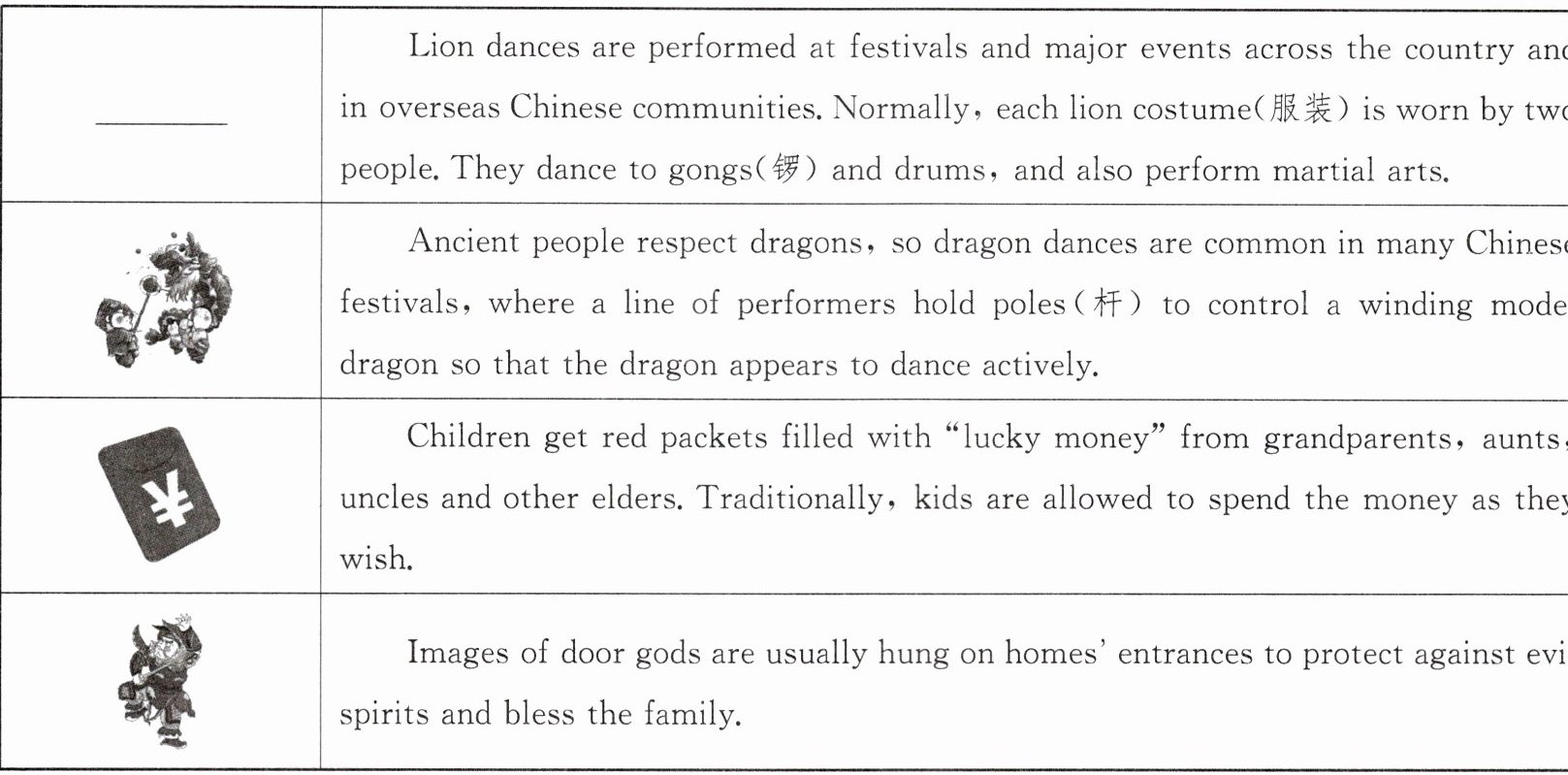
|| Ancient people respect dragons, so dragon dances are common in many Chinese festivals, where a line of performers hold poles(杆) to control a winding model dragon so that the dragon appears to dance actively. |
|| Children get red packets filled with “lucky money” from grandparents, aunts, uncles and other elders. Traditionally, kids are allowed to spend the money as they wish. |
|| Images of door gods are usually hung on homes' entrances to protect against evil spirits and bless the family. |
(

A.
B.
C.
D.
(
A. Because many people like them.
B. Because they have a long tradition.
C. Because they are easy to learn.
D. Because ancient people respect dragons.
(
A. The big events of the Spring Festival.
B. The special meanings of the Spring Festival.
C. The traditional customs of the Spring Festival.
D. The interesting games of the Spring Festival.
| | Lion dances are performed at festivals and major events across the country and in overseas Chinese communities. Normally, each lion costume(服装) is worn by two people. They dance to gongs(锣) and drums, and also perform martial arts. |
|| Ancient people respect dragons, so dragon dances are common in many Chinese festivals, where a line of performers hold poles(杆) to control a winding model dragon so that the dragon appears to dance actively. |
|| Children get red packets filled with “lucky money” from grandparents, aunts, uncles and other elders. Traditionally, kids are allowed to spend the money as they wish. |
|| Images of door gods are usually hung on homes' entrances to protect against evil spirits and bless the family. |
(
A
)1. Which of the following picture can be filled in the blank?A.
B.
C.
D.
(
D
)2. Why are dragon dances common in many Chinese festivals?A. Because many people like them.
B. Because they have a long tradition.
C. Because they are easy to learn.
D. Because ancient people respect dragons.
(
C
)3. What is the passage mainly about?A. The big events of the Spring Festival.
B. The special meanings of the Spring Festival.
C. The traditional customs of the Spring Festival.
D. The interesting games of the Spring Festival.
答案
1. A 2. D 3. C
解析
【分析】
拿到这篇阅读理解后,先通读所有段落,明确每段分别介绍的内容:第一段讲舞狮表演,第二段讲舞龙,第三段讲长辈给孩子发压岁钱红包,第四段讲贴门神的习俗。之后逐题推进解题:
1. 第一题是图文匹配题,题干要求选出和第一段描述内容对应的图片,第一段明确介绍的是舞狮的相关特征,直接匹配对应场景的图片即可选出答案。
2. 第二题是细节理解题,直接定位到介绍舞龙的第二段内容,找到原文给出的舞龙在节日十分常见的原因,和选项直接对照就能得到结果。
3. 第三题是主旨大意题,把四段介绍的内容汇总,梳理所有内容的共同主题,对比四个选项就能选出最贴合的主旨项。
【解析】
1. 图文匹配题:第一段内容描述的是舞狮表演,需要两人共穿一套狮服,伴随锣鼓声表演相关技艺,对应选项A的舞狮场景,其余选项分别对应舞龙、红包、门神的内容,不符合第一段描述,故选A。
2. 细节理解题:根据第二段原文"Ancient people respect dragons, so dragon dances are common in many Chinese festivals",明确说明舞龙在很多中国节日很常见的原因是古人尊崇龙,对应选项D,其余选项原文均未提及,故选D。
3. 主旨大意题:全文分别介绍了舞狮、舞龙、发压岁钱、贴门神这四项中国春节的传统习俗,A选项“春节的重大事件”、B选项“春节的特殊意义”、D选项“春节的趣味游戏”均不能覆盖全文内容,只有C选项“春节的传统习俗”是对全文内容的准确概括,故选C。
【答案】
1. A 2. D 3. C
【知识点】
英语细节理解,英语主旨归纳,春节传统习俗
【点评】
本题属于难度偏低的文化类阅读理解,既考察学生快速定位原文信息、匹配图文和归纳主旨的基础阅读能力,也融入了中国传统民俗文化的相关常识,学生解题时只要耐心回文对照原文内容,避开无关干扰选项,就能轻松选出正确答案。
【难度系数】
0.8
拿到这篇阅读理解后,先通读所有段落,明确每段分别介绍的内容:第一段讲舞狮表演,第二段讲舞龙,第三段讲长辈给孩子发压岁钱红包,第四段讲贴门神的习俗。之后逐题推进解题:
1. 第一题是图文匹配题,题干要求选出和第一段描述内容对应的图片,第一段明确介绍的是舞狮的相关特征,直接匹配对应场景的图片即可选出答案。
2. 第二题是细节理解题,直接定位到介绍舞龙的第二段内容,找到原文给出的舞龙在节日十分常见的原因,和选项直接对照就能得到结果。
3. 第三题是主旨大意题,把四段介绍的内容汇总,梳理所有内容的共同主题,对比四个选项就能选出最贴合的主旨项。
【解析】
1. 图文匹配题:第一段内容描述的是舞狮表演,需要两人共穿一套狮服,伴随锣鼓声表演相关技艺,对应选项A的舞狮场景,其余选项分别对应舞龙、红包、门神的内容,不符合第一段描述,故选A。
2. 细节理解题:根据第二段原文"Ancient people respect dragons, so dragon dances are common in many Chinese festivals",明确说明舞龙在很多中国节日很常见的原因是古人尊崇龙,对应选项D,其余选项原文均未提及,故选D。
3. 主旨大意题:全文分别介绍了舞狮、舞龙、发压岁钱、贴门神这四项中国春节的传统习俗,A选项“春节的重大事件”、B选项“春节的特殊意义”、D选项“春节的趣味游戏”均不能覆盖全文内容,只有C选项“春节的传统习俗”是对全文内容的准确概括,故选C。
【答案】
1. A 2. D 3. C
【知识点】
英语细节理解,英语主旨归纳,春节传统习俗
【点评】
本题属于难度偏低的文化类阅读理解,既考察学生快速定位原文信息、匹配图文和归纳主旨的基础阅读能力,也融入了中国传统民俗文化的相关常识,学生解题时只要耐心回文对照原文内容,避开无关干扰选项,就能轻松选出正确答案。
【难度系数】
0.8
