

 登录
登录
5. 如图,将等边三角形ABC折叠,使点A落在BC边上的点D处(不与点B,C重合),折痕为EF.
(1)求证:$△ BDE ∽ △ CFD$.
(2)若$BD=6$,$DC=2$,求$△ BDE$和$△ CFD$的周长.
(3)在(2)的条件下,求BE的长.
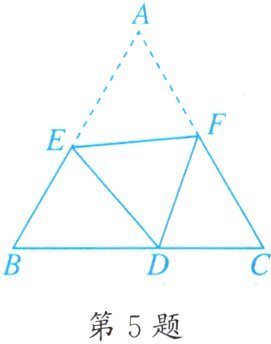
(1)求证:$△ BDE ∽ △ CFD$.
(2)若$BD=6$,$DC=2$,求$△ BDE$和$△ CFD$的周长.
(3)在(2)的条件下,求BE的长.
答案
5. (1)证明:$\because△ ABC$是等边三角形,
$\therefore∠ B=∠ C=∠ A=60°$.
由折叠的性质,得$∠ EDF=∠ A=60°$.
$\therefore∠ EDF=∠ C$.
$\because∠ FDB=∠ C+∠ DFC=∠ EDF+∠ EDB$,
$\therefore∠ DFC=∠ EDB$.
又$\because∠ B=∠ C$,
$\therefore△ BDE∽△ CFD$.
(2)解:$\because BD=6$,$DC=2$,
$\therefore BC=BD+DC=8$.
$\because△ ABC$是等边三角形,
$\therefore AB=AC=BC=8$.
由折叠的性质,得$AE=DE$,$AF=DF$,
$\therefore△ BDE$的周长为$BD+DE+BE=BD+AE+BE=BD+AB=6+8=14$,
$△ CFD$的周长为$CD+DF+CF=CD+AF+FC=CD+AC=2+8=10$.
(3)$\because△ BDE∽△ CFD$,$△ BDE$的周长为14,$△ CFD$的周长为10,
$\therefore\frac{BE}{CD}=\frac{14}{10}$.
$\because DC=2$,
$\therefore\frac{BE}{2}=\frac{14}{10}$.
$\therefore BE=2.8$.
$\therefore∠ B=∠ C=∠ A=60°$.
由折叠的性质,得$∠ EDF=∠ A=60°$.
$\therefore∠ EDF=∠ C$.
$\because∠ FDB=∠ C+∠ DFC=∠ EDF+∠ EDB$,
$\therefore∠ DFC=∠ EDB$.
又$\because∠ B=∠ C$,
$\therefore△ BDE∽△ CFD$.
(2)解:$\because BD=6$,$DC=2$,
$\therefore BC=BD+DC=8$.
$\because△ ABC$是等边三角形,
$\therefore AB=AC=BC=8$.
由折叠的性质,得$AE=DE$,$AF=DF$,
$\therefore△ BDE$的周长为$BD+DE+BE=BD+AE+BE=BD+AB=6+8=14$,
$△ CFD$的周长为$CD+DF+CF=CD+AF+FC=CD+AC=2+8=10$.
(3)$\because△ BDE∽△ CFD$,$△ BDE$的周长为14,$△ CFD$的周长为10,
$\therefore\frac{BE}{CD}=\frac{14}{10}$.
$\because DC=2$,
$\therefore\frac{BE}{2}=\frac{14}{10}$.
$\therefore BE=2.8$.
6. 如图,在$\mathrm{Rt}△ ABC$中,$∠ ACB=90°$,$CD$是$AB$边上的高。
(1)求证:$△ ACD ∽ △ CBD$。
(2)若$AB=8$,$AD=6$,求$CD$的长。
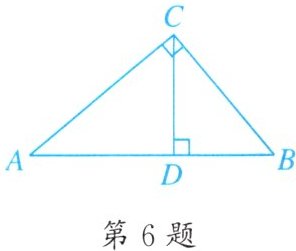
(1)求证:$△ ACD ∽ △ CBD$。
(2)若$AB=8$,$AD=6$,求$CD$的长。
答案
6. (1)证明:$\because CD⊥ AB$,
$\therefore∠ CDA=∠ CDB=90°$.
$\because∠ ACB=90°$,
$\therefore∠ ACD+∠ BCD=90°$,$∠ BCD+∠ B=90°$.
$\therefore∠ ACD=∠ B$.
$\therefore△ ACD∽△ CBD$.
(2)解:$\because△ ACD∽△ CBD$,
$\therefore\frac{AD}{CD}=\frac{CD}{BD}$.
$\therefore CD^2=AD· BD$.
$\because AD=6$,$BD=AB-AD=2$,
$\therefore CD^2=12$.
$\because CD>0$,
$\therefore CD=2\sqrt{3}$.
$\therefore∠ CDA=∠ CDB=90°$.
$\because∠ ACB=90°$,
$\therefore∠ ACD+∠ BCD=90°$,$∠ BCD+∠ B=90°$.
$\therefore∠ ACD=∠ B$.
$\therefore△ ACD∽△ CBD$.
(2)解:$\because△ ACD∽△ CBD$,
$\therefore\frac{AD}{CD}=\frac{CD}{BD}$.
$\therefore CD^2=AD· BD$.
$\because AD=6$,$BD=AB-AD=2$,
$\therefore CD^2=12$.
$\because CD>0$,
$\therefore CD=2\sqrt{3}$.
7. 如图,在$\mathrm{Rt}△ ABC$中,$∠ C=90°$,$AC=12\ \mathrm{cm}$,$BC=8\ \mathrm{cm}$,现有动点$P$从点$C$出发沿$CA$向点$A$方向运动,动点$Q$从点$B$出发沿$BC$向点$C$方向运动。点$P$的速度是$2\ \mathrm{cm/s}$,点$Q$的速度是$1\ \mathrm{cm/s}$,它们同时出发,当有一点到达所在线段的端点时,点$P$,$Q$就停止运动,设运动时间为$t\ \mathrm{s}$.
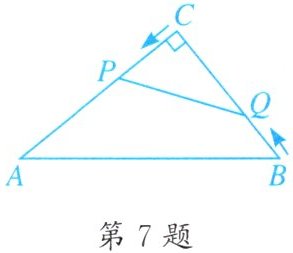
(1)用含$t$的代数式表示:$CP=$
(2)当$t$为多少时,$PQ$的长为$\sqrt{61}\ \mathrm{cm}$?
(3)当$t$为多少时,以$C$,$P$,$Q$为顶点的三角形与$△ ABC$相似?
(1)用含$t$的代数式表示:$CP=$
$2t$
,$CQ=$$8-t$
.(2)当$t$为多少时,$PQ$的长为$\sqrt{61}\ \mathrm{cm}$?
(3)当$t$为多少时,以$C$,$P$,$Q$为顶点的三角形与$△ ABC$相似?
答案
7. 解:(1)$2t$,$8-t$
(2)在$\mathrm{Rt}△ PCQ$中,根据勾股定理,得$CP^2+CQ^2=PQ^2$.
令$(2t)^2+(8-t)^2=(\sqrt{61})^2$,
解得$t=0.2$或$t=3$.
$\therefore$当$t$为0.2或3时,$PQ$的长为$\sqrt{61}\ \mathrm{cm}$.
(3)当$△ CPQ∽△ CAB$时,
有$\frac{CP}{CA}=\frac{CQ}{CB}$,
即$\frac{2t}{12}=\frac{8-t}{8}$.
解得$t=\frac{24}{7}$.
当$△ CPQ∽△ CBA$时,
有$\frac{CP}{CB}=\frac{CQ}{CA}$,
即$\frac{2t}{8}=\frac{8-t}{12}$.
解得$t=2$.
综上所述,当$t$为$\frac{24}{7}$或2时,以$C$,$P$,$Q$为顶点的三角形与$△ ABC$相似.
(2)在$\mathrm{Rt}△ PCQ$中,根据勾股定理,得$CP^2+CQ^2=PQ^2$.
令$(2t)^2+(8-t)^2=(\sqrt{61})^2$,
解得$t=0.2$或$t=3$.
$\therefore$当$t$为0.2或3时,$PQ$的长为$\sqrt{61}\ \mathrm{cm}$.
(3)当$△ CPQ∽△ CAB$时,
有$\frac{CP}{CA}=\frac{CQ}{CB}$,
即$\frac{2t}{12}=\frac{8-t}{8}$.
解得$t=\frac{24}{7}$.
当$△ CPQ∽△ CBA$时,
有$\frac{CP}{CB}=\frac{CQ}{CA}$,
即$\frac{2t}{8}=\frac{8-t}{12}$.
解得$t=2$.
综上所述,当$t$为$\frac{24}{7}$或2时,以$C$,$P$,$Q$为顶点的三角形与$△ ABC$相似.
