

 登录
登录
Ⅳ. 阅读短文,选择最佳选项。
What are you holding in your hand while you are taking the exam? Right. A pen.
The history of the pen is very long. A long time ago, people used sharp stones to make marks on things. Then, the ancient Egyptians made reed(芦苇)pens. They cut reeds and used them to write. Later, in China, people invented the writing brush. It feels soft and can write beautiful characters. In the Middle Ages in Europe, it was popular to use birds' feathers to write. And now, we have all kinds of pens like ballpoint pens(圆珠笔)and gel pens(中性笔). They are very convenient.
Pens are widely used in many ways. Students use pens to do homework and take notes in class. Scientists use pens to record experiment results. Artists use special pens to draw pictures. Pens help us record knowledge and history. Because of pens, we can read many great works from different times. Pens also let us show our creativity. We can write our own thoughts and feelings. And when we write with a pen, it makes us think more.
In the future, pens will be more amazing. With the development of science and technology, pens might have built-in cameras to record what we write and draw. Maybe they can change colours according to our feelings and correct our spelling mistakes right away. They will also
connect to the Internet, helping search for information while writing. What's more, they will be made of new materials that are environmentally friendly.
Pens are not just simple tools. They are the most powerful instruments which we own. They are a big part of culture and lives. They have changed the world greatly and will remain important in the future.
1. How does the writer start the text? (
A. By asking a question.
B. By telling a story.
C. By giving an example.
D. By listing numbers.
2. Which of the following shows the correct order of the development of writing tools? (
A. Reed pens—Feather pens—Writing brush—Gel pens
B. Sharp stones—Reed pens—Feather pens—Gel pens
C. Sharp stones—Writing brush—Reed pens—Feather pens
D. Writing brush—Sharp stones—Reed pens—Ballpoint pens
3. What can we know from paragraph 3? (
A. The development of pens.
B. The different kinds of pens.
C. The uses and importance of pens.
D. The history of the invention of pens.
4. What will the future pens be like according to paragraph 4? (
A. They will make more mistakes.
B. They will be too expensive to buy.
C. They will be friendly to the environment.
D. They will be written only after connecting to the Internet.
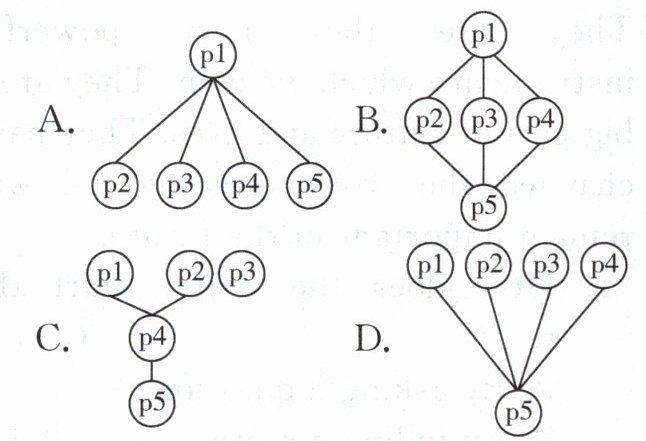
5. Which is the right structure of the text? (
What are you holding in your hand while you are taking the exam? Right. A pen.
The history of the pen is very long. A long time ago, people used sharp stones to make marks on things. Then, the ancient Egyptians made reed(芦苇)pens. They cut reeds and used them to write. Later, in China, people invented the writing brush. It feels soft and can write beautiful characters. In the Middle Ages in Europe, it was popular to use birds' feathers to write. And now, we have all kinds of pens like ballpoint pens(圆珠笔)and gel pens(中性笔). They are very convenient.
Pens are widely used in many ways. Students use pens to do homework and take notes in class. Scientists use pens to record experiment results. Artists use special pens to draw pictures. Pens help us record knowledge and history. Because of pens, we can read many great works from different times. Pens also let us show our creativity. We can write our own thoughts and feelings. And when we write with a pen, it makes us think more.
In the future, pens will be more amazing. With the development of science and technology, pens might have built-in cameras to record what we write and draw. Maybe they can change colours according to our feelings and correct our spelling mistakes right away. They will also
connect to the Internet, helping search for information while writing. What's more, they will be made of new materials that are environmentally friendly.
Pens are not just simple tools. They are the most powerful instruments which we own. They are a big part of culture and lives. They have changed the world greatly and will remain important in the future.
1. How does the writer start the text? (
A
)A. By asking a question.
B. By telling a story.
C. By giving an example.
D. By listing numbers.
2. Which of the following shows the correct order of the development of writing tools? (
B
)A. Reed pens—Feather pens—Writing brush—Gel pens
B. Sharp stones—Reed pens—Feather pens—Gel pens
C. Sharp stones—Writing brush—Reed pens—Feather pens
D. Writing brush—Sharp stones—Reed pens—Ballpoint pens
3. What can we know from paragraph 3? (
C
)A. The development of pens.
B. The different kinds of pens.
C. The uses and importance of pens.
D. The history of the invention of pens.
4. What will the future pens be like according to paragraph 4? (
C
)A. They will make more mistakes.
B. They will be too expensive to buy.
C. They will be friendly to the environment.
D. They will be written only after connecting to the Internet.
5. Which is the right structure of the text? (
B
)答案
1-5 ABCCB
解析
【分析】
本题为英语阅读理解题,需结合原文内容逐一分析各小题:第1题定位文章开头判断写作方式;第2题在原文第二段按时间顺序梳理书写工具发展顺序;第3题分析第三段核心内容;第4题定位第四段关于未来笔的描述;第5题梳理文章整体结构匹配选项。
【解析】
1. 文章开头以问句“What are you holding in your hand while you are taking the exam?”引入,故第1题选A;
2. 第二段明确书写工具发展顺序为:sharp stones→reed pens→writing brush→feather pens→ballpoint/gel pens,对应选项B,故第2题选B;
3. 第三段列举不同人群使用笔的场景,说明笔的用途与重要性,故第3题选C;
4. 第四段提到未来笔“will be made of new materials that are environmentally friendly”,对应选项C,故第4题选C;
5. 梳理文章结构:引入笔→讲历史→讲用途→讲未来→总结,匹配选项B,故第5题选B。
【答案】
ABCCB
【知识点】
英语阅读理解、细节理解、主旨大意
【点评】
本题考查学生对英语阅读理解中细节、主旨、结构的理解能力,需结合原文定位信息逐一解答,难度适中。
【难度系数】
0.7
本题为英语阅读理解题,需结合原文内容逐一分析各小题:第1题定位文章开头判断写作方式;第2题在原文第二段按时间顺序梳理书写工具发展顺序;第3题分析第三段核心内容;第4题定位第四段关于未来笔的描述;第5题梳理文章整体结构匹配选项。
【解析】
1. 文章开头以问句“What are you holding in your hand while you are taking the exam?”引入,故第1题选A;
2. 第二段明确书写工具发展顺序为:sharp stones→reed pens→writing brush→feather pens→ballpoint/gel pens,对应选项B,故第2题选B;
3. 第三段列举不同人群使用笔的场景,说明笔的用途与重要性,故第3题选C;
4. 第四段提到未来笔“will be made of new materials that are environmentally friendly”,对应选项C,故第4题选C;
5. 梳理文章结构:引入笔→讲历史→讲用途→讲未来→总结,匹配选项B,故第5题选B。
【答案】
ABCCB
【知识点】
英语阅读理解、细节理解、主旨大意
【点评】
本题考查学生对英语阅读理解中细节、主旨、结构的理解能力,需结合原文定位信息逐一解答,难度适中。
【难度系数】
0.7
