

 登录
登录
12. 如图,▱$ABCD$的两个顶点$A$,$C$分别在直线$m$,$n$上,且$m// n$,$∠ 1 = 25°$,则$∠ 2$等于(
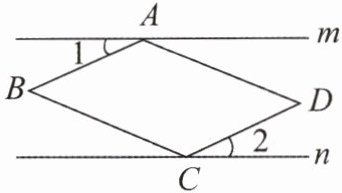
A.$20°$
B.$25°$
C.$30°$
D.$65°$
B
)A.$20°$
B.$25°$
C.$30°$
D.$65°$
答案
12. B
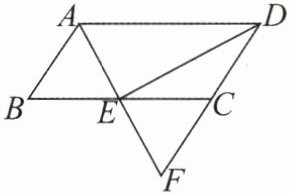
13. 如图,在▱$ABCD$中,$E$是$BC$的中点,连结$AE$并延长交$DC$的延长线于点$F$.
(1)求证:$AB = CF$.
(2)连结$DE$,若$AD = 2AB$,求证:$DE⊥ AF$.
(1)求证:$AB = CF$.
(2)连结$DE$,若$AD = 2AB$,求证:$DE⊥ AF$.
答案
13. 证明:(1)$\because$四边形$ABCD$是平行四边形,
$\therefore AB// DF$,$\therefore ∠ ABE=∠ FCE$,
$\because E$为$BC$中点,
$\therefore BE=CE$,
在$△ ABE$与$△ FCE$中,
$\begin{cases}∠ ABE=∠ FCE, \\BE=CE, \\∠ AEB=∠ CEF,\end{cases}$
$\therefore △ ABE≌ △ FCE(\mathrm{ASA})$,$\therefore AB=CF$.
(2)$\because AD=2AB$,$AB=FC=CD$,
$\therefore AD=DF$,
$\because △ ABE≌ △ FCE$,
$\therefore AE=EF$,$\therefore DE⊥ AF$.
$\therefore AB// DF$,$\therefore ∠ ABE=∠ FCE$,
$\because E$为$BC$中点,
$\therefore BE=CE$,
在$△ ABE$与$△ FCE$中,
$\begin{cases}∠ ABE=∠ FCE, \\BE=CE, \\∠ AEB=∠ CEF,\end{cases}$
$\therefore △ ABE≌ △ FCE(\mathrm{ASA})$,$\therefore AB=CF$.
(2)$\because AD=2AB$,$AB=FC=CD$,
$\therefore AD=DF$,
$\because △ ABE≌ △ FCE$,
$\therefore AE=EF$,$\therefore DE⊥ AF$.
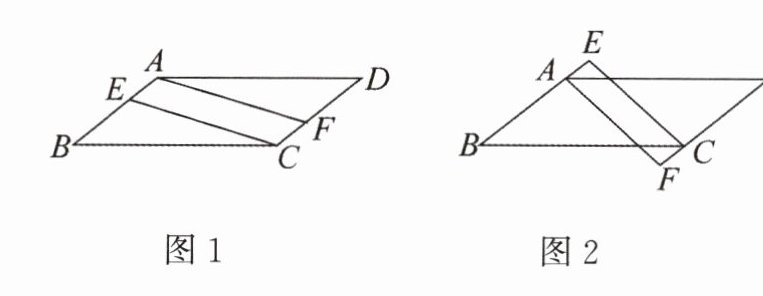
14. (1)在▱$ABCD$中,当$E$是$AB$上一点,$F$是$CD$上一点,且$AE = CF$时,如图$1$所示,求证:$AF = CE$,$∠ ECF = ∠ EAF$.
(2)在▱$ABCD$中,当$E$变为$BA$延长线上一点,$F$变为$DC$延长线上一点,且$AE = CF$时,如图$2$所示,则(1)中的结论是否仍成立?请直接写出结论,不必说明理由.
(2)在▱$ABCD$中,当$E$变为$BA$延长线上一点,$F$变为$DC$延长线上一点,且$AE = CF$时,如图$2$所示,则(1)中的结论是否仍成立?请直接写出结论,不必说明理由.
答案
14. (1)证明:$\because$四边形$ABCD$为平行四边形,
$\therefore ∠ D=∠ B$,$AD=CB$,$AB=CD$,
又$\because AE=CF$,$\therefore BE=AB-AE=CD-CF=DF$
在$△ ADF$与$△ CBE$中,
$\begin{cases}BE=DF, \\∠ D=∠ B, \\BC=AD,\end{cases}$
$\therefore △ ADF≌ △ CBE(\mathrm{SAS})$,
$\therefore AF=CE$,$∠ DAF=∠ BCE$,
$\because ∠ BCD=∠ BAD$,
$\therefore ∠ ECF=∠ EAF$.
(2)仍成立.
$\therefore ∠ D=∠ B$,$AD=CB$,$AB=CD$,
又$\because AE=CF$,$\therefore BE=AB-AE=CD-CF=DF$
在$△ ADF$与$△ CBE$中,
$\begin{cases}BE=DF, \\∠ D=∠ B, \\BC=AD,\end{cases}$
$\therefore △ ADF≌ △ CBE(\mathrm{SAS})$,
$\therefore AF=CE$,$∠ DAF=∠ BCE$,
$\because ∠ BCD=∠ BAD$,
$\therefore ∠ ECF=∠ EAF$.
(2)仍成立.
