

 登录
登录
一、根据括号内所给汉语注释写出单词的正确形式(每空一词)
1. The ancient
2. It is said that there was a powerful
3. The wind is blowing from the
4. My dream is to become an
5. We had a wonderful picnic in the
6. My brother is
7. Good
8. The beautiful scenery of the lake never fails to
1. The ancient
remains
(遗迹)tell us a lot about the life of people in the past.2. It is said that there was a powerful
kingdom
(王国)in this area hundreds of years ago.3. The wind is blowing from the
northwest
(西北方), so it is quite cold today.4. My dream is to become an
archaeologist
(考古学家)and study old civilizations in the future.5. We had a wonderful picnic in the
centre
(中心)of the city park last weekend.6. My brother is
creative
(有创造力)and good at making small inventions.7. Good
luck
(幸运)is when preparation meets opportunity.8. The beautiful scenery of the lake never fails to
amaze
(使大为惊奇)the visitors.答案
1. remains
2. kingdom
3. northwest
4. archaeologist
5. centre
6. creative
7. luck
8. amaze
2. kingdom
3. northwest
4. archaeologist
5. centre
6. creative
7. luck
8. amaze
解析
【分析】
解题思路:先通读每个句子,分析句子成分确定所需单词的词性,再结合括号内的汉语注释,同时注意语法规则(如冠词、单复数、固定搭配、词性变化等),填写正确的单词形式。例如:第1题谓语动词为复数形式tell,故需用名词复数;第6题be动词后需用形容词作表语;第8题fail to后接动词原形,据此逐一确定答案。
【解析】
1. 句意:古代遗迹告诉我们很多关于过去人们生活的信息。谓语动词tell为复数形式,需用名词复数,结合汉语“遗迹”,填remains。
2. 句意:据说几百年前这个地区有一个强大的王国。不定冠词a后接单数可数名词,结合汉语“王国”,填kingdom。
3. 句意:风从西北方吹来,所以今天很冷。结合汉语“西北方”,填名词northwest。
4. 句意:我的梦想是将来成为一名考古学家,研究古代文明。不定冠词an后接单数可数名词,结合汉语“考古学家”,填archaeologist。
5. 句意:上周末我们在城市公园的中心进行了一次很棒的野餐。固定短语in the centre of表示“在……的中心”,结合汉语“中心”,填centre。
6. 句意:我哥哥有创造力,擅长制作小发明。be动词后需用形容词作表语,结合汉语“有创造力”,填creative。
7. 句意:好运是当准备遇到机会时。形容词good后需接名词,结合汉语“幸运”,填luck。
8. 句意:湖的美景总能让游客大为惊奇。fail to do sth是固定结构,需用动词原形,结合汉语“使大为惊奇”,填amaze。
【答案】
1. remains 2. kingdom 3. northwest 4. archaeologist 5. centre 6. creative 7. luck 8. amaze
【知识点】
英语单词拼写;词性辨析;固定短语搭配
【点评】
本题为基础单词拼写题,考查核心词汇在语境中的正确运用,涉及词性判断、语法规则及固定搭配等基础知识点,难度较低,是巩固英语基础的典型题型。
【难度系数】
0.9
解题思路:先通读每个句子,分析句子成分确定所需单词的词性,再结合括号内的汉语注释,同时注意语法规则(如冠词、单复数、固定搭配、词性变化等),填写正确的单词形式。例如:第1题谓语动词为复数形式tell,故需用名词复数;第6题be动词后需用形容词作表语;第8题fail to后接动词原形,据此逐一确定答案。
【解析】
1. 句意:古代遗迹告诉我们很多关于过去人们生活的信息。谓语动词tell为复数形式,需用名词复数,结合汉语“遗迹”,填remains。
2. 句意:据说几百年前这个地区有一个强大的王国。不定冠词a后接单数可数名词,结合汉语“王国”,填kingdom。
3. 句意:风从西北方吹来,所以今天很冷。结合汉语“西北方”,填名词northwest。
4. 句意:我的梦想是将来成为一名考古学家,研究古代文明。不定冠词an后接单数可数名词,结合汉语“考古学家”,填archaeologist。
5. 句意:上周末我们在城市公园的中心进行了一次很棒的野餐。固定短语in the centre of表示“在……的中心”,结合汉语“中心”,填centre。
6. 句意:我哥哥有创造力,擅长制作小发明。be动词后需用形容词作表语,结合汉语“有创造力”,填creative。
7. 句意:好运是当准备遇到机会时。形容词good后需接名词,结合汉语“幸运”,填luck。
8. 句意:湖的美景总能让游客大为惊奇。fail to do sth是固定结构,需用动词原形,结合汉语“使大为惊奇”,填amaze。
【答案】
1. remains 2. kingdom 3. northwest 4. archaeologist 5. centre 6. creative 7. luck 8. amaze
【知识点】
英语单词拼写;词性辨析;固定短语搭配
【点评】
本题为基础单词拼写题,考查核心词汇在语境中的正确运用,涉及词性判断、语法规则及固定搭配等基础知识点,难度较低,是巩固英语基础的典型题型。
【难度系数】
0.9
二、单句语法填空
1. Shanghai lies
2. Time is the most
3. As long as things go
4. It was
5. Some important
6. We must work hard to keep up with the rapid development of
1. Shanghai lies
in
the east of China.2. Time is the most
valuable
(value) thing we have, so we shouldn't waste it.3. As long as things go
smoothly
(smooth), she will be fine.4. It was
such
a difficult problem that none of us could work it out.5. Some important
discoveries
(discover) have changed the way we understand the world.6. We must work hard to keep up with the rapid development of
today's
(today) society.答案
1. in
2. valuable
3. smoothly
4. such
5. discoveries
6. today's
2. valuable
3. smoothly
4. such
5. discoveries
6. today's
解析
【分析】
1. 考查方位介词用法:in表示在某一范围内部,on表示接壤,to表示不接壤,上海属于中国领土范围,故用in。
2. 考查形容词最高级构成:most后需接形容词原级构成最高级,名词value的形容词形式为valuable,故填valuable。
3. 考查副词用法:修饰动词go需用副词,形容词smooth的副词形式为smoothly,故填smoothly。
4. 考查固定句式:such...that...为固定搭配,意为“如此……以至于……”,此处后接名词短语a difficult problem,符合such的用法,故填such。
5. 考查名词复数:some后接可数名词复数,动词discover的名词形式为discovery,其复数为discoveries,故填discoveries。
6. 考查名词所有格:修饰名词society需用定语,today的名词所有格today's可作定语,意为“当今的”,故填today's。
【解析】
1. 方位介词中,in表示在内部,上海在中国内部,故填in。
2. most构成形容词最高级,需用value的形容词形式valuable,故填valuable。
3. 修饰动词go用副词,smooth的副词是smoothly,故填smoothly。
4. such...that...是固定句式,后接名词短语,故填such。
5. some后接可数名词复数,discovery的复数是discoveries,故填discoveries。
6. 修饰society用所有格today's,故填today's。
【答案】
1. in
2. valuable
3. smoothly
4. such
5. discoveries
6. today's
【知识点】
方位介词;词形转换;固定句式
【点评】
本题考查单句语法填空,涵盖方位介词、词类转换、固定句式等基础语法点,侧重学生对基础语法知识的运用,难度适中,适合巩固基础语法。
【难度系数】
0.7
1. 考查方位介词用法:in表示在某一范围内部,on表示接壤,to表示不接壤,上海属于中国领土范围,故用in。
2. 考查形容词最高级构成:most后需接形容词原级构成最高级,名词value的形容词形式为valuable,故填valuable。
3. 考查副词用法:修饰动词go需用副词,形容词smooth的副词形式为smoothly,故填smoothly。
4. 考查固定句式:such...that...为固定搭配,意为“如此……以至于……”,此处后接名词短语a difficult problem,符合such的用法,故填such。
5. 考查名词复数:some后接可数名词复数,动词discover的名词形式为discovery,其复数为discoveries,故填discoveries。
6. 考查名词所有格:修饰名词society需用定语,today的名词所有格today's可作定语,意为“当今的”,故填today's。
【解析】
1. 方位介词中,in表示在内部,上海在中国内部,故填in。
2. most构成形容词最高级,需用value的形容词形式valuable,故填valuable。
3. 修饰动词go用副词,smooth的副词是smoothly,故填smoothly。
4. such...that...是固定句式,后接名词短语,故填such。
5. some后接可数名词复数,discovery的复数是discoveries,故填discoveries。
6. 修饰society用所有格today's,故填today's。
【答案】
1. in
2. valuable
3. smoothly
4. such
5. discoveries
6. today's
【知识点】
方位介词;词形转换;固定句式
【点评】
本题考查单句语法填空,涵盖方位介词、词类转换、固定句式等基础语法点,侧重学生对基础语法知识的运用,难度适中,适合巩固基础语法。
【难度系数】
0.7
三、阅读理解
A
Today, the name "Chengdu" is widely known, but do you know its other names?
The City of Tortoise(龟城)
In 316 BC, Zhang Yi and Zhang Ruo, generals(将军) of the Qin State, built a city wall in Chengdu to better protect its people against enemies(敌人). The wall was built in the shape of a huge tortoise, with four gates located in the east, south, west and north, corresponding to(对应) the tortoise's four feet. The Zhang Yi Tower at the west gate was very tall, while the Zhang Ruo Tower at the east gate was slightly shorter. When the sun rose, the Zhang Ruo Tower looked like the head of a tortoise, and the Zhang Yi Tower looked like its tail. This is how Chengdu got this nickname.
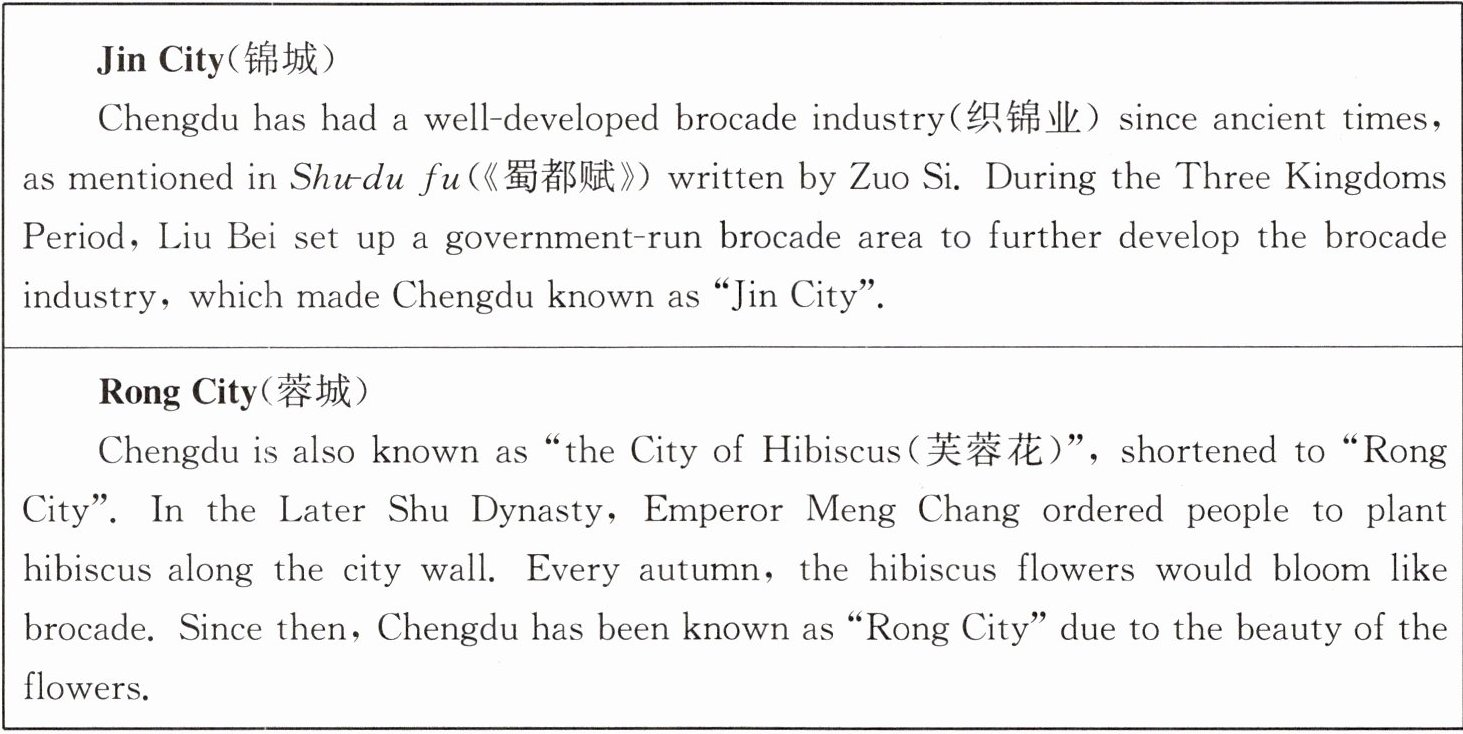
Jin City(锦城)
Chengdu has had a well-developed brocade industry(织锦业) since ancient times, as mentioned in Shu-du fu(《蜀都赋》) written by Zuo Si. During the Three Kingdoms Period, Liu Bei set up a government-run brocade area to further develop the brocade industry, which made Chengdu known as "Jin City".
Rong City(蓉城)
Chengdu is also known as "the City of Hibiscus(芙蓉花)", shortened to "Rong City". In the Later Shu Dynasty, Emperor Meng Chang ordered people to plant hibiscus along the city wall. Every autumn, the hibiscus flowers would bloom like brocade. Since then, Chengdu has been known as "Rong City" due to the beauty of the flowers.
(
A. To create a safe place for people.
B. To attract more people to Chengdu.
C. To show the strength of the Qin State.
D. To provide a special area for training.
(
A. The name came from Shu-du fu.
B. Liu Bei gave the place the name.
C. Zuo Si let more people know the name.
D. The name showed the successful local brocade industry.
(
A. In a storybook.
B. In a science report.
C. In a travel magazine.
D. In a sports newspaper.
A
Today, the name "Chengdu" is widely known, but do you know its other names?
The City of Tortoise(龟城)
In 316 BC, Zhang Yi and Zhang Ruo, generals(将军) of the Qin State, built a city wall in Chengdu to better protect its people against enemies(敌人). The wall was built in the shape of a huge tortoise, with four gates located in the east, south, west and north, corresponding to(对应) the tortoise's four feet. The Zhang Yi Tower at the west gate was very tall, while the Zhang Ruo Tower at the east gate was slightly shorter. When the sun rose, the Zhang Ruo Tower looked like the head of a tortoise, and the Zhang Yi Tower looked like its tail. This is how Chengdu got this nickname.
Jin City(锦城)
Chengdu has had a well-developed brocade industry(织锦业) since ancient times, as mentioned in Shu-du fu(《蜀都赋》) written by Zuo Si. During the Three Kingdoms Period, Liu Bei set up a government-run brocade area to further develop the brocade industry, which made Chengdu known as "Jin City".
Rong City(蓉城)
Chengdu is also known as "the City of Hibiscus(芙蓉花)", shortened to "Rong City". In the Later Shu Dynasty, Emperor Meng Chang ordered people to plant hibiscus along the city wall. Every autumn, the hibiscus flowers would bloom like brocade. Since then, Chengdu has been known as "Rong City" due to the beauty of the flowers.
(
A
)1. What was the two generals' purpose in building a city wall?A. To create a safe place for people.
B. To attract more people to Chengdu.
C. To show the strength of the Qin State.
D. To provide a special area for training.
(
D
)2. What can we know about the name "Jin City"?A. The name came from Shu-du fu.
B. Liu Bei gave the place the name.
C. Zuo Si let more people know the name.
D. The name showed the successful local brocade industry.
(
C
)3. Where can we read the passage?A. In a storybook.
B. In a science report.
C. In a travel magazine.
D. In a sports newspaper.
答案
1. A
2. D
3. C
2. D
3. C
解析
【分析】
做阅读理解题时,需根据题干关键词定位原文对应内容,再比对选项选出答案。第1题关键词是“two generals' purpose”,定位到龟城相关段落;第2题关键词是“Jin City”,定位到锦城相关段落;第3题问文章出处,需结合文章内容判断适用场景。
【解析】
1. 定位到“The City of Tortoise”段落第一句:“In 316 BC, Zhang Yi and Zhang Ruo, generals of the Qin State, built a city wall in Chengdu to better protect its people against enemies.” 建城墙的目的是保护人民免受敌人侵害,对应选项A“为人们创造安全的地方”,故选A。
2. 定位到“Jin City”段落:“During the Three Kingdoms Period, Liu Bei set up a government-run brocade area to further develop the brocade industry, which made Chengdu known as 'Jin City'.” 说明“锦城”的名字源于当地发达的织锦业,对应选项D。A选项《蜀都赋》仅提及织锦业,并非名字来源;B选项刘备是发展织锦业而非直接命名;C选项左思的作品只是提到织锦业,并非让更多人知晓名字,故选D。
3. 文章介绍成都的别名由来,属于城市文化介绍类内容,最可能出现在旅游杂志,对应选项C。A故事书、B科学报告、D体育报纸均不符合,故选C。
【答案】
1.A 2.D 3.C
【知识点】
英语阅读理解、细节理解题、推理判断题
【点评】
本文围绕成都的三个别名展开,题目侧重考查原文细节定位与理解,整体难度适中,只要仔细查找对应信息即可正确作答,适合巩固初中英语阅读基础。
【难度系数】
0.7
做阅读理解题时,需根据题干关键词定位原文对应内容,再比对选项选出答案。第1题关键词是“two generals' purpose”,定位到龟城相关段落;第2题关键词是“Jin City”,定位到锦城相关段落;第3题问文章出处,需结合文章内容判断适用场景。
【解析】
1. 定位到“The City of Tortoise”段落第一句:“In 316 BC, Zhang Yi and Zhang Ruo, generals of the Qin State, built a city wall in Chengdu to better protect its people against enemies.” 建城墙的目的是保护人民免受敌人侵害,对应选项A“为人们创造安全的地方”,故选A。
2. 定位到“Jin City”段落:“During the Three Kingdoms Period, Liu Bei set up a government-run brocade area to further develop the brocade industry, which made Chengdu known as 'Jin City'.” 说明“锦城”的名字源于当地发达的织锦业,对应选项D。A选项《蜀都赋》仅提及织锦业,并非名字来源;B选项刘备是发展织锦业而非直接命名;C选项左思的作品只是提到织锦业,并非让更多人知晓名字,故选D。
3. 文章介绍成都的别名由来,属于城市文化介绍类内容,最可能出现在旅游杂志,对应选项C。A故事书、B科学报告、D体育报纸均不符合,故选C。
【答案】
1.A 2.D 3.C
【知识点】
英语阅读理解、细节理解题、推理判断题
【点评】
本文围绕成都的三个别名展开,题目侧重考查原文细节定位与理解,整体难度适中,只要仔细查找对应信息即可正确作答,适合巩固初中英语阅读基础。
【难度系数】
0.7
