

 登录
登录
第三节 听短文,根据所听内容选择能回答所提问题的最佳选项。短文读两遍。
(
A. In England. B. In China. C. In Japan.
(
A. Paper and cloth. B. Wood and bamboo. C. Plastic and metal.
(
A. To send messages and avoid bad luck. B. To compete in festivals.
C. To exercise their bodies.
(
A. As big as a football field. B. As big as three basketball courts.
C. As big as a small house.
(
A. During the Spring Festival.
B. During the Weifang International Kite Festival in April.
C. During the Mid-Autumn Festival.
(
B
)11. Where were kites invented?A. In England. B. In China. C. In Japan.
(
B
)12. What were the earliest kites made of?A. Paper and cloth. B. Wood and bamboo. C. Plastic and metal.
(
A
)13. Why did people fly kites in the past?A. To send messages and avoid bad luck. B. To compete in festivals.
C. To exercise their bodies.
(
B
)14. How big is one of the world's largest kites?A. As big as a football field. B. As big as three basketball courts.
C. As big as a small house.
(
B
)15. When is the best time to see colorful kites in China?A. During the Spring Festival.
B. During the Weifang International Kite Festival in April.
C. During the Mid-Autumn Festival.
答案
11—15 BBABB
Ⅱ. 阅读下面短文,掌握其大意,从每小题所给的A、B、C三个选项中选出最佳选项。
A
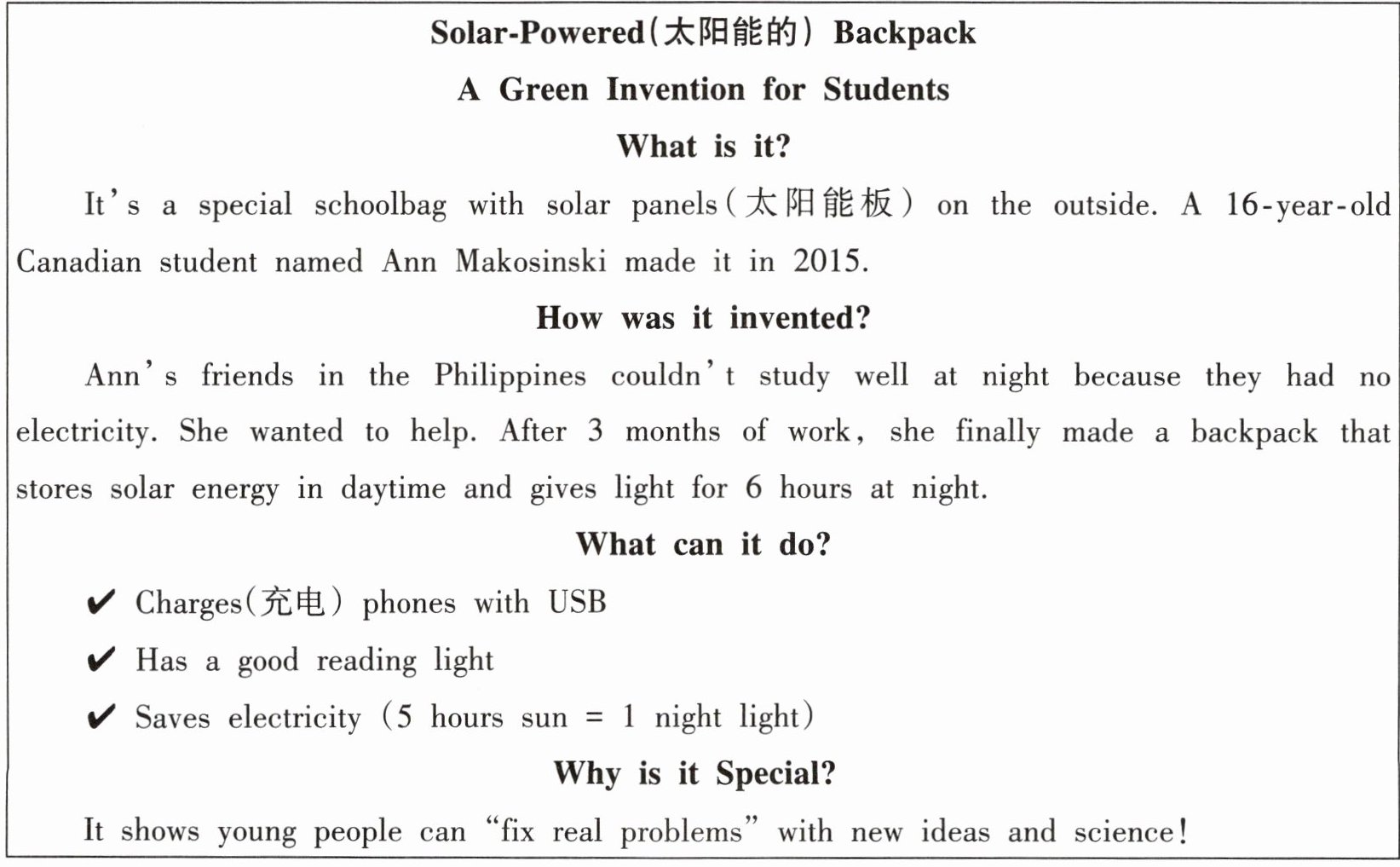
Solar-Powered(太阳能的) Backpack
A Green Invention for Students
What is it?
It's a special schoolbag with solar panels(太阳能板) on the outside. A 16-year-old Canadian student named Ann Makosinski made it in 2015.
How was it invented?
Ann's friends in the Philippines couldn't study well at night because they had no electricity. She wanted to help. After 3 months of work, she finally made a backpack that stores solar energy in daytime and gives light for 6 hours at night.
What can it do?
✔ Charges(充电) phones with USB
✔ Has a good reading light
✔ Saves electricity (5 hours sun = 1 night light)
Why is it Special?
It shows young people can "fix real problems" with new ideas and science!
(
A. In 2010. B. In 2015. C. In 2020.
(
A. She wanted to make much money.
B. Her friends needed light to study at night.
C. Her teacher asked her to do it.
(
A. It can give reading light.
B. It can charge everything.
C. It can make electricity.
(
A. In a science magazine.
B. In a history textbook.
C. In a cooking book.
(
A. To tell how solar panels work.
B. To show a useful student invention.
C. To talk about different school bags.
A
Solar-Powered(太阳能的) Backpack
A Green Invention for Students
What is it?
It's a special schoolbag with solar panels(太阳能板) on the outside. A 16-year-old Canadian student named Ann Makosinski made it in 2015.
How was it invented?
Ann's friends in the Philippines couldn't study well at night because they had no electricity. She wanted to help. After 3 months of work, she finally made a backpack that stores solar energy in daytime and gives light for 6 hours at night.
What can it do?
✔ Charges(充电) phones with USB
✔ Has a good reading light
✔ Saves electricity (5 hours sun = 1 night light)
Why is it Special?
It shows young people can "fix real problems" with new ideas and science!
(
B
)1. When was the solar-powered backpack invented?A. In 2010. B. In 2015. C. In 2020.
(
B
)2. Why did Ann Makosinski invent this backpack?A. She wanted to make much money.
B. Her friends needed light to study at night.
C. Her teacher asked her to do it.
(
A
)3. What can the backpack do?A. It can give reading light.
B. It can charge everything.
C. It can make electricity.
(
A
)4. Where are you most likely to find this text?A. In a science magazine.
B. In a history textbook.
C. In a cooking book.
(
B
)5. What is the main purpose of this article?A. To tell how solar panels work.
B. To show a useful student invention.
C. To talk about different school bags.
答案
1—5 BBAAB
解析
【分析】
本题为英语阅读理解题,解题思路是:先通读全文把握文章大意,再针对每道题目,回到原文中定位对应信息,将原文内容与选项逐一匹配,从而选出最佳答案。具体来说,第1题定位发明时间,第2题定位发明原因,第3题定位背包功能,第4题推理文本出处,第5题提炼文章主旨。
【解析】
1. 细节理解题:根据原文“What is it?”部分最后一句“A 16-year-old Canadian student named Ann Makosinski made it in 2015.”可知,太阳能背包的发明时间是2015年,对应选项B。
2. 细节理解题:根据原文“How was it invented?”部分“Ann's friends in the Philippines couldn't study well at night because they had no electricity. She wanted to help.”可知,Ann发明背包是因为朋友晚上需要光学习,对应选项B。
3. 细节理解题:根据原文“What can it do?”部分的第二个点“Has a good reading light”,可知背包能提供阅读灯,选项A正确;选项B“charge everything”与原文“charge phones with USB”不符,选项C“make electricity”与原文“stores solar energy”不符,故选A。
4. 推理判断题:本文介绍的是学生发明的太阳能背包,属于科技发明类内容,最可能出现在科学杂志中,对应选项A。
5. 主旨大意题:文章主要介绍了Ann发明的太阳能背包,展示了一项实用的学生发明,对应选项B。
【答案】
BBAAB
【知识点】
英语阅读理解、细节理解、主旨大意
【点评】
本题是基础型英语阅读理解题,主要考查学生快速定位原文信息的能力,题目设置简单,只要认真阅读原文即可轻松解答,适合初中低年级学生巩固阅读技巧。
【难度系数】
0.8
本题为英语阅读理解题,解题思路是:先通读全文把握文章大意,再针对每道题目,回到原文中定位对应信息,将原文内容与选项逐一匹配,从而选出最佳答案。具体来说,第1题定位发明时间,第2题定位发明原因,第3题定位背包功能,第4题推理文本出处,第5题提炼文章主旨。
【解析】
1. 细节理解题:根据原文“What is it?”部分最后一句“A 16-year-old Canadian student named Ann Makosinski made it in 2015.”可知,太阳能背包的发明时间是2015年,对应选项B。
2. 细节理解题:根据原文“How was it invented?”部分“Ann's friends in the Philippines couldn't study well at night because they had no electricity. She wanted to help.”可知,Ann发明背包是因为朋友晚上需要光学习,对应选项B。
3. 细节理解题:根据原文“What can it do?”部分的第二个点“Has a good reading light”,可知背包能提供阅读灯,选项A正确;选项B“charge everything”与原文“charge phones with USB”不符,选项C“make electricity”与原文“stores solar energy”不符,故选A。
4. 推理判断题:本文介绍的是学生发明的太阳能背包,属于科技发明类内容,最可能出现在科学杂志中,对应选项A。
5. 主旨大意题:文章主要介绍了Ann发明的太阳能背包,展示了一项实用的学生发明,对应选项B。
【答案】
BBAAB
【知识点】
英语阅读理解、细节理解、主旨大意
【点评】
本题是基础型英语阅读理解题,主要考查学生快速定位原文信息的能力,题目设置简单,只要认真阅读原文即可轻松解答,适合初中低年级学生巩固阅读技巧。
【难度系数】
0.8
