

 登录
登录
四、Read and judge. 放学之后,Nancy对所学的太空探索的知识进行了总结。请你读一读,判断下列句子的正(T)误(F)。
(
(
(
(
(
T
)1. We use a telescope to look into space.(
T
)2. Astronauts can walk in space.(
F
)3. There are no man-made objects in space.(
F
)4. We can explore space in only one way.答案
1. T 2. T 3. F 4. F
解析
【分析】
本题是结合太空探索知识的英语判断题,需先理解每个句子的含义,再结合日常积累的太空相关常识,逐一判断句子表述是否正确。
【解析】
1. 句子意为“我们用望远镜观测太空”,望远镜的核心功能就是观测天体、探索太空,表述正确,故填T;
2. 句子意为“宇航员可以在太空行走”,实际航天任务中宇航员会进行太空行走完成相关作业,表述正确,故填T;
3. 句子意为“太空中没有人造物体”,但太空中存在人造卫星、空间站等大量人造物体,表述错误,故填F;
4. 句子意为“我们只能用一种方式探索太空”,实际探索太空的方式有天文观测、无人探测器探测、载人航天等多种,表述错误,故填F。
【答案】
1.T 2.T 3.F 4.F
【知识点】
太空探索常识、英语阅读判断
【点评】
本题将英语句子理解与基础太空常识结合,考查学生对太空知识的掌握及英语句意的判断能力,题目贴近基础常识,难度适中。
【难度系数】
0.7
本题是结合太空探索知识的英语判断题,需先理解每个句子的含义,再结合日常积累的太空相关常识,逐一判断句子表述是否正确。
【解析】
1. 句子意为“我们用望远镜观测太空”,望远镜的核心功能就是观测天体、探索太空,表述正确,故填T;
2. 句子意为“宇航员可以在太空行走”,实际航天任务中宇航员会进行太空行走完成相关作业,表述正确,故填T;
3. 句子意为“太空中没有人造物体”,但太空中存在人造卫星、空间站等大量人造物体,表述错误,故填F;
4. 句子意为“我们只能用一种方式探索太空”,实际探索太空的方式有天文观测、无人探测器探测、载人航天等多种,表述错误,故填F。
【答案】
1.T 2.T 3.F 4.F
【知识点】
太空探索常识、英语阅读判断
【点评】
本题将英语句子理解与基础太空常识结合,考查学生对太空知识的掌握及英语句意的判断能力,题目贴近基础常识,难度适中。
【难度系数】
0.7
五、Read and fill in the table. 人类是如何探索太空的呢?请你读一读,根据短文内容完成表格。
How do we explore space?
We all love space. We want to know more about the Moon and the stars. How do we explore space? We have two good ways.
First, we can use telescopes on Earth. Telescopes are great tools. They help us observe(观察) the Moon and the stars far away. We don't need to go to space. We can do it at home or at school. Second, some people go to space. They are astronauts. They fly to space by spaceship. It is a special "car" for space.
In space, there is a space station. It is like a big house. Some astronauts live and work there for months. They do many jobs to learn about space.
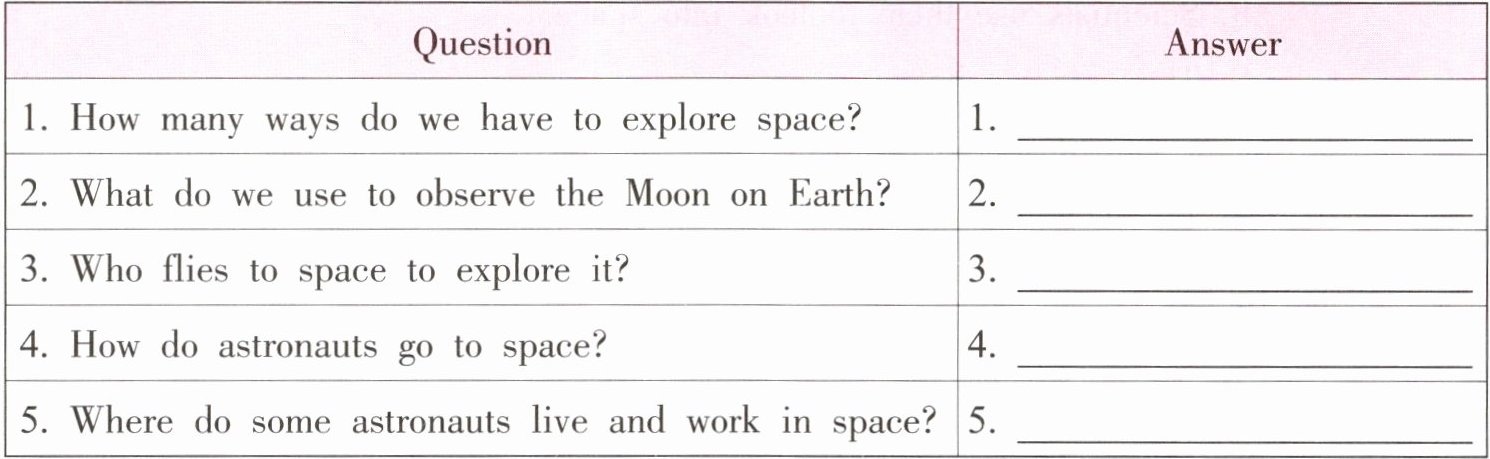
Question
1. How many ways do we have to explore space?
2. What do we use to observe the Moon on Earth?
3. Who flies to space to explore it?
4. How do astronauts go to space?
5. Where do some astronauts live and work in space?
Answer
1.
2.
3.
4.
5.
How do we explore space?
We all love space. We want to know more about the Moon and the stars. How do we explore space? We have two good ways.
First, we can use telescopes on Earth. Telescopes are great tools. They help us observe(观察) the Moon and the stars far away. We don't need to go to space. We can do it at home or at school. Second, some people go to space. They are astronauts. They fly to space by spaceship. It is a special "car" for space.
In space, there is a space station. It is like a big house. Some astronauts live and work there for months. They do many jobs to learn about space.
Question
1. How many ways do we have to explore space?
2. What do we use to observe the Moon on Earth?
3. Who flies to space to explore it?
4. How do astronauts go to space?
5. Where do some astronauts live and work in space?
Answer
1.
We have two good ways to explore space.
2.
We use telescopes to observe the Moon on Earth.
3.
Astronauts fly to space to explore it.
4.
Astronauts go to space by spaceship.
5.
Some astronauts live and work on a space station.
答案
1. We have two good ways to explore space.
2. We use telescopes to observe the Moon on Earth.
3. Astronauts fly to space to explore it.
4. Astronauts go to space by spaceship.
5. Some astronauts live and work on a space station.
2. We use telescopes to observe the Moon on Earth.
3. Astronauts fly to space to explore it.
4. Astronauts go to space by spaceship.
5. Some astronauts live and work on a space station.
解析
【分析】
要解答这些问题,需仔细阅读关于太空探索的短文,定位每个问题对应的关键信息:
1. 问题1询问探索太空的方法数量,对应短文第一段末尾内容;
2. 问题2询问在地球上观察月球的工具,对应短文第二段开头内容;
3. 问题3询问飞往太空探索的主体,对应短文第二段中提到的人物;
4. 问题4询问宇航员去太空的方式,对应短文第二段中关于交通方式的描述;
5. 问题5询问宇航员在太空生活工作的地点,对应短文第三段中提到的场所。
【解析】
1. 从短文第一段最后一句“We have two good ways.”整理得:We have two good ways to explore space.
2. 从短文第二段第一句“we can use telescopes on Earth.”整理得:We use telescopes to observe the Moon on Earth.
3. 从短文第二段“some people go to space. They are astronauts.”整理得:Astronauts fly to space to explore it.
4. 从短文第二段“They fly to space by spaceship.”整理得:Astronauts go to space by spaceship.
5. 从短文第三段“there is a space station... Some astronauts live and work there...”整理得:Some astronauts live and work on a space station.
【答案】
1. We have two good ways to explore space.
2. We use telescopes to observe the Moon on Earth.
3. Astronauts fly to space to explore it.
4. Astronauts go to space by spaceship.
5. Some astronauts live and work on a space station.
【知识点】
阅读理解,太空探索
【点评】
本题考查短文细节信息的提取能力,要求学生认真阅读文本,精准定位每个问题对应的关键语句,准确整理出符合要求的答案。
【难度系数】
0.2
要解答这些问题,需仔细阅读关于太空探索的短文,定位每个问题对应的关键信息:
1. 问题1询问探索太空的方法数量,对应短文第一段末尾内容;
2. 问题2询问在地球上观察月球的工具,对应短文第二段开头内容;
3. 问题3询问飞往太空探索的主体,对应短文第二段中提到的人物;
4. 问题4询问宇航员去太空的方式,对应短文第二段中关于交通方式的描述;
5. 问题5询问宇航员在太空生活工作的地点,对应短文第三段中提到的场所。
【解析】
1. 从短文第一段最后一句“We have two good ways.”整理得:We have two good ways to explore space.
2. 从短文第二段第一句“we can use telescopes on Earth.”整理得:We use telescopes to observe the Moon on Earth.
3. 从短文第二段“some people go to space. They are astronauts.”整理得:Astronauts fly to space to explore it.
4. 从短文第二段“They fly to space by spaceship.”整理得:Astronauts go to space by spaceship.
5. 从短文第三段“there is a space station... Some astronauts live and work there...”整理得:Some astronauts live and work on a space station.
【答案】
1. We have two good ways to explore space.
2. We use telescopes to observe the Moon on Earth.
3. Astronauts fly to space to explore it.
4. Astronauts go to space by spaceship.
5. Some astronauts live and work on a space station.
【知识点】
阅读理解,太空探索
【点评】
本题考查短文细节信息的提取能力,要求学生认真阅读文本,精准定位每个问题对应的关键语句,准确整理出符合要求的答案。
【难度系数】
0.2
六、Think and say. 学校正在招募“太空科普小讲解员”。请你想一想,用英语向同学们讲解你了解到的太空知识吧。

答案
参考示例:
Hi, everyone! I'm Yaoyao. Today I'll tell you how we explore space.
First, we use big telescopes to watch the stars and planets far away in space. Then we send spaceships into space. Some spaceships take astronauts to visit the moon. We also send smart robots to Mars to take photos and learn about this red planet. Space is so wonderful, and we will find more interesting things about it later.
Hi, everyone! I'm Yaoyao. Today I'll tell you how we explore space.
First, we use big telescopes to watch the stars and planets far away in space. Then we send spaceships into space. Some spaceships take astronauts to visit the moon. We also send smart robots to Mars to take photos and learn about this red planet. Space is so wonderful, and we will find more interesting things about it later.
解析
【分析】
本题是英语口语表达类题目,要求围绕“太空探索”主题用英语做小讲解。解题思路为:先进行自我介绍和主题引入,再分点说明太空探索的具体方式(如使用望远镜观测、发射宇宙飞船、派遣机器人探测等),最后总结太空的奇妙之处,确保语句通顺、符合英语表达习惯,结合所学词汇组织内容即可。
【解析】
按照口语讲解的逻辑,先打招呼并引出主题,再分步骤阐述太空探索的方法:首先用大望远镜观测太空中遥远的星星和行星,接着发射宇宙飞船,部分飞船搭载宇航员探访月球,还可派遣智能机器人前往火星拍照、了解火星,最后总结太空的奇妙,展望未来的探索发现。
【答案】
Hi, everyone! I'm Yaoyao. Today I'll tell you how we explore space. First, we use big telescopes to watch the stars and planets far away in space. Then we send spaceships into space. Some spaceships take astronauts to visit the moon. We also send smart robots to Mars to take photos and learn about this red planet. Space is so wonderful, and we will find more interesting things about it later.
【知识点】
英语口语表达、太空相关英语词汇、英语小短文写作
【点评】
本题结合学校招募讲解员的情境,考查学生用英语进行日常口语表达的能力,内容贴近生活,需要学生结合所学太空知识组织语言,难度适中,能有效锻炼学生的英语运用能力。
【难度系数】
0.5
本题是英语口语表达类题目,要求围绕“太空探索”主题用英语做小讲解。解题思路为:先进行自我介绍和主题引入,再分点说明太空探索的具体方式(如使用望远镜观测、发射宇宙飞船、派遣机器人探测等),最后总结太空的奇妙之处,确保语句通顺、符合英语表达习惯,结合所学词汇组织内容即可。
【解析】
按照口语讲解的逻辑,先打招呼并引出主题,再分步骤阐述太空探索的方法:首先用大望远镜观测太空中遥远的星星和行星,接着发射宇宙飞船,部分飞船搭载宇航员探访月球,还可派遣智能机器人前往火星拍照、了解火星,最后总结太空的奇妙,展望未来的探索发现。
【答案】
Hi, everyone! I'm Yaoyao. Today I'll tell you how we explore space. First, we use big telescopes to watch the stars and planets far away in space. Then we send spaceships into space. Some spaceships take astronauts to visit the moon. We also send smart robots to Mars to take photos and learn about this red planet. Space is so wonderful, and we will find more interesting things about it later.
【知识点】
英语口语表达、太空相关英语词汇、英语小短文写作
【点评】
本题结合学校招募讲解员的情境,考查学生用英语进行日常口语表达的能力,内容贴近生活,需要学生结合所学太空知识组织语言,难度适中,能有效锻炼学生的英语运用能力。
【难度系数】
0.5
