

 登录
登录
2. Yaming went to Mount Huangshan with his family... Yaming saw the Guest-Greeting Pine, the Sea of Clouds lots of strange rocks, and many ancient build-mgs. 亚明和他的家人去了黄山。亚明看到了迎客松、云海、许多奇形怪状的岩石,以及许多古建筑。
【感知】(1)Peter went to Yunnan with his family. They visited Yulong Mountain and took a lot of photos there. 皮特和他的家人去了云南。他们在那儿游览了玉龙雪山并拍了许多照片。
(2)I went to Beijing and saw the Great Wall last summer vacation. 去年暑假,我去了北京,参观了长城。
【思考】观察上面的句子,它们用了
【运用】根据汉语提示完成句子。
(1)上个月,我和家人去了北京度假。我们参观了长城,品尝了一些好吃的东西。
I
(2)去年暑假,我和爸爸妈妈一起去了新疆。我们骑了马,看到了许多美景。
I went to Xinjiang
(3)今年暑假,我没去什么特别的地方,只是待在家里读书、放松。
This summer vacation, I didn't go
【感知】(1)Peter went to Yunnan with his family. They visited Yulong Mountain and took a lot of photos there. 皮特和他的家人去了云南。他们在那儿游览了玉龙雪山并拍了许多照片。
(2)I went to Beijing and saw the Great Wall last summer vacation. 去年暑假,我去了北京,参观了长城。
【思考】观察上面的句子,它们用了
一般过去
时态,描写了过去的假期经历,其中包括人物
、地点
、活动
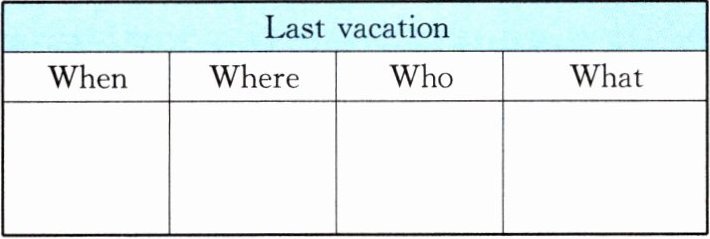
。请与同学交流以往的假期生活,填写下面的表格。【运用】根据汉语提示完成句子。
(1)上个月,我和家人去了北京度假。我们参观了长城,品尝了一些好吃的东西。
I
went
to
Beijing on vacation with my family last month. We visited
the Great Wall and tasted
something delicious.(2)去年暑假,我和爸爸妈妈一起去了新疆。我们骑了马,看到了许多美景。
I went to Xinjiang
with
my parents last summer vacation. We rode
horses and saw
some beautiful landscape.(3)今年暑假,我没去什么特别的地方,只是待在家里读书、放松。
This summer vacation, I didn't go
anywhere
special
. I just stayed
at home to
read
and relax
.答案
【思考】
观察上面的句子,它们用了一般过去时态,描写了过去的假期经历,其中包括人物、地点、活动。
【运用】
(1) went to; visited; tasted
(2) with; rode; saw
(3) anywhere special; stayed; to read; relax
观察上面的句子,它们用了一般过去时态,描写了过去的假期经历,其中包括人物、地点、活动。
【运用】
(1) went to; visited; tasted
(2) with; rode; saw
(3) anywhere special; stayed; to read; relax
解析
【分析】首先观察题目中的例句,如“Peter went to Yunnan...”“I went to Beijing...”,动词均使用过去式,可判断时态为一般过去时;这些句子描写过去假期经历,包含人物、地点、活动三个核心要素。解题时需结合汉语提示,运用一般过去时的动词形式,注意介词搭配、不定代词用法等,完成句子填空。
【解析】
【思考】
例句中的动词(went、visited、took、saw等)为动词过去式,因此用了一般过去时态;描写过去假期经历的内容包含人物、地点、活动。
【运用】
(1) “去了北京”对应短语go to,过去式为went to;“参观”是visit,过去式为visited;“品尝”是taste,过去式为tasted。
(2) “和……一起”用介词with;“骑马”是ride horses,过去式为rode;“看到”是see,过去式为saw。
(3) 否定句中“什么特别的地方”用anywhere special;“待在家里”是stay at home,过去式为stayed;“读书、放松”表目的,用不定式to read和relax。
【答案】
【思考】一般过去;人物;地点;活动
【运用】(1) went to;visited;tasted (2) with;rode;saw (3) anywhere special;stayed;to read;relax
【知识点】
一般过去时;介词用法;不定代词用法
【点评】
本题围绕假期话题,考查一般过去时的运用,结合实际场景,需掌握动词过去式变化、介词搭配及不定代词用法,属于基础语法题,易理解和掌握。
【难度系数】
0.5
【解析】
【思考】
例句中的动词(went、visited、took、saw等)为动词过去式,因此用了一般过去时态;描写过去假期经历的内容包含人物、地点、活动。
【运用】
(1) “去了北京”对应短语go to,过去式为went to;“参观”是visit,过去式为visited;“品尝”是taste,过去式为tasted。
(2) “和……一起”用介词with;“骑马”是ride horses,过去式为rode;“看到”是see,过去式为saw。
(3) 否定句中“什么特别的地方”用anywhere special;“待在家里”是stay at home,过去式为stayed;“读书、放松”表目的,用不定式to read和relax。
【答案】
【思考】一般过去;人物;地点;活动
【运用】(1) went to;visited;tasted (2) with;rode;saw (3) anywhere special;stayed;to read;relax
【知识点】
一般过去时;介词用法;不定代词用法
【点评】
本题围绕假期话题,考查一般过去时的运用,结合实际场景,需掌握动词过去式变化、介词搭配及不定代词用法,属于基础语法题,易理解和掌握。
【难度系数】
0.5
3. —How was your holiday? 你的假期过得怎么样?
—It was fantastic. 非常棒。
【感知】(1)—How was the food there? 那里的食物怎么样?
—The food was great. / Everything tasted good. 食物很棒。/ 每样东西都尝起来很好。
(2)He still had a relaxing and fun holiday. 他仍然度过了一个轻松愉快的假期。
(3)It just took my breath away. 这简直让我惊叹不已。
【思考】观察上面的句式,询问对某事、某物的感受时,用
—It was fantastic. 非常棒。
【感知】(1)—How was the food there? 那里的食物怎么样?
—The food was great. / Everything tasted good. 食物很棒。/ 每样东西都尝起来很好。
(2)He still had a relaxing and fun holiday. 他仍然度过了一个轻松愉快的假期。
(3)It just took my breath away. 这简直让我惊叹不已。
【思考】观察上面的句式,询问对某事、某物的感受时,用
How was/were
来提问。表达对假期的感受时,可以用恰当的形容
词。常见的褒义形容词有fantastic, great, wonderful, amazing
;贬义形容词有terrible, bad, boring
;中性形容词有OK, not too bad
。也可以从个人感受出发,如:“I was so bored that I decided to find something to read.”或“It made me relaxed.”等。答案
【思考】
观察上面的句式,询问对某事、某物的感受时,用How was/were来提问。表达对假期的感受时,可以用恰当的形容词。常见的褒义形容词有fantastic, great, wonderful, amazing;贬义形容词有terrible, bad, boring;中性形容词有OK, not too bad。
观察上面的句式,询问对某事、某物的感受时,用How was/were来提问。表达对假期的感受时,可以用恰当的形容词。常见的褒义形容词有fantastic, great, wonderful, amazing;贬义形容词有terrible, bad, boring;中性形容词有OK, not too bad。
解析
【分析】
首先观察题目给出的示例对话,询问对某事、某物的感受时,均使用“How was/were + 主语”的结构,因此第一个空需填该结构;表达感受时需用形容词来修饰,故第二个空填“形容词”;再结合日常积累的描述感受的形容词,按褒义、贬义、中性分类填写对应词汇即可。
【解析】
根据题目中的感知句式,询问对事物的感受用“How was/were”引导的特殊疑问句,因此第一空填“How was/were”;表达感受需用形容词,故第二空填“形容词”;常见褒义形容词如fantastic、great、wonderful、amazing,贬义如terrible、bad、boring,中性如OK、not too bad,这些都是描述感受的常用词汇。
【答案】
How was/were;形容词;fantastic, great, wonderful, amazing;terrible, bad, boring;OK, not too bad
【知识点】
形容词的用法;特殊疑问句
【点评】
本题通过示例引导学生掌握询问感受的句型及相关形容词的分类,属于基础知识点考察,难度适中。
【难度系数】
0.5
首先观察题目给出的示例对话,询问对某事、某物的感受时,均使用“How was/were + 主语”的结构,因此第一个空需填该结构;表达感受时需用形容词来修饰,故第二个空填“形容词”;再结合日常积累的描述感受的形容词,按褒义、贬义、中性分类填写对应词汇即可。
【解析】
根据题目中的感知句式,询问对事物的感受用“How was/were”引导的特殊疑问句,因此第一空填“How was/were”;表达感受需用形容词,故第二空填“形容词”;常见褒义形容词如fantastic、great、wonderful、amazing,贬义如terrible、bad、boring,中性如OK、not too bad,这些都是描述感受的常用词汇。
【答案】
How was/were;形容词;fantastic, great, wonderful, amazing;terrible, bad, boring;OK, not too bad
【知识点】
形容词的用法;特殊疑问句
【点评】
本题通过示例引导学生掌握询问感受的句型及相关形容词的分类,属于基础知识点考察,难度适中。
【难度系数】
0.5
