

 登录
登录
(
— Wow! He runs really fast.
A.more than
B.less than
C.at least
D.better than
B
) 6. — Su Bingtian is the first Asian to finish the 100-metre race in less than
10 seconds.— Wow! He runs really fast.
A.more than
B.less than
C.at least
D.better than
答案
6. B
解析
【分析】本题考查英语短语的词义辨析,需结合对话语境判断合适的短语。先明确各选项含义,再根据“跑得真快”的提示,确定苏炳添完成100米跑的时间特征,进而选出正确答案。
【解析】逐一分析选项:A.more than意为“超过”,若用时超过10秒则不符合“跑得快”的描述;B.less than意为“少于、不到”,结合“跑得真快”可知苏炳添用时不到10秒,符合语境;C.at least意为“至少”,与“快”的语境不符;D.better than意为“比……好”,此处描述的是时间,并非比较好坏,不符合句意。因此正确答案为B。
【答案】B
【知识点】短语辨析;常用短语用法
【点评】本题为基础短语辨析题,结合对话语境即可快速判断,难度较低,适合巩固基础知识点。
【难度系数】0.8
【解析】逐一分析选项:A.more than意为“超过”,若用时超过10秒则不符合“跑得快”的描述;B.less than意为“少于、不到”,结合“跑得真快”可知苏炳添用时不到10秒,符合语境;C.at least意为“至少”,与“快”的语境不符;D.better than意为“比……好”,此处描述的是时间,并非比较好坏,不符合句意。因此正确答案为B。
【答案】B
【知识点】短语辨析;常用短语用法
【点评】本题为基础短语辨析题,结合对话语境即可快速判断,难度较低,适合巩固基础知识点。
【难度系数】0.8
四、完成句子
1. 你经常午餐大吃一顿吗?
Do you often
2. 有些孩子在两餐之间吃了太多小吃。等到正餐就没了胃口。
Some kids have
3. 非常好!你得了15分,你不需要改变你的生活方式。
Good! You
4. 别在智能手机或平板电脑上花太多的时间。
Don’t
5. 为了保持健康,不要吃像薯片这样的不健康食品。
To keep fit, never eat
1. 你经常午餐大吃一顿吗?
Do you often
have a big meal for
lunch?2. 有些孩子在两餐之间吃了太多小吃。等到正餐就没了胃口。
Some kids have
too many snacks between meals
. And they lose their appetite for dinner.3. 非常好!你得了15分,你不需要改变你的生活方式。
Good! You
get 15/fifteen points
. You don’t need/have to change/make any changes to your lifestyle
.4. 别在智能手机或平板电脑上花太多的时间。
Don’t
spend too much time on
your smartphone or tablet.5. 为了保持健康,不要吃像薯片这样的不健康食品。
To keep fit, never eat
unhealthy food like chips
.答案
1. have a big meal for 2. too many snacks between meals 3. get 15/fifteen points; need/have to change/make any changes to your lifestyle 4. spend too much time on 5. unhealthy food like chips
解析
【分析】本题为完成句子题,需结合中文句意匹配英语常用固定短语,使句子完整通顺。解题时先理解每个句子的中文含义,再对应查找课本中相关的固定表达,注意短语的正确搭配和形式,确保填入内容符合语法和句意。
【解析】1. 中文“午餐大吃一顿”对应固定短语have a big meal for,故填have a big meal for;2. 中文“两餐之间吃了太多小吃”对应too many snacks between meals,故填too many snacks between meals;3. 中文“得了15分”对应get 15/fifteen points,“不需要改变你的生活方式”对应need/have to change/make any changes to your lifestyle,故依次填get 15/fifteen points;need/have to change/make any changes to your lifestyle;4. 中文“在智能手机或平板电脑上花太多的时间”对应spend too much time on,故填spend too much time on;5. 中文“像薯片这样的不健康食品”对应unhealthy food like chips,故填unhealthy food like chips。
【答案】1. have a big meal for 2. too many snacks between meals 3. get 15/fifteen points; need/have to change/make any changes to your lifestyle 4. spend too much time on 5. unhealthy food like chips
【知识点】固定搭配;动词短语;名词短语
【点评】本题考查日常英语基础短语的运用,属于常规基础题型,侧重考查学生对课本常用表达的掌握,难度较低。
【难度系数】0.7
【解析】1. 中文“午餐大吃一顿”对应固定短语have a big meal for,故填have a big meal for;2. 中文“两餐之间吃了太多小吃”对应too many snacks between meals,故填too many snacks between meals;3. 中文“得了15分”对应get 15/fifteen points,“不需要改变你的生活方式”对应need/have to change/make any changes to your lifestyle,故依次填get 15/fifteen points;need/have to change/make any changes to your lifestyle;4. 中文“在智能手机或平板电脑上花太多的时间”对应spend too much time on,故填spend too much time on;5. 中文“像薯片这样的不健康食品”对应unhealthy food like chips,故填unhealthy food like chips。
【答案】1. have a big meal for 2. too many snacks between meals 3. get 15/fifteen points; need/have to change/make any changes to your lifestyle 4. spend too much time on 5. unhealthy food like chips
【知识点】固定搭配;动词短语;名词短语
【点评】本题考查日常英语基础短语的运用,属于常规基础题型,侧重考查学生对课本常用表达的掌握,难度较低。
【难度系数】0.7
五、阅读理解
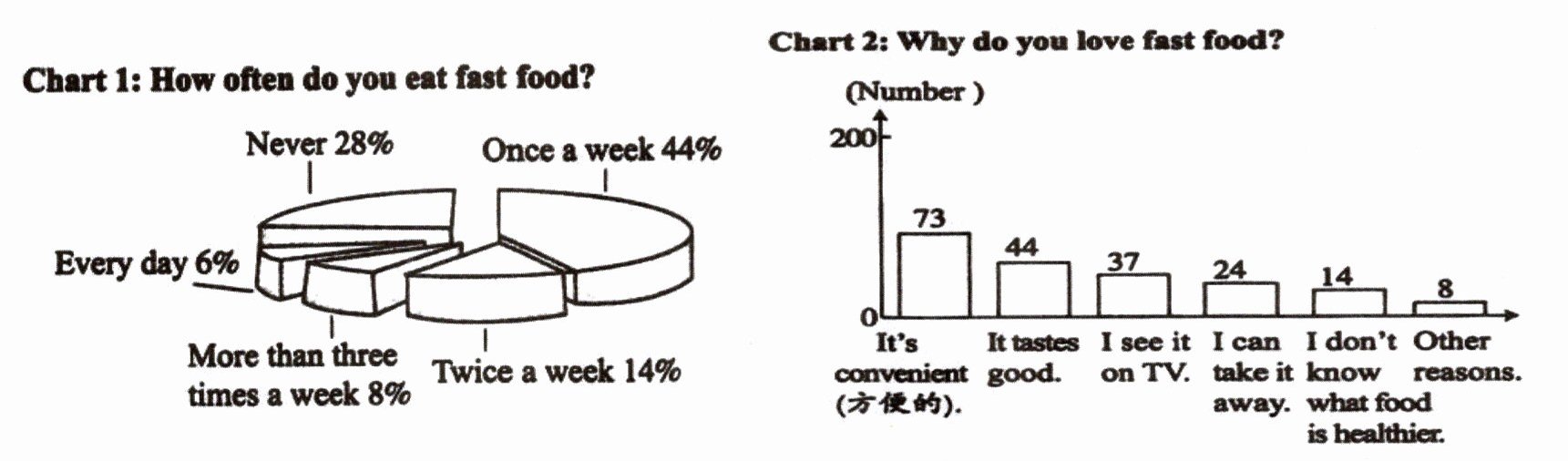
Do you love fast food? Why? How often do you eat it? 200 people joined our survey. And here is the result.
(
A. twice a week
B. three times a week
C. more than three times a week
D. every day
(
A. cheap
B. delicious
C. healthy
D. convenient
(
A. All people love fast food.
B. Fast food makes people fat.
C. People only eat fast food on the weekend.
D. Someone doesn’t know what food is healthier.
Do you love fast food? Why? How often do you eat it? 200 people joined our survey. And here is the result.
(
D
) 1. 6% of the people eat fast food every day
.A. twice a week
B. three times a week
C. more than three times a week
D. every day
(
B
) 2. 44 people love fast food because it is delicious
.A. cheap
B. delicious
C. healthy
D. convenient
(
D
) 3. What can we learn from the result?A. All people love fast food.
B. Fast food makes people fat.
C. People only eat fast food on the weekend.
D. Someone doesn’t know what food is healthier.
答案
1. D 2. B 3. D
解析
【分析】
本题为图表类阅读理解题,需结合两个图表的信息逐一分析题目:首先看Chart1(吃快餐的频率),对应第1题;Chart2(喜欢快餐的原因)对应第2题;第3题需结合两个图表的信息判断选项正误,关键是准确提取图表中的数据和对应内容。
【解析】
1. 第1题:定位Chart1,“Every day”对应的比例是6%,因此6%的人每天吃快餐,对应选项D。
2. 第2题:定位Chart2,“It tastes good.”对应的人数是44,“tastes good”意为“美味的”,即delicious,对应选项B。
3. 第3题:逐一分析选项:A选项“所有人都爱快餐”,Chart1中28%的人Never(从不)吃快餐,错误;B选项“快餐让人发胖”,图表未提及,错误;C选项“只在周末吃快餐”,图表无相关信息,错误;D选项“有人不知道什么食物更健康”,Chart2中存在“I don't know what food is healthier.”的原因,正确。
【答案】
1.D 2.B 3.D
【知识点】
阅读理解,图表信息提取
【点评】
本题考查学生从图表中快速提取关键信息并匹配题目的能力,难度适中,需仔细对应图表数据与选项内容。
【难度系数】
0.5
本题为图表类阅读理解题,需结合两个图表的信息逐一分析题目:首先看Chart1(吃快餐的频率),对应第1题;Chart2(喜欢快餐的原因)对应第2题;第3题需结合两个图表的信息判断选项正误,关键是准确提取图表中的数据和对应内容。
【解析】
1. 第1题:定位Chart1,“Every day”对应的比例是6%,因此6%的人每天吃快餐,对应选项D。
2. 第2题:定位Chart2,“It tastes good.”对应的人数是44,“tastes good”意为“美味的”,即delicious,对应选项B。
3. 第3题:逐一分析选项:A选项“所有人都爱快餐”,Chart1中28%的人Never(从不)吃快餐,错误;B选项“快餐让人发胖”,图表未提及,错误;C选项“只在周末吃快餐”,图表无相关信息,错误;D选项“有人不知道什么食物更健康”,Chart2中存在“I don't know what food is healthier.”的原因,正确。
【答案】
1.D 2.B 3.D
【知识点】
阅读理解,图表信息提取
【点评】
本题考查学生从图表中快速提取关键信息并匹配题目的能力,难度适中,需仔细对应图表数据与选项内容。
【难度系数】
0.5
