

 登录
登录
J Read and complete(根据表格完成短文)
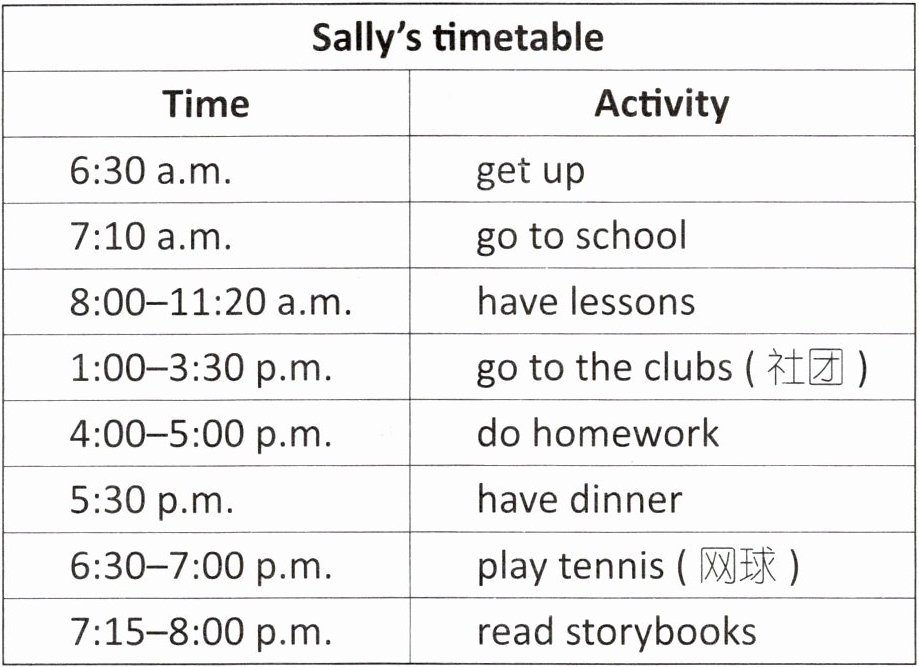
Sally is a primary (小学的)
Sally is a primary (小学的)
student
. She gets up and goes to school early
. She has four lessons
in the morning. She goes to the clubs in the afternoon
. She does her homework
from four to five. She has
dinner
at five thirty. After
dinner, she plays
tennis with her father. Now it is seven fifty in the evening. Sally is reading
stories. She likes reading very much.答案
student, early, lessons, afternoon, homework, has, dinner, After, plays, reading
解析
【分析】
首先,我们需要先通读短文,明确每个空缺处需要填写的内容类型,再对照Sally的时间表,逐一匹配对应信息:
1. 第一个空:根据表格里Sally上学、上课的活动,判断她的身份是小学生,应填表示身份的词汇;
2. 第二个空:结合起床和上学的时间,能看出时间很早,需填描述时间状态的副词;
3. 第三个空:上午的活动是上课,four后要填课程的复数形式;
4. 第四个空:社团活动的时间在下午,需填表示时段的名词;
5. 第五个空:4:00-5:00的活动是做作业,直接对应相关名词;
6-7. 第五个空后,5:30的活动是吃晚餐,主语是She,要用动词的第三人称单数形式;
8. 结合语境,打网球是在晚餐之后,需填表示时间先后的介词;
9. play tennis的主语是She,要用动词第三人称单数形式;
10. 最后,7:50属于读故事书的时段,句子是现在进行时,需填动词的现在分词形式。
【解析】
1. 根据表格中Sally的上学、上课等日常活动,可知她是小学学生,故填student;
2. Sally早上6:30起床,7:10上学,时间很早,故填early;
3. 表格显示上午8:00-11:20是上课时间,four后接课程的复数形式lessons;
4. 社团活动的时间是下午1:00-3:30,故填afternoon;
5. 表格中4:00-5:00的活动是do homework,故填homework;
6-7. 5:30的活动是have dinner,主语She是第三人称单数,动词用has,故填has dinner;
8. 结合语境,打网球是在晚餐之后,故填After;
9. play tennis的主语是She,第三人称单数形式为plays;
10. 现在是晚上7:50,属于读故事书的时段,句子为现在进行时,故填reading。
【答案】
student, early, lessons, afternoon, homework, has, dinner, After, plays, reading
【知识点】
1. 词汇运用;2. 时态运用;3. 信息提取
【点评】
本题考查学生对表格信息的提取能力,以及对词汇、时态的综合运用,需要学生结合短文语境,精准匹配表格中的活动信息,既锻炼了信息整合能力,也巩固了基础的英语语言知识。
【难度系数】
0.8
首先,我们需要先通读短文,明确每个空缺处需要填写的内容类型,再对照Sally的时间表,逐一匹配对应信息:
1. 第一个空:根据表格里Sally上学、上课的活动,判断她的身份是小学生,应填表示身份的词汇;
2. 第二个空:结合起床和上学的时间,能看出时间很早,需填描述时间状态的副词;
3. 第三个空:上午的活动是上课,four后要填课程的复数形式;
4. 第四个空:社团活动的时间在下午,需填表示时段的名词;
5. 第五个空:4:00-5:00的活动是做作业,直接对应相关名词;
6-7. 第五个空后,5:30的活动是吃晚餐,主语是She,要用动词的第三人称单数形式;
8. 结合语境,打网球是在晚餐之后,需填表示时间先后的介词;
9. play tennis的主语是She,要用动词第三人称单数形式;
10. 最后,7:50属于读故事书的时段,句子是现在进行时,需填动词的现在分词形式。
【解析】
1. 根据表格中Sally的上学、上课等日常活动,可知她是小学学生,故填student;
2. Sally早上6:30起床,7:10上学,时间很早,故填early;
3. 表格显示上午8:00-11:20是上课时间,four后接课程的复数形式lessons;
4. 社团活动的时间是下午1:00-3:30,故填afternoon;
5. 表格中4:00-5:00的活动是do homework,故填homework;
6-7. 5:30的活动是have dinner,主语She是第三人称单数,动词用has,故填has dinner;
8. 结合语境,打网球是在晚餐之后,故填After;
9. play tennis的主语是She,第三人称单数形式为plays;
10. 现在是晚上7:50,属于读故事书的时段,句子为现在进行时,故填reading。
【答案】
student, early, lessons, afternoon, homework, has, dinner, After, plays, reading
【知识点】
1. 词汇运用;2. 时态运用;3. 信息提取
【点评】
本题考查学生对表格信息的提取能力,以及对词汇、时态的综合运用,需要学生结合短文语境,精准匹配表格中的活动信息,既锻炼了信息整合能力,也巩固了基础的英语语言知识。
【难度系数】
0.8
K Read and judge(阅读短文,判断句子正误,用T或F表示)
Table manners in China
In China, people love sitting together to eat and share yummy food. Here are some key points of table manners.
• Wait for the elders to sit down and eat first.
• Use chopsticks politely. Don’t stick them upright in your bowl. And don’t point them at other people.
• Use the serving chopsticks or spoons to get food from the shared dishes. This is clean and healthy.
• Try to eat all the food in your bowl. It tells the host, “This meal is yummy!”
(
(
(
(
(
Table manners in China
In China, people love sitting together to eat and share yummy food. Here are some key points of table manners.
• Wait for the elders to sit down and eat first.
• Use chopsticks politely. Don’t stick them upright in your bowl. And don’t point them at other people.
• Use the serving chopsticks or spoons to get food from the shared dishes. This is clean and healthy.
• Try to eat all the food in your bowl. It tells the host, “This meal is yummy!”
(
T
) 1 Table manners in China show respect for the elders.(
F
) 2 Sticking chopsticks in the rice bowl is polite.(
T
) 3 “Serving chopsticks” mean “公筷” in Chinese.(
F
) 4 It’s not polite to eat all the food in your bowl.(
T
) 5 These table manners are really about being kind to others.答案
1 T 2 F 3 T 4 F 5 T
解析
【分析】
首先需要通读短文,明确中国餐桌礼仪的几个核心要点,然后将每个题目句子与短文内容逐一比对,判断表述是否符合原文信息:
1. 思考第一题时,找到短文中关于长辈的礼仪规则,判断该规则是否体现对长辈的尊重;
2. 第二题需定位到筷子使用的禁忌,看题目表述是否与原文相反;
3. 第三题结合短文里serving chopsticks的使用场景,判断其对应的中文释义是否正确;
4. 第四题找到关于碗中食物的礼仪要求,对比题目表述是否错误;
5. 第五题综合全文礼仪的出发点,判断是否是为了善待他人。
【解析】
1. 根据短文第一条礼仪规则“Wait for the elders to sit down and eat first.”,这条规则体现了对长辈的尊重,所以句子“Table manners in China show respect for the elders.”表述正确,填T。
2. 短文第二条明确提到“Don’t stick them upright in your bowl.”,说明将筷子直立插在碗里是不礼貌的行为,因此句子“Sticking chopsticks in the rice bowl is polite.”表述错误,填F。
3. 短文第三条“Use the serving chopsticks or spoons to get food from the shared dishes.”中,serving chopsticks是用于从共享菜品中取餐的筷子,对应中文的“公筷”,所以句子表述正确,填T。
4. 短文第四条指出“Try to eat all the food in your bowl. It tells the host, ‘This meal is yummy!’”,说明吃完碗里的食物是对主人饭菜的认可,是礼貌的行为,因此句子“It’s not polite to eat all the food in your bowl.”表述错误,填F。
5. 综合全文的礼仪要点:尊重长辈、使用公筷保证卫生、吃完食物认可主人,这些礼仪的本质都是为了善待他人,所以句子“These table manners are really about being kind to others.”表述正确,填T。
【答案】
1 T 2 F 3 T 4 F 5 T
【知识点】
中国餐桌礼仪、阅读理解判断正误
【点评】
本题考查学生对英语短文细节信息的提取与比对能力,同时融入了中国餐桌礼仪的文化知识,既锻炼了阅读能力,也帮助学生了解本土文化礼仪,增强文化认知。
【难度系数】
0.8
首先需要通读短文,明确中国餐桌礼仪的几个核心要点,然后将每个题目句子与短文内容逐一比对,判断表述是否符合原文信息:
1. 思考第一题时,找到短文中关于长辈的礼仪规则,判断该规则是否体现对长辈的尊重;
2. 第二题需定位到筷子使用的禁忌,看题目表述是否与原文相反;
3. 第三题结合短文里serving chopsticks的使用场景,判断其对应的中文释义是否正确;
4. 第四题找到关于碗中食物的礼仪要求,对比题目表述是否错误;
5. 第五题综合全文礼仪的出发点,判断是否是为了善待他人。
【解析】
1. 根据短文第一条礼仪规则“Wait for the elders to sit down and eat first.”,这条规则体现了对长辈的尊重,所以句子“Table manners in China show respect for the elders.”表述正确,填T。
2. 短文第二条明确提到“Don’t stick them upright in your bowl.”,说明将筷子直立插在碗里是不礼貌的行为,因此句子“Sticking chopsticks in the rice bowl is polite.”表述错误,填F。
3. 短文第三条“Use the serving chopsticks or spoons to get food from the shared dishes.”中,serving chopsticks是用于从共享菜品中取餐的筷子,对应中文的“公筷”,所以句子表述正确,填T。
4. 短文第四条指出“Try to eat all the food in your bowl. It tells the host, ‘This meal is yummy!’”,说明吃完碗里的食物是对主人饭菜的认可,是礼貌的行为,因此句子“It’s not polite to eat all the food in your bowl.”表述错误,填F。
5. 综合全文的礼仪要点:尊重长辈、使用公筷保证卫生、吃完食物认可主人,这些礼仪的本质都是为了善待他人,所以句子“These table manners are really about being kind to others.”表述正确,填T。
【答案】
1 T 2 F 3 T 4 F 5 T
【知识点】
中国餐桌礼仪、阅读理解判断正误
【点评】
本题考查学生对英语短文细节信息的提取与比对能力,同时融入了中国餐桌礼仪的文化知识,既锻炼了阅读能力,也帮助学生了解本土文化礼仪,增强文化认知。
【难度系数】
0.8
