

 登录
登录
五、根据汉语意思完成句子,每空一词
1. 我对这首歌曲一点也不感兴趣。
I am
2. 数学是一门相当有趣的学科,你会爱上它的。
Maths is
3. 我奶奶把她花园里的植物照顾得很好。
My grandma
4. 我的书在地上。你能帮我捡起来吗?
My book is on the floor. Can you help me
5. 在中国,面条是长寿的象征。
Noodles are
1. 我对这首歌曲一点也不感兴趣。
I am
not
interested in the song at
all
.2. 数学是一门相当有趣的学科,你会爱上它的。
Maths is
quite
an
interesting
subject. You'll love it.3. 我奶奶把她花园里的植物照顾得很好。
My grandma
takes
good
care
of
her plants in the garden.4. 我的书在地上。你能帮我捡起来吗?
My book is on the floor. Can you help me
pick
it up
?5. 在中国,面条是长寿的象征。
Noodles are
a
symbol
of
long life in China.答案
1. not; at all
2. quite an interesting
3. takes good care of
4. pick; up
5. a symbol of
2. quite an interesting
3. takes good care of
4. pick; up
5. a symbol of
解析
【分析】
本题为根据汉语意思完成句子的基础题型,需结合英语固定短语、词性规则及句子结构填空。1. “一点也不”对应固定搭配not...at all;2. “相当有趣的”中,quite修饰形容词interesting,因subject是可数名词单数且interesting以元音音素开头,需加不定冠词an;3. “照顾得很好”是固定短语take good care of,主语grandma为第三人称单数,谓语动词用单三形式;4. “捡起来”是动词短语pick up,代词作宾语需放短语中间;5. “……的象征”是固定搭配a symbol of,后接名词短语。
【解析】
1. 表达“一点也不”的固定结构为not...at all,故填not;at all。
2. “相当”用quite,“有趣的”是interesting,subject为可数名词单数,interesting以元音音素开头,需加不定冠词an,故填quite an interesting。
3. “照顾得很好”是固定短语take good care of,主语my grandma是第三人称单数,一般现在时谓语动词用单三形式takes,故填takes good care of。
4. “捡起来”是动词短语pick up,代词it作宾语需放短语中间,help sb do sth结构中用动词原形,故填pick;up。
5. 表达“……的象征”的固定搭配为a symbol of,后接名词短语long life,故填a symbol of。
【答案】
1. not; at all
2. quite an interesting
3. takes good care of
4. pick; up
5. a symbol of
【知识点】
固定短语、形容词用法、动词短语
【点评】
本题考查英语基础固定搭配与句式运用,属于初中英语基础题型,侧重考查学生对常用短语的掌握,难度较低,适合巩固基础。
【难度系数】
0.3
本题为根据汉语意思完成句子的基础题型,需结合英语固定短语、词性规则及句子结构填空。1. “一点也不”对应固定搭配not...at all;2. “相当有趣的”中,quite修饰形容词interesting,因subject是可数名词单数且interesting以元音音素开头,需加不定冠词an;3. “照顾得很好”是固定短语take good care of,主语grandma为第三人称单数,谓语动词用单三形式;4. “捡起来”是动词短语pick up,代词作宾语需放短语中间;5. “……的象征”是固定搭配a symbol of,后接名词短语。
【解析】
1. 表达“一点也不”的固定结构为not...at all,故填not;at all。
2. “相当”用quite,“有趣的”是interesting,subject为可数名词单数,interesting以元音音素开头,需加不定冠词an,故填quite an interesting。
3. “照顾得很好”是固定短语take good care of,主语my grandma是第三人称单数,一般现在时谓语动词用单三形式takes,故填takes good care of。
4. “捡起来”是动词短语pick up,代词it作宾语需放短语中间,help sb do sth结构中用动词原形,故填pick;up。
5. 表达“……的象征”的固定搭配为a symbol of,后接名词短语long life,故填a symbol of。
【答案】
1. not; at all
2. quite an interesting
3. takes good care of
4. pick; up
5. a symbol of
【知识点】
固定短语、形容词用法、动词短语
【点评】
本题考查英语基础固定搭配与句式运用,属于初中英语基础题型,侧重考查学生对常用短语的掌握,难度较低,适合巩固基础。
【难度系数】
0.3
六、按要求完成句子,每空一词
1. You shouldn't eat in the classroom,Dave.(改为祈使句)
2. My friend Tony is tall and thin.(对画线部分提问)
3. Can lions run fast?(作肯定回答)
4. The monkey looks clever.(对画线部分提问)
5. I don't like tigers because they are dangerous.(对画线部分提问)
1. You shouldn't eat in the classroom,Dave.(改为祈使句)
Don't
eat
in the classroom,Dave.2. My friend Tony is tall and thin.(对画线部分提问)
What
does
your friend Tony look
like
?3. Can lions run fast?(作肯定回答)
Yes
, they
can
.4. The monkey looks clever.(对画线部分提问)
How
does the monkey look
?5. I don't like tigers because they are dangerous.(对画线部分提问)
Why
don't
you
like tigers?答案
1. Don't eat
2. What does; look like
3. Yes; they can
4. How; look
5. Why don't you
2. What does; look like
3. Yes; they can
4. How; look
5. Why don't you
解析
【分析】
本题为英语句型转换题,共5小题,分别考查否定祈使句转换、对外貌提问的特殊疑问句、情态动词开头的一般疑问句肯定回答、对形容词提问的特殊疑问句、对原因提问的特殊疑问句。解题时需回忆对应语法规则:1. 否定祈使句结构为“Don't + 动词原形”;2. 询问人物外貌用固定句型“What does sb look like”;3. 情态动词can引导的一般疑问句,肯定回答为“Yes, 主语+can”;4. 询问事物状态用“How + 动词原形”;5. 对原因提问用“Why don't you”(针对原句主语为I的情况)。
【解析】
1. 原句为否定陈述句,转换为否定祈使句,需在动词原形前加Don't,原句动词为eat,故填Don't eat;
2. 画线部分为人物外貌(tall and thin),对外貌提问用固定句型“What does sb look like”,主语Tony为第三人称单数,助动词用does,故填What does; look like;
3. 原句是Can引导的一般疑问句,主语lions为复数,肯定回答用Yes,主语用they,后接can,故填Yes; they can;
4. 画线部分为形容词clever(表事物状态),询问“怎么样”用How,后接动词原形look,故填How; look;
5. 画线部分为原因状语(because they are dangerous),对原因提问用Why,原句主语为I,转换后针对提问对象用Why don't you,故填Why don't you。
【答案】
1. Don't eat
2. What does; look like
3. Yes; they can
4. How; look
5. Why don't you
【知识点】
祈使句转换、特殊疑问句、一般疑问句回答
【点评】
本题考查初中英语核心基础句型转换,涵盖祈使句、各类特殊疑问句及一般疑问句回答,是英语学习的基础题型,需学生熟练掌握相关语法规则。
【难度系数】
0.6
本题为英语句型转换题,共5小题,分别考查否定祈使句转换、对外貌提问的特殊疑问句、情态动词开头的一般疑问句肯定回答、对形容词提问的特殊疑问句、对原因提问的特殊疑问句。解题时需回忆对应语法规则:1. 否定祈使句结构为“Don't + 动词原形”;2. 询问人物外貌用固定句型“What does sb look like”;3. 情态动词can引导的一般疑问句,肯定回答为“Yes, 主语+can”;4. 询问事物状态用“How + 动词原形”;5. 对原因提问用“Why don't you”(针对原句主语为I的情况)。
【解析】
1. 原句为否定陈述句,转换为否定祈使句,需在动词原形前加Don't,原句动词为eat,故填Don't eat;
2. 画线部分为人物外貌(tall and thin),对外貌提问用固定句型“What does sb look like”,主语Tony为第三人称单数,助动词用does,故填What does; look like;
3. 原句是Can引导的一般疑问句,主语lions为复数,肯定回答用Yes,主语用they,后接can,故填Yes; they can;
4. 画线部分为形容词clever(表事物状态),询问“怎么样”用How,后接动词原形look,故填How; look;
5. 画线部分为原因状语(because they are dangerous),对原因提问用Why,原句主语为I,转换后针对提问对象用Why don't you,故填Why don't you。
【答案】
1. Don't eat
2. What does; look like
3. Yes; they can
4. How; look
5. Why don't you
【知识点】
祈使句转换、特殊疑问句、一般疑问句回答
【点评】
本题考查初中英语核心基础句型转换,涵盖祈使句、各类特殊疑问句及一般疑问句回答,是英语学习的基础题型,需学生熟练掌握相关语法规则。
【难度系数】
0.6
七、阅读理解
阅读下面的短文,从短文后方框内的选项中选出可以填入空白处的最佳选项。选项中有一项为多余选项。
英语
There is a small lion living with his mother by the river. One day, the mother lion is sleeping and the small lion goes into the forest to play. 1.
The small lion is afraid. He runs everywhere but he still(仍然) doesn't know how to go home. When he doesn't know what to do, a sheep sees him. 2.
The sheep likes the small lion and looks after him very well. And the small lion likes living with the sheep too. 3. But he is afraid of other animals.
Some days later, a big lion comes. When he roars(吼叫), lots of animals are afraid and run away. 4. He is happy to meet the big lion and runs to play with him. Then he knows what he is really like. And other animals in the forest start to be afraid of him.
5. But when we learn more about ourselves, we will know how strong we are.
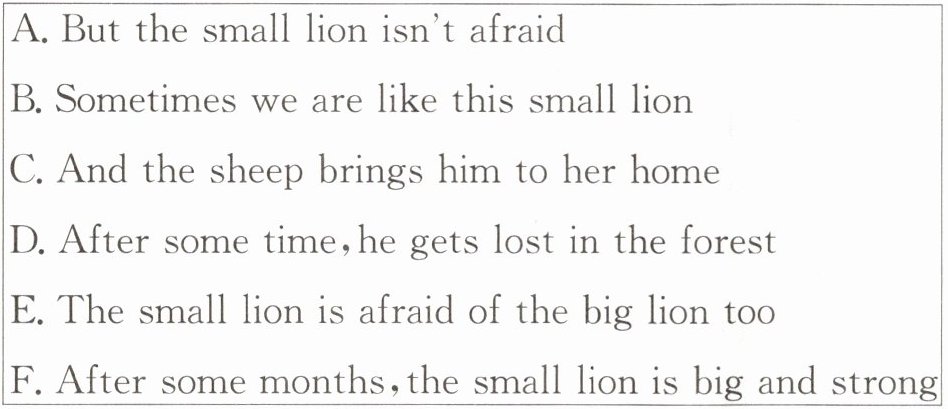
1.
阅读下面的短文,从短文后方框内的选项中选出可以填入空白处的最佳选项。选项中有一项为多余选项。
英语
There is a small lion living with his mother by the river. One day, the mother lion is sleeping and the small lion goes into the forest to play. 1.
The small lion is afraid. He runs everywhere but he still(仍然) doesn't know how to go home. When he doesn't know what to do, a sheep sees him. 2.
The sheep likes the small lion and looks after him very well. And the small lion likes living with the sheep too. 3. But he is afraid of other animals.
Some days later, a big lion comes. When he roars(吼叫), lots of animals are afraid and run away. 4. He is happy to meet the big lion and runs to play with him. Then he knows what he is really like. And other animals in the forest start to be afraid of him.
5. But when we learn more about ourselves, we will know how strong we are.
1.
D
2. C
3. F
4. A
5. B
答案
1-5 DCFAB
解析
【分析】
本题为英语阅读理解句子还原题,需梳理短文故事脉络,结合上下文的逻辑衔接(承接、转折等),匹配合适的选项填入空白处。解题时先通读全文,明确小狮子的经历:外出玩耍→迷路→被羊收留→成长→遇大狮子→感悟,再逐一分析每个空白处前后的内容,对应选项的逻辑关系。
【解析】
1. 前文提到小狮子去森林玩,后文说小狮子害怕、找不到回家的路,因此1空需填表示“迷路”的句子,对应D选项。
2. 前文提到羊看到小狮子,后文说羊照顾小狮子,因此2空需填羊带小狮子回家的句子,对应C选项。
3. 前文说小狮子和羊生活融洽,后文转折说他怕其他动物,因此3空需填小狮子成长变化的句子,对应F选项(几个月后他变得又大又壮)。
4. 前文说大狮子吼叫,其他动物害怕跑开,后文说小狮子开心跑过去玩,因此4空需填小狮子不怕大狮子的句子,对应A选项。
5. 后文将小狮子和“我们”联系,点明感悟,因此5空需填过渡到“我们”的句子,对应B选项。
【答案】
1.D 2.C 3.F 4.A 5.B
【知识点】
阅读理解 句子还原
【点评】
本题考查学生对语篇逻辑的理解能力,需梳理故事发展顺序,结合上下文的转折、承接关系选择合适句子,难度适中。
【难度系数】
0.5
本题为英语阅读理解句子还原题,需梳理短文故事脉络,结合上下文的逻辑衔接(承接、转折等),匹配合适的选项填入空白处。解题时先通读全文,明确小狮子的经历:外出玩耍→迷路→被羊收留→成长→遇大狮子→感悟,再逐一分析每个空白处前后的内容,对应选项的逻辑关系。
【解析】
1. 前文提到小狮子去森林玩,后文说小狮子害怕、找不到回家的路,因此1空需填表示“迷路”的句子,对应D选项。
2. 前文提到羊看到小狮子,后文说羊照顾小狮子,因此2空需填羊带小狮子回家的句子,对应C选项。
3. 前文说小狮子和羊生活融洽,后文转折说他怕其他动物,因此3空需填小狮子成长变化的句子,对应F选项(几个月后他变得又大又壮)。
4. 前文说大狮子吼叫,其他动物害怕跑开,后文说小狮子开心跑过去玩,因此4空需填小狮子不怕大狮子的句子,对应A选项。
5. 后文将小狮子和“我们”联系,点明感悟,因此5空需填过渡到“我们”的句子,对应B选项。
【答案】
1.D 2.C 3.F 4.A 5.B
【知识点】
阅读理解 句子还原
【点评】
本题考查学生对语篇逻辑的理解能力,需梳理故事发展顺序,结合上下文的转折、承接关系选择合适句子,难度适中。
【难度系数】
0.5
