

 登录
登录
B 让我们读一读名人的故事,学习他们是怎样成功的。
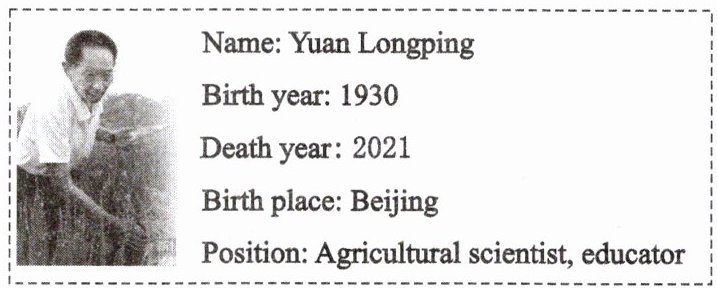
If I am not at home, I must be on the farmland; if I am not on the farmland, I must be on my way to the farmland.
我如果不在家,就一定在试验田;如果不在试验田,就一定在去试验田的路上。
For many Chinese families, rice is an important part of almost every meal. Where does rice come from? Yuan Longping and his team worked to grow rice on the farmland(耕地).
Food was a big problem in China in the past. This is because China has 22% of the world’s population(人口), but only 7% of its farmland. As an agronomy(农学)teacher, Yuan decided to work on a kind of hybrid rice(杂交水稻). It has a high output(产量).
At the time, other scientists didn’t think hybrid rice had much value(价值). But Yuan and his team worked on it every day. They took very good care of their rice seeds(种子).
At last, in 1973, they grew a new type of hybrid rice. This rice is strong. Farmers can grow it on many different kinds of farmland and also in bad weather. It can fight disease, too. Its output is much greater than common(普通的)kinds of rice. With the new type, about 70,000,000 people could have food every year!
Yuan solved(解决)the food problem in China. But he still worked on rice. Before he retired(退休), he hoped to grow rice in the sea!
根据所阅读的内容,回答下面的问题。
1. When was Yuan Longping born?
2. Why was food a big problem in China in the past?
3. When did a new type of hybrid rice come out?
4. What did Yuan hope to do before he retired?
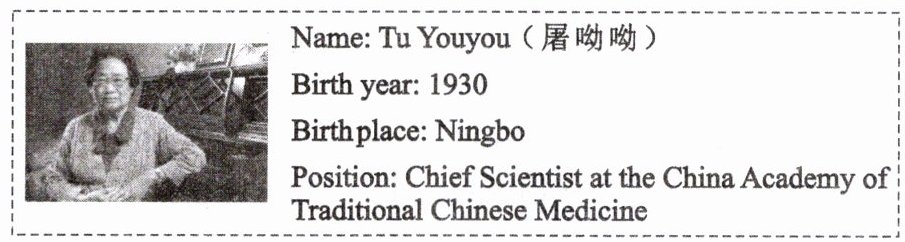
I feel more rewarded when I see so many cured patients.
对我而言,更大的奖励是看到许多人痊愈。
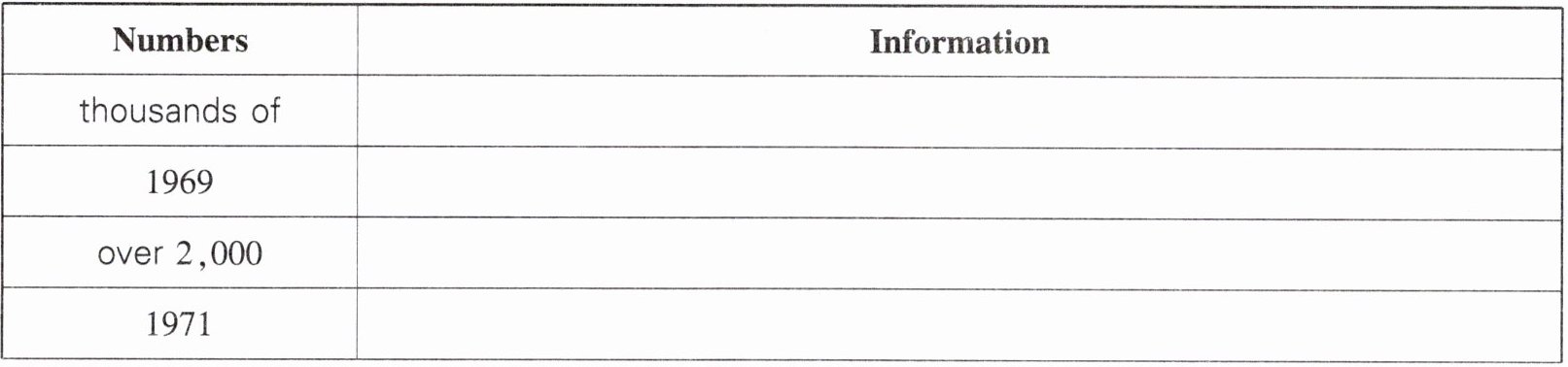
Every year, malaria(疟疾)takes thousands of lives around the world, especially(尤其)in Africa. But a Chinese scientist named Tu Youyou found a way to fight this disease. She uses a common plant in China. It is sweet wormwood(青蒿).
In 1969, many people in China had malaria. Tu, an expert(专家)in Chinese medicine, had to find a way to stop it. But her medical equipment(医疗设备)was not good enough. Sometimes she had to test medicines by trying them herself! Over the years, she tested over 2,000 prescriptions(药方).
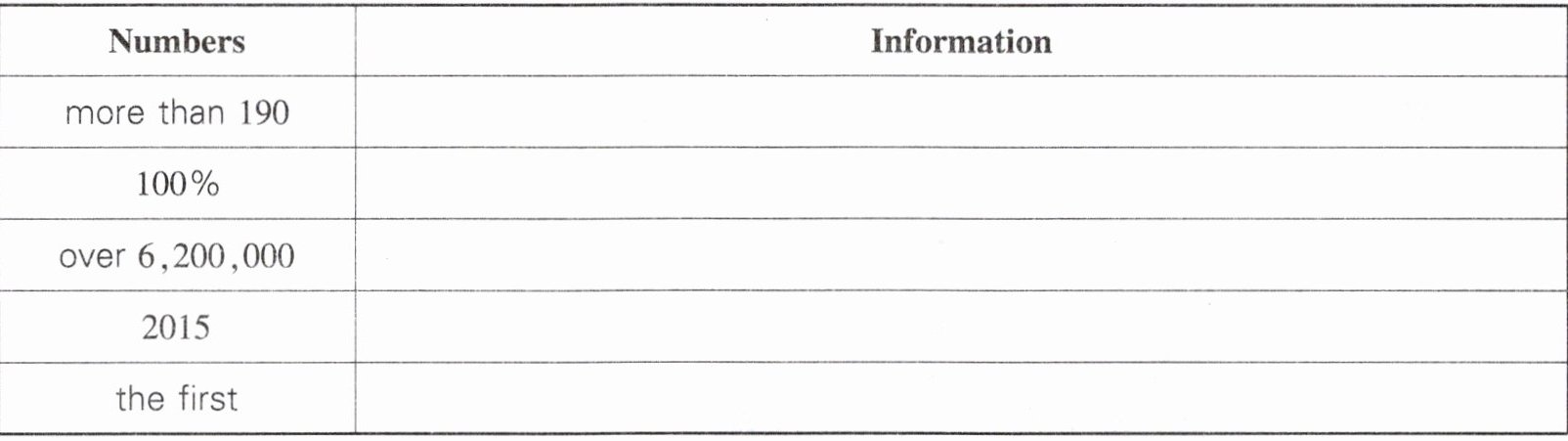
One day, when Tu was reading an old Chinese medicine book, she found a new plant—sweet wormwood. She began to make extracts(提取物)from it. In 1971, after more than 190 failures(失败), Tu finally found an extract that was 100-percent effective(有效的)against malaria!
Soon, people around the world began to use the new drug. The drug is not only effective but also cheap. People in poor countries can be cured(被治愈). From 2000 to 2015, the drug saved over 6,200,000 lives.
In 2015, Tu won the Nobel Prize in Physiology or Medicine(诺贝尔生理学或医学奖). She was the first native(本土的)Chinese scientist to win this prize.
根据所阅读的内容,完成下面的表格。
(续表)
根据所阅读的内容,判断正误(True or False),正确的写“T”,错误的写“F”。
(
(
(
(
(
If I am not at home, I must be on the farmland; if I am not on the farmland, I must be on my way to the farmland.
我如果不在家,就一定在试验田;如果不在试验田,就一定在去试验田的路上。
For many Chinese families, rice is an important part of almost every meal. Where does rice come from? Yuan Longping and his team worked to grow rice on the farmland(耕地).
Food was a big problem in China in the past. This is because China has 22% of the world’s population(人口), but only 7% of its farmland. As an agronomy(农学)teacher, Yuan decided to work on a kind of hybrid rice(杂交水稻). It has a high output(产量).
At the time, other scientists didn’t think hybrid rice had much value(价值). But Yuan and his team worked on it every day. They took very good care of their rice seeds(种子).
At last, in 1973, they grew a new type of hybrid rice. This rice is strong. Farmers can grow it on many different kinds of farmland and also in bad weather. It can fight disease, too. Its output is much greater than common(普通的)kinds of rice. With the new type, about 70,000,000 people could have food every year!
Yuan solved(解决)the food problem in China. But he still worked on rice. Before he retired(退休), he hoped to grow rice in the sea!
根据所阅读的内容,回答下面的问题。
1. When was Yuan Longping born?
He was born in 1930.
2. Why was food a big problem in China in the past?
Because China has 22% of the world's population, but only 7% of its farmland.
3. When did a new type of hybrid rice come out?
In 1973.
4. What did Yuan hope to do before he retired?
He hoped to grow rice in the sea.
I feel more rewarded when I see so many cured patients.
对我而言,更大的奖励是看到许多人痊愈。
Every year, malaria(疟疾)takes thousands of lives around the world, especially(尤其)in Africa. But a Chinese scientist named Tu Youyou found a way to fight this disease. She uses a common plant in China. It is sweet wormwood(青蒿).
In 1969, many people in China had malaria. Tu, an expert(专家)in Chinese medicine, had to find a way to stop it. But her medical equipment(医疗设备)was not good enough. Sometimes she had to test medicines by trying them herself! Over the years, she tested over 2,000 prescriptions(药方).
One day, when Tu was reading an old Chinese medicine book, she found a new plant—sweet wormwood. She began to make extracts(提取物)from it. In 1971, after more than 190 failures(失败), Tu finally found an extract that was 100-percent effective(有效的)against malaria!
Soon, people around the world began to use the new drug. The drug is not only effective but also cheap. People in poor countries can be cured(被治愈). From 2000 to 2015, the drug saved over 6,200,000 lives.
In 2015, Tu won the Nobel Prize in Physiology or Medicine(诺贝尔生理学或医学奖). She was the first native(本土的)Chinese scientist to win this prize.
根据所阅读的内容,完成下面的表格。
(续表)
根据所阅读的内容,判断正误(True or False),正确的写“T”,错误的写“F”。
(
T
)1. Tu Youyou found a way to fight malaria.(
F
)2. Right now many people in China still die of malaria.(
T
)3. Tu Youyou had to test medicines by trying them herself.(
F
)4. In 1969, Tu Youyou finally found an extract that was effective against malaria.(
T
)5. Finally, Tu Youyou won the Nobel Prize in Physiology or Medicine.答案
Yuan Longping:
1. He was born in 1930.
2. Because China has 22% of the world's population, but only 7% of its farmland.
3. In 1973.
4. He hoped to grow rice in the sea.
Tu Youyou:
| Numbers | Information |
| ---- | ---- |
| thousands of | Malaria takes thousands of lives around the world. |
| 1969 | In 1969, many people in China had malaria. |
| over 2,000 | Tu Youyou tested over 2,000 prescriptions. |
| 1971 | In 1971, she found an extract that was 100% effective against malaria. |
| more than 190 | After more than 190 failures, she found an extract. |
| 100% | She found an extract that was 100% effective against malaria. |
| over 6,200,000 | The drug saved over 6,200,000 lives from 2000 to 2015. |
| 2015 | In 2015, Tu Youyou won the Nobel Prize in Physiology or Medicine. |
| the first | She was the first native Chinese scientist to win the prize. |
1—5 TFTFT
1. He was born in 1930.
2. Because China has 22% of the world's population, but only 7% of its farmland.
3. In 1973.
4. He hoped to grow rice in the sea.
Tu Youyou:
| Numbers | Information |
| ---- | ---- |
| thousands of | Malaria takes thousands of lives around the world. |
| 1969 | In 1969, many people in China had malaria. |
| over 2,000 | Tu Youyou tested over 2,000 prescriptions. |
| 1971 | In 1971, she found an extract that was 100% effective against malaria. |
| more than 190 | After more than 190 failures, she found an extract. |
| 100% | She found an extract that was 100% effective against malaria. |
| over 6,200,000 | The drug saved over 6,200,000 lives from 2000 to 2015. |
| 2015 | In 2015, Tu Youyou won the Nobel Prize in Physiology or Medicine. |
| the first | She was the first native Chinese scientist to win the prize. |
1—5 TFTFT
